
This article comprehensively evaluates the risks involved in recruiting attorneys from non-traditional legal backgrounds, such as in-house positions, academia, public interest roles, and those who have pursued further education like LLMs, shifted to clerkships, or established solo practices or unrelated businesses. The article emphasizes the importance for law firms to conduct a thorough assessment of candidates by considering many factors to ensure that they align well with the firm's culture, work standards, and long-term objectives. Being aware of the risks and having an informed approach is the best way for law firms to make smart hiring decisions.

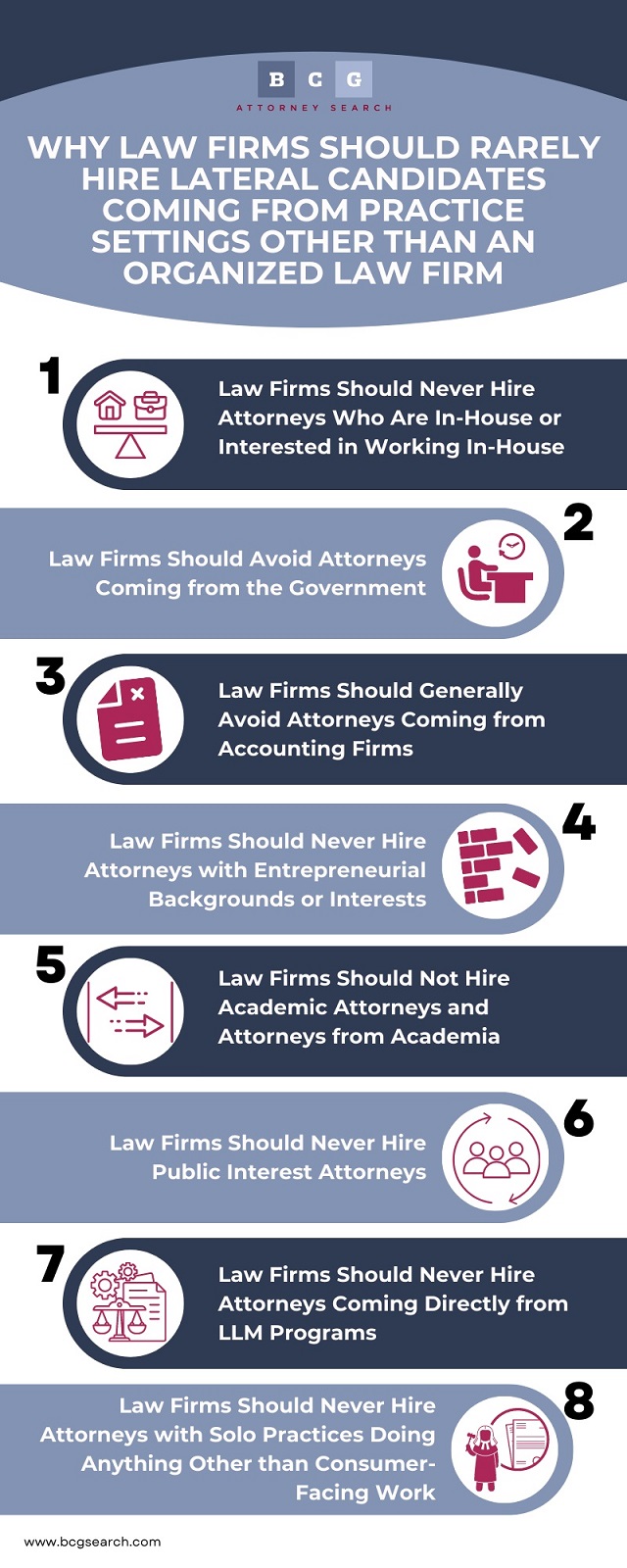
1. Why should law firms not hire attorneys from in-house roles or those interested in working in-house?
Law firms should be cautious when hiring attorneys from in-house roles or those interested in it. Differences in work ethics, accountability, and responsibilities between the two environments could lead to shorter tenures if such attorneys return to a law firm setting. In-house attorneys usually have less stress but are ill-suited for the demanding nature of law firm work. Therefore, they may not last long if they decide to return.2. Why is it not a good idea to hire attorneys with entrepreneurial backgrounds or interests
Entrepreneurs are inherently risk-takers and interested in disrupting the status quo, traits that are incompatible with the more risk-averse and focused nature of legal practice. Entrepreneurs will never be satisfied working under someone else and will be more focused on their own ventures, making them unsuitable candidates for a law firm. The only exception noted is 'failed entrepreneurs,' who may be more committed after an initial failure.3. Are attorneys in academia or those coming from LLM programs suitable for law firm work?
Attorneys from academia or from LLMs are generally unsuited for traditional law firm roles. Academics often lack the practical skills and accountability needed in a law firm setting, as they are more focused on theoretical approaches and are not used to pleasing paying clients. LLMs in specialized fields like tax or healthcare may be seen more favorably, but most are not. Foreign attorneys who earn LLMs in the U.S. can pose a risk due to their unsteady commitment and difficulty adapting to the legal system.4. Why should law firms avoid hiring attorneys coming from the government or public interest?
Attorneys coming from the government or public interest typically have different motivations than those working in a law firm. Government attorneys often work fixed hours and are focused on enforcing rules rather than interpreting them flexibly. Their roles tend to be less dynamic and unattractive to law firms for recruitment. Those who leave typically don't return, indicating a shift in career interests or dissatisfaction with the environment. Public interest attorneys are seen as a risk by firms due to potential conflicts of interest or legal liabilities. Such attorneys usually emphasize their pro-bono or public service work, indicating their primary interest.5. Is hiring attorneys who also run non law-related businesses or manage solo law practices advantageous?
Hiring attorneys operating non-legal businesses or solo practices can offer unique benefits, particularly for consumer-facing work. However, since they are accustomed to being their own bosses, they may find adapting to a more collaborative or hierarchical work environment challenging. Therefore, it's crucial to carefully evaluate whether such attorneys will integrate well into your team before making a hiring decision.- Attorneys in transition should also be aware of the key mistakes lateral attorneys make that harm career growth.
Law firms should rarely, if ever, hire candidates not coming from law firms.
This includes in-house attorneys, attorneys in academia, an attorney in public interest positions, attorneys who went back to school for LLMs, attorneys who left law firms to do clerkships, attorneys who have solo practices, attorneys working in accounting firms, attorneys doing public interest work, attorneys who have their non law-related businesses.
These hires most often will not work out—I'm sorry. Has it ever worked out? I've placed thousands of attorneys. Law firms that hire people not coming from law firms almost always lose.
It costs me money when these attorneys do not work out; it is bad for law firms, their clients, the morale of other attorneys in the firm, and the attorney hired from another practice setting. Sure, it works out sometimes, but rarely.
The best law firms out there—the ones with well-organized recruiting departments that know what they are doing—rarely, if ever, hire people from other practice settings.
They know what works and what does not.
It should be a business rule slapped in giant letters on the wall in every recruiting department office, every hiring partner's office wall, and in giant letters in the conference rooms where recruiting committees meet: DO NOT GET SUCKERED AND HIRE ATTORNEYS NOT COMING FROM LAW FIRMS!
Once an attorney has shown any form of disloyalty and lack of commitment to what a law firm offers, it is game over most of the time—they do not belong in a law firm and never will. People who are not working in law firms either cannot get positions, do not like working in a law firm, or are asked to leave a law firm. Why would a law firm take this chance when they could easily find people without these issues from another law firm? Attorneys from practice settings other than law firms will almost always leave the law firms, with everyone involved having a bad taste in their mouth. Whatever the issues were in the past that made working in a law firm distasteful or problematic for them, they will occur again.
Not working in a law firm is not nearly as demanding as working in a law firm. In a law firm, you are accountable to paying clients that will take their business elsewhere if you do not perform. In other practice settings, most of what makes a law firm a law firm does not exist.
You are welcome to hire whomever you want, but you will almost lose if you hire any people below who do not belong in a law firm. I do not want your money hiring these people—I will not even try to sell you this trouble. Here are different practice settings you can hire attorneys from and why you will lose and take a considerable risk hiring these people. You will lose if you hire these sorts of attorneys. Similar patterns apply to educational choices, as explained in Why JDs Are 20x More Valuable Than LLMs for Foreign Attorneys.
See Related Articles:
- Why Law Firms Do Not Like to Hire Attorneys from Most Practice Settings Other Than Law Firms
- How Law Firms and Other Hiring Organizations Can Determine if an Attorney Will Do the Job Long Term
When an attorney is in-house, their client (the company) is likely not a lawyer and often just blindly follows the in-house attorney's advice about work that should be done and who should do it. Quite often, this means to say, others should be doing the work. In-house attorneys are often specialists in referring work out (this is most common). Many find ways to avoid responsibility, arrive late and leave early, take long lunches, and are unaccountable for their time.
The main reasons attorneys give for going in-house are:
- to have more of a work-life balance and
- not to have to bill their time.
In most cases, you would have to be out of your mind to hire them. Some in-house employers have very high standards and do exceptional work; however, this is difficult to discern and understand. You have no idea from company to company. Most law firms know other law firms and understand what it means to be coming from a peer firm. You generally have no way of understanding this if the attorney comes from an in-house environment.
Working for one client is far different from working for multiple clients, as an attorney needs to do in a law firm. You do not have to work hard and develop various solutions for clients who will only pay if you do a good job. You do not have to please many different personalities and are only accountable to one type of client. You can easily learn how to manipulate your employer to give them the minimal amount of work they need to keep you around.
Someone I know well from an entrepreneurship group I am a part of was paying $900,000 a year to an outside law firm to assist him with corporate-related work. He offered an in-house counsel position to a senior associate doing all of his work for him at the law firm he was paying to do the work.
He thought paying her $350,000/year would save him money because he would no longer have to pay the law firm $900,000 a year. Instead, the opposite occurred: The in-house attorney started finding even more work their former law firm to do and referring even more work to the law firms they came from. The attorney would say things like they did not feel "confident" doing various types of work they did when they were working for the law firm. The in-house attorney found all sorts of reasons not to do work and called it "malpractice" and other things to avoid responsibility. Soon, my acquaintance was spending $1,500,000 on his legal bills than before and paid an in-house attorney $350,000 a year.
Why would you want to rehire someone who has learned not to practice law and give work to others? While this may sound a little extreme, the fact is that this is more common than not for attorneys who go in-house. It would help if you avoided these sorts of attorneys because they will not like the new levels of accountability they are expected to have in a law firm.
Here is what happens when I talk to these candidates on the phone. They state they had reasons for leaving a law firm but would like to "give it a try again." Many profess to be great interviewers who can seduce and convince you to hire them. It just never is going to work. They may have the skills to get a job and do it for you for some time, but trust me—they almost always leave.
More significantly, an attorney that has gone in-house has made a conscious decision not to work in a law firm. This should tell you all you need to know. Anyone wanting a law firm position can get one somewhere—over 35,000 law firms are out there. People who choose to go in-house instead of a law firm, either as their first, second, third, or fourth job, almost never last or stick around. When confronted with a less stressful, less accountable, and less time-consuming opportunity, most attorneys never want to go back. If these attorneys do go back, they rarely start for long because they've seen that they may not have to work as hard or be as accountable to get ahead.
See Related Articles:
- Why Going In-house Is Often the Worst Decision a Good Attorney Can Ever Make
- The 'Dark Side' of Going In-house
When an attorney works for the government, they typically work an eight-hour day (or less). There is little threat of losing your job if you do not do great work. The atmosphere is often depressing and lacks energy. The people often move around without much enthusiasm, and many government offices where attorneys work feel a bit sad—not all but many.
People with the government are often there because they are not interested in being in a law firm or were not hired by law firms. Sometimes they are there because they believe in public service; other times, they are there because they want to support their political party. Serving the public, or their political party, is a far different task than serving many clients with different needs and interests.
Regardless, the lifestyle of a government attorney is much different than working in a law firm. Law firm attorneys need to be experts in bending the rules and perceptions. In contrast, government attorneys are often experts in enforcing rules—whether a prosecutor or any government attorney, most come to law firms as experts in enforcing something. They are also the "authority" on whatever issue they are prosecuting. Being the authority is a far different exercise that needs to outthink, argue and prosecute the needs of different types of clients with different needs and interests.
Additionally, attorneys from the government have the same problems as in-house attorneys: They represent one client that always believes it is right (the government) and not many clients with varied perspectives.
They may be running from the pressures or something else. Who knows—beyond perhaps hiring former US Attorneys and possibly prosecutors in various government positions.
Large law firms rarely take an interest in attorneys from the United States Patent and Trademark Office. In some patent practice areas (such as electrical engineering), there have occasionally been massive shortages of patent attorneys with these skills. Still, most of these market imbalances have not been strong enough in the past two decades for law firms to take this risk. I've never seen a law firm hire a trademark attorney from the USPTO.
Attorneys from the USPTO are often there because they could not get positions with law firms—and most do not work in law firms during their summers (but some do). Reviewing patent applications is not the same as writing patents. Being a judge is different than being someone trying to convince someone of something—these are two different positions.
Faced with the option of making two or more times working in a law firm compared to the USPTO, very few attorneys choose this route.
Attorneys from clerkships can work best only if the clerkship is their first job after law school.
However, if an attorney has a job in a law firm and then goes to work for a judge after this, they are not likely to work out when they return. They very rarely do. They left the law firm for a reason. Most attorneys who leave their law firms to clerk, do not return. I see them all the time. After working as clerks, they want different firms. This suggests they were unhappy in a firm and now enjoy a new one.
I would argue that the experience of any clerkship—federal district or circuit court clerkship even—is not worth the attorney jumping out of legal practice to clerking. This wanderlust almost always continues to a new firm, and this stint is often short-lived.
If an attorney takes a position as a clerk after law school and has not worked in a law firm during any of their summers, this is also incredibly risky. The attorney has not been tested in a law firm environment and probably could not get a position with a law firm during the summer because of something. Judges can hire whomever they want as clerks—and do. There are no close to uniform standards for hiring judicial clerks—just what each judge likes. In contrast, law firms have relatively uniform hiring standards everyone knows about and understands.
Do not even get me started about hiring judges. Judges are incredibly risky because they come from environments where they were in charge and accountable for keeping a docket as clean as possible, adjudicating cases, hopefully not getting overruled, and having clerks assist in writing opinions and doing this sort of work. Being forced to get a job, being accountable for the quality of their work, being in an environment where they are not in charge, having their work done by others, and choosing sides in a dispute (and not advocating for one side) is different than what a law firm attorney does. To see these hiring concerns broken down visually and conceptually, watch this video on why law firms avoid hiring attorneys from most non-law-firm practice settings.
- To balance these cautions with a wider view of the market, check out our guide to 2025 law firm recruitment trends and what they mean for lateral candidates.
Most judges leave private practice, or government jobs, to take positions as judges.
They were in government jobs and left private practice for a reason. They are not interested in working in law firms, have chosen to be judges and not advocates, and rarely will have the business generation and other skills necessary to work well in law firms and for other attorneys with work and business.
- This aligns with the issues detailed in 10 Candidate Red Flags That Could Cost Your Law Firm Big Time, which emphasizes why certain backgrounds raise serious concerns during recruitment.
See Related Articles:
- How Difficult Is It for Attorneys to Move from a Government Position to a Law Firm Attorney Job?
- Can I Move to a Government Job then Come Back to a Law Firm?
Attorneys in accounting firms are generally there because they could not get a position with a law firm—everyone knows this. The pay is often less than half of what a law firm would pay them. These attorneys may be intelligent, likable, and more—but they are at accounting firms, and attorneys working in accounting firms generally do not do well when transitioning to law firms—but some do.
There are some exceptions for attorneys I have seen do well: Attorneys in ERISA, executive compensation, and tax controversy, for example, are highly in demand in law firms, and these are often the best hires. Anything beyond that is generally not workable.
Virtually every large law firm does not hire attorneys from accounting firms save for a few practice areas above. In 25+ years, I can only think of a few examples where law firms hired attorneys from accounting firms in major markets like New York and the Bay Area.
They have occasionally shown interest in state and local or international tax, but law firms with this sort of work almost uniformly prefer to hire attorneys from law firms. The only reason I can surmise for this is that the attorneys worked in the accounting firm practice setting that historically did not convert well once the attorney was brought on board. Also, most accounting firm attorneys are rarely summer associates anywhere. They very typically have no track records.
See Related Articles:
- Transitioning from an Accounting Firm
- Why You Should Start Your Career in a Law Firm Rather Than an Accounting Firm
Hiring an entrepreneur with a business that has nothing to do with practicing law is bonkers. Entrepreneurs, by nature, are interested in new things and overturning the status quo.
What makes hiring one of these movers and shakers a good idea? These people will never be happy working in a law firm and reporting to others. This is a complete waste and insane.
Being a true entrepreneur is almost programmed into certain people—it was me.
This sucks for law firms.
From the time I was nine years old, I was starting all sorts of businesses. I would sell holiday cards door to door. I would do a morning and afternoon paper route.
I would write and self-publish various books about how to make money and be a better lover (whatever)—even as a 17-year-old virgin. I just wanted to make money and looked for opportunities to do so. Why not? This is what entrepreneurs do. I'm embarrassed at the lengths I went to do business. It was in my nature, and I am programmed that way. I'm the last fu##### person a law firm should hire.
When I turned 18, I started an asphalt business. I had at least 10-15 people working for me every summer from when I was 18, shoveling asphalt and getting dirty with me. I worked at the business every summer—the summer before college, in law school, the summer after my last year of law school, while clerking for a federal judge, and the summer after I worked for a federal judge. I grew my business so large, and it became so profitable, that when I chose to go to law school, people I knew around Detroit thought I was insane. I would not leave my house unless I was going to do $10,000 in business that day. I bought a Porsche, then other fun cars, flew my girlfriends around the country, and had a ball. Why would someone like me want anything to do with being a lawyer?
Who knows—I was a mess.
Lawyers are lawyers (risk averse, focused), and entrepreneurs take risks and are always trying different things and never satisfied with the status quo. That is just how it works.
I stayed precisely one month in my summer job after my first year of law school, working for the Justice Department in Washington, DC, because I could not wait to return to Detroit and my asphalt business. When I graduated from law school, I was excited that the bar was not required for this job, and I did not study for it so I could work on my business all summer.
When my job with the judge started in late August, I spent every weekend doing my business while working for the judge until it was too cold to work outdoors. When I needed to study for the bar after my clerkship, once again, I threw myself into the work instead of spending enough time studying for the bar—that was risky behavior (but my business was more important to me than that).
When I started my first job in a law firm, all I could do was yearn for when I had my own business. I took all the money I had made in my business and bought a very expensive Porsche convertible and house in the Hollywood Hills overlooking Los Angeles.
I joined a costly country club for $25,000. Who knows what I was doing, slaving in a law firm 3,000 hours a year? I was clearly out of my mind.
I dreamed of being an entrepreneur so much that I was unhappy every day at work. I thought about doing something other than practicing law all the time—because I was an entrepreneur at heart. I was depressed practicing law—so much so that when I started talking to recruiters to go to my third firm in less than two years, I launched onto that, quit my law firm, and walked away from what at the time was the equivalent of a $500,000 book of business and jumped into something I did not even understand: I started a legal recruiting business.
You do not want to hire people like me—that would be a terrible thing to do. All entrepreneurs are like me. They will rarely be happy working for someone else.
I have one exception: Failed entrepreneurs who blew it in their first foray into business. If someone has failed, they may have tried something because they were caught in an economic boom, sold an idea, or something of the sort. I have seen that people who failed in their first foray into entrepreneurship are often great hires because they come back more committed and afraid to fail again. Lawyers generally make horrible entrepreneurs and almost always fail—they think they should be starting businesses but do not have the skills or ability. Like me, I thought I should be a lawyer but was an entrepreneur.
- This is especially true for LL.M. graduates, as The Employability of Attorneys Coming Out of LLM Programs shows, where lack of firm experience often hinders hiring opportunities.
See Related Articles:
- Why Attorneys Often Fail as Businesspeople and Entrepreneurs
- Top 20 Reasons Why There Is No Better Profession Than Practicing Law
I'm not talking much about this one because it should be evident that there is not much of a need to go too far into this. Law firms make this mistake, but by the slim chance this is something you are considering, I have a few suggestions to offer.
Most academics become very theoretical. They write erudite papers that are not widely reasoned or littered with footnotes and concepts that only other academics can understand. They are paid to sit around, think, and teach a few weekly classes. They preach to law students that they need to listen to what they are saying and are expected to parrot it back as closely as possible. They are often only accountable for writing articles, sometimes giving opinions, and students may also rate them. They strive for tenure, which gives them even less accountability.
Just because someone is a subject matter expert does not mean they are an attorney who should be working in a law firm. The lack of accountability, perceived invincibility to young students, and no need to please paying clients creates all sorts of issues.
Academics who do things like get master's degrees and doctorates in nonscientific disciplines (scientific disciplines—engineering, physics, computer science, life sciences, etc., are helpful for patent prosecutors and IP litigators) are almost always a train wreck. Law firm lawyers are paid to be direct, communicate succinctly, and not blow a bunch of drawn-out discussions of theories. Unfortunately, this is what law firms are confronted with and habits they need to break—if they can—when they hire attorneys from academia.
Many law firms are so fed up with academics that they avoid people from Yale Law School, in particular, who entirely run young attorneys to PhD-level discourse and theoretical approaches to the law the second the first-year law student arrives on campus. Moreover, this law school breeds disdain for all things practical and attorney-like, and most of its graduates come out self-righteous, suspicious of law firms, entitled, and more interested in the debate than the practical realities of being a law firm attorney. They believe their degrees entitle them to lifelong reverence from the legal establishment, government offices, public interest organizations, academic institutions, and more. Of course, this is only sometimes the case, but it is familiar enough that many law firms will avoid these graduates. Their ideals have more to do with not practicing law and being praised for their brilliant insights into various issues than practicing law.
See Related Articles:
I will only spend a little time on this one because most law firms already know this one. These attorneys prioritize their beliefs in social or other issues as more important than what most law firm attorneys are motivated by (money, prestige, advancement, winning in deals, litigation, etc.), and their priorities are elsewhere.
These attorneys should be avoided because they are almost guaranteed not to work out. You can try hiring them, but I'm unaware of many examples where law firms were glad they did this.
Attorneys coming from public interest organizations are a trainwreck. While I prefer not to go too far down the rabbit hole with this one, why would you be interested in hiring someone whose work will likely be entirely shaped by their left, right, or whatever type of politics? Do you want to get involved in this nonsense?
This does not do your clients any good. What if your lateral attorney disagrees with your client's point of view?
Then what. Attorneys more interested in this stuff are abhorred when they see their iron-fast beliefs violated. This does no one any good. Attorneys interested in public service will always list a bunch of stuff on their resume (if at a law firm) describing with great enthusiasm pro bono work they may have done at their law firms—incredibly, it often comes first.
There is no way in hell you should indulge in this nonsense. These attorneys will leave—they usually may sue you. You want nothing to do with these attorneys most of the time. The resumes of these attorneys are often littered with all sorts of activities they did in college, law school, and after law school supporting their favorite groups. They do not want to be law firm attorneys. Run for the hills.
Another point of major concern is those crazy ass attorneys who litter their resumes with all sorts of public interest activities. If an attorney does this, they show you this is their priority.
You should avoid them. I've seen some incredible stuff repeat itself consistently. An attorney will work as a corporate attorney in a major law firm for a few years.
They will then produce a resume that talks about all sorts of pro-bono-related work they did in this position and list this first in a three to four-line discussion. Then they will have a line or two discussing their actual client-paying legal work at the end. These sorts of candidates are incredibly risky hires for reasons that should be obvious. Do not hire them. They will leave.
See Related Articles:
- How Can I Be Recognized for My Work as an Attorney and Not as a Politician?
- 25 of the Most Important Facts That Attorneys, Law Students, and Partners Need to Know About Law Firm Politics
US-based attorneys often spend a year or two practicing law and then get an LLM.
Many times, they are applying directly from an LLM program. They are often foreign attorneys who came to the US and got an LLM.
Often, American attorneys will get LLMs from more prestigious schools than they attended. They expect law firms to view them favorably because they went to Georgetown, New York University, or elsewhere. An LLM is not another law degree like a JD. When you get a JD, you are measured against your classmates, get into law school based on your grades and LSAT score, and come out of your first year with a basis to compare you to everyone else. Most LLM programs are money machines for law schools, and grades are often meaningless because almost everyone gets good grades in LLM programs.
An LLM does not change very much at all.
It shows that the attorney could not get a position in a law firm and now wants to demonstrate that they are worthy of reconsideration.
Too much theoretical education is not a good thing for future attorneys. The longer this goes on, the more the attorney moves away from what is expected of them working in a law firm for paying clients.
There are other classes of LLMs, of course. For example, some LLMs attend NYU for a tax law degree. Law firms are often welcoming and tolerant of that because it is seen as practical training and learning needed to be a better tax attorney. Some attorneys with healthcare interests and backgrounds get LLMs to be more effective.
Law firms often hire. Some attorneys want to practice education law and sometimes have luck. There are programs in executive compensation and employee benefits that are also practical that law firms will often hire from. However, outside of these LLMs, most law firms are not that impressed—and more often not impressed with the LLMs above than they are impressed.
Finally, there is the case of a foreign-trained attorney who comes to the US to get an LLM. These attorneys are a bad risk. First, their training is in a foreign legal system, and they cannot be expected to switch gears and adopt a different legal system—but some may. The larger issue is that these attorneys may want to work for a few years and then return to their home countries. In my experience, most of these attorneys never commit to working in the United States and leave at some point. Their families and social networks are somewhere else. I've seen these LLMs work out occasionally; however, it is the exception to the rule, and this is just not a good idea for most firms.
See Related Articles:
- The LL.M. Degree: Friend or Foe? The Pros and Cons of Pursuing an LL.M. in Lieu of Practicing Law
- The Top 17 Reasons Law Firms Do Not Hire and Make Offers to Attorneys and Law Students: It's Not What You Think
Attorneys with solo practices are their bosses. There is no one to look over their work. They are in charge of collections, hiring help, marketing, and all sorts of things law firms do not require. Most solo attorneys do not have large clients, and many work in various practice areas. Working alone, no one reviews their work and sets their own rules.
They are independent, set their hours, and are unaccountable to other groups of attorneys for their hours, quality of work, and ability to work with large attorneys. Working in a law firm requires attorneys to collaborate and be accountable to each other.
There are two types of solo attorneys:
- those working for individuals (consumer-facing) and
- those working for companies (company-facing).
Solo practitioners can work out in consumer-facing firms. Solo attorneys working in personal injury, family law, trust and estates, workers' compensation, and plaintiff's employment work can do well-joining law firms doing the same type of work. Here, accountability to the client is low (individuals). By all means, hire away if you are comfortable doing so. The scrappy nature of these attorneys will benefit you if you hire the right attorney (they will generate business, work hard, and may get awesome results in the right environment with support). I'm not suggesting there are issues with these sorts of attorneys—I am concerned with attorneys who claim to be working for companies and other businesses.
Solo attorneys claiming to represent companies are to be avoided. In many cases, these attorneys represent that they have some portable business that will move with them to your firm.
Sometimes they put together impressive-looking business plans that they believe will result in lots of business if they join your firm. I'm very sorry that I rarely see any of this pan out. In most cases where I have seen attorneys hired who claimed to represent companies, the numbers they told firms interested in them were vastly overrepresented, or there were no numbers. Law firms were mad at me, the attorneys, and it was a bad situation for everyone involved. Coming from solo practices, law firms cannot verify numbers other than what the attorney says. They often will arrive at a law firm and make up story after story about how their clients are not coming over, and they need more time, and so forth. This is incredibly disappointing for everyone involved.
Additionally, with no one looking over their work and being self-taught, many of these attorneys have picked up bad habits that are difficult to break.
If you are interested in a solo practitioner, then ask for their tax returns—demand them. If they will not show you these, you know they are not telling the truth and should move on.
See Related Articles:
- Should You Start Your Own Law Firm? Top 10 Reasons to Start or Not Start Your Own Firm
- Why You Should (and Should Not) Open a Solo Law Practice
Conclusions
Law firms need to avoid hiring the wrong people. When you hire people from practice settings outside of law firms, the result is generally not good. Stay away from this nonsense if you want to make money, protect your culture, and not be disappointed.
About Harrison Barnes
No legal recruiter in the United States has placed more attorneys at top law firms across every practice area than Harrison Barnes. His unmatched expertise, industry connections, and proven placement strategies have made him the most influential legal career advisor for attorneys seeking success in Big Law, elite boutiques, mid-sized firms, small firms, firms in the largest and smallest markets, and in over 350 separate practice areas.
A Reach Unlike Any Other Legal Recruiter
Most legal recruiters focus only on placing attorneys in large markets or specific practice areas, but Harrison places attorneys at all levels, in all practice areas, and in all locations-from the most prestigious firms in New York, Los Angeles, and Washington, D.C., to small and mid-sized firms in rural markets. Every week, he successfully places attorneys not only in high-demand practice areas like corporate and litigation but also in niche and less commonly recruited areas such as:
- Immigration Law
- Workers Compensation
- Insurance
- Family Law
- Trust and Estate
- Municipal law
- And many more...
This breadth of placements is unheard of in the legal recruiting industry and is a testament to his extraordinary ability to connect attorneys with the right firms, regardless of market size or practice area.
Proven Success at All Levels
With over 25 years of experience, Harrison has successfully placed attorneys at over 1,000 law firms, including:
- Top Am Law 100 firms such including Sullivan and Cromwell, and almost every AmLaw 100 and AmLaw 200 law firm.
- Elite boutique firms with specialized practices
- Mid-sized firms looking to expand their practice areas
- Growing firms in small and rural markets
He has also placed hundreds of law firm partners and has worked on firm and practice area mergers, helping law firms strategically grow their teams.
Unmatched Commitment to Attorney Success - The Story of BCG Attorney Search
Harrison Barnes is not just the most effective legal recruiter in the country, he is also the founder of BCG Attorney Search, a recruiting powerhouse that has helped thousands of attorneys transform their careers. His vision for BCG goes beyond just job placement; it is built on a mission to provide attorneys with opportunities they would never have access to otherwise. Unlike traditional recruiting firms, BCG Attorney Search operates as a career partner, not just a placement service. The firm's unparalleled resources, including a team of over 150 employees, enable it to offer customized job searches, direct outreach to firms, and market intelligence that no other legal recruiting service provides. Attorneys working with Harrison and BCG gain access to hidden opportunities, real-time insights on firm hiring trends, and guidance from a team that truly understands the legal market. You can read more about how BCG Attorney Search revolutionizes legal recruiting here: The Story of BCG Attorney Search and What We Do for You.
The Most Trusted Career Advisor for Attorneys
Harrison's legal career insights are the most widely followed in the profession.
- His articles on BCG Search alone are read by over 150,000 attorneys per month, making his guidance the most sought-after in the legal field. Read his latest insights here.
- He has conducted hundreds of hours of career development webinars, available here: Harrison Barnes Webinar Replays.
- His placement success is unmatched-see examples here: Harrison Barnes' Attorney Placements.
- He has created numerous comprehensive career development courses, including BigLaw Breakthrough, designed to help attorneys land positions at elite law firms.
Submit Your Resume to Work with Harrison Barnes
If you are serious about advancing your legal career and want access to the most sought-after law firm opportunities, Harrison Barnes is the most powerful recruiter to have on your side.
Submit your resume today to start working with him: Submit Resume Here
With an unmatched track record of success, a vast team of over 150 dedicated employees, and a reach into every market and practice area, Harrison Barnes is the recruiter who makes career transformations happen and has the talent and resources behind him to make this happen.
A Relentless Commitment to Attorney Success
Unlike most recruiters who work with only a narrow subset of attorneys, Harrison Barnes works with lawyers at all stages of their careers, from junior associates to senior partners, in every practice area imaginable. His placements are not limited to only those with "elite" credentials-he has helped thousands of attorneys, including those who thought it was impossible to move firms, find their next great opportunity.
Harrison's work is backed by a team of over 150 professionals who work around the clock to uncover hidden job opportunities at law firms across the country. His team:
- Finds and creates job openings that aren't publicly listed, giving attorneys access to exclusive opportunities.
- Works closely with candidates to ensure their resumes and applications stand out.
- Provides ongoing guidance and career coaching to help attorneys navigate interviews, negotiations, and transitions successfully.
This level of dedicated support is unmatched in the legal recruiting industry.
A Legal Recruiter Who Changes Lives
Harrison believes that every attorney-no matter their background, law school, or previous experience-has the potential to find success in the right law firm environment. Many attorneys come to him feeling stuck in their careers, underpaid, or unsure of their next steps. Through his unique ability to identify the right opportunities, he helps attorneys transform their careers in ways they never thought possible.
He has worked with:
- Attorneys making below-market salaries who went on to double or triple their earnings at new firms.
- Senior attorneys who believed they were "too experienced" to make a move and found better roles with firms eager for their expertise.
- Attorneys in small or remote markets who assumed they had no options-only to be placed at strong firms they never knew existed.
- Partners looking for a better platform or more autonomy who successfully transitioned to firms where they could grow their practice.
For attorneys who think their options are limited, Harrison Barnes has proven time and time again that opportunities exist-often in places they never expected.
Submit Your Resume Today - Start Your Career Transformation
If you want to explore new career opportunities, Harrison Barnes and BCG Attorney Search are your best resources. Whether you are looking for a BigLaw position, a boutique firm, or a move to a better work environment, Harrison's expertise will help you take control of your future.
Submit Your Resume Here to get started with Harrison Barnes today.
Harrison's reach, experience, and proven results make him the best legal recruiter in the industry. Don't settle for an average recruiter-work with the one who has changed the careers of thousands of attorneys and can do the same for you.
About BCG Attorney Search
BCG Attorney Search matches attorneys and law firms with unparalleled expertise and drive, while achieving results. Known globally for its success in locating and placing attorneys in law firms of all sizes, BCG Attorney Search has placed thousands of attorneys in law firms in thousands of different law firms around the country. Unlike other legal placement firms, BCG Attorney Search brings massive resources of over 150 employees to its placement efforts locating positions and opportunities its competitors simply cannot. Every legal recruiter at BCG Attorney Search is a former successful attorney who attended a top law school, worked in top law firms and brought massive drive and commitment to their work. BCG Attorney Search legal recruiters take your legal career seriously and understand attorneys. For more information, please visit www.BCGSearch.com.
Harrison Barnes does a weekly free webinar with live Q&A for attorneys and law students each Wednesday at 10:00 am PST. You can attend anonymously and ask questions about your career, this article, or any other legal career-related topics. You can sign up for the weekly webinar here: Register on Zoom
Harrison also does a weekly free webinar with live Q&A for law firms, companies, and others who hire attorneys each Wednesday at 10:00 am PST. You can sign up for the weekly webinar here: Register on Zoom
You can browse a list of past webinars here: Webinar Replays
You can also listen to Harrison Barnes Podcasts here: Attorney Career Advice Podcasts
You can also read Harrison Barnes' articles and books here: Harrison's Perspectives
Harrison Barnes is the legal profession's mentor and may be the only person in your legal career who will tell you why you are not reaching your full potential and what you really need to do to grow as an attorney--regardless of how much it hurts. If you prefer truth to stagnation, growth to comfort, and actionable ideas instead of fluffy concepts, you and Harrison will get along just fine. If, however, you want to stay where you are, talk about your past successes, and feel comfortable, Harrison is not for you.
Truly great mentors are like parents, doctors, therapists, spiritual figures, and others because in order to help you they need to expose you to pain and expose your weaknesses. But suppose you act on the advice and pain created by a mentor. In that case, you will become better: a better attorney, better employees, a better boss, know where you are going, and appreciate where you have been--you will hopefully also become a happier and better person. As you learn from Harrison, he hopes he will become your mentor.
To read more career and life advice articles visit Harrison's personal blog.