
After placing thousands of attorneys at top law firms over the past 25 years, I've discovered that attorney turnover and dissatisfaction stem from something far deeper—a fundamental misunderstanding of what actually drives lawyer loyalty and career satisfaction. The firms that consistently retain their best talent aren't necessarily the ones paying the highest salaries or offering the most prestigious work. They're the ones that understand the science of human connection and what attorneys truly need to thrive in their careers.

The Crisis of Connection in Modern Legal Practice
In over 25 years of placing attorneys at law firms across the country—from AmLaw 100 giants to boutique practices—I have witnessed a fundamental shift in how attorneys relate to their employers. What I see today deeply concerns me as someone who has dedicated his career to helping lawyers find not just jobs, but true professional fulfillment.
- To fully understand current trends in attorney turnover, explore the in-depth analysis of what causes associate attrition and the factors driving it.
Every week, I speak with attorneys who are technically successful by every external measure. They work at prestigious firms, earn substantial salaries, and handle sophisticated matters. Yet when I dig deeper into their career satisfaction, I discover something troubling: many feel no genuine loyalty to their firms, and more importantly, their firms have failed to inspire any real sense of belonging or commitment.
This is not just about unhappy lawyers—though there are certainly plenty of those. This is about a fundamental breakdown in the relationship between attorneys and the institutions where they practice. And this breakdown is costing everyone: firms lose talented lawyers, attorneys damage their careers through poor decisions, and clients ultimately suffer when there's no stability or deep commitment to excellence. Before deciding to switch, assess your motivation carefully — this video on assessing your motivation before switching firms offers guidance.
- For thoughtful insights on career-stage transition decisions, read this balanced overview of when moves are driven by strategy versus necessity.
After placing thousands of attorneys and observing what makes some lawyers thrive while others struggle, I have come to understand that loyalty in law firms is not about luck, charisma, or even exceptional talent. It is about meeting fundamental psychological needs that most firm leaders completely misunderstand or ignore entirely. Many of these are tied to common factors that cause associates to leave law firms — factors that can be addressed if recognized early. In some cases, solutions start with fair and competitive compensation strategies in law firms that balance pay structures with long-term retention goals.
- For attorneys who feel loyalty has eroded and are weighing next steps, Should You Quit the Practice of Law? A Comprehensive Exploration provides a comprehensive framework.
See Related Articles:
- Retaining Top Legal Talent: Strategies for Boosting Employee Satisfaction and Loyalty
- What Law Firm Associates Really Want from Their Jobs
- How to Create a Culture That Makes Attorneys Happy
The Three Pillars of Attorney Loyalty: What Really Matters
Let me start with a principle that will surprise many law firm partners: loyalty is not created by high compensation, prestigious clients, or fancy offices. I have seen attorneys leave million-dollar partnerships and others turn down significant pay increases to stay at firms that understood something deeper about human motivation. One senior associate told me, "I made great money, but I felt like a stranger at my own workplace every single day for three years." This disconnect often appears even in elite environments, reinforcing what I’ve written in The Hidden Costs of BigLaw: Why Chasing High Salaries Can Hurt Your Career in Law Firms — prestige and pay cannot substitute for belonging.
Based on my extensive work with attorneys across all practice areas and firm sizes, I have identified three psychological needs that, when consistently met, create genuine loyalty and long-term career satisfaction: Understanding the unique challenges of financial services law is key to long-term satisfaction; see Financial Services Legal Careers: Banking, Fintech, and Investment Law for a career-focused perspective on this sector.
1. Belonging: The Need to Be Part of Something Meaningful
Every human being has a deep need to belong and be part of a team. In my article "How Attorneys Destroy Their Careers by Choosing the Wrong Law Firms," I wrote about this fundamental truth: "We feel like we belong when we are around others who share our values and beliefs. All of us need to feel like we are part of a group that will protect us."
In the context of law firms, belonging means:
- Feeling that your values align with the firm's mission and culture
- Believing you are respected and understood by colleagues
- Knowing you are not just a replaceable billing unit but part of a team with shared goals
- Having confidence that the firm will support you during difficult times
I cannot tell you how many attorneys I have placed who left highly compensated positions simply because they never felt like they truly belonged at their firms. One senior associate told me, "I made great money, but I felt like a stranger at my own workplace every single day for three years." To complement this research, check out our video explaining how frequent job changes affect long-term employment potential and learn practical ways to demonstrate commitment.
2. Significance: The Need to Feel Valued and Important
Attorneys need to feel that their contributions matter and that they are recognized for their efforts. This goes far deeper than annual bonuses or year-end reviews. Significance is about feeling essential to the firm's success and knowing that your individual efforts are seen and appreciated.
In my experience working with law firms on retention issues, the firms that excel at creating significance do several things consistently:
- They provide genuine acknowledgment for excellent work, not just at review time but when it happens
- They give attorneys meaningful opportunities for growth and advancement
- They seek input from attorneys on important firm decisions
- They make each attorney feel like their success is personally important to firm leadership
I have seen partners leave firms making $2 million annually because they felt like replaceable cogs in a machine. Conversely, I have worked with associates who turned down significant salary increases to stay at firms where they felt genuinely valued and important to the organization's mission.
3. Security: The Need for Professional and Emotional Safety
Security in a law firm context means attorneys believe their careers are safe, the firm's leadership is stable and trustworthy, and mistakes will be treated with fairness rather than hostility. This is perhaps the most overlooked element of attorney loyalty, yet it may be the most important.
In my article on "The Only Three Reasons an Attorney Should Ever Switch Law Firms," I emphasized that one of the legitimate reasons to leave a firm is when "you are on the wrong side of the political climate of your office." This speaks directly to the security issue—when attorneys don't feel safe professionally or personally, loyalty becomes impossible.
Firms that excel at providing security demonstrate:
- Consistent and transparent leadership
- Fair treatment in evaluations and advancement decisions
- Protection of attorneys during economic downturns or firm challenges
- Clear communication about firm direction and individual career paths
- A culture where admitting mistakes leads to learning rather than punishment

The Three Psychological Needs That Drive Loyalty in Law Firms
The Path from Transaction to True Loyalty
Most law firm relationships begin as purely transactional. An attorney provides legal services, the firm provides compensation and resources. But the firms that build lasting success understand that transactional relationships are inherently unstable—they last only as long as no better offer comes along.
True loyalty develops through a predictable progression that I have observed in my most successful placements:
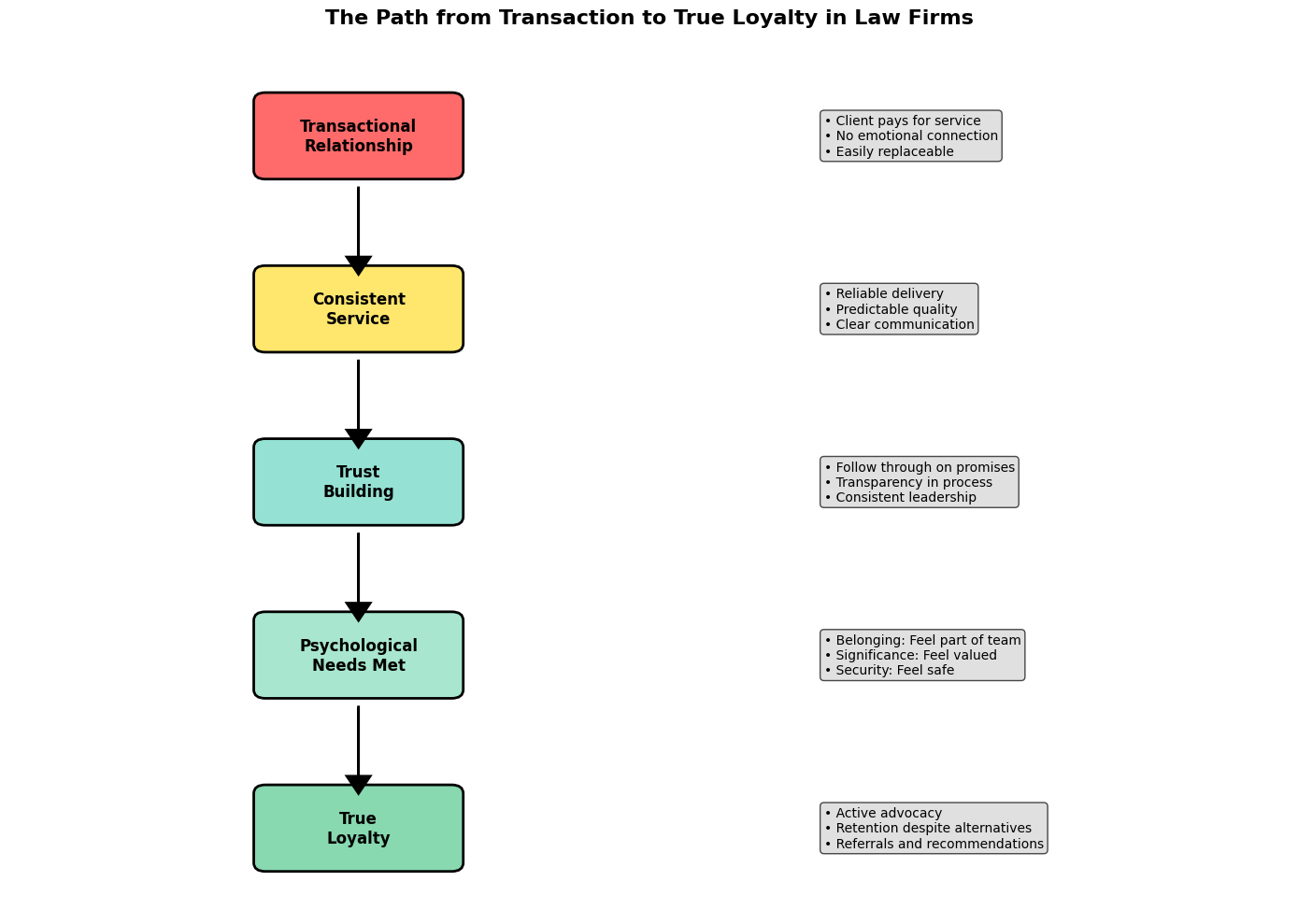
The Path from Transaction to True Loyalty in Law Firms
Stage 1: Consistent Service and Reliability
Everything begins with competence and reliability. The firm must consistently deliver on its promises—not just to clients, but to its own attorneys. This means honest communication about workload, realistic timelines for advancement, and following through on commitments made during recruitment.
I have seen too many firms damage potential loyalty relationships before they even begin by overpromising during the recruitment process. When an attorney arrives expecting one thing and finds another, the foundation for loyalty is permanently weakened.
Stage 2: Building Trust Through Predictability
Trust develops when attorneys can predict how the firm will respond in various situations. This predictability allows attorneys to feel secure and plan their careers accordingly. Firms with inconsistent leadership, frequent policy changes, or unpredictable treatment of attorneys never progress past this stage.
As I noted in my observations about attorney career satisfaction, the most successful lawyers work in environments where they can anticipate firm responses and make informed decisions about their professional development.
Stage 3: Meeting Psychological Needs
This is where the three pillars become critical. Once basic competence and trust are established, firms must actively work to create belonging, significance, and security. This is not a one-time effort but an ongoing commitment that must be renewed constantly.
Stage 4: True Loyalty and Advocacy
When all three psychological needs are consistently met, attorneys develop genuine loyalty. They become advocates for the firm, referring business and top talent. They stay during difficult times and decline attractive offers from competitors. Most importantly, they perform at their highest level because they are emotionally invested in the firm's success.
The True Cost of Ignoring Attorney Loyalty
Law firm leaders often treat attorney turnover as a cost of doing business, but my experience suggests they dramatically underestimate the real expenses involved. As explored in how to address associate attrition, the replacement costs for attorneys can be staggering. Replacing a mid-level associate can cost an average of $350,000, factoring in recruitment fees, lost productivity, and team disruption. Senior associates and partners cost even more. These losses are compounded when attorneys leave for reasons that could have been prevented. When you factor in all costs—recruitment, training, lost productivity, client relationship disruption, and opportunity costs—the numbers are staggering.

The True Cost of Attrition vs. Investment in Loyalty (Average Annual Costs)
Consider these real costs I have observed:
-
Client Acquisition and Replacement Costs
-
Associate Replacement Costs
-
Partner Replacement Costs
-
Lost Opportunity Costs
-
The Investment Alternative
See Related Articles:
- How to Address Associate Attrition
- What Causes Associates to Leave Law Firms?
- Salary Wars and Associate Hiring
Why Most Law Firms Fail at Building Loyalty
In my work with hundreds of law firms, I have identified several common mistakes that prevent firms from building genuine attorney loyalty:
1. Confusing Compensation with Loyalty
The most common mistake I observe is the belief that paying attorneys well automatically creates loyalty. While competitive compensation is necessary, it is not sufficient. I have placed numerous attorneys who left high-paying positions for opportunities that offered less money but better addressed their psychological needs. As outlined in work-life balance and compensation trade-offs in the U.S. legal profession, money alone doesn’t guarantee commitment.
As I wrote in "What Law Firm Associates Really Want from Their Jobs," attorneys want "a balance between professional and personal goals, between economic success and personal satisfaction. A consuming career is no longer enough."
2. Treating Attorneys as Interchangeable Resources
Many firms operate on the assumption that talented attorneys are readily replaceable. This commodity mindset prevents the development of genuine relationships and undermines all three psychological needs. When attorneys feel like replaceable parts, they behave accordingly—keeping their options open and their commitment limited.
3. Inconsistent Leadership and Communication
Firms with inconsistent messages, frequent leadership changes, or unclear strategic direction cannot provide the security that attorneys need. I have seen firms lose excellent attorneys simply because the lawyers could not predict what the firm would look like in two or three years. A major factor in why attorneys lose their jobs in law firms.
4. Focusing on Individual Performance Rather Than Team Success
The emphasis on individual billing hours and business development often undermines the sense of belonging that attorneys crave. The most successful firms I work with have found ways to recognize individual achievement while reinforcing team identity and shared success.
5. Neglecting Career Development Beyond Technical Skills
Many firms provide excellent technical training but ignore the broader career development needs that make attorneys feel significant and valued. Often, the root cause of turnover is explored in navigating career transitions between law firms. Leadership development, business skills training, and mentoring programs are often treated as optional rather than essential to attorney satisfaction.
- Even loyal attorneys may face unexpected job loss; this video shows steps to take if you’re worried about being let go and how to recover professionally.
Practical Strategies for Building Attorney Loyalty
For law firm leaders serious about retention, how to retain associate talent is essential reading. Based on my extensive experience placing attorneys in firms that excel at retention, here are specific strategies that work:
- Understanding the real cost of attorney attrition vs investment in loyalty can reshape how you prioritize client and employee stability—this article lays out the financial stakes in sharp relief.
Creating Belonging: Building True Community
Strategy 1: Values-Based Hiring
Hire for cultural fit, not just technical competence. In my experience, attorneys who align with firm values are dramatically more likely to develop loyalty. This requires clearly defining and consistently communicating what the firm stands for beyond making money.
Strategy 2: Mentoring and Integration Programs
Assign new attorneys formal mentors and create structured programs to help them understand firm culture, build relationships, and find their place within the organization. The best programs I have seen extend for at least two years and include multiple mentors at different levels.
Strategy 3: Cross-Practice Collaboration
Create opportunities for attorneys in different practice areas to work together and understand each other's contributions to firm success. This builds a broader sense of community and shared purpose.
Strategy 4: Shared Experiences and Traditions
Develop firm traditions and shared experiences that reinforce belonging. This might include annual retreats, pro bono projects, community service initiatives, or regular social gatherings that help attorneys connect as people, not just colleagues.
Building Significance: Making Every Attorney Feel Essential
Strategy 1: Regular Recognition and Feedback
Implement systems for recognizing excellent work immediately when it occurs, not just at annual reviews. The most effective recognition is specific, public when appropriate, and clearly connects individual contributions to firm success.
Strategy 2: Career Development Planning
Work with each attorney to develop personalized career plans that align individual goals with firm needs. Review and update these plans regularly, and provide concrete steps and resources to help attorneys achieve their objectives. Understanding why attorneys leave is crucial—How Attorneys Destroy Their Careers by Choosing the Wrong Law Firms complements this discussion by showing career consequences firsthand.
Strategy 3: Leadership Opportunities
Give attorneys opportunities to lead initiatives, mentor junior colleagues, or represent the firm in external activities. These opportunities help attorneys feel important and develop skills that benefit both them and the firm.
Strategy 4: Input on Firm Decisions
Regularly seek attorney input on decisions that affect their work and career development. Even when you cannot implement every suggestion, the process of seeking input makes attorneys feel valued and important to firm success.
Providing Security: Creating Professional and Emotional Safety
Strategy 1: Transparent Communication
Communicate regularly and honestly about firm performance, strategic direction, and market conditions. Attorneys can handle difficult news, but they cannot tolerate uncertainty and surprise.
Strategy 2: Consistent Policies and Procedures
Develop clear, written policies for evaluation, advancement, and discipline, and apply them consistently. Attorneys need to know what is expected and how they will be evaluated.
Strategy 3: Professional Development Investment
Invest significantly in attorney development through CLE programs, skills training, leadership development, and educational opportunities. This demonstrates commitment to attorney success and provides security about their marketability.
Strategy 4: Fair Treatment During Difficulties
How you treat attorneys during economic downturns, personal crises, or performance issues will be remembered by everyone in the firm. Fair, compassionate treatment during difficult times builds lasting loyalty.
Case Studies: Loyalty in Action
Let me share several examples from my experience that illustrate how these principles work in practice:
Case Study 1: The Boutique That Competed with BigLaw
I worked with a 25-attorney intellectual property boutique that consistently recruited top associates away from AmLaw 100 firms, despite offering salaries that were 20-30% lower than their competitors. Their secret was exceptional attention to all three psychological needs:
Belonging: The firm had a clearly defined mission to be the premier IP boutique for emerging technology companies. Every attorney understood how their work contributed to this mission, and the firm regularly celebrated victories that advanced their shared goals.
Significance: Partners knew every associate's career goals and regularly provided opportunities aligned with those objectives. Associates received individual attention and customized development plans that larger firms could not match.
Security: The firm provided extraordinary transparency about finances, pipeline, and strategic planning. Associates knew exactly where they stood and what opportunities lay ahead.
Result: Over five years, this firm had zero involuntary associate departures and a 95% retention rate among attorneys they wanted to keep.
- Not all moves are equal. Learn when switching firms makes sense to help determine if a departure is truly warranted.
Case Study 2: The Large Firm That Fixed Its Culture
A 300-attorney firm approached me after losing 40% of their associates in two years. Despite competitive compensation and interesting work, they could not retain talent. After analyzing their situation, we identified culture problems in all three areas:
The firm implemented a comprehensive loyalty strategy:
- Restructured their mentoring program to focus on relationship-building, not just technical guidance
- Created cross-practice teams to work on major matters, building broader firm relationships
- Implemented monthly recognition programs highlighting individual contributions to firm success
- Established transparent communication about firm strategy and individual career paths
- Invested heavily in leadership training for partners focused on attorney development
Result: Associate turnover dropped to 12% within 18 months, and the firm began attracting top lateral candidates who cited culture as a primary reason for joining.
Case Study 3: The Solo Practitioner Who Built a Team
A successful solo practitioner wanted to build a small firm but struggled to retain associates. Despite offering good compensation and interesting work, attorneys kept leaving after 18-24 months. The problem was that the founder, despite being technically excellent, had never learned to build loyalty relationships.
We worked together to implement loyalty principles:
- The founder learned to delegate meaningful work and provide recognition for associate contributions
- They created a shared vision for the firm's future that included specific roles for each attorney
- They established regular communication about firm goals and individual development
- They invested in training and development opportunities that benefited both associates and the firm
Result: The firm grew from 3 to 8 attorneys over three years, with 100% retention among attorneys who fit the firm culture.
The Loyalty Performance Matrix: How Different Firm Types Succeed
Not all firms need to excel equally in all three areas, but understanding where your firm type typically excels and struggles can help focus improvement efforts:
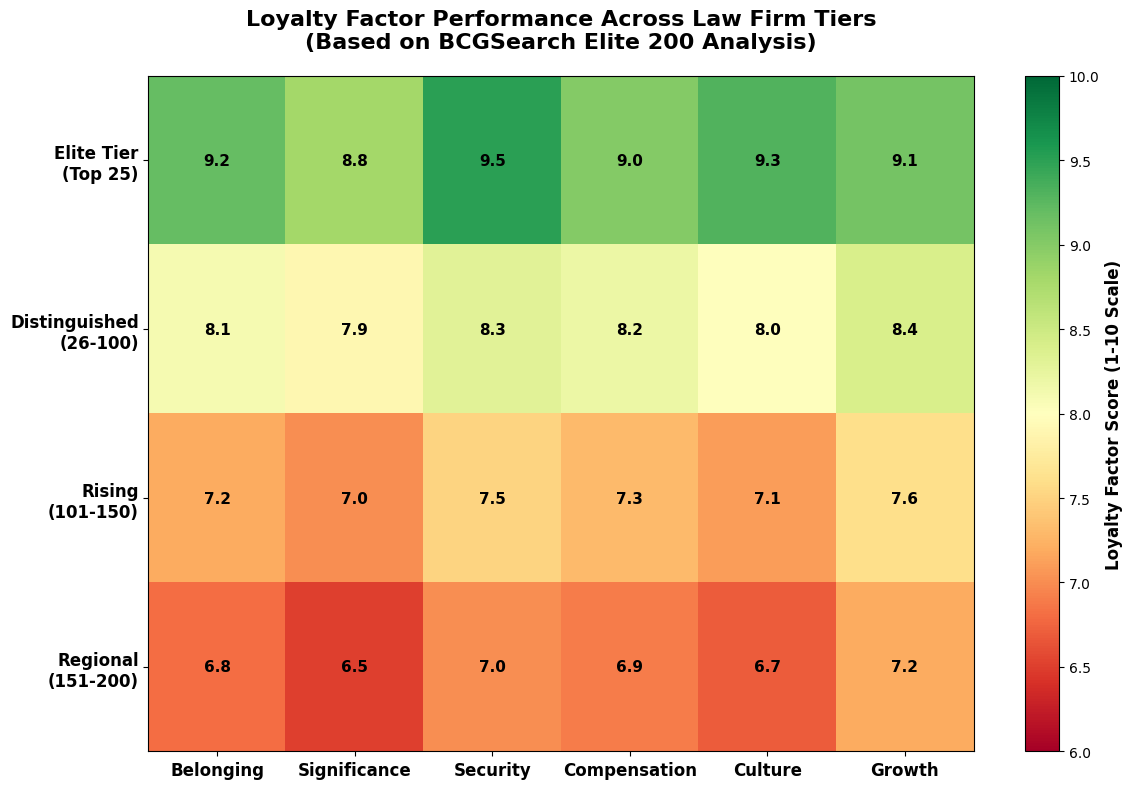
Loyalty Factor Performance Across Different Types of Law Firms
Elite Large Firms (AmLaw 50)
These firms typically excel at providing significance through prestigious work and excellent compensation. They often struggle with belonging due to size and competitive internal cultures, and security can be problematic due to economic volatility and up-or-out policies.
Focus Areas: Building community within practice groups, creating mentoring relationships that extend beyond technical guidance, and providing more career security through diverse advancement paths. Loyalty starts with choosing the right firm — the top ten reasons attorneys do not approve firms and how to fix each one provides a framework for identifying and resolving early misalignments.
Mid-Size and Regional Firms
These firms often excel at belonging and security due to their size and community focus. They may struggle with significance if they cannot provide the prestigious work or advancement opportunities that attorneys seek.
Focus Areas: Creating leadership opportunities, providing challenging work assignments, and helping attorneys build their professional reputation in the broader legal community.
Boutique Firms
Boutiques typically excel at significance by providing important roles to every attorney and meaningful work in specialized areas. They can struggle with security due to economic vulnerability and limited advancement paths.
Focus Areas: Providing financial transparency, creating diverse career paths, and building stable client relationships that provide long-term security.
Government and Non-Profit Organizations
These organizations often excel at belonging through shared mission and values. They typically struggle with significance (due to bureaucracy) and security (due to political or funding volatility).
Focus Areas: Recognizing individual contributions, providing professional development opportunities, and creating internal advancement paths. Explore how current pay levels influence attorney turnover in our Law Firm Partner Compensation Report.
- For those who work tirelessly and wonder if loyalty pays off, Why Hard-Working Attorneys Should Stay at Their Firms explores the powerful career advantages of commitment.
Common Loyalty Killers: What Destroys Attorney Commitment
Just as important as understanding what builds loyalty is recognizing what destroys it. In my experience, certain behaviors and policies can quickly undermine years of loyalty-building efforts:
1. Broken Promises and Inconsistent Communication
Nothing destroys loyalty faster than a firm that says one thing and does another. This includes promises made during recruitment that are not kept, inconsistent messages from leadership, and failure to follow through on commitments.
I have seen attorneys leave within months of starting because the firm they joined bore no resemblance to the firm described during interviews. This is not just about major issues—small inconsistencies can be equally damaging because they signal unreliability.
2. Favoritism and Unfair Treatment
Attorneys are trained to spot inconsistency and unfairness. When they perceive that some colleagues receive better treatment, opportunities, or consideration without clear justification, loyalty erodes quickly.
This is particularly damaging to significance and security needs. If advancement seems arbitrary or political rather than merit-based, attorneys will conclude that their efforts don't matter and their futures are uncertain.
3. Lack of Growth Opportunities
Attorneys who feel stuck in their current roles, with no clear path for advancement or increased responsibility, will eventually seek opportunities elsewhere. This is especially true for ambitious attorneys who were attracted to the firm by growth possibilities.
4. Poor Work-Life Integration
While attorneys expect to work hard, they also need to feel that the firm respects their need for some personal life and professional balance. Firms that consistently demand excessive hours without regard for attorney well-being will lose loyalty over time.
As I noted in my article about attorney career satisfaction, the most satisfied attorneys work in environments that support both professional excellence and personal fulfillment.
5. Toxic Personalities in Leadership
Partners or senior associates who consistently treat others poorly, take credit for others' work, or create hostile work environments can single-handedly destroy loyalty throughout a firm. These individuals undermine all three psychological needs and must be addressed quickly and decisively.
Implementing a Loyalty Strategy: A Practical Framework
Based on my experience helping firms improve attorney retention, here is a practical framework for implementing loyalty-building strategies:
- Attorneys hoping to stay competitive and satisfied in their careers will benefit from the strategies in How to Avoid Being Unmarketable as an Attorney. One proactive way to curb turnover is by implementing well-being initiatives in law firms.
Phase 1: Assessment and Foundation (Months 1-3)
Step 1: Conduct Anonymous Attorney Surveys
Survey all attorneys about their satisfaction with belonging, significance, and security at the firm. Ask specific questions about recognition, career development, firm culture, and leadership communication.
Step 2: Analyze Turnover Data
Review departure reasons, exit interview data, and patterns in attorney turnover. Look for trends that suggest systematic problems with loyalty factors.
Step 3: Leadership Training
Train partners and senior associates on loyalty principles and their role in creating attorney satisfaction. This is essential because loyalty-building requires consistent behavior from leadership.
Step 4: Policy Review
Review all firm policies related to evaluation, advancement, communication, and professional development. Ensure they support loyalty objectives and are consistently applied.
Phase 2: Implementation (Months 4-12)
Step 1: Launch Enhanced Programs
Implement improved mentoring programs, recognition systems, career development planning, and communication processes based on assessment findings.
Step 2: Create Accountability Systems
Establish metrics for tracking progress on loyalty factors and make attorney development a formal part of partner responsibilities and evaluation.
Step 3: Regular Communication
Implement regular communication about firm performance, strategy, and attorney development. This should include both formal communications and informal check-ins.
Step 4: Address Problem Areas
Identify and address specific issues that undermine loyalty, including problem personalities, unfair policies, or systemic communication failures.
Phase 3: Evaluation and Refinement (Months 13-18)
Step 1: Measure Results
Conduct follow-up surveys, analyze turnover data, and gather feedback on program effectiveness. Compare results to baseline data from Phase 1.
Step 2: Refine Programs
Adjust programs based on results and feedback. What works for one firm may need modification for another, so continuous improvement is essential.
Step 3: Expand Successful Initiatives
Scale up programs that show clear positive results and consider expanding them to other areas of firm operations.
Step 4: Plan for Long-term Success
Develop systems for maintaining loyalty focus over time, including regular reassessment, leadership development, and continuous program refinement.
- If you’re exploring departure, these key factors leading to departures from BigLaw —like burnout or toxic culture—can provide clarity on what to watch for.
The Economics of Loyalty: ROI Analysis
Let me address the question that every managing partner asks: What is the return on investment for loyalty-building efforts?
Based on my analysis of firms that have implemented comprehensive loyalty strategies, the financial returns are substantial:
Direct Cost Savings
- Reduced recruitment and training costs: $200,000-$500,000 annually for a 100-attorney firm
- Lower business development costs due to attorney referrals: $150,000-$300,000 annually
- Decreased management time spent on turnover issues: $100,000-$200,000 in partner time value
Revenue Enhancement
- Increased client retention due to relationship stability: 5-15% revenue improvement
- Enhanced business development from loyal attorney networks: 10-25% new business increase
- Premium pricing due to reputation for stability and quality: 3-8% rate improvement
Operational Benefits
- Improved productivity from experienced, committed attorneys
- Better client service due to continuity and dedication
- Enhanced firm reputation in the legal market
- Easier recruitment of top talent attracted by firm culture
The total ROI typically ranges from 300-600% within three years for firms that implement comprehensive loyalty strategies.
- Many of these turnover triggers are by-products of strategic firm adjustments, as described in Report Highlights Law Firms’ Strategic Adjustments Amidst Economic Landscape.
Looking Forward: The Future of Attorney Loyalty
As I look at trends in the legal profession, several factors will make attorney loyalty even more critical in the coming years:
Generational Shifts
Younger attorneys entering the profession have different expectations about work-life integration, career development, and firm culture. They are less willing to sacrifice personal fulfillment for professional advancement and more likely to change jobs if their psychological needs are not met. Performance reviews can influence career decisions; An Associate’s Guide to Law Firm Performance Reviews helps associates navigate these evaluations to make informed choices. To cultivate long-term passion and resilience in your legal career, this video on not letting negativity drain your spirit in law is inspiring and grounding.
Increased Competition for Talent
The competition for qualified attorneys continues to intensify, particularly in specialized practice areas. Firms that cannot build loyalty will find themselves in constant recruitment mode, competing primarily on compensation—a losing strategy for all but the most elite firms.
Clients increasingly expect consistency and deep relationships with their legal counsel. Firms with high turnover struggle to meet these expectations and may find themselves losing clients to more stable competitors.
Technology and Remote Work
Technology enables greater flexibility in work arrangements but also makes it easier for attorneys to work for multiple firms or start their own practices. Loyalty becomes even more important when geographic constraints are reduced.
Special Considerations for Different Practice Areas
While the three psychological needs are universal, different practice areas face unique loyalty challenges:
Corporate and Transactional Practices
These practices often provide natural significance through high-profile deals and client relationships. The challenge is typically building belonging in competitive environments and providing security during economic volatility.
Focus: Team-based deal structures, long-term client relationship development, and cross-training to provide work security during market downturns.
Litigation Practices
Litigation can provide strong belonging through team case work and significant meaning through advocacy. Security is often the biggest challenge due to unpredictable case loads and outcomes.
Focus: Portfolio management to balance case types and timing, skill development in emerging areas, and strong mentoring relationships.
Regulatory and Compliance Practices
These practices often excel at security through steady client relationships but may struggle with significance due to the routine nature of much of the work.
Focus: Highlighting the importance of compliance work, providing variety in assignments, and creating opportunities for thought leadership.
Specialized Boutique Practices
Boutiques typically provide strong significance and belonging but may struggle with security due to economic vulnerability and limited career paths.
Focus: Financial transparency, diverse revenue streams, and creative advancement opportunities.
To boost loyalty, consider transparent and competitive compensation strategies that align reward with commitment.
Conclusion: The Choice Every Law Firm Must Make
After 25 years in legal recruitment and thousands of conversations with attorneys at every level, I am convinced that the future belongs to firms that understand and apply the science of loyalty. The firms that continue to treat attorneys as interchangeable resources, competing primarily on compensation while ignoring psychological needs, will find themselves in an increasingly difficult position.
- For attorneys considering whether to stay or move, Strategic Moves: Why Attorneys Change Law Firms to Shape Their Careers explains how strategic choices align with long-term satisfaction.
The choice is stark and unavoidable: Either invest in building genuine loyalty through belonging, significance, and security, or accept the enormous costs of constant turnover, client instability, and a reputation as a place where attorneys come to gain experience before moving on to better opportunities.
- Sometimes the problem is internal—up against toxic behaviors that undermine careers.
Let me be clear about what this means for different audiences:
For Law Firm Leaders
You cannot delegate loyalty-building to your HR department or hope that it will develop naturally. Loyalty requires intentional, consistent effort from firm leadership, backed by significant investment in systems, training, and culture development. The firms that make this investment will have a decisive competitive advantage in recruiting, retaining, and maximizing the performance of top legal talent.
As I wrote in my analysis of why attorneys switch firms, the decision to leave usually comes down to fundamental failures in meeting psychological needs, not minor dissatisfactions or marginally better offers elsewhere.
- Sometimes the highest salaries come with hidden costs—discover the downside of chasing BigLaw salaries.
For Individual Attorneys
Understanding loyalty science can transform your career decisions. Instead of focusing primarily on compensation, prestige, or short-term opportunities, evaluate potential employers based on their ability to provide belonging, significance, and security. Ask yourself:
- Do I share values with this firm's culture and mission?
- Will my contributions be recognized and valued?
- Can I trust this firm's leadership and feel secure about my future?
Attorneys who prioritize these factors in their career decisions consistently report higher satisfaction and achieve better long-term success than those who chase money or prestige alone.
As I noted in my article about attorney career satisfaction, the happiest lawyers work in environments that provide intellectual challenge, supportive relationships, and alignment between personal values and professional responsibilities.
For the Legal Profession
We are at a crossroads. We can continue with the current model of high turnover, attorney dissatisfaction, and transactional relationships that serve no one well in the long run. Or we can embrace a more human approach that recognizes attorneys as whole people with psychological needs that extend beyond compensation and advancement. Many attorneys leave firms not just for better pay, but in search of genuine fulfillment. Finding Happiness in the Legal Industry offers actionable insights on how to regain satisfaction and meaning in your legal career. High turnover is common in big firms; check out this video on why most lawyers should not work in large law firms for insights on avoiding these pitfalls.
The profession will be stronger, more stable, and more attractive to top talent when we prioritize loyalty and long-term relationships over short-term extraction of maximum value.
A core driver of turnover is the imbalance between hours and pay—see how the work-life balance vs. compensation trade-off plays out across different legal sectors.
A Personal Reflection
When I founded BCG Attorney Search, I thought my job was simply to match attorneys with law firms based on technical qualifications and compensation requirements. Over the years, I have learned that my real role is helping attorneys find professional homes where they can thrive and helping firms build the kind of culture that attracts and retains exceptional people.
The attorneys I am most proud of placing are not necessarily those who achieved the highest compensation or most prestigious positions. They are the ones who found firms where they genuinely belong, where their contributions are valued, and where they feel secure enough to do their best work over many years.
These attorneys become leaders in their firms and in the profession. They build lasting client relationships, mentor junior colleagues, and contribute to the kind of legal practice that serves clients and society well. They prove that loyalty is not just good for individual careers and firm profitability—it is essential to the integrity and effectiveness of our profession.
Taking Action
If you are a law firm leader reading this article, I challenge you to begin implementing loyalty principles immediately. Start with honest assessment of your current culture, invest in leadership training focused on psychological needs, and commit to the long-term effort required to build genuine loyalty.
If you are an attorney evaluating career options, use the loyalty framework to guide your decisions. Look beyond the obvious factors and evaluate potential employers based on their ability to provide belonging, significance, and security.
The science of loyalty is not theoretical. It is practical, measurable, and immediately applicable. The question is whether you will use this knowledge to build something better or continue with the status quo that serves no one well.
The choice is yours, but the consequences will shape the future of our profession.
In addition to understanding the “why,” learn strategies to reduce associate turnover and keep valued attorneys on your team longer.
About Harrison Barnes
No legal recruiter in the United States has placed more attorneys at top law firms across every practice area than Harrison Barnes. His unmatched expertise, industry connections, and proven placement strategies have made him the most influential legal career advisor for attorneys seeking success in Big Law, elite boutiques, mid-sized firms, small firms, firms in the largest and smallest markets, and in over 350 separate practice areas.
A Reach Unlike Any Other Legal Recruiter
Most legal recruiters focus only on placing attorneys in large markets or specific practice areas, but Harrison places attorneys at all levels, in all practice areas, and in all locations-from the most prestigious firms in New York, Los Angeles, and Washington, D.C., to small and mid-sized firms in rural markets. Every week, he successfully places attorneys not only in high-demand practice areas like corporate and litigation but also in niche and less commonly recruited areas such as:
- Immigration Law
- Workers Compensation
- Insurance
- Family Law
- Trust and Estate
- Municipal law
- And many more...
This breadth of placements is unheard of in the legal recruiting industry and is a testament to his extraordinary ability to connect attorneys with the right firms, regardless of market size or practice area.
Proven Success at All Levels
With over 25 years of experience, Harrison has successfully placed attorneys at over 1,000 law firms, including:
- Top Am Law 100 firms such including Sullivan and Cromwell, and almost every AmLaw 100 and AmLaw 200 law firm.
- Elite boutique firms with specialized practices
- Mid-sized firms looking to expand their practice areas
- Growing firms in small and rural markets
He has also placed hundreds of law firm partners and has worked on firm and practice area mergers, helping law firms strategically grow their teams.
Unmatched Commitment to Attorney Success - The Story of BCG Attorney Search
Harrison Barnes is not just the most effective legal recruiter in the country, he is also the founder of BCG Attorney Search, a recruiting powerhouse that has helped thousands of attorneys transform their careers. His vision for BCG goes beyond just job placement; it is built on a mission to provide attorneys with opportunities they would never have access to otherwise. Unlike traditional recruiting firms, BCG Attorney Search operates as a career partner, not just a placement service. The firm's unparalleled resources, including a team of over 150 employees, enable it to offer customized job searches, direct outreach to firms, and market intelligence that no other legal recruiting service provides. Attorneys working with Harrison and BCG gain access to hidden opportunities, real-time insights on firm hiring trends, and guidance from a team that truly understands the legal market. You can read more about how BCG Attorney Search revolutionizes legal recruiting here: The Story of BCG Attorney Search and What We Do for You.
The Most Trusted Career Advisor for Attorneys
Harrison's legal career insights are the most widely followed in the profession.
- His articles on BCG Search alone are read by over 150,000 attorneys per month, making his guidance the most sought-after in the legal field. Read his latest insights here.
- He has conducted hundreds of hours of career development webinars, available here: Harrison Barnes Webinar Replays.
- His placement success is unmatched-see examples here: Harrison Barnes' Attorney Placements.
- He has created numerous comprehensive career development courses, including BigLaw Breakthrough, designed to help attorneys land positions at elite law firms.
Submit Your Resume to Work with Harrison Barnes
If you are serious about advancing your legal career and want access to the most sought-after law firm opportunities, Harrison Barnes is the most powerful recruiter to have on your side.
Submit your resume today to start working with him: Submit Resume Here
With an unmatched track record of success, a vast team of over 150 dedicated employees, and a reach into every market and practice area, Harrison Barnes is the recruiter who makes career transformations happen and has the talent and resources behind him to make this happen.
A Relentless Commitment to Attorney Success
Unlike most recruiters who work with only a narrow subset of attorneys, Harrison Barnes works with lawyers at all stages of their careers, from junior associates to senior partners, in every practice area imaginable. His placements are not limited to only those with "elite" credentials-he has helped thousands of attorneys, including those who thought it was impossible to move firms, find their next great opportunity.
Harrison's work is backed by a team of over 150 professionals who work around the clock to uncover hidden job opportunities at law firms across the country. His team:
- Finds and creates job openings that aren't publicly listed, giving attorneys access to exclusive opportunities.
- Works closely with candidates to ensure their resumes and applications stand out.
- Provides ongoing guidance and career coaching to help attorneys navigate interviews, negotiations, and transitions successfully.
This level of dedicated support is unmatched in the legal recruiting industry.
A Legal Recruiter Who Changes Lives
Harrison believes that every attorney-no matter their background, law school, or previous experience-has the potential to find success in the right law firm environment. Many attorneys come to him feeling stuck in their careers, underpaid, or unsure of their next steps. Through his unique ability to identify the right opportunities, he helps attorneys transform their careers in ways they never thought possible.
He has worked with:
- Attorneys making below-market salaries who went on to double or triple their earnings at new firms.
- Senior attorneys who believed they were "too experienced" to make a move and found better roles with firms eager for their expertise.
- Attorneys in small or remote markets who assumed they had no options-only to be placed at strong firms they never knew existed.
- Partners looking for a better platform or more autonomy who successfully transitioned to firms where they could grow their practice.
For attorneys who think their options are limited, Harrison Barnes has proven time and time again that opportunities exist-often in places they never expected.
Submit Your Resume Today - Start Your Career Transformation
If you want to explore new career opportunities, Harrison Barnes and BCG Attorney Search are your best resources. Whether you are looking for a BigLaw position, a boutique firm, or a move to a better work environment, Harrison's expertise will help you take control of your future.
Submit Your Resume Here to get started with Harrison Barnes today.
Harrison's reach, experience, and proven results make him the best legal recruiter in the industry. Don't settle for an average recruiter-work with the one who has changed the careers of thousands of attorneys and can do the same for you.
About BCG Attorney Search
BCG Attorney Search matches attorneys and law firms with unparalleled expertise and drive, while achieving results. Known globally for its success in locating and placing attorneys in law firms of all sizes, BCG Attorney Search has placed thousands of attorneys in law firms in thousands of different law firms around the country. Unlike other legal placement firms, BCG Attorney Search brings massive resources of over 150 employees to its placement efforts locating positions and opportunities its competitors simply cannot. Every legal recruiter at BCG Attorney Search is a former successful attorney who attended a top law school, worked in top law firms and brought massive drive and commitment to their work. BCG Attorney Search legal recruiters take your legal career seriously and understand attorneys. For more information, please visit www.BCGSearch.com.
Harrison Barnes does a weekly free webinar with live Q&A for attorneys and law students each Wednesday at 10:00 am PST. You can attend anonymously and ask questions about your career, this article, or any other legal career-related topics. You can sign up for the weekly webinar here: Register on Zoom
Harrison also does a weekly free webinar with live Q&A for law firms, companies, and others who hire attorneys each Wednesday at 10:00 am PST. You can sign up for the weekly webinar here: Register on Zoom
You can browse a list of past webinars here: Webinar Replays
You can also listen to Harrison Barnes Podcasts here: Attorney Career Advice Podcasts
You can also read Harrison Barnes' articles and books here: Harrison's Perspectives
Harrison Barnes is the legal profession's mentor and may be the only person in your legal career who will tell you why you are not reaching your full potential and what you really need to do to grow as an attorney--regardless of how much it hurts. If you prefer truth to stagnation, growth to comfort, and actionable ideas instead of fluffy concepts, you and Harrison will get along just fine. If, however, you want to stay where you are, talk about your past successes, and feel comfortable, Harrison is not for you.
Truly great mentors are like parents, doctors, therapists, spiritual figures, and others because in order to help you they need to expose you to pain and expose your weaknesses. But suppose you act on the advice and pain created by a mentor. In that case, you will become better: a better attorney, better employees, a better boss, know where you are going, and appreciate where you have been--you will hopefully also become a happier and better person. As you learn from Harrison, he hopes he will become your mentor.
To read more career and life advice articles visit Harrison's personal blog.