

Before you start filling out law school applications, it is critical that you understand the legal lifestyle and the proper strategy for crafting a successful legal career. Simply earning a J.D. is not enough. Depending on your ultimate goal, making a thoughtful transition into law as a non-traditional law student requires your consideration of a number of factors before you take the leap.
This article will examine what an individual with an advanced degree or an established career needs to consider when wanting to go to law school later in life and approaching a transition into law. A subsequent article will examine how to have a successful career as a law firm associate if you come to a firm with an advanced degree (or degrees) or significant career experience.
So you want to be a lawyer? Do you think you might be too old for law school? How much do you know about what lawyers do? Do you have friends in the law? Have you been perusing law firm websites, reading bios, and hearing about those entry-level salaries for associates at top firms? Don't get caught up in fantasy. Do your research. Talk to people who are doing the work you think you might enjoy. Take them out to lunch. Ask about hours. Ask about how they spend their days. Ask about client contact and participation (or lack thereof) in law firm management. Take an inventory of what you have enjoyed in your professional life and what drives you crazy. Learn what lawyers do, and decide whether living out that reality would make you happy.
The potential salaries are seductive, but be realistic. Most of the associates earning top dollar at the big firms are billing between 2,000 and 2,300 hours per year. And that doesn't include "non-billable" hours. This can be a shock to someone who is considering law school after 35 and is trying to balance family needs with the demands of being a junior associate. Many firms expect you to work into the evenings and on weekends. Many firms expect you to take on rush projects with very little notice. Many associates will say, "Your life is not your own." All of this is palatable if you are doing something stimulating that you enjoy, but it can be burdensome if you are doing work just to generate a paycheck. The firms paying the top salaries will also expect you to possess top credentials in terms of your law school and your grades.
Some people may choose law school at 40 or older as a second career for philosophical reasons. They want to become advocates for people, animals, or causes. Many of these individuals choose to work for the government, nonprofits, or smaller firms where profits per partner may not be the sole criteria for judging success. If the zeal of advocacy, rather than the vision of making partner, is your driving motivation, you can take a more flexible route through law school as an older law student.
Some choose law as a second career based on fascination or experience with specific subject matter. Many experienced individuals have had exposure to specific areas of the law in their professional lives, such as employment law, landlord rights, or real estate, and can further their careers by getting the J.D. Again, the route through law school can be more flexible for these individuals, depending on the sizes of the firms they hope to join.
A J.D. can open the door to a multitude of opportunities within firms, within the corporate environment, within the nonprofit sector, within government, and for individual entrepreneurs. BCG specializes in placing attorneys in law firms; thus, these recommendations will focus on the individual pursuing a J.D. with employment in a law firm as his or her immediate goal.
Before you consider where to apply to law school, it is imperative to know what type of law firm you may want to set your sights on.
Below are run-downs of some of the types of law firms you may be interested in joining.
Large, Prestigious National and International Law Firms
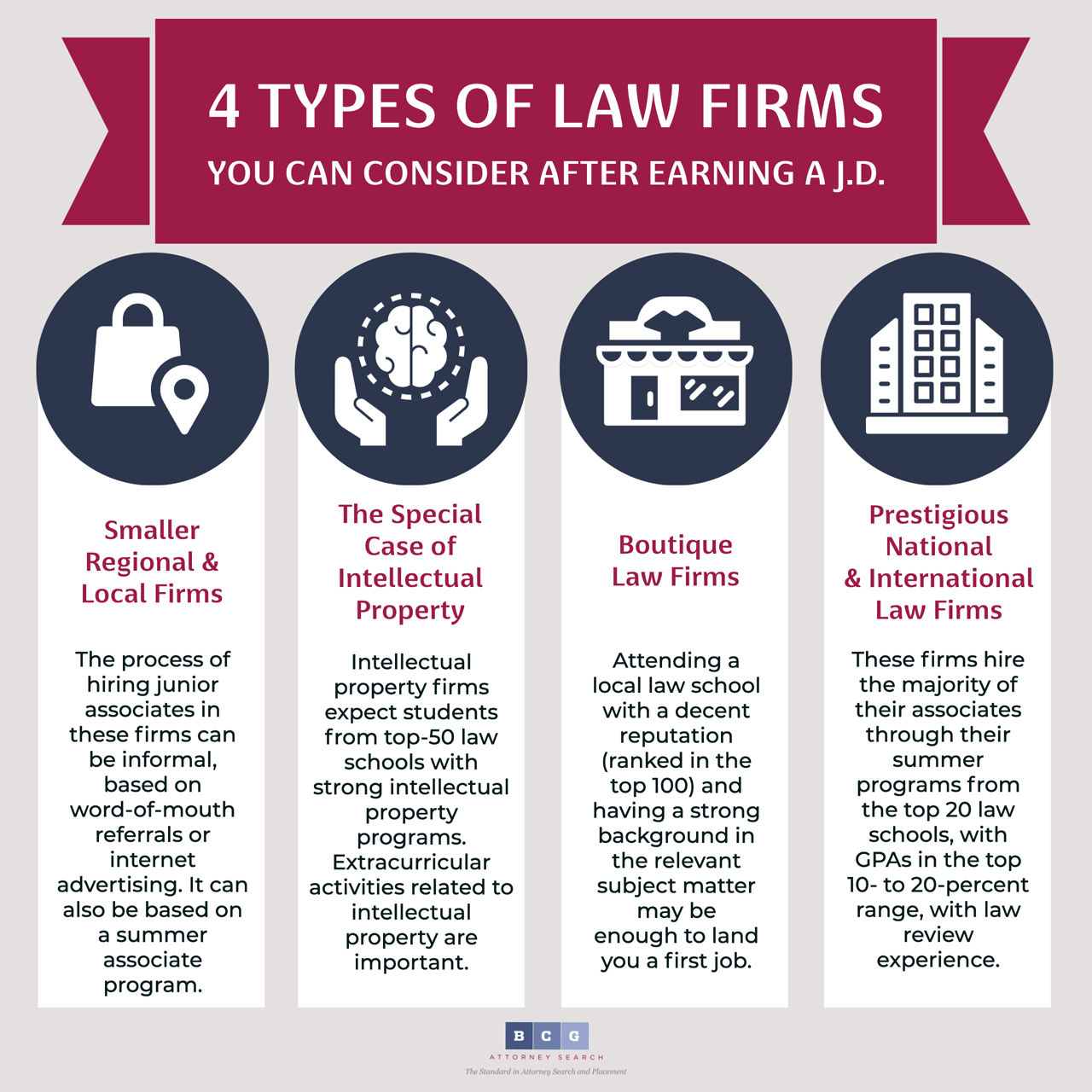
The top-tier national and international law firms tend to be large, with multiple offices, high-profile clients, and significant profits per partner. These firms offer access to the premier lawyers in their practice areas, sophisticated and challenging work, the prestige connected with association with a top firm, and opportunities to develop careers that may lead to national and international recognition. These are the firms that pay the top associate salaries. However, most of these firms are very rigid in their hiring criteria. Many will only consider candidates from the top 20 law schools, as ranked by U.S. News and World Report. Many also require GPAs in the top 10- to 20-percent range, law review experience, and, in some cases, judicial clerkship experience. Competition to get job offers for beginning associates at these firms is intense. And you need to understand the process involved.
These firms hire the majority of their associates through their summer programs. The firms conduct on-campus interviews during students' first and second years of law school to consider who they might invite to work for them as summer associates. If you have a successful on-campus interview, you will be invited to the firm for one or more call-back interviews. If you do well at these interviews, you may receive an "offer" to be a summer associate. Depending on how your experience goes during the summer, the firm may extend an offer to join them after you graduate.
If you set your sights on a prestigious firm, you need to have this process in mind when choosing your law school, approaching your studies and exams, and getting involved in extra law school activities. Don't expect to be granted special notice or credit for life experience in law school. If you want to get into a top firm, your GPA will be a critical consideration.
Boutique Law Firms
Many individuals with concentrated experience in specific subject areas will set their sights on law firm boutiques that specialize in areas of the law that complement their backgrounds. A few examples include boutiques specializing in healthcare law, employment law, real estate and environmental law, municipal law, or intellectual property. Often, these boutiques may be more locally or regionally based. Attending a local law school with a decent reputation (ranked in the top 100) and having a strong background in the relevant subject matter may be enough to land you a first job. Grades will still be important, but hiring partners will probably take a broader view of what you are bringing to the table and what subjects you emphasized during law school. If you know what area of the law you want to practice in, it may be smart to consider which are the best law schools for older students and are highly rated for programs specific to your area of interest. For example, in some cases, attending a school that is ranked highly in environmental law may be more important than attending a school in the top 20 that may not have a strong environmental program.
However, be advised that the national boutique law firms that carry prestige and serve the big-name clients will probably be as demanding as the big general practice national and international firms. These high-profile boutiques want to be able to flaunt top-level credentials on their attorney bio webpages, and top-notch writing skills are a prerequisite.
Smaller Regional and Local Firms
Firms with 50 attorneys or fewer are incredibly variable in terms of their practice mixes and the types of junior attorneys they may want to hire. Some smaller firms are just as elite and particular as the large international firms. A good rule of thumb is to explore a firm's website and look at the attorneys' backgrounds and academic pedigrees. The firm will be looking for junior associates with the same types of backgrounds. If you find a small firm that emphasizes the practice that interests you, make contact with one of its attorneys and find out if and how they bring in new attorneys. Most attorneys enjoy speaking with people who want to learn about what they do, as long as they are not asking for anything more than information. The process of hiring junior associates in these firms can be informal, based on word of mouth referrals or Internet advertising, or it can be based on a summer associate program as rigid and formal as those at the larger firms.
The Special Case of Intellectual Property
Those individuals with strong science or engineering backgrounds make up a unique group. In some markets, intellectual property law firms are aggressively recruiting junior associates from among first-year law students who claim these credentials. If you have an electrical engineering degree, a computer science degree, a physics degree or a Ph.D. in the bio arts, as well as significant industry experience, a recruiter may be able to represent you as a new graduate. The top intellectual property firms are selective and expect students from top-20 law schools, although students from law schools in the top 50 with strong intellectual property programs may be considered. Grades are important, but extracurricular activities related to intellectual property are also weighed heavily. Speaking to a BCG recruiter with expertise in the intellectual property market while charting your course through law school will keep your options open, as you plan submissions to firms and progress through the associate ranks. A legal recruiter can be incredibly helpful long before you need him or her to help you find a job.
Conclusion
Do your research. Have some idea of where you are headed before you jump into law school. As a first-year law student, I had a sudden awakening. I thought I was taking time off from life to contemplate a new career, try things out, enjoy the luxury of simply being a student, and explore whatever might interest me. I was jolted out of this reverie by the law school career counselor who gave the first-year students their October orientation. She stressed that we were not allowed to submit resumes to law firms in pursuit of summer associate jobs until December of our first year. I seemed to be the only student surprised that we were expected to start approaching potential employers only 12 weeks after beginning law school. I remember walking out of that meeting dumbfounded, thinking about how I had no idea what I wanted to do after law school. How was I to know where to submit resumes?
Mature students can also benefit from reviewing the Law School ROI Report, which evaluates lifetime income potential across different starting points.
Although not knowing what you want to do is not a terminal condition in your first year, if you end up setting your sights on the top-level firms, you will be behind in the game if you did not enter law school knowing that was your goal from the beginning.
Other considerations for someone who may want to be a law student at 50 (or even over 30) include the debt load you are willing to shoulder to achieve your goals in the law, the issue of geographic relocation, and how well you will be able to balance law school and the legal lifestyle with your current lifestyle. I will explore these topics, as well as day-to-day strategies for "older" associates in sophisticated law firms, in future articles.
See the following article to learn how much the law school you attended matters when moving to a new firm:
How Much Does the Law School You Went to Matter When You Lateral Firms?
Learn the 10 Factors That Matter to Big Firms More Than Where You Went to Law School
About Harrison Barnes
No legal recruiter in the United States has placed more attorneys at top law firms across every practice area than Harrison Barnes. His unmatched expertise, industry connections, and proven placement strategies have made him the most influential legal career advisor for attorneys seeking success in Big Law, elite boutiques, mid-sized firms, small firms, firms in the largest and smallest markets, and in over 350 separate practice areas.
A Reach Unlike Any Other Legal Recruiter
Most legal recruiters focus only on placing attorneys in large markets or specific practice areas, but Harrison places attorneys at all levels, in all practice areas, and in all locations-from the most prestigious firms in New York, Los Angeles, and Washington, D.C., to small and mid-sized firms in rural markets. Every week, he successfully places attorneys not only in high-demand practice areas like corporate and litigation but also in niche and less commonly recruited areas such as:
- Immigration Law
- Workers Compensation
- Insurance
- Family Law
- Trust and Estate
- Municipal law
- And many more...
This breadth of placements is unheard of in the legal recruiting industry and is a testament to his extraordinary ability to connect attorneys with the right firms, regardless of market size or practice area.
Proven Success at All Levels
With over 25 years of experience, Harrison has successfully placed attorneys at over 1,000 law firms, including:
- Top Am Law 100 firms such including Sullivan and Cromwell, and almost every AmLaw 100 and AmLaw 200 law firm.
- Elite boutique firms with specialized practices
- Mid-sized firms looking to expand their practice areas
- Growing firms in small and rural markets
He has also placed hundreds of law firm partners and has worked on firm and practice area mergers, helping law firms strategically grow their teams.
Unmatched Commitment to Attorney Success - The Story of BCG Attorney Search
Harrison Barnes is not just the most effective legal recruiter in the country, he is also the founder of BCG Attorney Search, a recruiting powerhouse that has helped thousands of attorneys transform their careers. His vision for BCG goes beyond just job placement; it is built on a mission to provide attorneys with opportunities they would never have access to otherwise. Unlike traditional recruiting firms, BCG Attorney Search operates as a career partner, not just a placement service. The firm's unparalleled resources, including a team of over 150 employees, enable it to offer customized job searches, direct outreach to firms, and market intelligence that no other legal recruiting service provides. Attorneys working with Harrison and BCG gain access to hidden opportunities, real-time insights on firm hiring trends, and guidance from a team that truly understands the legal market. You can read more about how BCG Attorney Search revolutionizes legal recruiting here: The Story of BCG Attorney Search and What We Do for You.
The Most Trusted Career Advisor for Attorneys
Harrison's legal career insights are the most widely followed in the profession.
- His articles on BCG Search alone are read by over 150,000 attorneys per month, making his guidance the most sought-after in the legal field. Read his latest insights here.
- He has conducted hundreds of hours of career development webinars, available here: Harrison Barnes Webinar Replays.
- His placement success is unmatched-see examples here: Harrison Barnes' Attorney Placements.
- He has created numerous comprehensive career development courses, including BigLaw Breakthrough, designed to help attorneys land positions at elite law firms.
Submit Your Resume to Work with Harrison Barnes
If you are serious about advancing your legal career and want access to the most sought-after law firm opportunities, Harrison Barnes is the most powerful recruiter to have on your side.
Submit your resume today to start working with him: Submit Resume Here
With an unmatched track record of success, a vast team of over 150 dedicated employees, and a reach into every market and practice area, Harrison Barnes is the recruiter who makes career transformations happen and has the talent and resources behind him to make this happen.
A Relentless Commitment to Attorney Success
Unlike most recruiters who work with only a narrow subset of attorneys, Harrison Barnes works with lawyers at all stages of their careers, from junior associates to senior partners, in every practice area imaginable. His placements are not limited to only those with "elite" credentials-he has helped thousands of attorneys, including those who thought it was impossible to move firms, find their next great opportunity.
Harrison's work is backed by a team of over 150 professionals who work around the clock to uncover hidden job opportunities at law firms across the country. His team:
- Finds and creates job openings that aren't publicly listed, giving attorneys access to exclusive opportunities.
- Works closely with candidates to ensure their resumes and applications stand out.
- Provides ongoing guidance and career coaching to help attorneys navigate interviews, negotiations, and transitions successfully.
This level of dedicated support is unmatched in the legal recruiting industry.
A Legal Recruiter Who Changes Lives
Harrison believes that every attorney-no matter their background, law school, or previous experience-has the potential to find success in the right law firm environment. Many attorneys come to him feeling stuck in their careers, underpaid, or unsure of their next steps. Through his unique ability to identify the right opportunities, he helps attorneys transform their careers in ways they never thought possible.
He has worked with:
- Attorneys making below-market salaries who went on to double or triple their earnings at new firms.
- Senior attorneys who believed they were "too experienced" to make a move and found better roles with firms eager for their expertise.
- Attorneys in small or remote markets who assumed they had no options-only to be placed at strong firms they never knew existed.
- Partners looking for a better platform or more autonomy who successfully transitioned to firms where they could grow their practice.
For attorneys who think their options are limited, Harrison Barnes has proven time and time again that opportunities exist-often in places they never expected.
Submit Your Resume Today - Start Your Career Transformation
If you want to explore new career opportunities, Harrison Barnes and BCG Attorney Search are your best resources. Whether you are looking for a BigLaw position, a boutique firm, or a move to a better work environment, Harrison's expertise will help you take control of your future.
Submit Your Resume Here to get started with Harrison Barnes today.
Harrison's reach, experience, and proven results make him the best legal recruiter in the industry. Don't settle for an average recruiter-work with the one who has changed the careers of thousands of attorneys and can do the same for you.
About BCG Attorney Search
BCG Attorney Search matches attorneys and law firms with unparalleled expertise and drive, while achieving results. Known globally for its success in locating and placing attorneys in law firms of all sizes, BCG Attorney Search has placed thousands of attorneys in law firms in thousands of different law firms around the country. Unlike other legal placement firms, BCG Attorney Search brings massive resources of over 150 employees to its placement efforts locating positions and opportunities its competitors simply cannot. Every legal recruiter at BCG Attorney Search is a former successful attorney who attended a top law school, worked in top law firms and brought massive drive and commitment to their work. BCG Attorney Search legal recruiters take your legal career seriously and understand attorneys. For more information, please visit www.BCGSearch.com.
Harrison Barnes does a weekly free webinar with live Q&A for attorneys and law students each Wednesday at 10:00 am PST. You can attend anonymously and ask questions about your career, this article, or any other legal career-related topics. You can sign up for the weekly webinar here: Register on Zoom
Harrison also does a weekly free webinar with live Q&A for law firms, companies, and others who hire attorneys each Wednesday at 10:00 am PST. You can sign up for the weekly webinar here: Register on Zoom
You can browse a list of past webinars here: Webinar Replays
You can also listen to Harrison Barnes Podcasts here: Attorney Career Advice Podcasts
You can also read Harrison Barnes' articles and books here: Harrison's Perspectives
Harrison Barnes is the legal profession's mentor and may be the only person in your legal career who will tell you why you are not reaching your full potential and what you really need to do to grow as an attorney--regardless of how much it hurts. If you prefer truth to stagnation, growth to comfort, and actionable ideas instead of fluffy concepts, you and Harrison will get along just fine. If, however, you want to stay where you are, talk about your past successes, and feel comfortable, Harrison is not for you.
Truly great mentors are like parents, doctors, therapists, spiritual figures, and others because in order to help you they need to expose you to pain and expose your weaknesses. But suppose you act on the advice and pain created by a mentor. In that case, you will become better: a better attorney, better employees, a better boss, know where you are going, and appreciate where you have been--you will hopefully also become a happier and better person. As you learn from Harrison, he hopes he will become your mentor.
To read more career and life advice articles visit Harrison's personal blog.