
- Competitiveness, unfair circumstances, an Olympic athlete who’s become a lawyer, though not with the grades and experience you have is hired over you.
- These are reasons for attorneys to be upset.
- Continue reading to find out why this and other scenarios have left attorneys frustrated and angry.
- Just remember: don’t blame others for your lack of success.
- You only have yourself to blame.
Summary: Find out what causes so many attorneys to be angry in this article.

Several years ago, a solo practitioner from Ohio applied to work with BCG Attorney Search to help him find a job. His name was Michael Winston. He applied several times and each time I told him we could not work with him. Mr. Winston had never worked in a law firm, performed unremarkably in law school, and had been unemployed for a few years. I had nothing to sell because he had no experience.

|
|
|
Unbeknownst to me at the time, Mr. Winston became convinced that I did no recruiting whatsoever and that my only purpose was to write about the legal market, advertise jobs and then tell people that I could not help them. He presumed I got some sick pleasure out of this and was holding him back. Why else would I not be interested in representing him?
Mr. Winston then somehow made the leap to believing that I was responsible for keeping him unemployed. He became very, very upset and set up a website that immediately attracted all sorts of followers. The followers were people I had been unable to help and who seemed to believe that I was responsible for their lack of success. To prevent these frustrations from the start, Surviving Your First Year as an Attorney teaches balance and resilience.
The website was a series of rants that mainly seemed to convey the idea that I was participating in a conspiracy to keep these attorneys down. All sorts of vicious personal attacks ensued against me and also against my wife. BCG Attorney Search was said to be a complete fiction and Mr. Winston informed his readers that he was on a mission to expose this. According to the blog, my entire purpose in the world was apparently to keep attorneys down and unemployed. Much of this unhappiness stems from poor cultural fit—see how to identify, compare, and thrive in the right environment to learn how to avoid these pitfalls.
I have more to say about Mr. Winston in a moment, because it is an incredible story that ends up being quite tragic. However, before I tell you more about Mr. Winston I would like to ask you:
- What do you think was going on here?
- Why would a cadre of unemployed attorneys take a legal recruiter so seriously and believe that he was keeping them out of the job market?
Then, I would like to ask you: Have you ever blamed others for your own lack of success, or for the lack of positive things happening in your career?
Attorneys are extremely competitive by nature. They have to be. Attorneys admire and respect other attorneys who are also competitive. Would you want an attorney who is not competitive to defend you or represent you? I would not want such an attorney in my corner. The simple fact is that the more competitive the attorney is, the more capable the attorney is—irrespective of paper qualifications. Society wants and needs competitive attorneys. Large law firm attorneys often bill the most hours not because they have to, but because they tend to be the most competitive. If a law firm can find the most competitive attorney, then that firm is probably serving its clients extremely well.
How important is the competitive nature of attorneys to law firms? For starters:
- The people that go to the best schools and get the best grades get the access to the most jobs and the highest paying jobs.
- The attorneys who bill the most hours generally have the most job security.
- The attorneys with the most business generally get the most jobs.
Over the past year I have represented a couple of former Olympic athletes (now attorneys) with decent, but not stellar qualifications. You would have thought the opposite, however. There was literally a major feeding frenzy over both of them—even though their practice areas were not in very much demand. One attorney received at least 10 offers and the other at least five. This all occurred when much more qualified candidates (from better firms, better law schools, and with better grades) were not experiencing even a fraction of this success. What was going on? The only thing I could think of was what one firm said to me when it wanted to interview one of these candidates: One way to avoid falling into a role that leads to dissatisfaction is by targeting firms even without open positions — a proactive approach that often results in more fulfilling placements. To understand how to navigate the legal job market effectively, our video navigating the legal job market effectively offers actionable guidance for attorneys and students alike. For attorneys weighing whether to leave the practice, this video on Why You Should (and Should Not) Quit the Practice of Law offers a clear perspective on the pros and cons of making that difficult choice. To see how dissatisfaction can motivate a change, check out this video on 25 Reasons to Move to a New Firm for practical examples of attorneys making strategic moves.
“We want our attorneys to be competitive.”
As I observed all of this interest, the only thing I could conclude was that “the competitive spirit” presumed to be inherent in a former Olympic athlete was driving the extreme interest in these candidates.
If there is one thing attorneys are competitive about it is their status in the legal profession. A major undercurrent of the legal profession involves the “status” of an attorney. Status is something that all animals (including humans) are extremely concerned with. When dogs meet they sniff one other to understand each other’s relative status. The animal that is lower status knows that if it attempts to challenge the higher status animal it will upset the higher status animal and could get hurt. Attorneys have a very good understanding of their status in the legal community. Status makes them feel good about themselves and more successful. Without the ability to compare themselves to others, attorneys’ own status becomes meaningless. Many of these frustrations stem from the same mindset that leads to career stagnation—something explored deeply in The Most Common Excuses That Attorneys Give for Failing in Their Careers and Why Each of Them Is Wrong.
When attorneys meet each other, they generally do what dogs do and start sniffing each other out immediately:
- Where do you work?
- Where did you go to law school?
When attorneys are discussing their relative status with one another, and one attorney shows any form of superiority over the other, the other attorney generally feels threatened. The threatened attorney will react either by (1) accepting his or her lower status (choosing not to fight), or (2) fighting (and choosing not to accept his or her lower status). A similar phenomenon occurs when firms go up against each other. When a small law firm is battling a large law firm, for example, the fight is often just as much about “status” as it is about the issue at hand. Attorneys are motivated by status and are competitive with one another. For partners contemplating a change, the video Partner-Level Transitions: What Law Firms Look for and How to Stand Out provides strategies to navigate career transitions successfully. Many attorneys’ frustrations stem from preventable errors; our video on the 15 most common career mistakes highlights these mistakes and how to sidestep them.
Status happens within law firms as well. Are you a contract attorney? Are you a partner or an associate? Are you an equity partner or an income partner?
Law firms that are of the highest status get the best candidates. Attorneys (correctly) believe that working for certain (high status) law firms will improve their own status as attorneys in the legal community. While many lawyers struggle, some reach exceptional rewards—see our feature on elite law firm partners earning $25M+ for perspective.
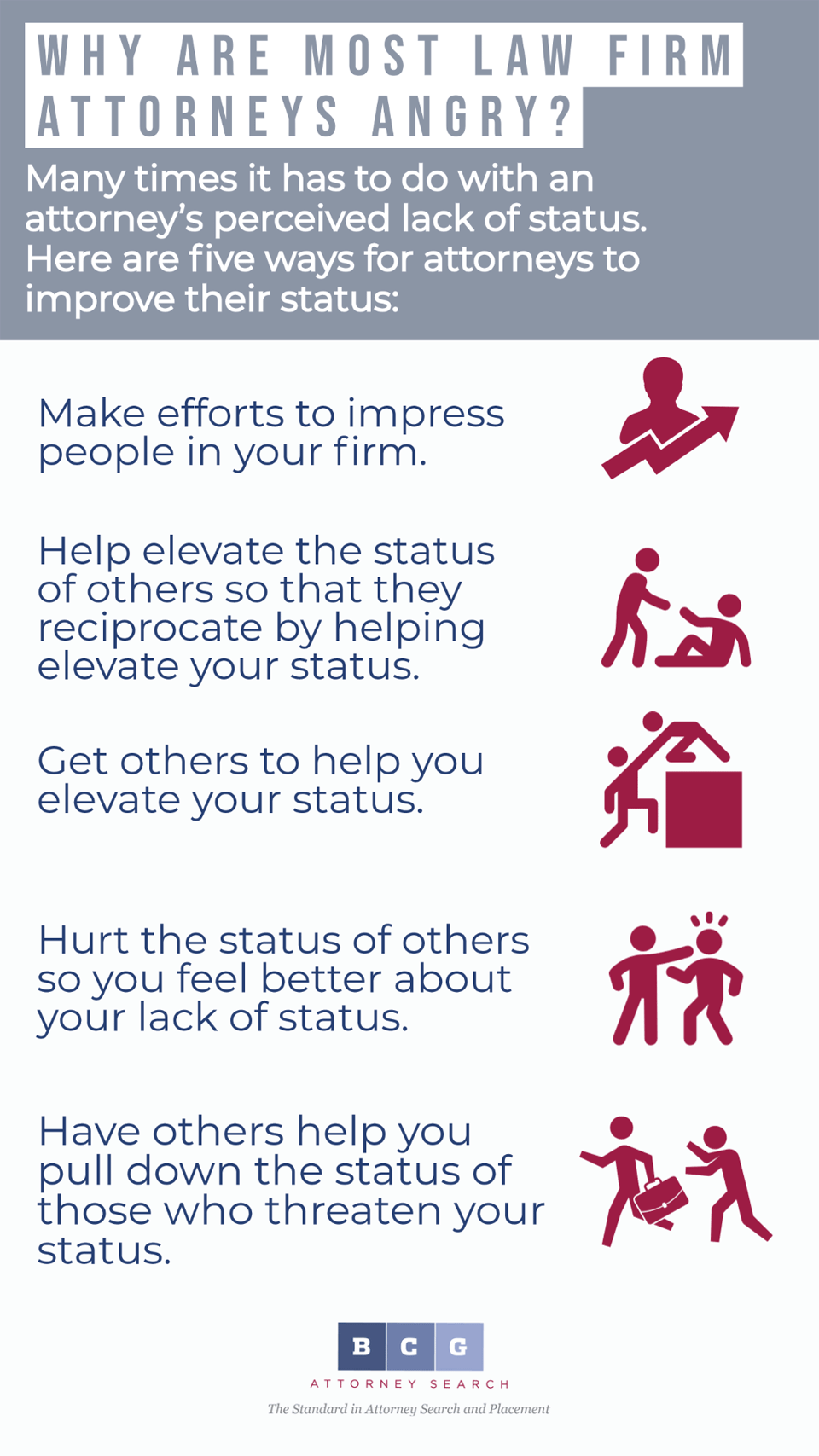
Status is everywhere. You should watch how status is playing out in the games between attorneys, between law firms and in the legal profession generally. When an attorney is confronted by his or her own lack of status in the legal profession the attorney generally can do one of the following: Before accepting an offer, watch The Art of Interviewing to ensure your interviews lead to the right position.
- Make efforts to improve the attorney’s status.
- Help elevate the status of others so that they reciprocate by helping elevate the attorney’s status.
- Get others to help elevate the attorney’s status.
- Hurt the status of others so the attorney feels better about his or herself and his or her lack of status.
- Have others help the attorney pull down and disparage the status of those who threaten the attorney’s status so the attorney feels better about his or herself and his or her lack of status.
If you are a competitive attorney you will be faced with these five choices. Every attorney is competitive and most attorneys are eager to improve their status within their own law firms, within the legal profession and within society.
Most of the things I write about (on this website, hb.org and other websites) involve the profound importance of making choices “1 through 3” and avoiding choices “4 and 5.”
The best thing you can do for your career is to make efforts to improve your own status, but you must go about this in the correct way. This means working hard, getting an LL.M. from a prestigious law school if you did not attend one originally, getting business, becoming a better attorney and more.
You can also help elevate the status of others so they help you elevate your status. This means you work hard for people so they want to return the favor. Finally, you can also get others to elevate your status for you—often even if you do not deserve it. You can do this through family connections, getting a favor from a powerful person and so forth.
Very few attorneys make choices 1 through 3 when their status is threated. In fact, the majority of attorneys I come into contact with make choices “4 and 5” at some point in their careers and become the sort of people who blame and attack others. They may not make this choice initially, but they generally will at some point in their careers when their status is threatened. This is one of the major reasons why attorneys are so angry and become negative people who disparage and tear down others.
There are two reasons for this.
First, the legal profession by its very nature makes it very difficult for an attorney to attain and maintain high status. Achieving initial status (law firms, big firms) is extremely competitive. Even if an attorney does achieve this initial status, holding onto this status is exceptionally difficult because the majority of attorneys do not survive more than five years or so in large law firm. To see proven techniques for avoiding negativity and boosting satisfaction, check out our video: How Can You Avoid Drama and Find Happiness as an Attorney?
Second, and most importantly, attorneys are actually trained to blame others for everything … We respect an attorney’s ability to make his or her clients look better by dressing down the other side and making them look bad. Attorneys are expected to take their clients’ side and make the other side look less deserving—regardless of the matter at issue. This is how we (as attorneys) view things: Avoiding burnout starts with realistic goals—see Why You Might be Better Off Being an Average Attorney Than Trying to Be an Exceptional One for a different perspective on success.
- If something has gone wrong (in a transaction, litigation matter and so forth), then someone other than our client is at fault.
- This person (or company’s) incompetence, crookedness, bias and so forth diminishes the respect he or she or it deserves as a person or company.
- This person, of course, deserves to be called names, talked about poorly and, in some cases, even physically attacked (or even killed).
- Our clients do not need to accept any responsibility for the situation because if they admit this that would diminish the respect they deserve as people and therefore entitle them to the same negative treatment.
Every transaction and litigation matter that an attorney takes a side on generally involves some variation of these four steps. Someone other than our client is at fault. You can see this pattern play itself out in every trial and notable transaction. In the OJ Simpson trial, for example, the police were portrayed as incompetent, racist and so forth. Because OJ Simpson’s defense team maintained he was wrongly accused, the bad people were the police and perhaps even the victims (one was portrayed as promiscuous and the other a ‘ne’er-do-well’) who did not deserve the respect of the public, the jurors or the accused. Many lawyers overlook how personality and communication style affect career satisfaction. Watch Transform Your Legal Career: Harnessing Personality and Salesmanship to learn how mastering your authentic persona can reignite passion and fulfillment in your practice.
This need to blame others, find fault and portray others as at fault also applies to how attorneys learn to evaluate their own lives. It is very rare that I speak with an attorney who is willing to accept full responsibility for whatever issues he or she is experiencing in his or her career. Probably the worst thing that attorneys can do is blame others for the lack of the sort of success they are hoping to achieve. To understand the root cause of frustration many attorneys face, see our video Why You Will Never Succeed at Practicing Law Until You Understand This One Thing, which highlights the mindset change that can prevent these common pitfalls.
- For attorneys considering a switch, exploring practice area or market transitions in our attorney lateral movement guide can help clarify options. One way to prevent career frustration is to align your work with areas of high demand and satisfaction. The Attorney Marketability Index 2026 provides insights that help attorneys make that alignment.
The blaming of others and attempting to push down the status of others because of our own lack of status and success is one of the most dangerous things that we can do. Not only does blaming others lead to our continued lack of success, it also leads to the worst acts that humans can do to one another. Things like wars, the Holocaust, ethnic cleansing, a large proportion of lawsuits, many crimes and other negative things in the world are often caused by our propensity to blame others. Our interest in blaming others and in taking them down for our own lack of status is profound and is something I unfortunately hear from attorneys on a daily basis.
- An attorney gets a poor evaluation and subsequently becomes hostile to the evaluator or the law firm and makes nasty comments about the evaluator or firm to others.
- An attorney makes a huge mistake on a project and blames the firm for giving him or her too much work.
- An attorney does not bill enough hours and loses a bonus or is let go and blames the firm for not having enough work, not allowing the attorney to bring in certain clients, or having a “flawed” assignment system.
- An attorney does not get made partner and blames the firm for being “sexist,” “racist,” “homophobic” or even “hating white males.”
- An attorney moves firms, gets fired, or quits and then blames the firm for being sexist, racist, homophobic, too Republican, or too liberal.
- An attorney is having a difficult time getting a position and looks for reasons outside of him or herself to justify why it is happening.
Attorneys are very good at tearing others down, blaming them and exposing their weakness. It is part of an attorney’s training and something that the better they do, the more likely they are to be successful as attorneys. When an attorney tears down an opposing side then the attorney’s side looks better.
For at least a year, Mr. Winston and several of his followers continued to write about how I was the cause of their lack of success in getting jobs and status in the legal community. The irrationality of this boggles the mind when you consider there are tens of thousands of legal employers in the country and I am not even a legal employer. Instead, I am someone who tries to help people get jobs and succeed in the legal profession and in life. I want to inspire people to be the best they can be. Why would a group of people believe that I had anything to do with keeping them unemployed?
Certainly it might upset people to learn that a high-profile legal recruiter is unable to represent them. What is most disconcerting, though, is why someone would take all of his anger, fears and frustration about his job prospects and put it all on one person.
None of this would have been much of a problem, or even a concern, if Mr. Winston did not have so many followers who seemed to quite adamantly believe the same thing. I was puzzled by this and it quickly turned quite alarming as Mr. Winston took his show on the road. He started ranting and raving to his readers that he was going to go find me and “expose me in person.”
As part of his mission to expose me, Mr. Winston reported to his readers that he drove six hours from his home in Cleveland to our Chicago offices where I do not work (I work in Los Angeles) and asked for me. When the receptionist informed him that I did not work there, he turned around and returned to his home in Ohio and logged onto his computer and let the world know that (1) he had gone to our Chicago office (where if he reviewed our website he would have found I clearly do not work), (2) looked for me and could not find me and (3) therefore concluded that BCG Attorney Search clearly did not exist. His posting was, of course, met with various cheers from his audience of other unemployed attorneys who, for reasons that are unclear to me, leeched onto Mr. Winston’s postings and turned the blame for their own lack of success in the legal market on me.
I am used to this, of course. I receive phone calls, emails and so forth regularly from attorneys looking for positions who are extremely upset with me when they learn I cannot help them. I obviously represent a good source of anger for these attorneys about the job market.
I called Mr. Winston numerous times and told him that I do exist. I offered to help him look for a position and he had no interest in me helping him—he preferred to be angry. His writing became more and more inflammatory and threatening. Eventually, I had to take him to court to get him to take down his writings. He agreed to take the writings down and then repeatedly put them up again and again—even after he got a job as a prosecutor in Cleveland. The writings showed so much contempt and were so unprofessional that it likely alarmed his colleagues in the East Cleveland Prosecutor’s Office.
Mr. Winston did not last too long as a prosecutor. After being a prosecutor, he started his own solo practice representing drug dealers and others. Then this happened:
A lawyer who represented one of three defendants in a lengthy Franklin County drug-trafficking case killed himself on March 13 after reportedly fleeing from the scene of a shooting in Cleveland.
Michael D. Winston, 38, died from a self-inflicted gunshot wound, the Cuyahoga County medical examiner’s office ruled last week.
Winston, whose law office was in Cleveland, represented Kiersten Smith, 23, during a trial that began in January and lasted four weeks in Common Pleas Court. When the trial was over, Winston was fined $500 by Judge Pat Sheeran for twice being about an hour late to court and for failing to appear for a meeting regarding jury deliberations.
The jury acquitted Smith of two counts and was unable to reach a verdict on one count of heroin possession with a gun specification. She is scheduled to be tried again on April 27.
Winston’s suicide occurred minutes after Cleveland police responded to a shooting at an E. 84th Street house. Officers said they saw a man run from the scene and get into a car parked on E. 85th Street, where he shot himself in the head.
How would you have handled someone like Winston? Is there anything that you would have done to prevent his tragic death?
Two men in the house were shot, and one of them died. Police have not commented on what role, if any, Winston played in the shooting.
Winston, a former East Cleveland prosecutor, ran unsuccessfully for a Cleveland Municipal Court judgeship in 2013.
http://www.dispatch.com/content/stories/local/2015/03/24/justice-insider-attorney-in-drug-trafficking-case-kills-self.html
Another story reported the following:
Winston went to a home on East 84th Street after learning that the home's owner had recently won a large sum of money. There, Winston first encountered 60-year-old Walter Saunders and fatally shot Saunders in the head. Winston then shot 52-year-old Irvin Hannon in the chest. Winston then placed a blanket over Saunders body and searched the house for money, unaware that Hannon had called police. When police arrived, they saw Winston "running from the East 84th Street home with stolen cash falling from his pockets." Winston shot himself when police cornered him inside a "get-away" car.
http://www.cleveland.com/naymik/index.ssf/2015/03/former_east_cleveland_prosecut.html
I am not sure what ultimately happened with Mr. Winston. He clearly had a lot of anger and beliefs about others that simply did not make a lot of sense. At the time of his murder-suicide he was fighting with a judge and scheduled to give testimony against her. Winston is an exaggerated version of what most attorneys do, however: They blame others and often irrationally. They blame others as a way to feel better about themselves.
- In contrast, firms like Alter Wolff Foley & Stutman are setting new standards — as detailed in Discover the Exceptional Employee Experience at Alter Wolff Foley & Stutman LLP.
Conclusion
When I was growing up one of my relatives used to drive me through neighborhoods of nice homes in our city. The goal of these drives was not to admire how other people lived; I was given other kinds of messages:
- In order to live like this you can never see your family and you must work all the time.
- Many people who live like this need to do bad things to others in order to live like this.
- If you live like this you clearly are “cheating” or doing something wrong.
There were all kinds of reasons I was instructed that financial success must be the product of being bad—or that there was something wrong with people who were successful. Because this was the result of being bad, instead of feeling bad about ourselves for not being as successful as others, we were able to feel good about ourselves. Similarly, children who grow up poor are often told by their parents that kids who have a lot of things are given these things by their parents because their parents do not love them. From a young age, most of us are taught that we can feel better about ourselves by finding fault in others who are more successful. Many of these frustrations stem from a deeper lack of focus and direction in one’s legal journey. For a deeper look at how to overcome that, explore Why Lawyers at Every Stage Struggle: The Hidden Costs of Lacking Focus in Your Legal Career.
The entire tabloid industry—and it is huge—generally is about finding fault in stars and others who look so successful in the limelight. When we find fault with others whose existence makes us feel bad about ourselves, we feel better about ourselves. Much of this unhappiness can be avoided by choosing between attorney placement and recruiting carefully, ensuring you find a firm that truly fits your goals.
The need for status in the legal community is something that is incredibly important to most attorneys. However, the desire to tear others down and attack them because of one’s own lack of status serves no useful purpose. The only solution to the predicament of feeling a lack of status is to not care at all, to attempt to elevate one’s own status, or to have others help elevate one’s status. In my opinion, the best option may be to simply go about doing the best one can and simply not care at all. Learn how our proactive placement system minimizes mismatched roles in The BCG Attorney Search Advantage.
About Harrison Barnes
No legal recruiter in the United States has placed more attorneys at top law firms across every practice area than Harrison Barnes. His unmatched expertise, industry connections, and proven placement strategies have made him the most influential legal career advisor for attorneys seeking success in Big Law, elite boutiques, mid-sized firms, small firms, firms in the largest and smallest markets, and in over 350 separate practice areas.
A Reach Unlike Any Other Legal Recruiter
Most legal recruiters focus only on placing attorneys in large markets or specific practice areas, but Harrison places attorneys at all levels, in all practice areas, and in all locations-from the most prestigious firms in New York, Los Angeles, and Washington, D.C., to small and mid-sized firms in rural markets. Every week, he successfully places attorneys not only in high-demand practice areas like corporate and litigation but also in niche and less commonly recruited areas such as:
- Immigration Law
- Workers Compensation
- Insurance
- Family Law
- Trust and Estate
- Municipal law
- And many more...
This breadth of placements is unheard of in the legal recruiting industry and is a testament to his extraordinary ability to connect attorneys with the right firms, regardless of market size or practice area.
Proven Success at All Levels
With over 25 years of experience, Harrison has successfully placed attorneys at over 1,000 law firms, including:
- Top Am Law 100 firms such including Sullivan and Cromwell, and almost every AmLaw 100 and AmLaw 200 law firm.
- Elite boutique firms with specialized practices
- Mid-sized firms looking to expand their practice areas
- Growing firms in small and rural markets
He has also placed hundreds of law firm partners and has worked on firm and practice area mergers, helping law firms strategically grow their teams.
Unmatched Commitment to Attorney Success - The Story of BCG Attorney Search
Harrison Barnes is not just the most effective legal recruiter in the country, he is also the founder of BCG Attorney Search, a recruiting powerhouse that has helped thousands of attorneys transform their careers. His vision for BCG goes beyond just job placement; it is built on a mission to provide attorneys with opportunities they would never have access to otherwise. Unlike traditional recruiting firms, BCG Attorney Search operates as a career partner, not just a placement service. The firm's unparalleled resources, including a team of over 150 employees, enable it to offer customized job searches, direct outreach to firms, and market intelligence that no other legal recruiting service provides. Attorneys working with Harrison and BCG gain access to hidden opportunities, real-time insights on firm hiring trends, and guidance from a team that truly understands the legal market. You can read more about how BCG Attorney Search revolutionizes legal recruiting here: The Story of BCG Attorney Search and What We Do for You.
The Most Trusted Career Advisor for Attorneys
Harrison's legal career insights are the most widely followed in the profession.
- His articles on BCG Search alone are read by over 150,000 attorneys per month, making his guidance the most sought-after in the legal field. Read his latest insights here.
- He has conducted hundreds of hours of career development webinars, available here: Harrison Barnes Webinar Replays.
- His placement success is unmatched-see examples here: Harrison Barnes' Attorney Placements.
- He has created numerous comprehensive career development courses, including BigLaw Breakthrough, designed to help attorneys land positions at elite law firms.
Submit Your Resume to Work with Harrison Barnes
If you are serious about advancing your legal career and want access to the most sought-after law firm opportunities, Harrison Barnes is the most powerful recruiter to have on your side.
Submit your resume today to start working with him: Submit Resume Here
With an unmatched track record of success, a vast team of over 150 dedicated employees, and a reach into every market and practice area, Harrison Barnes is the recruiter who makes career transformations happen and has the talent and resources behind him to make this happen.
A Relentless Commitment to Attorney Success
Unlike most recruiters who work with only a narrow subset of attorneys, Harrison Barnes works with lawyers at all stages of their careers, from junior associates to senior partners, in every practice area imaginable. His placements are not limited to only those with "elite" credentials-he has helped thousands of attorneys, including those who thought it was impossible to move firms, find their next great opportunity.
Harrison's work is backed by a team of over 150 professionals who work around the clock to uncover hidden job opportunities at law firms across the country. His team:
- Finds and creates job openings that aren't publicly listed, giving attorneys access to exclusive opportunities.
- Works closely with candidates to ensure their resumes and applications stand out.
- Provides ongoing guidance and career coaching to help attorneys navigate interviews, negotiations, and transitions successfully.
This level of dedicated support is unmatched in the legal recruiting industry.
A Legal Recruiter Who Changes Lives
Harrison believes that every attorney-no matter their background, law school, or previous experience-has the potential to find success in the right law firm environment. Many attorneys come to him feeling stuck in their careers, underpaid, or unsure of their next steps. Through his unique ability to identify the right opportunities, he helps attorneys transform their careers in ways they never thought possible.
He has worked with:
- Attorneys making below-market salaries who went on to double or triple their earnings at new firms.
- Senior attorneys who believed they were "too experienced" to make a move and found better roles with firms eager for their expertise.
- Attorneys in small or remote markets who assumed they had no options-only to be placed at strong firms they never knew existed.
- Partners looking for a better platform or more autonomy who successfully transitioned to firms where they could grow their practice.
For attorneys who think their options are limited, Harrison Barnes has proven time and time again that opportunities exist-often in places they never expected.
Submit Your Resume Today - Start Your Career Transformation
If you want to explore new career opportunities, Harrison Barnes and BCG Attorney Search are your best resources. Whether you are looking for a BigLaw position, a boutique firm, or a move to a better work environment, Harrison's expertise will help you take control of your future.
Submit Your Resume Here to get started with Harrison Barnes today.
Harrison's reach, experience, and proven results make him the best legal recruiter in the industry. Don't settle for an average recruiter-work with the one who has changed the careers of thousands of attorneys and can do the same for you.
About BCG Attorney Search
BCG Attorney Search matches attorneys and law firms with unparalleled expertise and drive, while achieving results. Known globally for its success in locating and placing attorneys in law firms of all sizes, BCG Attorney Search has placed thousands of attorneys in law firms in thousands of different law firms around the country. Unlike other legal placement firms, BCG Attorney Search brings massive resources of over 150 employees to its placement efforts locating positions and opportunities its competitors simply cannot. Every legal recruiter at BCG Attorney Search is a former successful attorney who attended a top law school, worked in top law firms and brought massive drive and commitment to their work. BCG Attorney Search legal recruiters take your legal career seriously and understand attorneys. For more information, please visit www.BCGSearch.com.
Harrison Barnes does a weekly free webinar with live Q&A for attorneys and law students each Wednesday at 10:00 am PST. You can attend anonymously and ask questions about your career, this article, or any other legal career-related topics. You can sign up for the weekly webinar here: Register on Zoom
Harrison also does a weekly free webinar with live Q&A for law firms, companies, and others who hire attorneys each Wednesday at 10:00 am PST. You can sign up for the weekly webinar here: Register on Zoom
You can browse a list of past webinars here: Webinar Replays
You can also listen to Harrison Barnes Podcasts here: Attorney Career Advice Podcasts
You can also read Harrison Barnes' articles and books here: Harrison's Perspectives
Harrison Barnes is the legal profession's mentor and may be the only person in your legal career who will tell you why you are not reaching your full potential and what you really need to do to grow as an attorney--regardless of how much it hurts. If you prefer truth to stagnation, growth to comfort, and actionable ideas instead of fluffy concepts, you and Harrison will get along just fine. If, however, you want to stay where you are, talk about your past successes, and feel comfortable, Harrison is not for you.
Truly great mentors are like parents, doctors, therapists, spiritual figures, and others because in order to help you they need to expose you to pain and expose your weaknesses. But suppose you act on the advice and pain created by a mentor. In that case, you will become better: a better attorney, better employees, a better boss, know where you are going, and appreciate where you have been--you will hopefully also become a happier and better person. As you learn from Harrison, he hopes he will become your mentor.
To read more career and life advice articles visit Harrison's personal blog.