
- Many recruiters use a five-level system to determine the ability of a law firm candidate.
- Of course, those levels are based on criteria not just of the client, but the law firm as well.
- That can include the firm’s client base’s stature and the prestige level of the firm’s partners.
- For the candidate, their law school grades and work ethic are used for evaluation.
Summary: This article reveals the secrets of the Harvard-inspired ranking system used by high-end legal recruiters to appropriately match attorney candidates with law firms. BCG recruiters assign rankings of “5” (highest) to “1” (lowest) to every law firm seeking to hire attorneys and to every candidate seeking to find a law firm position. The rankings are based on a host of criteria including (for law firms) the stature of the firm’s client base and caliber of the firm’s partners and (for attorney candidates) the candidate’s law school grades and the candidate’s work ethic.

Lawyers rarely have a full understanding of why they are or are not marketable to certain types of law firms. Similarly, law firms do not always understand why certain types of attorneys are, or are not, attracted to them.

|
|
|
Part of our jobs as legal recruiters is to send the most appropriate candidates to the most appropriate law firms. This means that we do not send a candidate to a law firm if the candidate is not suited to that law firm. This would only have the effect of upsetting both the firm and the candidate, and make us look like we do not know what we are doing as recruiters. Attorneys and law firms must be matched in a manner that is appropriate for both sides of the equation.
As discussed at the end of this article, the modern day legal profession shares many similarities with the eighteenth century Western European class system defined by the three major classes of gentry, middle class and peasantry. While it is possible to move among these classes, it is very difficult and often nearly impossible to move “up” as opposed to “down” within this system. Part of what we must do as recruiters is be mindful of the parameters within which the system works (and thus within which we must operate), while also maintaining creative and optimistic minds that can see and capitalize on those rare situations where upward movement is possible.
At BCG Attorney Search, we have a highly developed “1 to 5” ranking system that we use to rank attorneys and law firms. Attorneys who seek our assistance are reviewed and ranked when they enter our system. The ranking system is inspired by a college-applicant ranking system used by Harvard University. I learned this system from my father, who used to be an interviewer and recruiter for Harvard’s admission committee. The system measures, with some certainty, whether a given applicant will be competitive for a school like Harvard, Yale, Princeton and so forth. I have thought about this system through the years and, because I determined it would work well for high-level legal recruiting, I implemented a version of it at BCG Attorney Search.
How Harvard University Reviewed and Ranked Applicants to the College
- A “5” was very rare and generally a “highly probable admit”—very high test scores, very good grades, strong recommendations and something that made the applicant very “special” and indicated exceptional promise to do something “great” in the future (a Westinghouse Prize winner, famous child actor, published author, top ranked athlete, etc.). These sorts of people were rare and made up a small percentage of applicants. They generally were the sorts of people everyone in their schools, towns and so forth was talking about and were extremely gifted and “astonishing” on some level. Their application files were so strong that the admissions committee rarely needed to discuss them more than briefly before admitting them. They might make up 10% to 15% of the class at a school like Harvard.
- A “4” comprised the majority of admits—high test scores, great grades, obvious drive and a high level of achievement in more than just academics (but nothing mind blowing and spectacular as in the case of “5s”). These candidates were generally distinguished based on things such as (1) the quality of their high school, (2) their grades and test scores, (3) the number of extracurricular activities in which they participated, (4) how well they interviewed, (5) diversity issues, (6) where they were located geographically, (7) whether or not they were a legacy (parents attended the school), (8) their recommendations – and similar factors. These sorts of people were likely to get admitted at other Ivy League schools or highly ranked liberal arts colleges. They were very strong applicants but not “clear admits.” The admissions committee would spend the majority of its time debating and discussing these applicants and which of them should be accepted. Most ultimately would be rejected; however, they would have had their files reviewed closely. These students would make up at about 75% to 80% of the class.
- A “3” would be someone who was strong but not as strong as a “4”—a good applicant but not an outstanding one. They would have taken fewer AP courses, may have had low grades but high test scores, or may have had an uneven academic performance with some highs and some mediocrity (think all “As” and “Bs” in their junior year and “As” in their senior year). Alternatively, in terms of other activities, the applicant may have earned high grades and test scores but lacked other distinguishing characteristics. “3s” can make it into a school like Harvard—and do consistently—but not in anywhere near the proportion that “4s” do. Where 20% of “4s” might be offered admission, 5% of “3s” might be offered admission. The “3s” who were admitted may have had good but not outstanding grades and test scores but be “special” because, for example, they (1) were outstanding athletes, or (2) were incredibly gifted in some sort of discipline (like they began taking college-level calculus at the age of 10), or (3) were the child of very famous parents which would bring positive publicity to the school, or (4) did something unusual that made them interesting, or (5) overcame incredible odds in their lives. An applicant with various “special” defining characteristics would generally be qualified and competitive for most colleges ranked “15” and below. These students generally made up around 5% or a bit more of the Harvard class.
- A “2” would rarely get into a school like Harvard – but it was possible. They generally had mediocre grades and test scores that would not normally qualify them for admission. A “2” was admitted perhaps 1% of the time. When a “2” got accepted there was generally some sort of special reason. The applicant may have been “special” due to some rare talent or achievement, be the child of a faculty member or other very important person, or have other special extenuating reasons justifying admission. An applicant admitted as a “2” would generally be the subject of a lot of debate and discussion and everyone on the admissions committee would have to get comfortable that admitting the applicant was in the best interest of the school for some reason. These candidates would normally be rejected without any real review, but could be pushed up the ladder when outside forces brought the applicant to the committee’s attention. A “2” who was not admitted would generally not be qualified to go to most highly-ranked state schools (UCLA, Michigan, Virginia) and would generally be rejected by these schools on numbers alone. These applicants would make up less than 1% of the class.
- A “1” would be admitted less than 1 in 500 times—and extremely rarely. These students would have been perceived as not being 100% capable of even doing the work and may have needed tutoring. These “special cases” were generally admitted because the school saw reasons for doing so to serve the public good and to provide unusual and meaningful diversity to the school. They could be foreign students who were held captive in a prison for their political beliefs and escaped from North Korea, or something equally stunning and fascinating. There would always be a few people like this each year at extremely competitive colleges like Harvard. Most “1” candidates would have a difficult time getting admitted to even most “marginally selective” colleges in the United States without special circumstances justifying admission. “1s” comprise the majority of average to low performing high school students in the United States.
The lower an applicant falls in the rankings, the more “average” the applicant and the less likely the applicant would be admitted to a school like Harvard. As noted, most of an admission committee’s debate and discussion would revolve around “4” candidates.
- For a detailed look at the top private and public interest law firms in the U.S., refer to the BCG Attorney Search Rankings. A practical example of this system can be seen in our article How BCG Attorney Search Ranks Law Firms.
BCG Attorney Search Recruiters Rank Attorney Candidates and Law Firms in a Similar Manner
BCG recruiters use a similar kind of “ranking” system when it comes to both attorneys seeking law firm placements and law firms seeking attorney candidates. Because prestigious law firms generally require their attorneys to be at least “4s,” legal recruiters such as BCG Attorney Search are seeking as many “4” and “5” candidates as possible.
- There are very few “5s” and most of the people we work with are “4s.”
- Most of the debate, discussion and so forth (and where we make placements) is for the “4” candidates.
- Most of the law firms where we make placements are “4” law firms as well.
- The majority of candidates with whom we work are “4s.”
- We will work with almost any attorney who seeks our assistance and receives a ranking of “4” or “5”—so long as there is a market for those candidates at the time.
- We will work with some “3s” but not most.
- We will also occasionally work with “2s.”
- We will rarely work with “1s.”
Not surprisingly, the majority of attorneys who apply to jobs on BCG Attorney Search’s website are ranked a “3” or below. This is because about 95% of the attorneys in the United States are ranked “3” or below. Sometimes these “3” candidates get upset if we choose not to work with them because we do not think we can place them, but it does no service to either side of the transaction to try and make a match between a “4” or “5” firm and a “2” or “3” attorney.
Our firm does, of course, recruit for law firms ranked 1, 2, and 3 and match up attorneys appropriate for such law firms. Additionally, when the circumstances justify it, our firm will try to help deserving attorneys “move up the ladder” and help candidates ranked a “4” get a position in a “5” law firm, or candidates ranked a “3” get a position in a “4” law firm and so forth. This is an aspect of recruiting that I personally enjoy and I find it extremely rewarding and exciting when one of our recruiters is able to help a candidate in this life-changing way.
How to Distinguish Between the Most Prestigious Law Firms and Most Marketable Attorneys Using the BCG Attorney Search “1” to “5” Ranking System
RANK OF 5
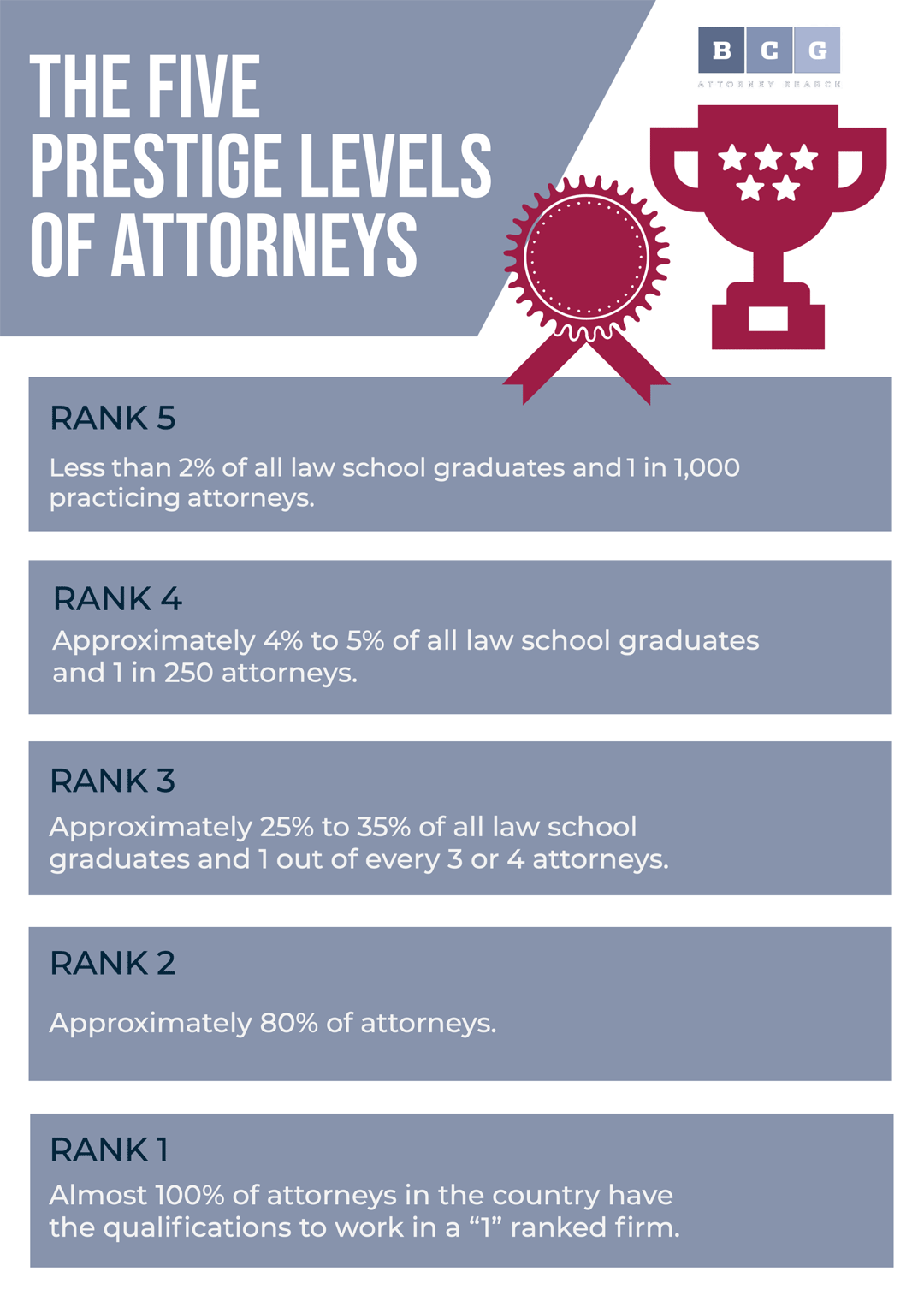
Law Firms Ranked “5”: Law firms that are ranked a “5” are typically major national firms with extremely selective hiring criteria. These are the best of the best and the most elite law firms in the world. Less than 2% of all law school graduates and 1 in 1,000 practicing attorneys likely have the qualifications to get hired by these law firms.
Hiring Criteria: These firms generally want people from top law schools, top law firms, people who appear stable and are very committed. They also have the confidence to take a few very high-performing people from local law schools who did exceptionally well without watering down their brands. They will generally only hire attorneys with 1 to 6 years of experience laterally. They look for people who are cerebral, who will work hard without questioning it and who are 100% committed to practicing law.
Business and Billings Requirements for Partners: In terms of hiring partners, they generally want people with at least $3,000,000 in business and very high billing rates.
Examples and Distinguishing Characteristics of Firms Ranked “5”: Firms in this group include firms like Sullivan & Cromwell; Gibson Dunn; Wachtel Lipton; Munger Tolles; Davis Polk; Quinn Emanuel and Irell & Manella. On the lower end of “5” firms would be firms like Skadden Arps; Latham & Watkins; Simpson Thacher; Jones Day and a few other similar firms (they are not quite as selective but still deserve to be “5s”). There are also several boutique firms around the country (generally in litigation) that may be composed of people formerly with large law firms who went to top law schools (Yale, Harvard and so forth) and only hire people with outstanding pedigrees and important clerkships (generally federal circuit court clerkships). These firms generally require very high grades and have grade cutoffs they keep internally that are meant to keep out all but the highest performing attorneys, often even at the partner level. (Gibson Dunn has famously rejected attorneys who formerly served on the cabinets of various presidential administrations for not making grade cutoffs). These sorts of “5” firms will rarely take chances on people because they do not need to.
Another feature of “5” firms is that they are generally not “on the way down” and are very well run. These firms also rarely—if ever—lay people off. Moreover, they are not likely to make people leave when they get senior, but will hold them back in terms of titles. These firms are extremely selective in their summer associate programs.
Typical Client Profile: These firms represent important institutional clients and have the ability to make an attorney partner without requiring the attorney to bring in any business. The clients of these firms will generally be large, established national and international brand name companies (General Mills, Mercedes, Apple) that everyone has heard of and knows about. These firms service the most important companies in the world and work on the most important matters for those companies. These firms rarely do contingency work—but may in high-end patent disputes, for example. These firms generally do not have a lot of client turnover and frequently turn down work. To see these prestige levels in action, our article The 100 Most Prestigious U.S. Law Firms lists the firms widely regarded as the elite in the U.S.
Candidates Ranked “5”: Candidates ranked a “5” typically are from major law firms, went to good law schools and did very well there and are in practice areas that are in demand. These candidates typically are quite suited for practicing law; they are professional and motivated. They generally are not leaving their existing firms due to any problems they are having at those firms. They are often attorneys who are relocating, or have reasons for switching firms that make perfect sense. If they are partners, they have large books of business that will generally be in excess of $3,000,000 and this business will be on behalf of large, national clients. If they are associates, they generally have between 1 and 6 years of experience.
Examples of Law Schools Attended by Candidates Ranked “5”: Attorneys at the tops of their classes in schools like Stanford, Yale, Columbia, Harvard and so forth tend to end up in “5” firms. These firms can be very selective and choose whomever they want. Students from Columbia often end up in “5” firms due to the school’s proximity to New York City as a place where most of the “5” law firms are.
RANK OF 4
Law Firms Ranked “4”: Law firms that are ranked a “4” will typically be large national law firms, or very strong regional law firms, or firms that were formerly “5s” but for whatever reason are no longer “5s” because their reputation has suffered through layoffs, mass defections, or lowering of their hiring standards. They have slightly less selective hiring criteria than firms ranked “5.” Approximately 4% to 5% of all law school graduates and 1 in 250 attorneys have the qualifications to get into these sorts of law firms.
Hiring Criteria: When it comes to hiring candidates, law firms that are ranked “4” typically will be status conscious regarding the “name” and “prestige” of a candidate’s law school; however, they will not be as selective as firms ranked “5” about the grades the candidate received there. You will know with almost a “certainty” that an attorney from a “5” firm likely had exceptional grades in law school, but you will not necessarily know this with a law firm ranked a “4.” Similarly, while law firms ranked “5” require exceptional employment stability in their hires, law firms ranked “4” have a bit more “give” in this area. A candidate may be able to secure a position in a “4” law firm even if the candidate has slightly less than optimal employment stability.
Business and Billings Requirements for Partners: The book of business for a partner required to get into a “4” firm may be anywhere from $1,000,000 to $3,000,000, but it is generally around $2,000,000. Moreover, these law firms will often lower their hiring standards when the market is strong for certain types of attorneys in desirable practice areas.
Examples and Distinguishing Characteristics of Firms Ranked “4”: Examples of “4” law firms include firms like Orrick; Wilson Sonsini; Greenberg Traurig; Honigman Miller (in Detroit); Paul Hastings; Akin Gump and the majority of strong national and highly-respected regional law firms that do work on behalf of major clients. These firms have the ability to make attorneys partner without those attorneys having any business, but it is much more difficult for attorneys to stay around in these law firms without business than at “5” firms. They tend to have equity and non-equity partnership structures where new partners are given a few years to “sink or swim.” These firms will generally be very concerned about attorneys having business and will be very open to lateral hiring of attorneys with business provided their billing rates are high enough.
These firms will typically do high, billable hour related work and will rarely cut fees too dramatically. They pay as much as “5” firms to their associates—and thus lots of attorneys want to work in them. These firms tend to have robust summer associate programs that recruit from big name law schools.
These firms tend to be very sensitive to the economy and will often lay off large groups of attorneys during economic downturns. These firms also tend to be the subject of lots of public gossip—much more so than “5” law firms.
Typical Client Profile: These law firms will represent the same caliber of clients as “5s” but will also take on smaller, midsized clients. These law firms are likely to be national in nature, or very strong regional players. The clients of these firms will include large national and international companies as well as several midsized to smaller (and even upstart) companies. The “bread and butter” of these law firms will generally come from larger national companies. These law firms will typically do a lot of work and can be profitable for the partners. Despite their size, attorney pedigrees and profitability, these law firms typically will not handle the most sophisticated litigation and transactions that occur in the country. When this sort of thing occurs “5” firms are almost always brought in.
Candidates Ranked “4”: Candidates ranked a “4” typically went to top law schools, or worked at a “4” or “5” firm. A candidate will generally be ranked a “4” if the attorney has between 1 and 6 years of experience, is at a top law firm and in a marketable practice area. Attorneys from top firms with over $1,000,000 in business are generally “4s” in terms of their marketability but may not necessarily be able to get into “4” or “5” firms. An associate candidate is generally a “4” if he or she is at a “4” or better firm—regardless of his or her law school performance provided the attorney is (1) in a good practice area and (2) does not have too many moves on his or her resume.
Examples of Law Schools Attended by Candidates Ranked “4”: Most graduates of schools like Michigan, Penn, Harvard, Duke, Virginia and Chicago end up in “4” law firms.
RANK OF 3
Law Firms Ranked “3”: Law firms ranked a “3” will typically be national firms with much lower billing rates than “4” firms, regional law firms around the country and law firms without the highest hiring standards. These law firms are all over the country and are never considered anywhere near as prestigious as their “4” counterparts. Approximately 25% to 35% of all law school graduates and 1 out of every 3 or 4 attorneys has the qualifications to work in a 3 ranked firm.
Hiring Criteria: The attorneys will have gone to second and third tier law schools. The law firm may be concerned about the attorney’s academics and some of the attorneys may have good academics—but the majority will not. They hire good people but not superstars; however, superstars may work there.
Business and Billings Requirements for Partners: A partner at a “3” law firm could be comfortable with $750,000 in business, or even less.
Examples and Distinguishing Characteristics of Firms Ranked “3”: Examples of “3” firms include firms like Littler Mendelson; Jackson Lewis; Ballard Spahr; Carlsmith Ball; Wood Smith & Henning; and Tressler. The defining factor of “3” law firms is that they do have consistent revenue coming in the door, but this revenue is much less than “4” or “5” firms and they generally always have lower billing rates. These law firms tend to have lower salaries and the salaries these law firms pay will generally be around 30% less than what larger law firms are paying—and sometimes more. These law firms will generally not have very high profits per partner. The founders of the firm may manage the firm, but it is more common that the firm will be larger and more institutional in nature. These firms may or may not have summer associate programs.
Typical Client Profile: These firms will often represent local governments (where billing rates are lower), but where there is consistent revenue. Additionally, these law firms will generally represent mainly small to midsized companies, local hospitals, auto dealerships and may have a few larger clients. They may also represent insurance companies in insurance defense litigation. They may also do labor and employment-related work for national franchises and even for some larger companies. They tend to cut their rates and not charge the highest rates. These law firms can do work in all practice areas, but the majority of the work that they do is generally in litigation. To the extent they do real estate, corporate and other transactional work, these law firms tend to do far less of it and have less bandwidth in these practice areas.
Candidates Ranked “3”: Candidates ranked a “3” can be quite strong, but they generally are not. They almost always do not have the academic or personal qualifications needed to get a position in a “4” or “5” law firm. Notwithstanding, they are solid attorneys despite not having top-notch qualifications. Attorneys who get positions in “3” law firms may or may not have outstanding academic qualifications. The issue with a “3” attorney compared to a “4” attorney is generally that you can point to one or more things in the attorney’s background that does not make that candidate suitable to work at a law firm ranked a “4” or a “5.” For example, the attorney may (1) have performed poorly in a top law school, (2) have gone to a poor law school, (3) have too many moves on his or her resume, (4) be in an unmarketable practice area, (5) never have been a summer associate in a major law firm, (6) have more than 7 years of experience, or (7) be a partner without enough business to be marketable.
Note that most (but not all) patent attorneys tend to be “3” candidates simply because they tend to have spotty work histories, did not attend the best law schools due to not having the best grades (they generally took science classes in college where grades are lower) and started out their careers in small firms. However, some patent attorneys have the potential to work in “5” law firms.
Examples of Law Schools Attended by Candidates Ranked “3”: Most attorneys who went to national law schools ranked below a 20 and did not finish in the top of their class tend to be “3s.” For example, most graduates of the University of Indiana, Ohio State, Hastings and so forth tend to be “3s” when they get out of school.
RANK OF 2
Law Firms Ranked “2”: Law firms ranked a “2” will typically be regional firms with lower hiring standards, or national law firms with lower hiring standards than “3” firms. Approximately 80% of attorneys have the qualifications to work in a “2” ranked firm.
Examples and Distinguishing Characteristics of Firms Ranked “2”: These law firms typically have low billing rates and inconsistent revenue. They rarely have summer associate programs. These law firms may be comfortable places to work for the people there and serve a purpose in the regions they are in. These law firms are rarely expanding rapidly but will hire firm time to time. Salaries can vary, but generally are quite low.
Typical Client Profile: These law firms will often be involved in insurance defense, representing smaller business clients in relatively unsophisticated matters and often may be involved in consumer-facing matters such as personal injury, bankruptcy, criminal law, family law and so forth. As a general rule, the farther you go down the law firm ranking chain the more likely the law firms are to be consumer-facing, work on low billable hour work and represent individuals in various matters. Law firms that represent individuals cannot rely on consistent revenue streams.
Candidates Ranked “2”: Candidates ranked a “2” are generally “average” without any distinguishing characteristics. They are good attorneys capable of doing satisfactory work, but not stellar. Attorneys who could otherwise be “3s” or “4s” are often a “2” because they made some mistakes in their earlier careers, or otherwise. Candidates who are a “2” are rarely marketable by legal recruiters because they do not have any distinguishing skills or talents that make them stick out. Attorneys ranked a “2” comprise the majority of attorneys out there. Because they are doing a significant amount of work for low-paying clients and often individuals, these attorneys rarely learn the skills to fully document transactions, or do a great deal of work in litigation. Their work tends to be “spotty” compared to what you see from attorneys in “4” and above firms and often there are typos, missed arguments and things that are not thought of or documented in transactions. This is not necessarily because the attorneys are not capable of this, it is due to the fact that the attorneys’ clients do not have the time to train these attorneys to do this sort of work.
A final issue with the difference between a “2” and “3, 4, or 5” candidate comes down to control. A “2” candidate is much more likely to be doing work with little supervision, making mistakes and doing what the candidate wants (not how things should be done) than a candidate ranked higher than this. The lack of the ability to be controlled and accountable is something that makes these candidates much weaker. They may have a more difficult time taking constructive criticism and generally are not nearly as intelligent as “4” or “5” candidates, which means that they will typically get the lower end of the deal in litigation and transactional matters when going up against a higher ranked attorney.
Examples of Law Schools Attended by Candidates Ranked “2”: These “2” candidates can come from any law school in the country and their law school performance is not that important.
RANK OF 1
Law Firms Ranked “1”: A law firm ranked a “1” is generally a small law firm, with inconsistent revenue, that is primarily consumer facing. Almost 100% of attorneys in the country have the qualifications to work in a “1” ranked firm.
Examples and Distinguishing Characteristics of Firms Ranked “1”: These small law firms generally do not have summer associate programs, typically very little training and will pay a fraction of what “4” and “5” law firms do. Despite their low ranking, law firms ranked a “1” comprise the majority of the law firms in the United States. They can be solo practitioners, or a group of several attorneys practicing together. They generally are somewhat disorganized, do not have a lot of sophisticated procedures in place and are not positioned for growth.
Typical Client Profile: These firms typically represent consumers and work on consumer issues. This means that they (generally) do not do work that is all that sophisticated. The attorneys in these firms also tend not to get a lot of training and the work required does not require a lot of thought. Work product tends to be of much lower quality than that of higher ranked law firms.
Candidates Ranked “1”: Most “1” candidates have poor training, inconsistent work performance, average to poor law schools and have worked at “1” firms in the past. Law firms that hire them (when they have openings) do not have the highest standard for those that they hire. Any attorney can work in a “1” firm. There is nothing wrong with “1” attorneys, of course, other than the fact that they do not have the qualifications needed to work at a higher ranked law firm. These sorts of attorneys comprise the majority of attorneys practicing at small to solo practice law firms throughout the United States.
Examples of Law Schools Attended by Candidates Ranked “1”: These attorneys can be from most law schools in the country and work history is not that important.
Conclusions
The legal profession has a class system that is akin to an eighteenth century Western European class system with layer upon layer of distinctions about who is marketable where. In the eighteenth century there were three major classes: The Gentry, The Middle Class and the Peasantry. Class was determined when you were born. If you were born into a wealthy family you were generally going to be wealthy, or middle class. If you were born poor, you generally stayed poor.
- The Peasants. Most of Western Europe in the eighteenth century was made up of the peasantry who farmed the land on the estates of the gentry, or were craftsmen. Approximately 85% of Western Europe was made up of peasants. In the legal profession, approximately 85% of attorneys do not practice at prestigious law firms and did not attend prestigious law schools. They are contract attorneys, lawyers at consumer-facing or insurance defense law firms, and lawyers who do a lot of work on behalf of individuals. For attorneys deciding between litigation routes, Commercial Litigation vs. Insurance Defense: Key Differences, Salaries, and Career Limitations demonstrates how practice type can affect prestige level. They work in lower-ranked state government roles, small companies, solo law firms and so forth. If you did not go to a prestigious law school, or start out in a prestigious law firm, you likely are doomed to being in the “peasant class” when it comes to practicing law.
- The Middle Class. The middle class consisted of merchants, lawyers, doctors and most military offices. This group made up about 10% to 12% of the population. In the legal profession, approximately 10% to 12% of attorneys practice in “middle class” jobs. These jobs could be in-house, in government jobs at the federal level, midsized law firms and law firms that do work on behalf of midsized companies and some individuals.
- The Gentry. The gentry comprised just 3% of the people. These people were considered very “special” and had a lot of power and several advantages in the society. In the legal profession, the gentry consists of most of the associates and partners who are working at the largest 200 law firms and prestigious boutiques, and who performed well at reputable law schools and so forth.
In the legal profession, it is extremely difficult, if not impossible to move up from the peasant class to the gentry. Making money is not enough – you are “born into it” based on your performance in law school, the ranking of your law school and the job you got out of law school.
Attorneys who want to redefine their career path can explore Taking the Leap: A Comprehensive Guide for Attorneys Starting a Solo Practice to better understand solo opportunities.
However, despite the fact that you are born into the gentry, it is very easy to move down. Most attorneys who begin their careers in the gentry eventually become middle class or peasants—you only have about six years to prove yourself with the gentry. These former “gentry” attorneys end up going in-house, to less prestigious law firms, or taking jobs that are less demanding. It is very difficult to stay in the gentry for very long and most attorneys do not stay there.
To see how perception influences opportunity, watch how prestige psychology shapes legal hiring decisions.
About Harrison Barnes
The Architect of the Hidden Legal Job Market
For most lawyers, an attorney job search begins with public job postings, law firm websites, and job boards. Harrison Barnes knows that the best opportunities are often found elsewhere—in the hidden legal job market, where confidential firm needs, quiet practice expansions, and customized roles are never publicly advertised.
As the Founder and CEO of BCG Attorney Search, Harrison has spent more than 25 years helping attorneys access opportunities before they reach the public market. He understands that law firms often hire strategically and confidentially, especially when seeking highly marketable lateral talent, replacing underperformers, or expanding key practice areas.
Harrison’s insight into law firm recruiting comes from firsthand legal experience. He is a graduate of the University of Virginia School of Law, a former federal law clerk, and a former associate at Quinn Emanuel. Early in his career, he saw that traditional legal recruiting was often reactive and overly dependent on posted openings.
To change that, Harrison built BCG Attorney Search into one of the most comprehensive legal recruiting platforms in the country. Over the past two and a half decades, he has invested heavily in proprietary law firm intelligence, attorney market data, and a nationwide recruiting team. This infrastructure helps identify legal career opportunities before they become visible to most candidates.
Harrison and his team do more than match resumes to job descriptions. They help attorneys understand their legal career options, improve their marketability, and position themselves as solutions to a law firm’s specific needs. Whether advising a junior associate, a senior associate, counsel, or a partner, Harrison focuses on aligning each attorney’s strengths with the right firm, platform, and long-term career path.
Through this approach, Harrison has helped place attorneys in thousands of law firms nationwide, from Am Law 100 firms to specialized boutiques and growing regional practices. His work has helped attorneys make career moves that many believed were impossible.
Today, Harrison Barnes is recognized as one of the legal industry’s leading recruiters and career strategists. His legal career advice, articles, webinars, podcasts, and resources such as The Legal Career Insider Substack are followed by attorneys across the country.
Harrison believes the best legal careers are built by finding doors others cannot see. Through BCG Attorney Search, he gives attorneys access to the hidden market—and helps them move toward the career they truly want.
This breadth of placements is unheard of in the legal recruiting industry and is a testament to his extraordinary ability to connect attorneys with the right firms, regardless of market size or practice area.
Proven Success at All Levels
With over 25 years of experience, Harrison has successfully placed attorneys at over 1,000 law firms, including:
- Top Am Law 100 firms such including Sullivan and Cromwell, and almost every AmLaw 100 and AmLaw 200 law firm.
- Elite boutique firms with specialized practices
- Mid-sized firms looking to expand their practice areas
- Growing firms in small and rural markets
He has also placed hundreds of law firm partners and has worked on firm and practice area mergers, helping law firms strategically grow their teams.
Unmatched Commitment to Attorney Success - The Story of BCG Attorney Search
Harrison Barnes is not just the most effective legal recruiter in the country, he is also the founder of BCG Attorney Search, a recruiting powerhouse that has helped thousands of attorneys transform their careers. His vision for BCG goes beyond just job placement; it is built on a mission to provide attorneys with opportunities they would never have access to otherwise. Unlike traditional recruiting firms, BCG Attorney Search operates as a career partner, not just a placement service. The firm's unparalleled resources, including a team of over 150 employees, enable it to offer customized job searches, direct outreach to firms, and market intelligence that no other legal recruiting service provides. Attorneys working with Harrison and BCG gain access to hidden opportunities, real-time insights on firm hiring trends, and guidance from a team that truly understands the legal market. You can read more about how BCG Attorney Search revolutionizes legal recruiting here: The Story of BCG Attorney Search and What We Do for You.
The Most Trusted Career Advisor for Attorneys
Harrison's legal career insights are the most widely followed in the profession.
- His articles on BCG Search alone are read by over 150,000 attorneys per month, making his guidance the most sought-after in the legal field. Read his latest insights here.
- He has conducted hundreds of hours of career development webinars, available here: Harrison Barnes Webinar Replays.
- His placement success is unmatched-see examples here: Harrison Barnes' Attorney Placements.
- He has created numerous comprehensive career development courses, including BigLaw Breakthrough, designed to help attorneys land positions at elite law firms.
Submit Your Resume to Work with Harrison Barnes
If you are serious about advancing your legal career and want access to the most sought-after law firm opportunities, Harrison Barnes is the most powerful recruiter to have on your side.
Submit your resume today to start working with him: Submit Resume Here
With an unmatched track record of success, a vast team of over 150 dedicated employees, and a reach into every market and practice area, Harrison Barnes is the recruiter who makes career transformations happen and has the talent and resources behind him to make this happen.
A Relentless Commitment to Attorney Success
Unlike most recruiters who work with only a narrow subset of attorneys, Harrison Barnes works with lawyers at all stages of their careers, from junior associates to senior partners, in every practice area imaginable. His placements are not limited to only those with "elite" credentials-he has helped thousands of attorneys, including those who thought it was impossible to move firms, find their next great opportunity.
Harrison's work is backed by a team of over 150 professionals who work around the clock to uncover hidden job opportunities at law firms across the country. His team:
- Finds and creates job openings that aren't publicly listed, giving attorneys access to exclusive opportunities.
- Works closely with candidates to ensure their resumes and applications stand out.
- Provides ongoing guidance and career coaching to help attorneys navigate interviews, negotiations, and transitions successfully.
This level of dedicated support is unmatched in the legal recruiting industry.
A Legal Recruiter Who Changes Lives
Harrison believes that every attorney-no matter their background, law school, or previous experience-has the potential to find success in the right law firm environment. Many attorneys come to him feeling stuck in their careers, underpaid, or unsure of their next steps. Through his unique ability to identify the right opportunities, he helps attorneys transform their careers in ways they never thought possible.
He has worked with:
- Attorneys making below-market salaries who went on to double or triple their earnings at new firms.
- Senior attorneys who believed they were "too experienced" to make a move and found better roles with firms eager for their expertise.
- Attorneys in small or remote markets who assumed they had no options-only to be placed at strong firms they never knew existed.
- Partners looking for a better platform or more autonomy who successfully transitioned to firms where they could grow their practice.
For attorneys who think their options are limited, Harrison Barnes has proven time and time again that opportunities exist-often in places they never expected.
Submit Your Resume Today - Start Your Career Transformation
If you want to explore new career opportunities, Harrison Barnes and BCG Attorney Search are your best resources. Whether you are looking for a BigLaw position, a boutique firm, or a move to a better work environment, Harrison's expertise will help you take control of your future.
👉 Submit Your Resume Here to get started with Harrison Barnes today.
Harrison's reach, experience, and proven results make him the best legal recruiter in the industry. Don't settle for an average recruiter-work with the one who has changed the careers of thousands of attorneys and can do the same for you.
About BCG Attorney Search
BCG Attorney Search matches attorneys and law firms with unparalleled expertise and drive, while achieving results. Known globally for its success in locating and placing attorneys in law firms of all sizes, BCG Attorney Search has placed thousands of attorneys in law firms in thousands of different law firms around the country. Unlike other legal placement firms, BCG Attorney Search brings massive resources of over 150 employees to its placement efforts locating positions and opportunities its competitors simply cannot. Every legal recruiter at BCG Attorney Search is a former successful attorney who attended a top law school, worked in top law firms and brought massive drive and commitment to their work. BCG Attorney Search legal recruiters take your legal career seriously and understand attorneys. For more information, please visit www.BCGSearch.com.

Harrison Barnes does a weekly free webinar with live Q&A for attorneys and law students each Wednesday at 10:00 am PST. You can attend anonymously and ask questions about your career, this article, or any other legal career-related topics. You can sign up for the weekly webinar here: Register on Zoom
Harrison also does a weekly free webinar with live Q&A for law firms, companies, and others who hire attorneys each Wednesday at 10:00 am PST. You can sign up for the weekly webinar here: Register on Zoom
You can browse a list of past webinars here: Webinar Replays
You can also listen to Harrison Barnes Podcasts here: Attorney Career Advice Podcasts
You can also read Harrison Barnes' articles and books here: Harrison's Perspectives
Harrison Barnes is the legal profession's mentor and may be the only person in your legal career who will tell you why you are not reaching your full potential and what you really need to do to grow as an attorney--regardless of how much it hurts. If you prefer truth to stagnation, growth to comfort, and actionable ideas instead of fluffy concepts, you and Harrison will get along just fine. If, however, you want to stay where you are, talk about your past successes, and feel comfortable, Harrison is not for you.
Truly great mentors are like parents, doctors, therapists, spiritual figures, and others because in order to help you they need to expose you to pain and expose your weaknesses. But suppose you act on the advice and pain created by a mentor. In that case, you will become better: a better attorney, better employees, a better boss, know where you are going, and appreciate where you have been--you will hopefully also become a happier and better person. As you learn from Harrison, he hopes he will become your mentor.
To read more career and life advice articles visit Harrison's personal blog.