
- There are four types of attorneys in today’s law firms.
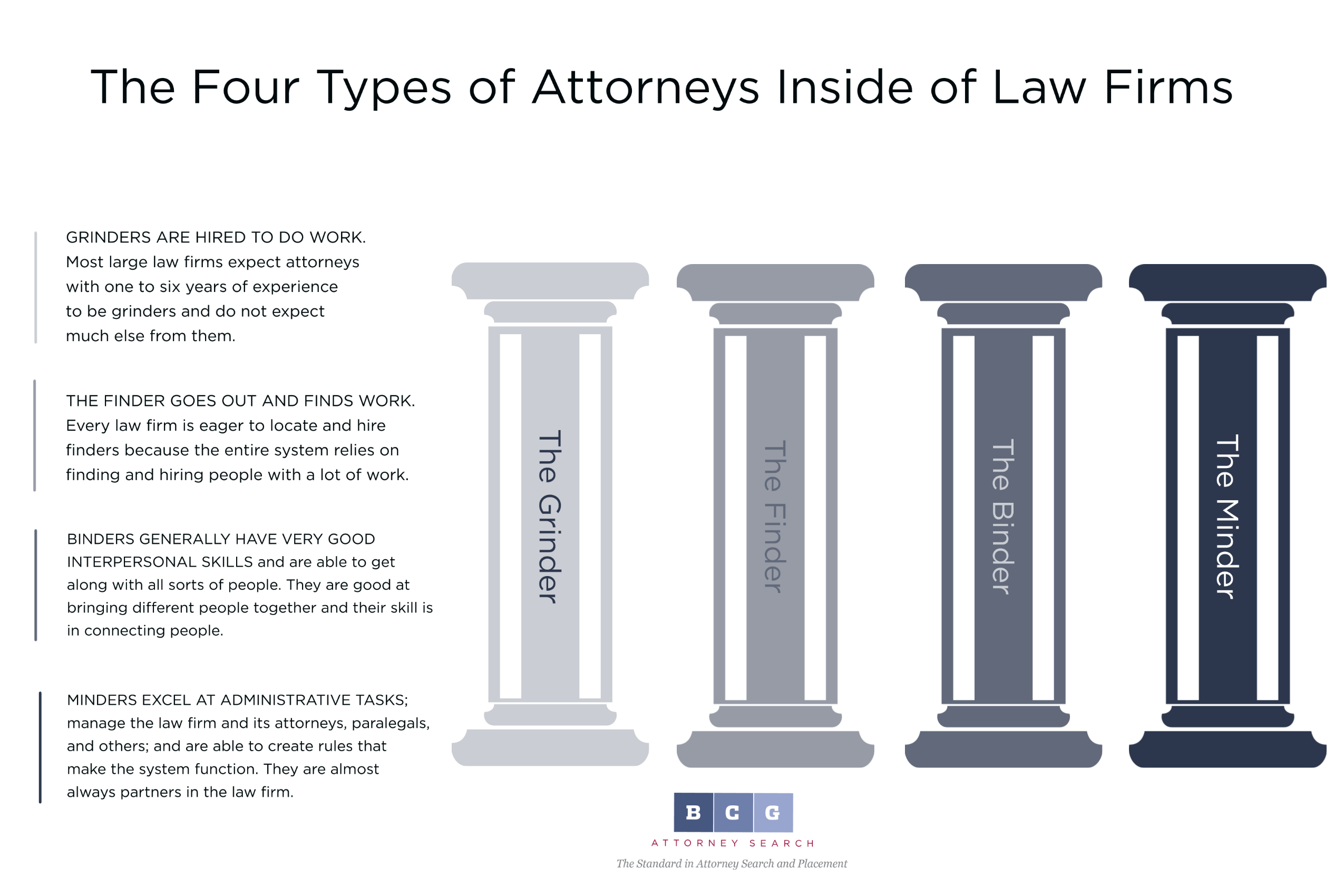
- They are the finder, minder, binder and grinder.
- Read this article to find out which type of attorney you are.
Summary: Knowing which one of the four types of attorneys you are matters a great deal to the future of your legal career.


|
|
|
- Partner with No Business. “I am on a lot of committees for associates and in charge of our associate satisfaction committee. A lot of our partners have always said I do very well helping associates and partners relate to one another.” This partner is what is known as a “binder.” A binder attorney makes sure the firm and various people inside of it (paralegals, associates, partners and others) all get along cohesively. Every firm has attorneys who excel at this.
- Partner with Business. “I brought in $3.7 million in billings last year and originated work for 21 different attorneys in the firm. I am also working on a large matter that I anticipate will generate at least $1.3 million over the next 14 to 16 months.” This sort of attorney is what is known as a “finder” or someone who brings in the business. Finders bring in work that keeps other attorneys in the firm busy and gives work to others to do.
- Associate with No Business. “I have been here for four years and am working extremely hard. I am starting to think that I need to find a job that is less demanding on my time. I rarely see my wife and am in the office every day.” This sort of attorney is what is known as a “grinder.” Grinders compose the majority of associates, service partners and counsel attorneys in most firms.
- Managing Partner of a Law Firm. “It is difficult for me to keep up with the demands of being on several committees and being expected to bill and bring in a certain amount of work. I am constantly doing all sorts of administrative tasks, creating rules and so forth and it is difficult when I am not being compensated for all of the time I am spending on this. I would like to concentrate more on [generating clients, doing legal work, etc.].” This sort of attorney is what is known as a “minder.” Minders are, generally, those who create rules and procedures to make sure that grinders, binders, finders and other staff get along and the firm functions well.
- I have seen grinders reinvent themselves as minders with the same firm because they found they enjoyed administrative work more than grinding out legal work day after day.
- In other cases I have seen attorneys leave large law firms and start entrepreneurial-oriented law firms where all they did was bring in work because they felt the finder role was more suitable for them as opposed to the grinder role.
- I have seen still other attorneys leave large law firms where they were finders or grinders and become mediators (binders) because they enjoyed helping people get along and find common ground.
What will happen to you in your legal career is generally going to be related to what specific type of role you are cut out for. The chances are you already know what role you are best suited for within the legal profession (at least in regards to being a finder, minder, grinder or binder). But even if you know what you want to be there are a whole set of rules that will help you get to where you want to go. Knowing the type of attorney you want to be will tell you things like whether or not you should go in-house, stay in a law firm, go into government, become a judge, teach at a law school and more. I have been thinking about and speaking with all sorts of attorneys my entire career and it is important you understand the sort of work that you should be doing. Knowing the sort of attorney you are now—instead of later—will have a profound impact on your level of happiness practicing law.
One of the biggest mistakes that attorneys make is failing to understand the exact role they play inside of law firms. Different attorneys have different skill sets and are hired, kept around, and let go because the firm has demands for different skill sets at different points in time. When an attorney does not understand and live up to what the law firm expects that attorney to be, trouble often ensues.
As a general rule, a law firm is made up of the following personalities:
The Grinder. Grinders are people who are hired to do work. Someone else is bringing in the business and the law firm generally only wants the attorney to do work and nothing else. Most large law firms expect attorneys with one to six years of experience to be grinders and do not expect much else from them. The attorneys are being hired to do work—and as much as possible. Firms generally want grinders who are young and relatively inexperienced. Usually they are looking for grinders with less than a decade of experience.
Many counsel-level attorneys are hired to be grinders. Many partners are even hired to be grinders if they do a specific type of work that the firm needs done. In general, older “grinder” attorneys have very specific skills that are rare in the market—these skills are generally (but not always) transactional in nature. An attorney trained and proficient in a rare transactional-related skill (intellectual property, real estate finance, corporate-related skills) may be able to get a role as a grinder. (Litigation is not transactional and there are litigators everywhere, which is why it is always harder for older litigator grinders to find work.) Older grinders are generally more marketable in smaller markets where there are not a lot of people like them.
The skill of a grinder is doing a specific type of work that others give to the grinder. The skill is not finding work, generating work, mentoring people, or running the law firm. The law firm generally wants these attorneys to do work and nothing more. They are hired for their skill and ability to do work. Grinders compose the majority of attorneys out there.
There are a couple of rules for hiring law firm grinders:
One way to think about hiring grinders is to try to imagine hiring football players for your professional football team. You could hire players from the best teams with the best stats, or you could hire players from average to poorer teams with not-as-good stats. If you have a lot of money to spend, you are always going to hire the best players you can – and large law firms have a lot of money to spend and will hire the best grinders they can.
Young, Motivated Grinders Are Preferred. Law firms hire grinders based on how much more grinding the attorney appears prepared to do. Will the attorney grind it out for another 5 years trying to reach the brass ring, or has the attorney already given up?
One way to think about the hiring of grinders is like trying to imagine if you were hiring someone for the Navy Seals.
- On the one hand, you could hire someone who is a young, well-conditioned athlete who has never seen a war and is gung-ho.
- On the other hand, you could hire someone who has worked for the Navy for 10 years, worked in multiple jobs, experienced ups and downs, is not fit anymore, is tired and a bit cynical. Soldiers like this have seen friends quit the Navy and have even seen a few casualties. Moreover, they think they know it all and are “more experienced.”
Who would you hire? Would you hire experience? Or would you hire stamina, youth and enthusiasm? Most people would pick the latter. This is exactly how law firms think when they hire grinders.
Law firms like grinders to work very hard. They know that the “shelf life” for an attorney to work extremely hard and not question orders is around 6 to 10 years – and maybe a little bit more or less. They also know that the grinder will be willing to work very, very hard for the prospect of advancement for a limited number of years and with high morale before losing their enthusiasm for hard work.
The Grinder Must Not Question His or Her Role. Law firms want to hire grinders who are going to work hard and follow orders without questioning those orders and without thinking he or she is too good to be a grinder. Firms need grinders to be like soldiers in a well-run army: Unquestioning followers who do what they are told and do what is expected of them.
Law firms have profound problems finding “the best” grinders and this is exactly why it is so difficult for most attorneys to get into good law firms. Not only are all large law firms seeking a certain level of quality from the grinders they hire and a certain level of experience, they are also seeking something else which is very important: That the attorney will do what the attorney is told and not question the attorney’s superiors or the system. The law firm has work coming in the door and it needs it done well and without question. The second the law firm senses that the grinder is questioning the system, or not doing the work well, the attorney will be out. Grinders literally can get “blackballed” if there are obvious signs they are questioning the system by doing things such as:
- Quitting jobs with nothing lined up
- Getting fired
- Switching jobs too much
- Jumping around between practice areas
- Upsetting people they are working for
- Making huge errors
- Bad-mouthing their firms or superiors
- Acting inappropriately outside of work in ways that bring into question their commitment to practicing law
- Speaking out publicly on firm business
- Taking credit for their work publicly if it is done on behalf of a superior
- Publicly questioning or contradicting superiors
These sorts of things are generally unacceptable for attorneys at the “grinder” stage of their careers. Grinders are the foot soldiers doing the work. Regardless how they may feel about their superiors or the practice of law, they are generally required to keep their opinions to themselves.
These attorneys are expected to be “soldiers”. As soldiers, the only thing the law firm cares about is whether or not they do work and how well they do their work. Many grinders believe they need to generate work—but this is simply not the case for all grinders. They may need to generate work at some point in their careers, but if they have no work when they are hired they are almost always being hired based on their abilities as a grinder.
Since the shelf life of a grinder is relatively limited in terms of their marketability (most are only marketable to large law firms in large cities for their first six or seven years of practice—or as long as work is coming in for older grinders), the question naturally arises: What happens to grinders?
My days generally contain several conversations with grinders. I speak with grinders who are getting senior and are getting pushed out, grinders who are junior and frustrated in their grinder roles and attorneys who are partners and made partner despite only being grinders. Being a grinder is a frustrating role.
The ideal scenario for a grinder is to work very, very hard, do good work, impress superiors and clients and find seven or eight years down the line that they are getting referrals for work from all sorts of places. They develop a reputation as being exceptional as grinders. When you do exceptional work and work hard the rewards generally follow.
A talented grinder will also often become indispensable to partners and others in their firm. They will do good work and be seen as someone whom others cannot afford not to have around. Most talented partners with a lot of business always have a hard working, talented grinder partner nearby on whom they rely to do a lot of their technical work.
A second—and more common—scenario for the grinder is to hit a wall. The grinder will be made a service partner, kept an associate, or put in a long-term role as a “counsel” attorney. All of these are fine. There are roles for grinders in each of these scenarios, but they often do not end well. If the work slows down the grinder is often let go. This generally happens at some point and is often unavoidable when there are work slowdowns, consultant “cost cutter and profit maximizers” are hired by the firm, or new management comes into the law firm seeking a bigger slice of the pie.
A third role for a grinder is to go in-house, become a law professor, go into government, find a new law firm to work for that does not require the business, find a role as a minder or binder, or pursue an alternative career.
Every grinder faces tough decisions in their career and it is difficult. The practice of law has many challenges; however, one of the most persistent challenges is related to grinders maintaining continual access to work. There are hundreds of thousands of talented grinders out there who have a very difficult time getting access to work. Without access to work a grinder is in a tough spot.
There are graduates of top law schools and alumni of top law firms all over the country that are barely skimping by, doing odd jobs and cannot find permanent work. Many are contract attorneys running around servicing the same young associates they once were in the same sorts of firms. These people were at one time on top of the world and thought they had bright futures as grinders, but found out too late that this is not enough. Time, an up-or-out culture and more is something that most grinders cannot avoid forever.
The Finder. The finder is someone who goes out and finds work. This is, quite obviously, a very useful thing for law firms to have. Law firms need work coming in. The more work that comes in the better the law firm will do. It is typically easier for law firms to find grinders than it is finders. There are always people willing to do the work—lots of them—but typically not as many willing to feed work to others, which is what finders can do.
Law firms with strong brand names that can attract plenty of grinders will generally always be very hungry for finders. Because there are so many grinders out there, the law firms are far more interested in finders than grinders. Every law firm is always eager to find and hire finders because the entire system relies upon them finding and hiring people with a lot of work.
An attorney with a large, stable book of business generally is always marketable. The larger the book of business, the larger and more prestigious the law firm the attorney can work in.
Finders face numerous problems:
Finders are almost always having their compensation messed with. Because the revenue they generate (via the work they do, or the work other attorneys do) is so crucial to the firm’s ongoing operations, most firms will play all sorts of games with what they do with the money the finder generates. They will slice and dice this money up in a variety of ways that will generally leave the finder with less money than the finder thought he or she would receive. Promises are often made and broken and at the end of the day the finder often gets in various arguments and other conflicts with management about this. Finders are often not happy with their compensation and accordingly will bounce between firms once every several years due to these concerns.
Finders often have inconsistent collections from year to year. Because finders may not always collect the same amount of money from year to year, they often can feel as if their futures and careers are at risk when their business slows down. Their value to the firm is slated widely toward their ability to generate business. When this slows down, their compensation will decline dramatically as well.
Finders will often leave their firms due to conflicts. Sometimes finders will be told they can no longer work for certain clients due to conflicts, or they may be told that they cannot bring in certain clients due to conflicts. This can often be a major source of stress in a finder’s relationship with his or her law firm.
Despite the drawbacks of being a finder, this is a role that most attorneys aspire to.
The Binder. Binders generally have very good interpersonal skills and are able to get along with all sorts of different types of people. They are able to understand both clients and people within the firm very well. They are good at bringing different sorts of people together and their skill is in connecting people. They are the sorts of attorneys in a firm that like to take various people to lunch, make introductions and get people together who might not otherwise come together. Law firms appreciate binders and they serve a role whether or not they have business. Others in the firm generally think very highly of binders because of their unique talent for bringing diverse sets of people together. Binders are also often useful for resolving conflicts within law firms, explaining opposing sides and making sure law firms function cohesively in the face of conflict.
The binder is a unique personality and there are binders everywhere—but they are not all that common. Binders take great joy in introducing different types of people and making connections. Binders also tend to have giant lists of connections and take great pride in making various connections. People also generally like binders a great deal. They are likable because they are trying to make others happy by making connections.
A binder inside of a law firm will generally start revealing him or herself to be a binder relatively early in his or her career. Their ability to connect different types of people often leads to them eventually becoming finders. Alternatively, binders can be promoted through the ranks and are given a “counsel” or similar type of role within a law firm. People like to keep binders around and will help them. They are useful for resolving conflicts the law firm may have with their clients and conflicts a law firm may have within the firm’s own ranks as well.
I know a woman who works for a small hospital chain and is an expert “binder.” Her role is very simple. If someone is injured or hurt in the hospital she goes and meets with the person and the doctor(s) (or others) involved in the injury. She understands the dispute and explains things to both sides in a caring way. She is extremely well compensated for this (hundreds of thousands of dollars a year) and her job is simply to help people upset with each other find common ground.
This sort of job is something that people enjoy and that attorneys can fall into inside of law firms. Law firms fill this role with a variety of people—partners, counsel-level attorneys, or attorneys who do not even practice law anymore. Law firms need these sorts of people – but they generally do not have many of them. Their jobs are always at risk when things get slow as well, or the firm administration changes.
If you are a binder inside of a law firm, you will generally know it and will start gravitating towards positions and functions that take advantage of binder-type abilities and talents. If you cannot find an outlet for this in your existing firm, you may go to another law firm that makes use of this or even transition into something different entirely. Binders make good mediators, judges, arbitrators, human resources professionals, recruiters inside of law firms, and legal recruiters. There are numerous roles for binders in the legal profession. It is often difficult for binders to get established inside of law firms, but it can be done.
Binders also can be exceptional attorneys when they are working with the right sorts of peers.
Minders. Minders are in every law firm. Minders are people who excel at administrative tasks, who manage the law firm and its attorneys, paralegals and others and who are able to create rules that make the system function. Minders are often managing partners, on executive committees and so forth. They are almost always partners in the law firm and they set rules and expectations for the attorneys who are working there. Minders often naturally gravitate towards their roles.
The role of a minder is incredibly important in law firms. They keep the finances managed, the headcount managed and ensure that the attorneys in the firm are hired and fired at the right time. Without strong minders a law firm will not function properly and most law firms that have gone out of business did so because of bad minders. For example, if a law firm promises too much “guaranteed” money to too many finders (regardless of the business they bring in), the law firm could end up collapsing if it cannot meet its obligations (i.e., like Dewey Leboeuf). Poor minders are behind the failure of almost every law firm.
Another word to describe a minder is “bureaucrat.” Minders tend to be bureaucratic in nature and because of this the amount of other work and business they bring in may be limited. Because they are not expected to have as much work, many attorneys without business (or declining business) often try to get into minder roles when they have no business being minders. Most older law firms become overly bureaucratic (like companies) and often have an overly bureaucratic culture that ends up choking profits and innovation.
Most minders become minders after becoming partners because they have leadership skills, are able to get their points across and have sufficient business and authority to generate respect. The role of a minder is something that most attorneys grow into or are picked for.
Attorneys who do not want to be minders inside of law firms often go in-house, or into business. Attorneys who speak of wanting to “work on the business side of things” often sense (or know) that they would be more effective as minders than whatever role they are in. Minders have all sorts of options outside of law firms and often do well in government, in particular, or administrative roles inside of law schools or companies.
You Need to Know Whether You Are a Binder, Minder, Finder, or Grinder. Far too many careers end—either early on, or later in an attorney’s career—because the attorney never understood what role he or she was best suited for. Like all professionals, attorneys function best when they commit themselves to tasks and positions that come naturally to them and they have an aptitude for. This means that attorneys are happiest, most fulfilled, and least likely to have continual career difficulty when they figure out what type of lawyer they are in terms of binder, minder, finder or grinder and follow a career path that places them in those types of positions.
An important point to understand, however, is that you generally cannot become a minder, finder, or binder without first excelling as a grinder. When you are a grinder your job is to go all out, learn everything you can and commit. Only then will you have the opportunity to find your place inside of a law firm. Alternatively, you can decide you do not want to remain a grinder and do something different entirely – in a different setting. Or, you can decide to be a grinder in a different setting where you see more opportunity to become a finder, binder, or minder. The reality is that many massive law firms where you will be a grinder have such high billing rates, such limited client contact and such high thresholds for the sorts of clients they will accept that you may have to leave if you want to become a finder and you are currently a grinder.
Most of the conversations I have with attorneys on a day-to-day basis are with attorneys who do not understand the role they serve inside their law firm and believe—rightly or wrongly—that they should be someone different.
Here are some examples of attorneys I have spoken with recently who are in trouble because they do not understand the role they had been hired for:
- An attorney who has been with a top New York law firm for 10+ years since he was a summer associate and who left to go to the office of another national law firm. He had been working 2,500 hour years most of his career. He got to his new job and was suddenly being given a lot of work and kept busy. He thought that he should be using his “top firm pedigree” to go out and try and generate business. However, he had never had any business before and the only reason the law firm hired him was to work on existing matters they were bringing in. When he got upset with the firm and told them he really could not take so much work because he needed to go out and generate business things did not go well. The attorney and firm ended up parting ways. The attorney has been unemployed for over six months and lost a position paying over $350,000 a year. This attorney was hired to be a “grinder” but thought he should be a finder. He was hired to be a grinder.
- I speak with attorneys weekly who are expected to maintain a certain level of business to remain partners but are failing to do so. To maintain their hours some of these partners have been getting work from other partners, but at some point the work dries up, or slows down, and the attorneys are told to start looking for new jobs. These attorneys were hired to be finders but turned into grinders to save their skin – while the work lasted.
- There are large law firms all over the country that may be shrinking, have management consultants showing up, younger management and so forth that start chopping away at their binders and minders. The binders will say things like “I’ve been the partner in charge of mentoring young associates since I was a young partner here and I have always been complemented for this and appreciated.” This is an example of a firm getting rid of binders because they want more finders. Similarly, partners who spent their career coasting on various compensation and management committees often are faced with newer, younger management teams that look at these partners and see they are not finders or grinders and want them gone. These partners are shown the door.
- Young attorneys call all the time frustrated with hours, lack of meaningful responsibility and complaining about wanting to generate business but not being able to do so. The law firm wants these attorneys to be grinders and not finders.
If you enjoy the practice law as a grinder, the odds are you should stick with it inside of a law firm. The work is the most important thing—and you need to enjoy what you are doing as a grinder. The law, like the practice of medicine, typically requires a significant commitment, long hours and very hard work at the beginning of your career. This is the case for any profession that deals with situations where peoples’ lives and futures are at stake.
However, if you do not enjoy the work and do not like being a grinder and instead find yourself drawn to something else—being a finder, a minder, or a binder—then you probably do not belong in a law firm. Even most talented finders still like the practice of law and doing some work. You need to know what you are and what is important to you. Once you understand the role to which you are best suited, then it will become much easier for you to make decisions about continuing to practice law, or changing your practice setting. For most people the decision is quite easy once they know who and what they are.
About Harrison Barnes
No legal recruiter in the United States has placed more attorneys at top law firms across every practice area than Harrison Barnes. His unmatched expertise, industry connections, and proven placement strategies have made him the most influential legal career advisor for attorneys seeking success in Big Law, elite boutiques, mid-sized firms, small firms, firms in the largest and smallest markets, and in over 350 separate practice areas.
A Reach Unlike Any Other Legal Recruiter
Most legal recruiters focus only on placing attorneys in large markets or specific practice areas, but Harrison places attorneys at all levels, in all practice areas, and in all locations-from the most prestigious firms in New York, Los Angeles, and Washington, D.C., to small and mid-sized firms in rural markets. Every week, he successfully places attorneys not only in high-demand practice areas like corporate and litigation but also in niche and less commonly recruited areas such as:
- Immigration Law
- Workers Compensation
- Insurance
- Family Law
- Trust and Estate
- Municipal law
- And many more...
This breadth of placements is unheard of in the legal recruiting industry and is a testament to his extraordinary ability to connect attorneys with the right firms, regardless of market size or practice area.
Proven Success at All Levels
With over 25 years of experience, Harrison has successfully placed attorneys at over 1,000 law firms, including:
- Top Am Law 100 firms such including Sullivan and Cromwell, and almost every AmLaw 100 and AmLaw 200 law firm.
- Elite boutique firms with specialized practices
- Mid-sized firms looking to expand their practice areas
- Growing firms in small and rural markets
He has also placed hundreds of law firm partners and has worked on firm and practice area mergers, helping law firms strategically grow their teams.
Unmatched Commitment to Attorney Success - The Story of BCG Attorney Search
Harrison Barnes is not just the most effective legal recruiter in the country, he is also the founder of BCG Attorney Search, a recruiting powerhouse that has helped thousands of attorneys transform their careers. His vision for BCG goes beyond just job placement; it is built on a mission to provide attorneys with opportunities they would never have access to otherwise. Unlike traditional recruiting firms, BCG Attorney Search operates as a career partner, not just a placement service. The firm's unparalleled resources, including a team of over 150 employees, enable it to offer customized job searches, direct outreach to firms, and market intelligence that no other legal recruiting service provides. Attorneys working with Harrison and BCG gain access to hidden opportunities, real-time insights on firm hiring trends, and guidance from a team that truly understands the legal market. You can read more about how BCG Attorney Search revolutionizes legal recruiting here: The Story of BCG Attorney Search and What We Do for You.
The Most Trusted Career Advisor for Attorneys
Harrison's legal career insights are the most widely followed in the profession.
- His articles on BCG Search alone are read by over 150,000 attorneys per month, making his guidance the most sought-after in the legal field. Read his latest insights here.
- He has conducted hundreds of hours of career development webinars, available here: Harrison Barnes Webinar Replays.
- His placement success is unmatched-see examples here: Harrison Barnes' Attorney Placements.
- He has created numerous comprehensive career development courses, including BigLaw Breakthrough, designed to help attorneys land positions at elite law firms.
Submit Your Resume to Work with Harrison Barnes
If you are serious about advancing your legal career and want access to the most sought-after law firm opportunities, Harrison Barnes is the most powerful recruiter to have on your side.
Submit your resume today to start working with him: Submit Resume Here
With an unmatched track record of success, a vast team of over 150 dedicated employees, and a reach into every market and practice area, Harrison Barnes is the recruiter who makes career transformations happen and has the talent and resources behind him to make this happen.
A Relentless Commitment to Attorney Success
Unlike most recruiters who work with only a narrow subset of attorneys, Harrison Barnes works with lawyers at all stages of their careers, from junior associates to senior partners, in every practice area imaginable. His placements are not limited to only those with "elite" credentials-he has helped thousands of attorneys, including those who thought it was impossible to move firms, find their next great opportunity.
Harrison's work is backed by a team of over 150 professionals who work around the clock to uncover hidden job opportunities at law firms across the country. His team:
- Finds and creates job openings that aren't publicly listed, giving attorneys access to exclusive opportunities.
- Works closely with candidates to ensure their resumes and applications stand out.
- Provides ongoing guidance and career coaching to help attorneys navigate interviews, negotiations, and transitions successfully.
This level of dedicated support is unmatched in the legal recruiting industry.
A Legal Recruiter Who Changes Lives
Harrison believes that every attorney-no matter their background, law school, or previous experience-has the potential to find success in the right law firm environment. Many attorneys come to him feeling stuck in their careers, underpaid, or unsure of their next steps. Through his unique ability to identify the right opportunities, he helps attorneys transform their careers in ways they never thought possible.
He has worked with:
- Attorneys making below-market salaries who went on to double or triple their earnings at new firms.
- Senior attorneys who believed they were "too experienced" to make a move and found better roles with firms eager for their expertise.
- Attorneys in small or remote markets who assumed they had no options-only to be placed at strong firms they never knew existed.
- Partners looking for a better platform or more autonomy who successfully transitioned to firms where they could grow their practice.
For attorneys who think their options are limited, Harrison Barnes has proven time and time again that opportunities exist-often in places they never expected.
Submit Your Resume Today - Start Your Career Transformation
If you want to explore new career opportunities, Harrison Barnes and BCG Attorney Search are your best resources. Whether you are looking for a BigLaw position, a boutique firm, or a move to a better work environment, Harrison's expertise will help you take control of your future.
Submit Your Resume Here to get started with Harrison Barnes today.
Harrison's reach, experience, and proven results make him the best legal recruiter in the industry. Don't settle for an average recruiter-work with the one who has changed the careers of thousands of attorneys and can do the same for you.
About BCG Attorney Search
BCG Attorney Search matches attorneys and law firms with unparalleled expertise and drive, while achieving results. Known globally for its success in locating and placing attorneys in law firms of all sizes, BCG Attorney Search has placed thousands of attorneys in law firms in thousands of different law firms around the country. Unlike other legal placement firms, BCG Attorney Search brings massive resources of over 150 employees to its placement efforts locating positions and opportunities its competitors simply cannot. Every legal recruiter at BCG Attorney Search is a former successful attorney who attended a top law school, worked in top law firms and brought massive drive and commitment to their work. BCG Attorney Search legal recruiters take your legal career seriously and understand attorneys. For more information, please visit www.BCGSearch.com.
Harrison Barnes does a weekly free webinar with live Q&A for attorneys and law students each Wednesday at 10:00 am PST. You can attend anonymously and ask questions about your career, this article, or any other legal career-related topics. You can sign up for the weekly webinar here: Register on Zoom
Harrison also does a weekly free webinar with live Q&A for law firms, companies, and others who hire attorneys each Wednesday at 10:00 am PST. You can sign up for the weekly webinar here: Register on Zoom
You can browse a list of past webinars here: Webinar Replays
You can also listen to Harrison Barnes Podcasts here: Attorney Career Advice Podcasts
You can also read Harrison Barnes' articles and books here: Harrison's Perspectives
Harrison Barnes is the legal profession's mentor and may be the only person in your legal career who will tell you why you are not reaching your full potential and what you really need to do to grow as an attorney--regardless of how much it hurts. If you prefer truth to stagnation, growth to comfort, and actionable ideas instead of fluffy concepts, you and Harrison will get along just fine. If, however, you want to stay where you are, talk about your past successes, and feel comfortable, Harrison is not for you.
Truly great mentors are like parents, doctors, therapists, spiritual figures, and others because in order to help you they need to expose you to pain and expose your weaknesses. But suppose you act on the advice and pain created by a mentor. In that case, you will become better: a better attorney, better employees, a better boss, know where you are going, and appreciate where you have been--you will hopefully also become a happier and better person. As you learn from Harrison, he hopes he will become your mentor.
To read more career and life advice articles visit Harrison's personal blog.