
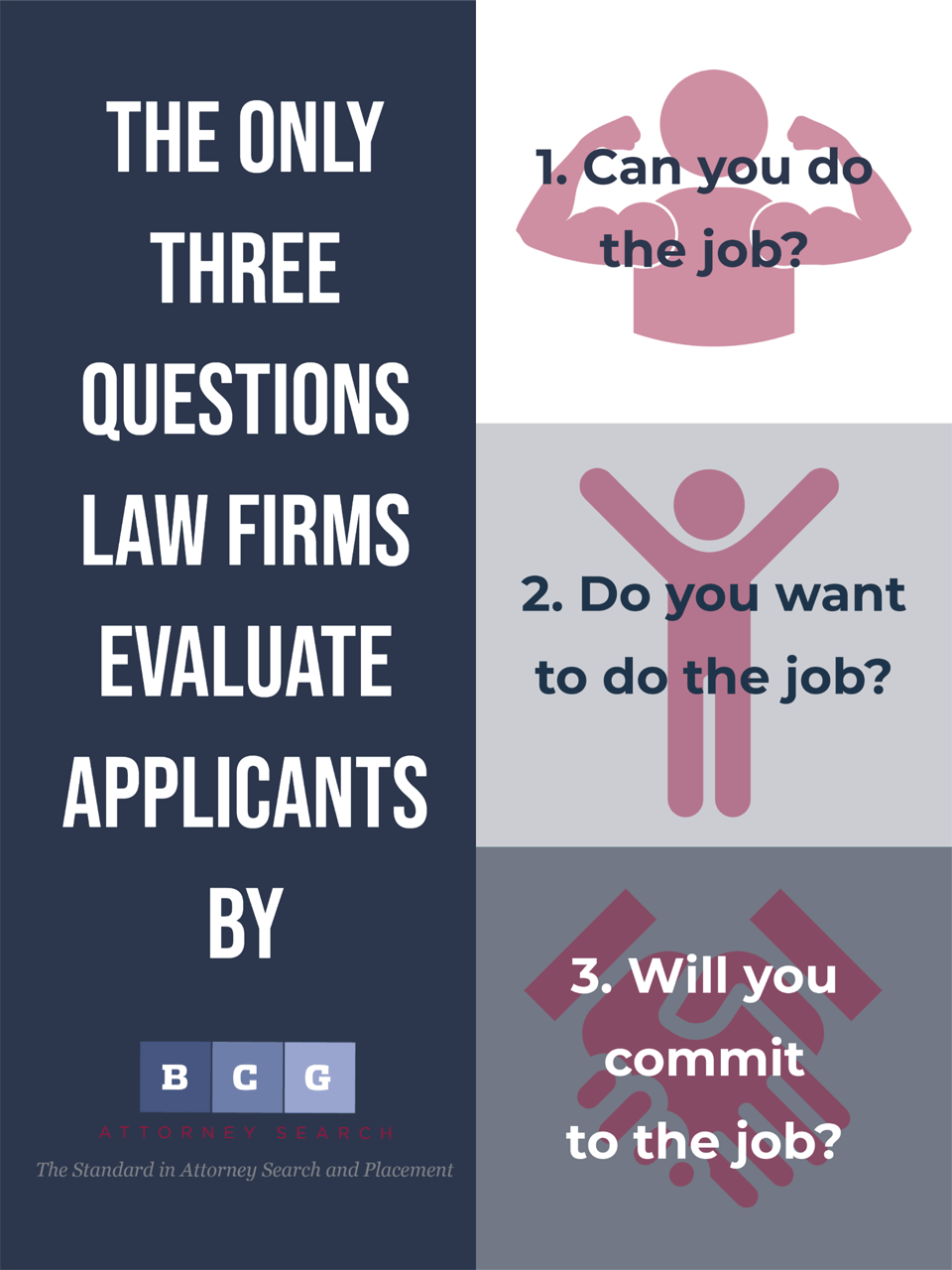
- Can you do the job?
- Do you want to do the job?
- Will you commit to the job?
Summary: A law firm is only concerned with these three questions when they evaluate applicants. Learn more about these three questions below:

1. Can you do the job?
2. Do you want to do the job?
3. Will you commit to the job?

|
| Harrison Barnes |
Ultimately, everything comes down to these three questions. If you convince an employer that the answer to these three questions is "YES," you can get any job you apply for. If the answer to two of them is "YES," you might get the job. Most attorneys never get all three answers as "YES," which is why it is so difficult to get jobs in competitive law firms. These three questions are all that a law firm is asking when it reviews your resume and talks to you.
It AMAZES ME that so few attorneys understand the importance of these three questions. Very few attorneys understand just how important these three questions are, and they continually blow their job search time because they do not understand them. If you are an unemployed attorney, you are unemployed because these questions are being answered improperly.
Regardless of your background, understanding how to frame yourself in response to these three questions is the key to succeeding in any job search. It is the key to longevity in the legal profession and getting started in the first place.
Can You Do The Job?
One of the most frustrating things for me in working with candidates is speaking with people who have the skills to do a certain job, but I know they will never be able to do it.
Many people can do the work the job requires, but very few people can truly do the job. People always come to me stating they have the experience or skills to do a certain job, and this does not mean they can do it.
A. You Can Only Do the Job if You Fit in.
A few weeks ago, I spoke with a firm patent attorney who was unemployed. She was African-American from a poor, urban background, had an electrical engineering degree from a top engineering school, and had gone to an Ivy League law school. She was very monotone on the phone with me, disconnected from the conversation, and not easy to speak with.
"Listen," I told her. "I'm sensing some hostility from you, and I am not sure why. I need to represent that you will be able to go into a law firm, fit in, and get along with people, and I cannot do that if I cannot relate to you."
"I have the education and skills to do the work," she said. "That is all that matters. Your job is to speak with me and then forward my resume to the employer, and that is it."
This attitude is a real career stopper and something I see more and more people expect because they have the skills and qualifications to do a job they will be hired for. I have news: THIS DOES NOT MATTER. THIS IS OFTEN THE LEAST IMPORTANT THING. People hire people (1) they like, (2) can get along with, (3) bring positive energy to the office, and more. They do not care what race you are; they care about how YOU MAKE THEM FEEL and whether they are comfortable around you.
I have repeatedly seen throughout my career that education and experience are not always enough to succeed. Being social, getting along with others, etc., can be just as important. It is upsetting that this ends so many careers, and I am 100% for the underdog and helping people.
When I was in college, I grew up in Detroit, where I started and managed a company that employed low-income people who had never worked. I want to help people. However, you cannot help people when they think it is all about the job and not getting along with others. The only people who cannot be helped are those who expect a job because they have the education or skills, and it does not work that way.
- See Also: You Need Relationships Before Transactions for more information.
I did not work with her because I knew she would have a tough time getting a position wherever a woman went. It is not just about the skills. It is about much, much more. Being able to do the job means getting along with co-workers, connecting with people, being pleasant in the office, and more. It is not just about skills and experience.
I looked up at the woman after our call. I saw that she had sued her former law firm for racial discrimination (and lost) and filed several other questionable lawsuits, including one against a hair salon for racial discrimination because they served a white customer before her. The woman was angry and would most likely cause trouble. As much as I wanted to help her, I knew she could not do the job.
See how the “big three” questions appear in practice in our full guide to 50 law firm interview questions.
A topic that has fascinated me for some time is discrimination in the legal profession. People who may not necessarily fit in all environments, whether because of their race, sexual orientation, or religion, often have difficulty getting hired by large law firms. This is not always the case, but it usually is, and I have often wondered why.
I have always wondered: "Is it discrimination? Or is it something else?" Here are some things I have observed:
- Suppose someone is an upper-middle-class African-American who fits in well and makes friends wherever they go. In that case, they have an EASIER time getting hired than a non-minority with similar qualifications. If they are from a lower-middle class background and cannot connect with others, they have an IMPOSSIBLE time getting hired.
- Suppose someone is an upper-middle class ultra-Orthodox Jew (with a beard and in a traditional all-black wardrobe with a top hat and so forth) who has a good personality and is easy to get along with. In that case, they will generally face some discrimination among various firms but may have an EASIER time getting a position with a firm that has several Jews in it. (They are, however, likely to face more discrimination than an African-American who is easy to get along with in most firms.) If the Orthodox Jew is very separatist and does not associate or want anything to do with non-Orthodox Jews, they have an impossible time getting hired.
- Suppose someone is gay, is easy to get along with, and does not make an issue; they generally have no specific problems with getting hired. If someone is flamboyantly gay and makes an issue of their gayness everywhere they go (and stands out with their extreme dress and grooming habits), they will have a challenging time getting hired.
When I have thought about it this way, the answer to the question "Is there discrimination inside law firms?" becomes far less clear. Law firms are groups of people coming together for a common purpose. As a group of people, they want to surround themselves with people they like and who like them. All they want is:
- People with whom they will be able to work but who can potentially be their friends, acquaintances, and others.
- People they are going to be able to trust.
- People that are not going to sue them or create problems.
- People that will be part of their social dynamic.
- People are not going to spread negative news about them.
The most critical component of being able to do the job is fitting in and getting along with your co-workers. Of course, the "fitting in" part goes further.
- Some firms are composed of conservatives. Other firms are composed of liberals.
- Some firms are composed of good-looking, slim people. Others—are overweight people.
- Some firms are composed of people of one religion.
- Some firms are composed primarily of women and others of men.
- Some firms are composed of people who like to cut corners, and other firms have people who would never cut corners.
- See Also: Firm Culture Matters Most for more information.
Regardless of what "fitting in" means, you need to fit in to do the job, and there is no question about it. To fit in, you need to find employers with similar values as you and who you identify with.
- See Also: The Importance of Fitting In for more information.
B. You can only do the job if you are willing to play by the rules of the employer
Different employers have different "games" they play. Whatever the game is, you need to play by it. Some law firms may demand incredible hours from the people working there and want the job to be your only reason for existing. If this is the case, the law firm interviewing you or evaluating your resume will look for any sign that you do not share this passion for the job.
- If you are a woman, and they sense you want to have kids and leave at some point, they will likely not be interested.
- If you are a man, and they see you have a lot of outside interests that consume your time, they will likely not be interested.
- They will likely not be interested if you seem headstrong and start talking about how you are willing to work hard for the proper compensation.
Playing by the rules of the employer means many different things, but all employers are asking are (1) can you be controlled, (2) will you follow, and (3) will you do what is required?
One of the most common sights in the legal world is the young male attorney who has gone to great schools, done well, and received many accolades for his impressive accomplishments. These people go into law firms with high expectations for themselves and beliefs about the need for immediate advancement. I speak with people like this all the time.
One of the common types of attorneys I have been seeing a lot of lately are young white men from top law schools who spent a few years as litigators at major American law firms. They left these firms, declaring "there is not enough money and responsibility" and that they now want to be personal injury/mass tort attorneys making millions.
They come to me expecting the doors of law firms to open to them because of their ambition to be rich and powerful. They believe that attending an excellent law school and working in a good firm makes them a "catch."
- See Also: Top Ten Interview Questions for more information
While I do not work with these attorneys, I counsel them often because, whether they realize it or not, THEY ARE IN CRISIS like the African-American woman I discussed earlier. I try and work them through this because they have gone off the rails. In many cases, they get interviews with various personal injury attorneys and are astonished to learn that the salaries in these firms are often one-third (if that) of what they would make in a large law firm.
The law firms, however, rarely make offers because the full-of-themselves attorneys always say something like: "I'm happy to go to work here. However, I will need significant responsibility immediately, and I want to be paid commensurate with my contribution to each recovery."
- See Also: Interviewing Tips for more information
This person cannot do the job. The law firm has no interest in this nonsense. Instead, the person who gets hired (and is likely to become successful) will be the person who puts their head down and works hard and does not have attitude and entitlement issues. The attorney with a big firm background is not a catch; they are a "problem."
C. Is your background what the firm needs?
When an employer looks at your resume, they want to see whether you have the requisite education, skills, and experience to do the work. Are you "qualified" to do the work that they have? If you have experience in a given practice area and look strong enough, then the odds are you can do the job.
However, being "qualified" for a job means different things to employers. Being "qualified" to work in a neighborhood law office means something entirely different than being qualified to work in a major law firm. No matter how you spin it, you may not have the qualifications for certain jobs.
- Many law firms will not look at people from certain law schools.
- Other law firms will not look at people unless they have met certain grade cutoffs.
- Some law firms will not be interested in you unless you are from a certain firm.
- Some law firms require you have very narrowly-defined experience.
While most of this is self-explanatory, it is important. Concerning the firm you are coming from, most law firms take this extremely seriously. Because they may have had a few goods or bad experiences with people who were trained (and socialized) by a given firm, they often favor or disfavor people from certain firms.
- See Also: Top 10 Ways Attorneys Can Move to a Better Law Firm and Get a Better Attorney Job for more information.
Every legal employer wants to see whether you can do the job you are asked to do.
After all, if you have passed the bar and are working in a given practice area, the odds are pretty good that you can do whatever the job is.
D. Are you willing to do everything the job requires?
I know an attorney who quit a job as a partner of a large law firm to work in-house with a large company. The first few weeks he was at work, he was given some papers to file with the Securities and Exchange Commission. The documents were inaccurate and were being filed to keep the firm's stock price up. When he spoke with his superiors, he was told, "This is what we have always done and been asked to do." He went to see the company's CEO about it and was fired.
He filed a lawsuit and spent the next few years looking for a job before he finally landed something in a small law firm. I am not saying you need to break the law, but specific jobs have requirements that you might not like.
- Some firms expect you to work every weekend.
- Other firms expect you to generate business quickly.
- Other firms require you to travel a lot.
- Other firms require you to go to client dinners each week.
- Some firms need you to go drinking with people from the firm frequently.
- See Also: A Message to Garcia and Your Career for more information.
Whatever the requirements of the job are, you need to do them. Firms are evaluating whether you can meet these requirements constantly.
One of the most frequent things I see is law firms that have notoriously demanding or difficulty getting along with partners. These people are often impossible to handle and require a certain type of person to have the skill to work with them. Thus, certain people need to be particularly strong-willed to work with certain people.
Do You Want to Do the Job?
Many people apply for jobs they do not want to, and it is exceedingly common for people to apply for jobs they may be perfectly qualified for but do not want to. One of the most common calls that recruiters receive is from attorneys who may be 20+ years out of law school, not making a ton of money, and are interested in working as first-year associates in major law firms for the first year's salaries.
While the point of this article is not to digress into the numerous reasons this could never work, one of the main reasons is that no 20+ year attorney wants to do first-year grunt work and take orders from someone younger and less experienced than them. Regardless of what comes out of their mouth, they simply do not want to do that job, and every employer knows it.
Law firms are smart and only want to hire people who want to do the job. When you start having conflicting things on your resume that suggest you do not want to do the job, law firms take notice, and they want nothing to do with you:
- Extended time off
- Going in-house
- Going to work for the government
- Frequent moves on your resume
The list of things that suggest you might not want to do the job could be endless. The point is that anything that means you are not interested in the job is not good.
- See Also: The #1 Attorney Career Killer that Attorneys Are Never Taught for more information.
What demonstrates someone wants to do the job is an interest and commitment to the subject matter and work they are doing. Attorneys who generate a lot of business are generally interested in the subject matter. Attorneys who do a lot of writing, speaking, and so forth are usually interested in the subject matter. Attorneys with a good reputation among other attorneys for doing good work and trying hard are generally interested in the subject matter.
People who truly want a job will act much differently than someone who does not want the job. They go into interviews enthusiastic and fired up. They ensure they are applying to numerous jobs, not just a few. An interview is a test to see how much you want the job. If you go in and do not give 100% and convince the employer that is where you want to be and what you want to do, it will be difficult for you to get the job.
Attorneys quite often "slip up" when it comes to convincing employers that they want the job. They say inappropriate things or give employers the impression that they do not want to work there. One of the worst and most discouraging things that can happen to employers is for them to extend an offer to someone and have the person turn the offer down. Law firms do not like this at all. They want to believe that they are your first choice and that you are someone who truly wants to work for them.
Early in my recruiting career, I noticed that the best and most desirable candidates would often approach me for exceptional help. Law firms were not eager to interview them. These were people in hot practice areas, from top law schools, and working at leading law firms. The law firms would often not respond favorably when I tried to get them interested in one of these stellar candidates. In contrast, there would be a virtual "feeding frenzy" for people with slightly lesser qualifications. Why the difference? To understand how to tailor your preparation around what firms truly evaluate, explore Why Following BCG’s System Gets You Interviews—and Hired, which explains how BCG’s proven framework aligns with these evaluation questions.
If someone has stellar qualifications, the law firms are all a little self-conscious and think: "Why would they be interested in us?" They believe the exact attorney is more likely to be interested in another firm. The law firm must be convinced that the attorney wants the job and to work for them.
You always need to convince employers that you want to do the job. Anything less than showing full commitment to the work will harm your chances of getting the job. You have to want to do the job.
Will You Do the Job Long Term?
One of the most perplexing things about being a recruiter is my frequent encounters with graduates of Yale Law School and the cold reception, so many of them receive in the market. This may seem counter-intuitive because, as everyone knows, Yale is the top law school in the United States and the people who come out of it are very, very smart. The cast of graduates who have come out of the school is nothing short of astonishing for their success, whether in politics, business, or academia.
- For a deeper dive into strategies for hiring attorneys who are committed to staying long-term, check out Commitment Matters: How to Hire Attorneys Who Will Stick Around.
And that is the problem. Most graduates of Yale Law School, in my experience, do not want to practice law forever. They are interested in doing something else. Generally, this might include politics, academics, business, writing, or a host of other areas. The problem is that most of them ARE NOT interested in working in a large law firm, and law firms can tell this from the variety of activities on their resume not related to practicing law. They may show up for interviews and carefully look over the employer to gauge their interest in the employer; however, more often than not, intelligent employers do not bite. The reason is because they know the person does not want to do the job for very long.
- See Also: In Defense of Long Term Employment with a Single Employer for more information.
This is a huge question and an important one. Employers are looking to hire people they believe will stay in the job and be there throughout their careers. If there is anything that suggests you are not likely to remain with the employer throughout your career that the employer picks up on, you will harm your chances of getting a job. It is risky for any employer to hire someone not likely to stick around. Understanding what law firms seek is useful, and for why firm employment can be more rewarding than going solo, refer to What Makes Working in a Law Firm Better Than Being a Solo Practitioner?.
- If someone lives in another area of the country, employers will always be nervous about whether the person will stay there "long term." People from a given area of the country are more likely to be trusted to remain there than people relocating.
- If you give employers any indication that you have plans to do anything with your career other than continue to practice law, then they are unlikely to be interested in you. If you tell the employer that you hope to one day do something else, they are unlikely to be interested in you.
- If an employer believes you are incredibly wealthy or come from a wealthy background, they often think this is an indicator you will not do the job long-term. Why would someone rich want to stick around for an extended period in a grueling work environment?
- Women that look like they are going to leave to raise families are also a group that looks like they might not do the work long term.
- People who move between jobs frequently also look like they will not do the work long-term. There are often reasons for these moves that make perfect sense; however, employers know that if the person has several activities and does not stay in jobs long, they are likely to do this with them.
- People with outside interests that look like they could become "all consuming" are also people who do not look like they would be likely to stick around.
- People who want to switch practice areas look conflicted and like they would leave.
- People have left law firms to teach, go in-house, or work for the government. It does not look like they will be around for long.
- People who have taken extended time off do not look like they will stick around.
- People in second careers with a lot of power and responsibility in earlier positions may leave due to the lack of commitment or change in title.
- People that could work in a better firm if the economy or something else was different will likely leave when things change.
- People only in a given area of the country, due to a spouse or circumstances beyond their control, may relocate again.
- People fired from their last job are more likely to "fire" their new employer because they often have residual anger.
- People that could make more money with a different employer may not stick around.
- People that have the personality or other problems will likely not last.
- See Also: 6 Things Attorneys and Law Students Need to Remove from their Resumes ASAP if They Want to Get Jobs with the Most Prestigious Law Firms for more information.
Law firms prefer hiring people they know are committed to working for them and are unlikely to go elsewhere. If the person has a home and mortgage, is committed to a given geographic area, and people know they are committed to practicing law in a law firm, then their odds of getting hired are significantly increased.
Law firms are risk averse and have no interest in hiring people who will just be there for the short term. They want every hire to work out for the long term, hopefully. This is part of the game they play when interviewing people; your job is to make employers think you will stay.
Conclusions
These three questions are the most critical component of any job search, and your job is to convince employers that you are the right person for the job. The success or failure of any job depends on the answers to these questions.
Click here to contact Harrison
About Harrison Barnes
No legal recruiter in the United States has placed more attorneys at top law firms across every practice area than Harrison Barnes. His unmatched expertise, industry connections, and proven placement strategies have made him the most influential legal career advisor for attorneys seeking success in Big Law, elite boutiques, mid-sized firms, small firms, firms in the largest and smallest markets, and in over 350 separate practice areas.
A Reach Unlike Any Other Legal Recruiter
Most legal recruiters focus only on placing attorneys in large markets or specific practice areas, but Harrison places attorneys at all levels, in all practice areas, and in all locations-from the most prestigious firms in New York, Los Angeles, and Washington, D.C., to small and mid-sized firms in rural markets. Every week, he successfully places attorneys not only in high-demand practice areas like corporate and litigation but also in niche and less commonly recruited areas such as:
- Immigration Law
- Workers Compensation
- Insurance
- Family Law
- Trust and Estate
- Municipal law
- And many more...
This breadth of placements is unheard of in the legal recruiting industry and is a testament to his extraordinary ability to connect attorneys with the right firms, regardless of market size or practice area.
Proven Success at All Levels
With over 25 years of experience, Harrison has successfully placed attorneys at over 1,000 law firms, including:
- Top Am Law 100 firms such including Sullivan and Cromwell, and almost every AmLaw 100 and AmLaw 200 law firm.
- Elite boutique firms with specialized practices
- Mid-sized firms looking to expand their practice areas
- Growing firms in small and rural markets
He has also placed hundreds of law firm partners and has worked on firm and practice area mergers, helping law firms strategically grow their teams.
Unmatched Commitment to Attorney Success - The Story of BCG Attorney Search
Harrison Barnes is not just the most effective legal recruiter in the country, he is also the founder of BCG Attorney Search, a recruiting powerhouse that has helped thousands of attorneys transform their careers. His vision for BCG goes beyond just job placement; it is built on a mission to provide attorneys with opportunities they would never have access to otherwise. Unlike traditional recruiting firms, BCG Attorney Search operates as a career partner, not just a placement service. The firm's unparalleled resources, including a team of over 150 employees, enable it to offer customized job searches, direct outreach to firms, and market intelligence that no other legal recruiting service provides. Attorneys working with Harrison and BCG gain access to hidden opportunities, real-time insights on firm hiring trends, and guidance from a team that truly understands the legal market. You can read more about how BCG Attorney Search revolutionizes legal recruiting here: The Story of BCG Attorney Search and What We Do for You.
The Most Trusted Career Advisor for Attorneys
Harrison's legal career insights are the most widely followed in the profession.
- His articles on BCG Search alone are read by over 150,000 attorneys per month, making his guidance the most sought-after in the legal field. Read his latest insights here.
- He has conducted hundreds of hours of career development webinars, available here: Harrison Barnes Webinar Replays.
- His placement success is unmatched-see examples here: Harrison Barnes' Attorney Placements.
- He has created numerous comprehensive career development courses, including BigLaw Breakthrough, designed to help attorneys land positions at elite law firms.
Submit Your Resume to Work with Harrison Barnes
If you are serious about advancing your legal career and want access to the most sought-after law firm opportunities, Harrison Barnes is the most powerful recruiter to have on your side.
Submit your resume today to start working with him: Submit Resume Here
With an unmatched track record of success, a vast team of over 150 dedicated employees, and a reach into every market and practice area, Harrison Barnes is the recruiter who makes career transformations happen and has the talent and resources behind him to make this happen.
A Relentless Commitment to Attorney Success
Unlike most recruiters who work with only a narrow subset of attorneys, Harrison Barnes works with lawyers at all stages of their careers, from junior associates to senior partners, in every practice area imaginable. His placements are not limited to only those with "elite" credentials-he has helped thousands of attorneys, including those who thought it was impossible to move firms, find their next great opportunity.
Harrison's work is backed by a team of over 150 professionals who work around the clock to uncover hidden job opportunities at law firms across the country. His team:
- Finds and creates job openings that aren't publicly listed, giving attorneys access to exclusive opportunities.
- Works closely with candidates to ensure their resumes and applications stand out.
- Provides ongoing guidance and career coaching to help attorneys navigate interviews, negotiations, and transitions successfully.
This level of dedicated support is unmatched in the legal recruiting industry.
A Legal Recruiter Who Changes Lives
Harrison believes that every attorney-no matter their background, law school, or previous experience-has the potential to find success in the right law firm environment. Many attorneys come to him feeling stuck in their careers, underpaid, or unsure of their next steps. Through his unique ability to identify the right opportunities, he helps attorneys transform their careers in ways they never thought possible.
He has worked with:
- Attorneys making below-market salaries who went on to double or triple their earnings at new firms.
- Senior attorneys who believed they were "too experienced" to make a move and found better roles with firms eager for their expertise.
- Attorneys in small or remote markets who assumed they had no options-only to be placed at strong firms they never knew existed.
- Partners looking for a better platform or more autonomy who successfully transitioned to firms where they could grow their practice.
For attorneys who think their options are limited, Harrison Barnes has proven time and time again that opportunities exist-often in places they never expected.
Submit Your Resume Today - Start Your Career Transformation
If you want to explore new career opportunities, Harrison Barnes and BCG Attorney Search are your best resources. Whether you are looking for a BigLaw position, a boutique firm, or a move to a better work environment, Harrison's expertise will help you take control of your future.
Submit Your Resume Here to get started with Harrison Barnes today.
Harrison's reach, experience, and proven results make him the best legal recruiter in the industry. Don't settle for an average recruiter-work with the one who has changed the careers of thousands of attorneys and can do the same for you.
About BCG Attorney Search
BCG Attorney Search matches attorneys and law firms with unparalleled expertise and drive, while achieving results. Known globally for its success in locating and placing attorneys in law firms of all sizes, BCG Attorney Search has placed thousands of attorneys in law firms in thousands of different law firms around the country. Unlike other legal placement firms, BCG Attorney Search brings massive resources of over 150 employees to its placement efforts locating positions and opportunities its competitors simply cannot. Every legal recruiter at BCG Attorney Search is a former successful attorney who attended a top law school, worked in top law firms and brought massive drive and commitment to their work. BCG Attorney Search legal recruiters take your legal career seriously and understand attorneys. For more information, please visit www.BCGSearch.com.
Harrison Barnes does a weekly free webinar with live Q&A for attorneys and law students each Wednesday at 10:00 am PST. You can attend anonymously and ask questions about your career, this article, or any other legal career-related topics. You can sign up for the weekly webinar here: Register on Zoom
Harrison also does a weekly free webinar with live Q&A for law firms, companies, and others who hire attorneys each Wednesday at 10:00 am PST. You can sign up for the weekly webinar here: Register on Zoom
You can browse a list of past webinars here: Webinar Replays
You can also listen to Harrison Barnes Podcasts here: Attorney Career Advice Podcasts
You can also read Harrison Barnes' articles and books here: Harrison's Perspectives
Harrison Barnes is the legal profession's mentor and may be the only person in your legal career who will tell you why you are not reaching your full potential and what you really need to do to grow as an attorney--regardless of how much it hurts. If you prefer truth to stagnation, growth to comfort, and actionable ideas instead of fluffy concepts, you and Harrison will get along just fine. If, however, you want to stay where you are, talk about your past successes, and feel comfortable, Harrison is not for you.
Truly great mentors are like parents, doctors, therapists, spiritual figures, and others because in order to help you they need to expose you to pain and expose your weaknesses. But suppose you act on the advice and pain created by a mentor. In that case, you will become better: a better attorney, better employees, a better boss, know where you are going, and appreciate where you have been--you will hopefully also become a happier and better person. As you learn from Harrison, he hopes he will become your mentor.
To read more career and life advice articles visit Harrison's personal blog.