
- Even if you’ve landed your dream job, giving notice at your current job might be an awkward and unpleasant experience.
- You might experience guilt or feel as if you’re betraying your current employer.
- Well, it’s time you get over that, especially as your dream job waits for you.


|
| Harrison Barnes |
You have just landed a job, and you are experiencing the elation of finally achieving your goal to get the perfect position at an exciting firm. Suddenly, you feel the onset of anxiety upon realizing that you face new challenges, excitement, and uncertainty. The one immediate challenge is that you still have to tell your present employer that you are leaving. You may feel guilty, deceitful, and disloyal. You may feel like a spouse who cheats, like a trusted confidant who reveals secrets, like a dependable accountant who doctors the books, or like a faithful deacon who dips his hands into the Sunday donation basket. Enough already! You have been concentrating on getting the position you were seeking, so much that you have postponed planning your exit. Get past the guilt, and strategize as to whom, how, and when you will give notice that you are leaving.
When you are on the verge of a life-changing decision, it is easy to look forward and forget to tie up the details of the situation you are leaving. It is important, however, to take the time to wrap up your prior situation appropriately and professionally before moving on.
1. Whom to tell first?
We suggest that you prepare a short letter of resignation to deliver to the head of your practice area, and that should be delivered in person. You should then tell each and every attorney with whom, and for whom, you work. Remember that news travels fast. Make sure you have several hours to "make the rounds," and try not to leave out any attorney who would be hurt to hear the news from anyone but you personally. You may have had a cordial and perhaps very personal, yet professional relationship with your fellow associates and partners. In that case, you should make sure to tell these people how they helped your career, that you will miss seeing them on a daily basis, and that you plan to keep in touch.
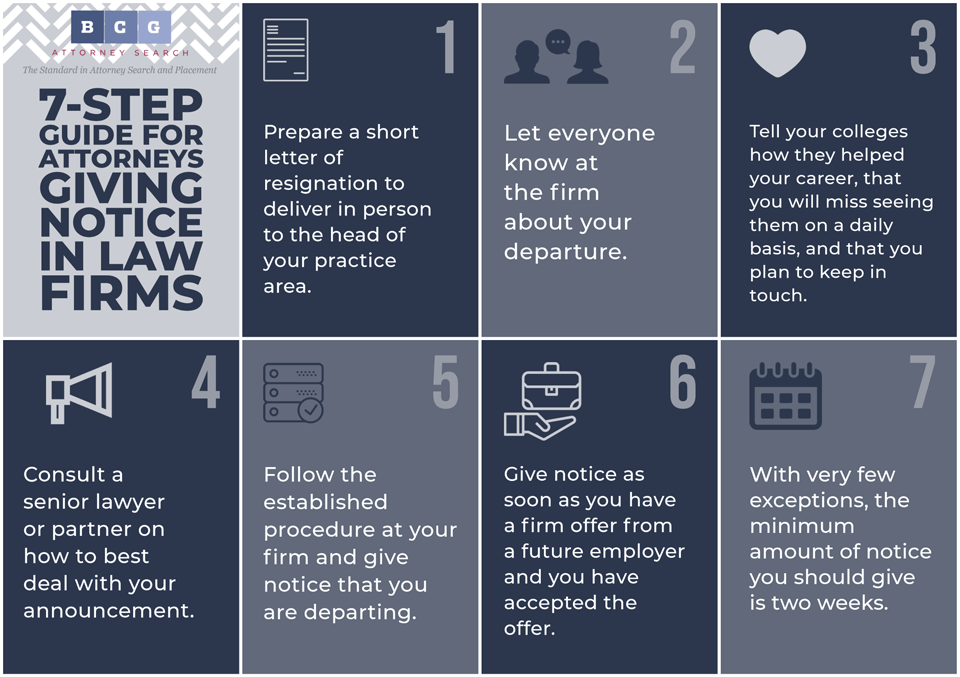
If you have any question as to how to announce your departure, ask a senior lawyer, preferably a partner, how to best deal with your announcement. He/She will feel obliged to give you the appropriate advice that depends on the culture of the firm and your distinct circumstance so that you can proceed tactfully in making your exit from the law firm. Once you have told someone that you are leaving, the news will move like the speed of sound or, with the advent of email, light. You should then follow the established procedure at your firm and give notice that you are departing. In that regard, you must ascertain the length of time you will stay at the firm before you finally depart.
There are several factors to consider when giving notice. First and foremost, you should preserve the positive view that your current employer has of you. At a minimum, you should approach a senior associate or partner with whom you have worked and have had a pleasant rapport and cement your relationship and get a firm commitment from him/her that he/she will provide you with terrific references in the future. Tell him/her that you have enjoyed working with him/her, that you admire his/her ability, and that the reason you are leaving has nothing to do with him/her, but rather it is because of your unique personal situation or some other informative, yet truthful, reason about the firm. He/She undoubtedly will be helpful and encouraging to you and, in most cases, will be honored to provide you with solid recommendations if the need ever arises.
On the contrary, you may have had a strained association and had dreamt about the day when you . . . Stop! Do not burn your bridges. The offer you have just received may be contingent upon your providing good references. Even if the offer has no conditions, don't forget that your past employers will act as your future references. An unfavorable or mediocre reference could be the reason an employer decides not to extend you an offer. Also, most partners at established law firms know their compatriots at other law firms. Even though it is illegal in some states to divulge more than your dates of employment and salary history, if your former employer is left with a bad taste in his/her mouth, unflattering information may likely be communicated about you through the grapevine. Even if you worked in the most awful of circumstances, resist the temptation to tell off your former partner. It could very well come back to hurt you.
As much as possible, avoid saying anything offensive or derogatory about the firm. People do not like to be reminded how awful or dead-end, whether or not accurate, the place had been. Do not forget that they are staying behind, while you chart a fresh course for your career. Simply, reinforce your bond with your colleagues and move on.
2. How long should I endure the unemotional goodbyes?
The next step is to determine how long of a notice you should give. The operative word here is should and not want. With very few exceptions, the minimum amount of notice you should give is two weeks. If your practice group is very busy and your leaving will jeopardize the proper and adequate representation of the clients you serve, you should give more than two weeks' notice and explain to your future employer the circumstances that you find yourself under. Your future employer will, in most cases, understand your predicament because the employer can foresee itself in a similar situation. Plus, this is yet another chance for your future employer to see how conscientious and professional you are in representing your clients.
Only under extremely rare circumstances should you feel that you can give less than two weeks' notice. In such exceptional situations, you can try to subtly suggest to your present employer your preference to leave with less than two weeks' notice. For example, if you have not been given any assignments lately and have no or very little billable work and the firm can readily have someone else take over the handling of the matters assigned to you, you may delicately persuade the firm that it makes business sense for you to leave with less than two weeks' notice. If your intimation is snubbed or scoffed at, however, you must prepare to work the entire two weeks.
There are circumstances when your current employer may be more enthusiastic, and hopefully not ecstatic, for you to leave with less than two weeks' notice. Let's say you are leaving your firm and have accepted an in-house attorney position, and in that capacity, you may have authority to retain outside counsel. Most firms will likely send you off with catered lunch from Spago or Nobu Café or at a minimum buy you an expensive lunch and be more sympathetic to bidding you farewell with less than two weeks' notice. Most people, however, leave a firm to accept a position with yet another firm. In such a case, you simply have no choice but to give, at a minimum, two weeks' notice before you depart.
3. When should I give notice?
You should give notice as soon as you have a firm offer from your future employer and you have accepted the offer. With some exception, you should never give notice if any condition on the offer has not been met. The only exception is if the employer wants to check your references at your present firm. Most firms require, at a minimum, conflict and reference checks before the offer becomes firm, but providing references from your present firm is tricky. If you are certain that someone you have worked with at your present firm will provide your future employer with an excellent recommendation that it hire you, you can feel comfortable that the conditions on your offer will soon be satisfied, and then you may confidently give notice of your impending departure.
On the other hand, if you are unable to name someone at your present firm who will act as a good reference, your situation is more complicated and is a matter for another discussion outside the scope of this article. But, in sum, you either have to be frank and explain to your future employer why you are unable to identify someone at your present firm to provide you with a stellar recommendation or hope that you are not asked for a reference from your present employer. Obviously, if you work for a sole practitioner and do not get along with him/her, there isn't much you can do to ameliorate the dilemma. The situation is much different and easier if you are employed in a large organization. Pardon our Monday-morning quarterbacking, but it is imperative that people cultivate potential references as they proceed with their careers.
4. Any last acts?
Make sure to say goodbye in person to partners, associates, staff personnel, and others with whom you had worked with during your tenure at the firm. People recall good deeds, and your last act will be remembered for a long time. It does not cost anything. It may instead cause a partner to forget the time you failed to deliver the memorandum on time, and he/she will thereafter think of you as the outstanding lawyer that you are. It will solidify the alliances you have formed with other associates, who may yet become your close allies once again in the future. It will endear you to those with whom you labored to get that brief filed two minutes before the court's doors closed. It is also just the most decent thing to do.
Many firms consider their departed lawyers as alumni. We believe that in our tight legal community, the idea that leaving a job doesn't mean burning a bridge is a good one. Remember that your former colleagues will most likely remain in your professional, and sometimes personal, lives.
Departing emails are good, but should be used judiciously. Again, even if your experience at the firm was a negative one, there is no good reason to publicize your bad experiences among the firm. You may want, instead, to arrange an exit interview to discreetly inform the firm of your concerns. Because you already have bid your farewell in person to those with whom you had worked, a general note saying you enjoyed working at the firm and that you wish everyone well is adequate. If you must, name just a few people that you would like to specifically thank. But this is dangerous, as those not included will feel slighted. Finally, include your forwarding information in case someone wants to contact you later. It is a nice gesture that tells everyone that you will continue to consider them as colleagues and, perhaps now, simply as friends.
In summary, before you give notice, make sure to carefully think through all the issues involved. Like many situations, your circumstances may be unique, and you may have to methodically plot whom to tell first, how much notice to give, and when and by what means to announce your departure. At BCG Attorney Search, our recruiters have been through this process personally and have guided their candidates through the process as well. We look forward to assisting you when the need arises.
Click here to contact Harrison
About Harrison Barnes
No legal recruiter in the United States has placed more attorneys at top law firms across every practice area than Harrison Barnes. His unmatched expertise, industry connections, and proven placement strategies have made him the most influential legal career advisor for attorneys seeking success in Big Law, elite boutiques, mid-sized firms, small firms, firms in the largest and smallest markets, and in over 350 separate practice areas.
A Reach Unlike Any Other Legal Recruiter
Most legal recruiters focus only on placing attorneys in large markets or specific practice areas, but Harrison places attorneys at all levels, in all practice areas, and in all locations-from the most prestigious firms in New York, Los Angeles, and Washington, D.C., to small and mid-sized firms in rural markets. Every week, he successfully places attorneys not only in high-demand practice areas like corporate and litigation but also in niche and less commonly recruited areas such as:
- Immigration Law
- Workers Compensation
- Insurance
- Family Law
- Trust and Estate
- Municipal law
- And many more...
This breadth of placements is unheard of in the legal recruiting industry and is a testament to his extraordinary ability to connect attorneys with the right firms, regardless of market size or practice area.
Proven Success at All Levels
With over 25 years of experience, Harrison has successfully placed attorneys at over 1,000 law firms, including:
- Top Am Law 100 firms such including Sullivan and Cromwell, and almost every AmLaw 100 and AmLaw 200 law firm.
- Elite boutique firms with specialized practices
- Mid-sized firms looking to expand their practice areas
- Growing firms in small and rural markets
He has also placed hundreds of law firm partners and has worked on firm and practice area mergers, helping law firms strategically grow their teams.
Unmatched Commitment to Attorney Success - The Story of BCG Attorney Search
Harrison Barnes is not just the most effective legal recruiter in the country, he is also the founder of BCG Attorney Search, a recruiting powerhouse that has helped thousands of attorneys transform their careers. His vision for BCG goes beyond just job placement; it is built on a mission to provide attorneys with opportunities they would never have access to otherwise. Unlike traditional recruiting firms, BCG Attorney Search operates as a career partner, not just a placement service. The firm's unparalleled resources, including a team of over 150 employees, enable it to offer customized job searches, direct outreach to firms, and market intelligence that no other legal recruiting service provides. Attorneys working with Harrison and BCG gain access to hidden opportunities, real-time insights on firm hiring trends, and guidance from a team that truly understands the legal market. You can read more about how BCG Attorney Search revolutionizes legal recruiting here: The Story of BCG Attorney Search and What We Do for You.
The Most Trusted Career Advisor for Attorneys
Harrison's legal career insights are the most widely followed in the profession.
- His articles on BCG Search alone are read by over 150,000 attorneys per month, making his guidance the most sought-after in the legal field. Read his latest insights here.
- He has conducted hundreds of hours of career development webinars, available here: Harrison Barnes Webinar Replays.
- His placement success is unmatched-see examples here: Harrison Barnes' Attorney Placements.
- He has created numerous comprehensive career development courses, including BigLaw Breakthrough, designed to help attorneys land positions at elite law firms.
Submit Your Resume to Work with Harrison Barnes
If you are serious about advancing your legal career and want access to the most sought-after law firm opportunities, Harrison Barnes is the most powerful recruiter to have on your side.
Submit your resume today to start working with him: Submit Resume Here
With an unmatched track record of success, a vast team of over 150 dedicated employees, and a reach into every market and practice area, Harrison Barnes is the recruiter who makes career transformations happen and has the talent and resources behind him to make this happen.
A Relentless Commitment to Attorney Success
Unlike most recruiters who work with only a narrow subset of attorneys, Harrison Barnes works with lawyers at all stages of their careers, from junior associates to senior partners, in every practice area imaginable. His placements are not limited to only those with "elite" credentials-he has helped thousands of attorneys, including those who thought it was impossible to move firms, find their next great opportunity.
Harrison's work is backed by a team of over 150 professionals who work around the clock to uncover hidden job opportunities at law firms across the country. His team:
- Finds and creates job openings that aren't publicly listed, giving attorneys access to exclusive opportunities.
- Works closely with candidates to ensure their resumes and applications stand out.
- Provides ongoing guidance and career coaching to help attorneys navigate interviews, negotiations, and transitions successfully.
This level of dedicated support is unmatched in the legal recruiting industry.
A Legal Recruiter Who Changes Lives
Harrison believes that every attorney-no matter their background, law school, or previous experience-has the potential to find success in the right law firm environment. Many attorneys come to him feeling stuck in their careers, underpaid, or unsure of their next steps. Through his unique ability to identify the right opportunities, he helps attorneys transform their careers in ways they never thought possible.
He has worked with:
- Attorneys making below-market salaries who went on to double or triple their earnings at new firms.
- Senior attorneys who believed they were "too experienced" to make a move and found better roles with firms eager for their expertise.
- Attorneys in small or remote markets who assumed they had no options-only to be placed at strong firms they never knew existed.
- Partners looking for a better platform or more autonomy who successfully transitioned to firms where they could grow their practice.
For attorneys who think their options are limited, Harrison Barnes has proven time and time again that opportunities exist-often in places they never expected.
Submit Your Resume Today - Start Your Career Transformation
If you want to explore new career opportunities, Harrison Barnes and BCG Attorney Search are your best resources. Whether you are looking for a BigLaw position, a boutique firm, or a move to a better work environment, Harrison's expertise will help you take control of your future.
Submit Your Resume Here to get started with Harrison Barnes today.
Harrison's reach, experience, and proven results make him the best legal recruiter in the industry. Don't settle for an average recruiter-work with the one who has changed the careers of thousands of attorneys and can do the same for you.
About BCG Attorney Search
BCG Attorney Search matches attorneys and law firms with unparalleled expertise and drive, while achieving results. Known globally for its success in locating and placing attorneys in law firms of all sizes, BCG Attorney Search has placed thousands of attorneys in law firms in thousands of different law firms around the country. Unlike other legal placement firms, BCG Attorney Search brings massive resources of over 150 employees to its placement efforts locating positions and opportunities its competitors simply cannot. Every legal recruiter at BCG Attorney Search is a former successful attorney who attended a top law school, worked in top law firms and brought massive drive and commitment to their work. BCG Attorney Search legal recruiters take your legal career seriously and understand attorneys. For more information, please visit www.BCGSearch.com.
Harrison Barnes does a weekly free webinar with live Q&A for attorneys and law students each Wednesday at 10:00 am PST. You can attend anonymously and ask questions about your career, this article, or any other legal career-related topics. You can sign up for the weekly webinar here: Register on Zoom
Harrison also does a weekly free webinar with live Q&A for law firms, companies, and others who hire attorneys each Wednesday at 10:00 am PST. You can sign up for the weekly webinar here: Register on Zoom
You can browse a list of past webinars here: Webinar Replays
You can also listen to Harrison Barnes Podcasts here: Attorney Career Advice Podcasts
You can also read Harrison Barnes' articles and books here: Harrison's Perspectives
Harrison Barnes is the legal profession's mentor and may be the only person in your legal career who will tell you why you are not reaching your full potential and what you really need to do to grow as an attorney--regardless of how much it hurts. If you prefer truth to stagnation, growth to comfort, and actionable ideas instead of fluffy concepts, you and Harrison will get along just fine. If, however, you want to stay where you are, talk about your past successes, and feel comfortable, Harrison is not for you.
Truly great mentors are like parents, doctors, therapists, spiritual figures, and others because in order to help you they need to expose you to pain and expose your weaknesses. But suppose you act on the advice and pain created by a mentor. In that case, you will become better: a better attorney, better employees, a better boss, know where you are going, and appreciate where you have been--you will hopefully also become a happier and better person. As you learn from Harrison, he hopes he will become your mentor.
To read more career and life advice articles visit Harrison's personal blog.