
When deciding on whether or not to open a branch office, businesses should assess the potential benefits of doing so. These include having a physical presence in a new region that can be used for sales and marketing, cultivating stronger relationships with existing customers, and establishing access to new talent pools. Additionally, businesses should consider the cost factors associated with such a move, including the upfront investment required, ongoing operational costs, the strain on existing resources, the need for legal advice and other compliance factors.
Once the decision to open a branch office has been made, the next step is to perform a feasibility analysis. This should include defining the purpose and objectives for the office, determining the necessary personnel and skill requirements, examining the expected cost of setup and ongoing operations, and reviewing any local business and regulatory laws. Additionally, businesses should research the local market to determine whether there is sufficient demand and opportunity to make the venture worthwhile.
From there, businesses will need to develop a business plan and budget to ensure the office meets their goals. This should include outlining the specific services they will offer, determining pricing and staffing models, and setting up the necessary infrastructure. Additionally, businesses should consider local incentives available, such as tax credits, to help reduce any potential costs.
Lastly, businesses need to consider the necessary legal and administrative requirements to establish a branch office. These include applying for permits, hiring employees, and setting up banking and accounting services. Additionally, businesses will need to ensure that all employees at the new office are adequately trained and familiar with procedures and protocols.
In conclusion, opening a branch office is a major undertaking that requires careful planning and thoughtful consideration of all relevant factors. By taking the time to properly assess the potential benefits and costs, as well as complying with all legal and administrative requirements, businesses can ensure that their expansion efforts are successful.
Growth is essential to the long-term survival of any business, whether it is opening a company in the USA, internationally, or expanding company offices. American and foreign law firms have grown by marketing to the public, acquiring lateral partners with portable practices, merging with other firms, and starting new branch offices.

Setting Up a Branch Office
When a business is ready to expand its operations, it often must consider the pros and cons of setting up a branch office in a new location. Whether the expansion is minor or large, the decision to create an extension of the business must be weighed carefully and involves a number of considerations. In the past, most businesses had to physically set up shop in a new city or country and staff it with qualified professionals to carry out its operations. But with today's technology and the emergence of remote offices, there are a variety of ways to open up a branch office.
What You Should Consider
When looking to set up a branch office, it's important to consider the business climate in the chosen city or country and how it affects the long-term success of this venture. Issues such as a country’s labor laws, tax regulations and cultural norms should be taken into account when making any decisions. For international businesses, it is also vital to consider the logistics of cross-border shipping, import/export protocols and the cost of foreign currency exchange. Additionally, the physical location of the office is important when selecting a space that is large enough to operate the business.
Structural Considerations
When establishing a branch office, business owners must carefully look at the structure of their organization and determine who will manage the branch. If a business hiring a manager from within, it is important for them to analyze the professional’s experience, qualifications, and leadership ability to determine if they are an appropriate fit. Alternatively, the business can consider the use of virtual offices and third-party recruiters to hire remote employees.
Long-term Benefits
When done correctly, setting up a branch office in a new location has numerous long-term benefits. It allows a business to break into new markets, expand its customer base, and generate more revenue. Additionally, a branch office allows a company to create a presence in a different location and build brand recognition in the region.

|
| Harrison Barnes |
Law firms around the world have opened thousands of new branch offices over the past decade. While many of these branch offices have been successful, numerous branch offices have also suffered failure. Every American, Asian, or European firm that seriously competes for work from multinational corporations is considering or has already pursued plans to open a branch office.
This article discusses important factors firms need to consider before opening a branch office and some of the common obstacles they are likely to encounter along the way. As will be discussed later in this article, one of the most important tasks a firm can undertake to ensure the success of a branch office is to hire attorneys from the local area.
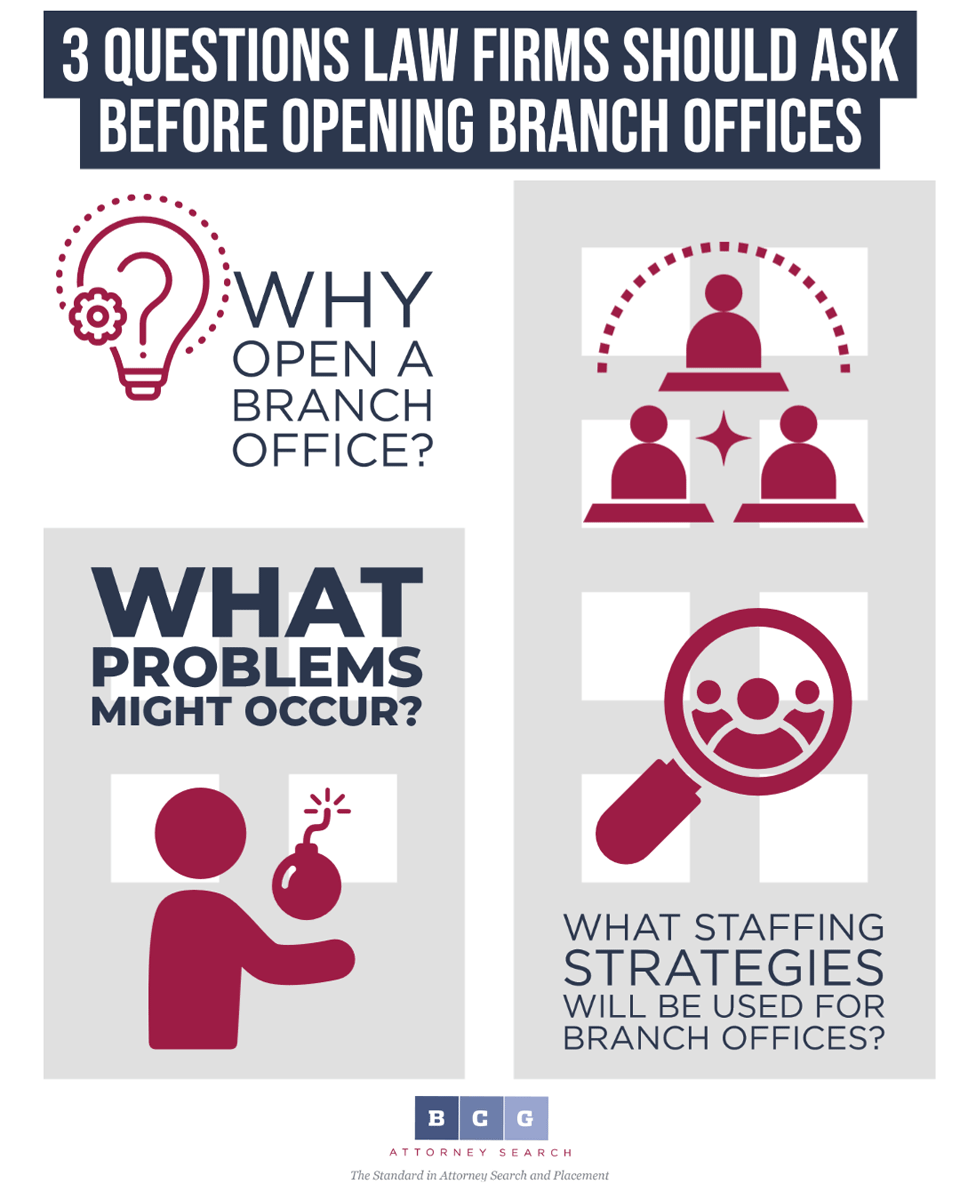
I. Why Open a Branch Office?
Firms open branch offices for many reasons, including servicing a single client, penetrating a new market, or preventing competitors from "poaching" existing clients in a particular area. A firm needs to outline and identify its specific reasons for opening a branch office. For example, a firm may identify that an area in which it believes there will be significant growth in the future and in which the firm may have numerous contacts with prospective clients may be a good area in which to open a branch office. These reasons would help support a desire to pursue "branding strategies" in a desire to be considered a national or international firm and further justify a branch office.
| Click Here to Get Assistance Opening a Branch Office from BCG Attorney Search |
A firm expanding to another market should have a serious commitment to its new office. Whatever the reasons the firm is choosing to open a branch office, these reasons should be part of a cohesive strategy. At its most fundamental level, this means that the firm must understand what services it intends to provide in the branch office, what types of clients it is seeking to service, and its capabilities to do the work it is seeking to do in the marketplace.
While there are numerous statistics on branch offices, firms that have branch offices will generally earn more than firms without branch offices. For the parent firm, the new office can provide an opportunity to improve partner income, add additional associates, and create new opportunities for partnership. Although this is certainly an intelligent growth strategy, as discussed below, it is important to note that opening branch offices can be a drain of time and money if done improperly or for the wrong reasons.
II. The Problems with Opening Branch Offices
A. The Failures of Branch Offices
Many firms have had bad experiences with branch offices. Partnership defections, high overhead, and the inability to meet projections for getting work can cause branch offices to fail. A more serious and less evident problem is that branch offices experiencing difficulty will often take a severe toll upon management. Firms that do not approach the opening of branch offices rationally often find themselves with far more headaches and drains on their profits than they anticipated.
Firms that are starting branch offices should be realistic in terms of the client base they believe the branch office will be able to generate. For example, many firms have opened branch offices only to find that the work they believed would appear has not materialized. Additionally, branch offices can often be a tremendous drain on the main office, as they can take substantial time to grow. Many deals being sought through the branch office may take much longer to materialize than originally anticipated. Without a large client base, the economic effects of waiting for work can often be devastating to the bottom line.
B. Barriers to Entry for Branch Offices
Whether a firm is opening a branch in another area of its home country or in a foreign country, there are going to be many barriers to success that are not immediately evident.
Domestically, there will always be some barriers to entry for any firm seeking to open a branch office. In many highly developed markets, there may be excessive competition from local firms or a very small potential client base. Any time a firm opens a branch office, it must be able and willing to respond to the fact that its entry into a new market will not necessarily be predictable. For example, many firms that have historically been leaders in their home areas have entered markets assuming that they will also be leaders in these new areas. This is not always the case. In the 1980s, for instance, several New York law firms came to Los Angeles with the expectation that Los Angeles would become a major international financial center. When Los Angeles failed to meet these expectations, a substantial number of these New York firms' branch offices failed. The New York firms that prospered often focused their efforts and resources on developing business in the litigation and real estate fields, despite the fact that they had no intention of doing so when they originally opened their branch offices. Companies that are opening new offices in the USA face similar problems.
Similarly, several firms that have come to New York in the past 10 years found that institutional New York firms, such as Cravath Swaine & Moore and Sullivan & Cromwell, had long-established relationships with their clients and were already performing the bulk of the corporate-related work that these new firms were seeking to do. More recently, many firms throughout the United States have relocated to Silicon Valley with great expectations, and while there are certainly some success stories, it is notable that our sources tell us many of these firms are suffering substantially at present.
Internationally, firms opening new branch offices can face massive obstacles. Many London firms that have recently entered the United States have been unable to produce the work they expected and have no choice but to discuss mergers with local firms in order to see some measure of success. One example is Clifford Chance
 , a London firm that merged with New York-based Rogers & Wells in January 2000.
One cost that many American law firms do not consider is office space. While there are substantial costs for travel and other associated expenses in opening branch offices, the costs for office space in markets such as London and Tokyo often far exceed costs in the United States. Even where a firm can afford office space, there may be other obstacles; in areas such as China, firms may have to wait for many years before getting approval for office leases.
Due to the lack of hours required of many foreign lawyers and the compensation of foreign partners being equal to or greater than that of American attorneys, profitability may be difficult without a large and developed client base. In addition, firms that have opened branch offices in other parts of the world often face obstacles that are not immediately apparent. For example, in Japan, an American lawyer can only provide advice on the law of the jurisdiction to which he/she is admitted. And in the U.K., American lawyers have only been able to partner with foreign lawyers since 1992.
C. Firm Management is Often a Serious Concern for Branch Offices
When a firm opens a branch office, there are also going to be substantive issues about the management skills of the leaders of the firm. While branch offices of firms can benefit from the marketing exposure and the firm's established reputation, the firm may have issues related to its ability to deal with the particular cultural sensitivities of the new market or the integration of lawyers into its institutional culture. Most branch offices are staffed both with attorneys from the main office of the firm and attorneys who are hired locally by the firm ("native talent"). Firms therefore need to be alert to the sensitivities of integrating new attorneys into their branch offices and ensuring that those who were relocated feel like they are still part of their firms.
Of all the reasons given for the failure of branch offices, one of the reasons we hear most often is that there is a serious lack of commitment on behalf of the home office. This is something that is very likely to cause partner defections once the branch office is established. It is extremely important for a firm to show a serious commitment to the development and successful operation of its branch office.
III. Staffing Strategies for Branch Offices
On one hand, clients may want to see a certain number of attorneys in the office before they begin dealing with the branch office. Conversely, the branch office of a firm practicing in a highly specialized area such as intellectual property may often be profitable despite the fact that there are only a few attorneys in the branch office due to a client's confidence in the firm to do specialized work.
Nevertheless, law firms depend upon people. The ability of firms to service clients depends upon the ability of the firm to lure people to its branch office. The fact that a firm may be able to attract partners with substantial portable business to its branch office can allow an office to quickly become profitable, as well as establish a fundamental foothold in its new area.
Once a firm opens a branch office, it is faced with many considerations that may not be immediately evident. These considerations can be addressed through aggressive recruiting strategies. For example, within the past few years – particularly on both coasts in the United States – law firms have increasingly faced pressure to provide advice in areas in which the law firm has not previously practiced. In order to continue providing services to its clients and develop their branch offices as profit centers, firms may be faced with an immediate need for attorneys who are familiar with this area of practice.
Following are some of the more common strategies firms can use for the staffing of their branch offices.
A. Dispatch Your Own Attorneys
Typically, law firms staff branch offices by dispatching their own attorneys to the new locales. This is quite expensive because many firms have to offer expensive perks, such as short-term housing allowances and frequent trips home. Additionally, relocating attorneys overseas can have staggering costs, including private schools for the attorneys' children, bar study stipends while attorneys take otherwise billable time off to study for the bar exam, and even Cost of Living Allowances ("COLA") to cover the added taxes and expenses of living in the new area.
When a firm is seeking to establish a branch office, firm management needs to take some time to speak with existing attorneys in the firm about any connections they may have in the new area. Sending an attorney with a concrete connection to the particular state or country in which the firm is considering opening a branch office can be an outstanding strategy. In addition to having some interest in relocating, these lawyers will be less likely to be viewed as "carpetbaggers" and more likely to be readily integrated into the new area. Lawyers within the parent firm with local contacts are also far more likely to stay in the branch office, feel a loyalty to the home office, and show more potential for further growth.
Even with local contacts, integrating an attorney into a new location can be difficult. The attorney may need time to integrate into the area and may only be seeking short-term objectives in the new market. In most cases, branch offices will need to add local attorneys in order to assure success.
B. Grow Your Own Attorneys
Most branch offices will at some point hire new law school graduates to staff their offices. The strength of hiring local lawyers is that they are more likely to remain in the area where you hire them and they can also be sources for networking in the local legal community.
Nevertheless, law school graduates need extensive training, and firms must devote a substantial amount of resources to make new associates productive. Several studies have shown that law firm associates generally do not generate any profit in their first year and may not show the firm any profit until the beginning of their fifth year. Additionally, a newly established branch office may not yet have the resources to train new attorneys. Until the branch office becomes more established, this is not the best option.
C. Acquire Experienced Local Lawyers
In order to have a satisfactory local presence, it will often be necessary for the firm to acquire lawyers in the area. There are a number of ways that a firm can approach the acquisition of these lawyers.
1. Word-of-Mouth Recruiting
One way many branch offices have acquired talent is by contacting in-house counsel and their clients in the area and asking them for references for local talent. Many attorneys who are being relocated to a branch office may also have already had extensive contact with lawyers from other firms in the area. Additionally, every attorney in a law firm graduated from a law school, and their fellow alumni and colleagues are all good contacts and sources for information. While many law firms do not have a problem with this type of recruitment, there are many firms that will not recruit directly from other firms. These types of limitations certainly would not prevent a firm from recruiting from a firm that is dissolving; however, many firms avoid direct recruiting altogether.
The reputation of an attorney hired through direct word-of-mouth recruiting is generally not too difficult to establish because there is an underlying assumption that a General Counsel or an attorney in your own firm would not recommend someone of whom he/she does not think highly. However, if the new attorney does not work out, the firm may be put in the position of alienating the attorney or client who made the recommendation.
2. Using a Search Firm to Recruit
Hiring laterally has been an important factor in the expansion of most international law firms within the United States, Asia, and Europe from the 1980s to the present. One of the greatest challenges firms face when opening branch offices is that they may often have a difficult time finding star talent, particularly for partner positions.
This difficulty can be overcome by consulting with a local or national search firm. There are real advantages in using a recruiter to identify and contact suitable candidates. Search firms often have a database of attorneys who might be interested in working for your firm, and they have access to attorneys who already have the requisite training and are committed to the market in which the firm is opening the branch office. The success of many law firm branch offices has been due to their reliance on search firms that recommend candidates of the highest caliber. The costs of using recruiting firms can be justified due to the rewards that hiring local attorneys with training can bring.
A search firm is beneficial because the search and recruiting process will often ensure that the firm becomes aware of the available attorneys in the market. The daily job of a search firm involves processing resumes, speaking with attorneys in the market, and studying the legal market. While some search firms simply cold-call associates with the prospect of "bombing" their resumes to local law firms, the search industry at its highest level is an extremely complex business driven by very sophisticated databases and constant contact with both partner- and associate-level attorneys in law firms. Good search consultants also have extensive experience in assisting branch offices with establishing their presences in other markets.
3. Advertising
Another vehicle for attracting excellent candidates can be advertising. There are several methods of advertising that can provide excellent candidates, including Internet job-posting boards and printed ads. In markets such as Hong Kong, advertising has always been an excellent way to attract candidates. However, in most senior-level searches, advertising simply will not be an effective way to identify and recruit top candidates.
Firms should be aware of the adage that the best candidates are usually too busy to be searching for a position. Out of every 300 candidates who contact our firm in response to a particular advertisement, less than .5% of those candidates may be a good fit for the particular position. Because most firms generally interview at least five candidates for a given position, this will mean that they will potentially have to sift through and evaluate more than 1,500 resumes and hundreds of phone inquiries to find suitable candidates. Reviewing the responses that come in from advertising is an enormous administrative task, and some large law firms have recruiting departments staffed with people whose only task is to respond to inquiries. Add up this administrative cost, the cost of hiring advertising agencies to create ads, and the cost of the ads themselves, and many firms simply conclude that advertising is not worth the small benefit it provides.
The benefit of using a search firm is that a good search firm employs both advertising and traditional search methods to find a suitable candidate.
D. A Combination Approach
The best means for staffing a branch office is through the use of a combination approach. By combining search strategies and staffing a branch office with local attorneys, the chances of that office succeeding can be maximized. This combination approach can also have the effect of allowing the integration of the firm's branch office with local lawyers more effectively.
IV. Conclusion
Due to a variety of factors, many firms have pursued the strategy of opening new branch offices. It is important, however, that firms approach the opening of branch offices with clearly defined goals and with the understanding that succeeding in the new market will by no means be an easy task.
One of the most important components for any firm starting a new branch office will be the recruitment strategy it employs. Through relocating its own attorneys, growing its own attorneys, and hiring local attorneys, a firm is most likely to experience success in its recruitment and retention of talented attorneys and in the overall growth and profitability of the new office.
Submit Your Resume to BCG Attorney Search and Get Feedback
Click here to contact Harrison
About Harrison Barnes
No legal recruiter in the United States has placed more attorneys at top law firms across every practice area than Harrison Barnes. His unmatched expertise, industry connections, and proven placement strategies have made him the most influential legal career advisor for attorneys seeking success in Big Law, elite boutiques, mid-sized firms, small firms, firms in the largest and smallest markets, and in over 350 separate practice areas.
A Reach Unlike Any Other Legal Recruiter
Most legal recruiters focus only on placing attorneys in large markets or specific practice areas, but Harrison places attorneys at all levels, in all practice areas, and in all locations-from the most prestigious firms in New York, Los Angeles, and Washington, D.C., to small and mid-sized firms in rural markets. Every week, he successfully places attorneys not only in high-demand practice areas like corporate and litigation but also in niche and less commonly recruited areas such as:
- Immigration Law
- Workers Compensation
- Insurance
- Family Law
- Trust and Estate
- Municipal law
- And many more...
This breadth of placements is unheard of in the legal recruiting industry and is a testament to his extraordinary ability to connect attorneys with the right firms, regardless of market size or practice area.
Proven Success at All Levels
With over 25 years of experience, Harrison has successfully placed attorneys at over 1,000 law firms, including:
- Top Am Law 100 firms such including Sullivan and Cromwell, and almost every AmLaw 100 and AmLaw 200 law firm.
- Elite boutique firms with specialized practices
- Mid-sized firms looking to expand their practice areas
- Growing firms in small and rural markets
He has also placed hundreds of law firm partners and has worked on firm and practice area mergers, helping law firms strategically grow their teams.
Unmatched Commitment to Attorney Success - The Story of BCG Attorney Search
Harrison Barnes is not just the most effective legal recruiter in the country, he is also the founder of BCG Attorney Search, a recruiting powerhouse that has helped thousands of attorneys transform their careers. His vision for BCG goes beyond just job placement; it is built on a mission to provide attorneys with opportunities they would never have access to otherwise. Unlike traditional recruiting firms, BCG Attorney Search operates as a career partner, not just a placement service. The firm's unparalleled resources, including a team of over 150 employees, enable it to offer customized job searches, direct outreach to firms, and market intelligence that no other legal recruiting service provides. Attorneys working with Harrison and BCG gain access to hidden opportunities, real-time insights on firm hiring trends, and guidance from a team that truly understands the legal market. You can read more about how BCG Attorney Search revolutionizes legal recruiting here: The Story of BCG Attorney Search and What We Do for You.
The Most Trusted Career Advisor for Attorneys
Harrison's legal career insights are the most widely followed in the profession.
- His articles on BCG Search alone are read by over 150,000 attorneys per month, making his guidance the most sought-after in the legal field. Read his latest insights here.
- He has conducted hundreds of hours of career development webinars, available here: Harrison Barnes Webinar Replays.
- His placement success is unmatched-see examples here: Harrison Barnes' Attorney Placements.
- He has created numerous comprehensive career development courses, including BigLaw Breakthrough, designed to help attorneys land positions at elite law firms.
Submit Your Resume to Work with Harrison Barnes
If you are serious about advancing your legal career and want access to the most sought-after law firm opportunities, Harrison Barnes is the most powerful recruiter to have on your side.
Submit your resume today to start working with him: Submit Resume Here
With an unmatched track record of success, a vast team of over 150 dedicated employees, and a reach into every market and practice area, Harrison Barnes is the recruiter who makes career transformations happen and has the talent and resources behind him to make this happen.
A Relentless Commitment to Attorney Success
Unlike most recruiters who work with only a narrow subset of attorneys, Harrison Barnes works with lawyers at all stages of their careers, from junior associates to senior partners, in every practice area imaginable. His placements are not limited to only those with "elite" credentials-he has helped thousands of attorneys, including those who thought it was impossible to move firms, find their next great opportunity.
Harrison's work is backed by a team of over 150 professionals who work around the clock to uncover hidden job opportunities at law firms across the country. His team:
- Finds and creates job openings that aren't publicly listed, giving attorneys access to exclusive opportunities.
- Works closely with candidates to ensure their resumes and applications stand out.
- Provides ongoing guidance and career coaching to help attorneys navigate interviews, negotiations, and transitions successfully.
This level of dedicated support is unmatched in the legal recruiting industry.
A Legal Recruiter Who Changes Lives
Harrison believes that every attorney-no matter their background, law school, or previous experience-has the potential to find success in the right law firm environment. Many attorneys come to him feeling stuck in their careers, underpaid, or unsure of their next steps. Through his unique ability to identify the right opportunities, he helps attorneys transform their careers in ways they never thought possible.
He has worked with:
- Attorneys making below-market salaries who went on to double or triple their earnings at new firms.
- Senior attorneys who believed they were "too experienced" to make a move and found better roles with firms eager for their expertise.
- Attorneys in small or remote markets who assumed they had no options-only to be placed at strong firms they never knew existed.
- Partners looking for a better platform or more autonomy who successfully transitioned to firms where they could grow their practice.
For attorneys who think their options are limited, Harrison Barnes has proven time and time again that opportunities exist-often in places they never expected.
Submit Your Resume Today - Start Your Career Transformation
If you want to explore new career opportunities, Harrison Barnes and BCG Attorney Search are your best resources. Whether you are looking for a BigLaw position, a boutique firm, or a move to a better work environment, Harrison's expertise will help you take control of your future.
Submit Your Resume Here to get started with Harrison Barnes today.
Harrison's reach, experience, and proven results make him the best legal recruiter in the industry. Don't settle for an average recruiter-work with the one who has changed the careers of thousands of attorneys and can do the same for you.
About BCG Attorney Search
BCG Attorney Search matches attorneys and law firms with unparalleled expertise and drive, while achieving results. Known globally for its success in locating and placing attorneys in law firms of all sizes, BCG Attorney Search has placed thousands of attorneys in law firms in thousands of different law firms around the country. Unlike other legal placement firms, BCG Attorney Search brings massive resources of over 150 employees to its placement efforts locating positions and opportunities its competitors simply cannot. Every legal recruiter at BCG Attorney Search is a former successful attorney who attended a top law school, worked in top law firms and brought massive drive and commitment to their work. BCG Attorney Search legal recruiters take your legal career seriously and understand attorneys. For more information, please visit www.BCGSearch.com.
Harrison Barnes does a weekly free webinar with live Q&A for attorneys and law students each Wednesday at 10:00 am PST. You can attend anonymously and ask questions about your career, this article, or any other legal career-related topics. You can sign up for the weekly webinar here: Register on Zoom
Harrison also does a weekly free webinar with live Q&A for law firms, companies, and others who hire attorneys each Wednesday at 10:00 am PST. You can sign up for the weekly webinar here: Register on Zoom
You can browse a list of past webinars here: Webinar Replays
You can also listen to Harrison Barnes Podcasts here: Attorney Career Advice Podcasts
You can also read Harrison Barnes' articles and books here: Harrison's Perspectives
Harrison Barnes is the legal profession's mentor and may be the only person in your legal career who will tell you why you are not reaching your full potential and what you really need to do to grow as an attorney--regardless of how much it hurts. If you prefer truth to stagnation, growth to comfort, and actionable ideas instead of fluffy concepts, you and Harrison will get along just fine. If, however, you want to stay where you are, talk about your past successes, and feel comfortable, Harrison is not for you.
Truly great mentors are like parents, doctors, therapists, spiritual figures, and others because in order to help you they need to expose you to pain and expose your weaknesses. But suppose you act on the advice and pain created by a mentor. In that case, you will become better: a better attorney, better employees, a better boss, know where you are going, and appreciate where you have been--you will hopefully also become a happier and better person. As you learn from Harrison, he hopes he will become your mentor.
To read more career and life advice articles visit Harrison's personal blog.