
Harrison Barnes' Legal Career Advice Podcast - Episode 48


- Are you a strategic or tactical attorney?
- Learn in this article how being a combination of both might be the best combination for you if you want to become a successful lawyer.
Summary: Learn how to do these two things that will ensure your successful career as an attorney.

Two different attorneys approached me recently looking for jobs. Both were self-confident men who had every reason to be successful but will not be. Both attended top law schools and did extremely well there. Both got jobs in major law firms out of law school but had recently lost their jobs. One was fired and the other quit.
Both attorneys made the same fundamental career mistake but in different ways. The attorney who was fired approached his career tactically but not strategically, while the attorney who quit approached his career strategically but not tactically. You must be both strategic and tactical to be truly successful in your legal career.
The Purely Tactical Attorney
The attorney who was fired had worked in an extremely prestigious New York law firm for exactly one year before he was let go. He had grades that put him among the top 10 or so graduating students in a top 5 law school. He had a history of stellar academic and life achievement and by all indications he should have had a very promising future in the legal profession. His downfall was his lack of strategy.

|
|
|
Things started off well for him at the firm. He worked very hard on the matters he was given. But he was very, very smart (perhaps too smart for his own good), and he soon began to make the mistake of questioning aspects of his assignments. He went back to the assigning partners and told them that some of the work was completely unnecessary because (1) it would never help the client and (2) it was a waste of money for the client. He believed the assignments and the work he was being asked to do were wasting the client’s money. For a step‑by‑step visual guide on applying these strategies in today’s competitive market, check out our video on how attorneys and law students can find jobs in a tight market. For an empowering perspective on staying confident in your legal career prospects, check out this video on why you should never worry about finding an attorney job.
He got into his first performance review and was told in no uncertain terms that he should leave the firm. He was told that he could spend the next few months looking for a position and “good luck.” He now goes into work each day with very little to do. To complement these insights, view our video on seven reasons attorneys don’t reach their potential and see what the remaining 95% often overlook.
- Attorneys aiming for top-tier success benefit from firms that encourage ambition, such as Lane Powell PC, known for opening career possibilities.
I recommended that he do a judicial clerkship and apply to every single judge he could. “That way, it will look to law firms like you worked for a year and then went to clerk. You will save your career. A few months is enough time for someone with your background to find a clerkship,” I told him. “This will work and save your career. If you do not find a job in the next few months then you are going to be unemployed and this will add to your future employment problems because it will look like you were fired.” These strategies are highlighted even further in our video, Everything an Attorney Needs to Know About Surviving in a New Law Firm Job, showing concrete examples from real associates.
“I want to stay in BigLaw,” he said. “What can you do for me now?”
Before going any further, I gave him an extensive lecture covering some of the finer points about what he did wrong:
I explained that he should have just done what was asked of him—he was a soldier and not a general at this point in his career. The partners assigning him work were paid based on how much work they assigned to associates like him and on how much work those associates produced. Those partners were excited about the opportunity to make money and the associate was not supposed to question their ideas. He was preventing the partners and the firm from making money by questioning his assignments. He was a liability to the firm because he was not doing the work he was assigned in the way it was assigned. The firm wanted to make money. The firm did not want to deal with an overly clever first-year associate. How could he expect to advance in the firm if he stood in its way?
After this lecture, with which he appeared to agree, I sent him a list of numerous firms all over the country:
- I recommended he look in other geographic areas—he refused.
- I recommended that he look at smaller firms as well—he refused.
- I recommended he apply to firms immediately—he wanted to think about it.
Then, after sending him the names of several law firms (including large law firms), he wanted to discuss each firm and the ways in which it was or was not “suitable” for someone like him culturally and in other ways. The problem with this attorney and his career prospects, I realized, was that he lacked strategy. He was purely a tactician; despite his intelligence, the lack of his ability to employ strategy in addition to tactics all but ensured his ultimate downfall. Strategic career planning often starts with understanding your options — get key insights on attorney placement vs. recruiting to guide your next move.
Your entire legal career is about your strategy and the means you employ to get where you want to go. If you are operating with “loose tactics” then you are going to have a very rocky and dangerous career and your career is going to fail, or never reach its full potential—no matter how smart you are. While the top 5% have unique strategies, this video Why You Might be Better Off Being an Average Attorney Than Trying to Be an Exceptional One explores why most attorneys may thrive without aiming for extraordinary.
The Purely Strategic Attorney
The other attorney was a pure strategist. He knew exactly what he wanted: He wanted to be in a law firm that rapidly advanced him to partner and a large paycheck. He was not interested in anything else. He had gone to a top law school, done extremely well there and believed that he was entitled to this. The best lawyers know how to sell their value authentically. Transform Your Legal Career: Harnessing Personality and Salesmanship breaks down how personality-driven persuasion creates lasting career momentum.
He had joined a top law firm out of law school and very quickly realized that the firm offered very little immediate advancement opportunity. When he realized it was going to be very difficult for him to get ahead, he immediately quit his job and expected a recruiter to find him a position in a law firm that would very quickly advance him without him having to learn the ropes, pay the price, or do much work whatsoever. He believed that strategy was more than enough for him to get ahead. To connect high-level career strategies with actionable interview tactics, view The Art of Interviewing.
- To see how those same traits—intelligence, perseverance, and strong social awareness—combine to define top performers, watch the video explaining how to thrive in large law firms by mastering these four essential skills.
He was wrong. You can have all the strategy you want, but without employing the proper “tactics” to get where you want to go nothing much ever happens.
What are the “tactical” realities involved in becoming a highly-compensated partner in a major law firm? For starters, you need to get into a good law school and do well there. Then you need to become very strong in your practice area, become indispensable to other partners and also generally bring in significant business (at least a few million). This attorney apparently thought his law school and grades were enough. He appeared oblivious to his need to continue with his tactics at the law firm—potentially for a decade or more and involving great toil on his part—to meet his strategic goal of advancing and getting a big paycheck. Those who don’t make the top 5% often fall back on justifications and excuses. This analysis of the most common excuses attorneys give for failing reveals how these mindsets prevent real success.
- One of those two things is turning disadvantages into advantages — as shown in our article on attorneys overcoming dyslexia.
The Interplay of Strategy and Tactics
Here is the critical interplay of strategy and tactics and why an attorney needs both in order to have a successful legal career:
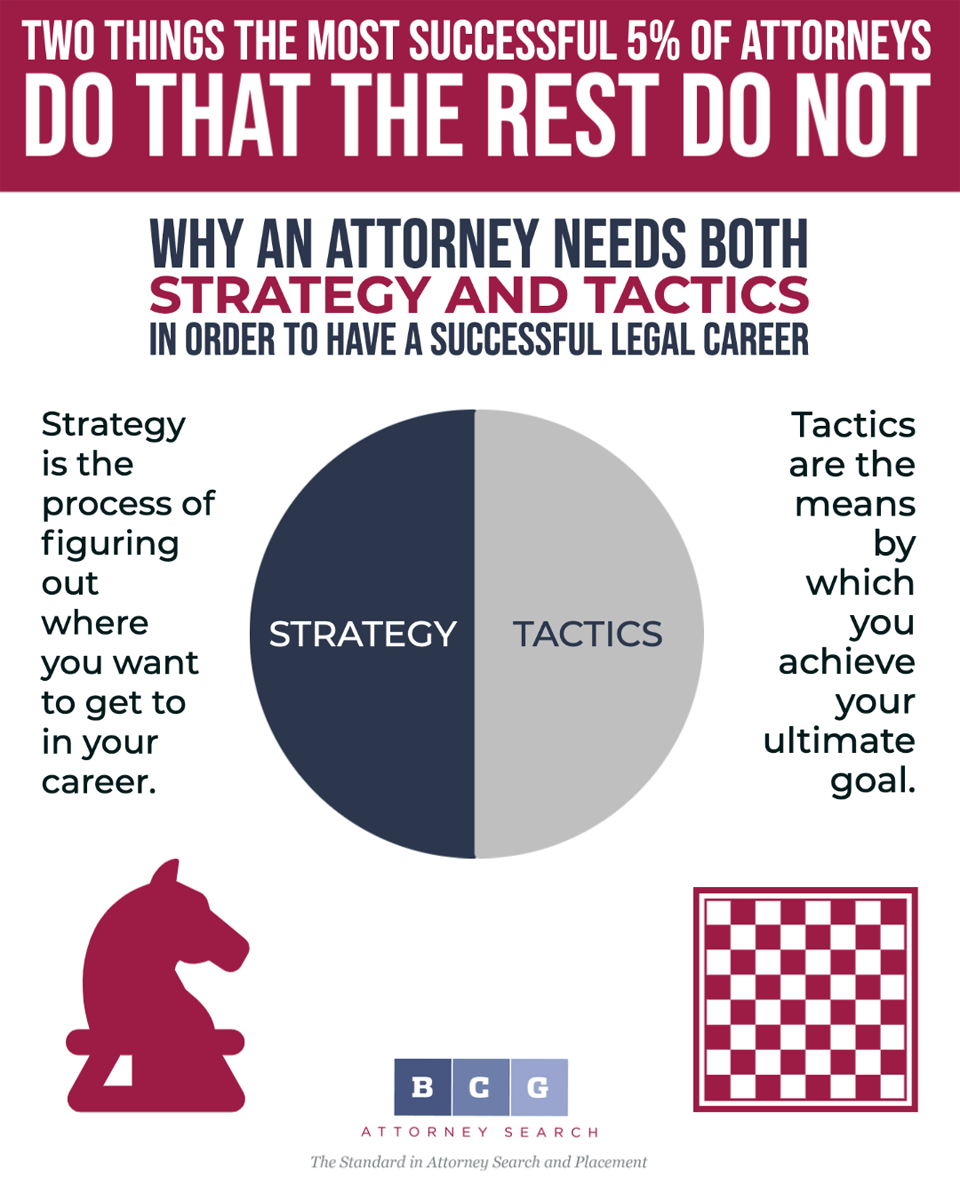
- Strategy is the process of figuring out where you want to ultimately get in your career (to be a partner in a major law firm, to be an important politician, to go into the United States Attorney’s Office, to start your own law firm one day).
- Tactics are the means by which you achieve your ultimate goal (working hard, taking positions along the way that bring you closer to your goal, doing a clerkship, becoming a law professor, and so forth.)
When it comes to your legal career, you need to make the absolute best strategic decisions before you make tactical decisions. The reason is because tactics follow (and implement) strategy. The “tactical” attorney never took the critical first step of coming up with an overall career strategy that would inform all the tactical decisions he would make. One of the first steps top attorneys take is refining their resume early—our Resume Review Workshop shows how to build a document that accelerates your legal career. Strategic career moves start with understanding when—and why—to transition; this video breaks down the key decision factor: The Only Thing That Attorneys Should Consider When Accepting or Leaving a Legal Job.
“What do you want to do with your career?” I asked him.
“I do not know,” he answered.
Because this attorney had no overall strategic goal for his legal career, his tactics had no context for success. If he had truly wanted to be a partner at the firm he was at, for example, he would have conducted himself differently. He would not have questioned his assignments but would have instead simply done whatever was asked of him. He would have learned everything he could and respected the partners instead of questioning them. Even after he went off track, he would have tried to salvage his overall goal by following my advice and applying to firms all over that might have openings for him.Both habits hinge on maintaining unwavering focus — the cornerstone of all elite performance. Why Lawyers at Every Stage Struggle explains why this skill separates thriving attorneys from stagnant ones. Complementing these habits, our video Why You Will Never Succeed at Practicing Law Until You Understand This One Thing dives into the crucial mindset that separates the highly successful attorneys from everyone else.
- For a detailed guide on how following a proven system can secure interviews and job offers, read Why Just About Every Candidate Who Follows BCG’s System Gets Interviews and Hired.
But he was not strategic and so he did not do these things. Tacticians think that because they are smart, because they can do the work and so forth, that good things should happen to them. They think that everything is about tactics and they fail to understand the need for overall strategy. This can work from time to time—but generally does not. In order to really achieve something you need to employ strategy along with tactics. A complementary viewpoint is explored in the video Why Your Family and Social Background Will Determine Your Happiness and Success as an Attorney, which explains how deeply these success predictors are shaped in childhood.
Let’s take the example of two different attorneys who say they want to be partners in major law firms. One uses just tactics and the other uses tactics along with strategy.
Attorney A Employs Tactics
- Attorney A’s tactics are to show up for work and do his or her job. Attorney A gets the best job possible out of law school—with a great firm. Attorney A completes his or her assignments as well as possible, making sure to follow the rules and work lots of hours. Attorney A hopes that after eight to ten years he or she will be made partner, but Attorney A does not really care much one way or the other. Instead, Attorney A thinks that he or she may go in-house down the road or find some other job he or she likes better. Who knows what the future will bring! In the interim, Attorney A is going to just work hard and do the best he or she can. One of the most effective strategies top attorneys use is relocating; see this in action in our video on relocating to a different market for career growth.
Attorney B Employs Tactics and Strategy
- Attorney B has a tactical strategy to do what needs to be done in order to become a partner in a large law firm. Attorney B carefully selects his or her firm based on the likelihood of that firm eventually making him or her partner. Attorney B selects a law firm that is growing and that has a reputation for making the most partners each year. Attorney B is very careful to network with the partners and others who have the most power at the firm and who will give Attorney B the most important work. Attorney B selects a practice area that is rich with opportunity and makes time to network outside of work to meet potential clients. Attorney B writes articles and gives presentations to establish him or herself as a subject matter expert. Attorney B never questions assignments while an associate. Attorney B avoids office gossip and makes sure to be on the right side of everyone. One of those key success habits is openness — an attitude highlighted in the ‘Definitive Guide to Why Attorneys Should Accept Every Law Firm Interview,’ where saying yes becomes the foundation for long-term career acceleration.
The strategies of top performers are mirrored at Porter Wright, where a legacy of excellence supports attorney achievement: learn more here.
Who do you think gets ahead? Who should get ahead? The differences between Attorney A and Attorney B are as different as night and day. One attorney is captaining a ship with a well-charted course and destination. The other is a member of a crew who simply sails on the ship with no idea or concern where it might arrive. Persistence is one of those defining traits — as underscored in the video Why an Attorney Should Never Give Up after Being Rejected from a Few (or Many) Law Firms, which captures how consistency leads to eventual success.
The majority of attorneys who approach me looking for positions in major law firms have not employed the correct combination of strategy and tactics to get a position in a major law firm:
- They are at a small law firm doing the sort of work major law firms do not do.
- They have had numerous jobs (inside of law firms, in government, in-house) that do not indicate the sort of stability necessary to be an attorney in a major law firm charged with servicing large clients.
- They are not committed to practicing law in a large law firm.
- They are partners, or senior associates, without significant business.
Most attorneys—70% to 75% of them—are pure tacticians and for that reason never reach their full potential. Many of these attorneys fail and end up unhappy, in jobs that are beneath their potential and wondering why they did not achieve more in their legal careers. They work in relative obscurity in various practice settings all over the world. Sometimes they succeed. Generally they can find work even as partners in some large law firms—but not much ever happens to them (as it should). To stay among the top-performing attorneys, consistency is key — Why Attorneys Who Take Extended Breaks Risk Losing Their Careers underscores why remaining professionally engaged pays off.
About 15% to 20% of attorneys are pure strategists. About half of all strategists survive, but barely. Strategists generally do not make very good lawyers because they do not employ the tactics needed to reach the goals they set out for themselves. You can have all of the strategies you want, but unless you are using well-defined tactics to get there you are going to be in trouble. High-achieving attorneys often go the extra mile in evaluating leading firms such as Adams and Reese LLP to ensure their next move aligns with long-term success. To see how these habits translate into financial results, watch this brief video on building real wealth as an attorney through consistency.
- Aligning your habits with firm opportunities can lead to satisfaction, as shown in Drinker Biddle & Reath LLP: Unraveling the Path to Professional Fulfillment.
If you are a tactical attorney you are just showing up for work. If you are also strategic, you are showing up for work and asking what is the most you can achieve with each tactic. If the answer is “to bill more hours” then you will always be chasing billable hours—and mediocrity—and not building a sustainable career. Seeing these principles in action can make all the difference; check out How Attorneys Destroy Their Careers by Choosing the Wrong Law Firms for a video explanation of what not to do. Successful attorneys consistently refine their professional presentation — our Resume Review Workshop is a great resource to emulate how the top 5% craft standout resumes. To better visualize these two critical actions, our video on showing up and advancing in law firms provides real-world examples of attorneys putting them into practice.
If you want to be a truly successful attorney, you need to be both strategic and tactical. You need to figure out your overall strategic goal and then develop and follow the tactical plan you need to get there. You need to master your sailing skills, chart your course, and then captain your ship safely into port. Strategic success often begins with understanding where your field stands—see the Likely Ranking of Attorneys in Different Practice Areas report for insights. Even the most successful attorneys sometimes struggle with firm approvals — this piece on the top ten reasons attorneys do not approve firms and how to fix each one explores the root causes and actionable solutions. Understanding the mindset behind successful attorneys, our video on 25 Reasons to Move to a New Firm highlights strategic moves that set top performers apart. To see how top attorneys implement these habits in a real-world context, check out our video Treating Your Career Like a Small Business.
- For those looking to put these strategies into practice at a leading firm, Exploring Sidley Austin: Key Insights for Prospective Attorneys is a helpful read. Top performers stay informed about where the legal market is heading. The Attorney Marketability Index 2026 helps attorneys identify which practice areas and regions are on the rise.
About Harrison Barnes
No legal recruiter in the United States has placed more attorneys at top law firms across every practice area than Harrison Barnes. His unmatched expertise, industry connections, and proven placement strategies have made him the most influential legal career advisor for attorneys seeking success in Big Law, elite boutiques, mid-sized firms, small firms, firms in the largest and smallest markets, and in over 350 separate practice areas.
A Reach Unlike Any Other Legal Recruiter
Most legal recruiters focus only on placing attorneys in large markets or specific practice areas, but Harrison places attorneys at all levels, in all practice areas, and in all locations-from the most prestigious firms in New York, Los Angeles, and Washington, D.C., to small and mid-sized firms in rural markets. Every week, he successfully places attorneys not only in high-demand practice areas like corporate and litigation but also in niche and less commonly recruited areas such as:
- Immigration Law
- Workers Compensation
- Insurance
- Family Law
- Trust and Estate
- Municipal law
- And many more...
This breadth of placements is unheard of in the legal recruiting industry and is a testament to his extraordinary ability to connect attorneys with the right firms, regardless of market size or practice area.
Proven Success at All Levels
With over 25 years of experience, Harrison has successfully placed attorneys at over 1,000 law firms, including:
- Top Am Law 100 firms such including Sullivan and Cromwell, and almost every AmLaw 100 and AmLaw 200 law firm.
- Elite boutique firms with specialized practices
- Mid-sized firms looking to expand their practice areas
- Growing firms in small and rural markets
He has also placed hundreds of law firm partners and has worked on firm and practice area mergers, helping law firms strategically grow their teams.
Unmatched Commitment to Attorney Success - The Story of BCG Attorney Search
Harrison Barnes is not just the most effective legal recruiter in the country, he is also the founder of BCG Attorney Search, a recruiting powerhouse that has helped thousands of attorneys transform their careers. His vision for BCG goes beyond just job placement; it is built on a mission to provide attorneys with opportunities they would never have access to otherwise. Unlike traditional recruiting firms, BCG Attorney Search operates as a career partner, not just a placement service. The firm's unparalleled resources, including a team of over 150 employees, enable it to offer customized job searches, direct outreach to firms, and market intelligence that no other legal recruiting service provides. Attorneys working with Harrison and BCG gain access to hidden opportunities, real-time insights on firm hiring trends, and guidance from a team that truly understands the legal market. You can read more about how BCG Attorney Search revolutionizes legal recruiting here: The Story of BCG Attorney Search and What We Do for You.
The Most Trusted Career Advisor for Attorneys
Harrison's legal career insights are the most widely followed in the profession.
- His articles on BCG Search alone are read by over 150,000 attorneys per month, making his guidance the most sought-after in the legal field. Read his latest insights here.
- He has conducted hundreds of hours of career development webinars, available here: Harrison Barnes Webinar Replays.
- His placement success is unmatched-see examples here: Harrison Barnes' Attorney Placements.
- He has created numerous comprehensive career development courses, including BigLaw Breakthrough, designed to help attorneys land positions at elite law firms.
Submit Your Resume to Work with Harrison Barnes
If you are serious about advancing your legal career and want access to the most sought-after law firm opportunities, Harrison Barnes is the most powerful recruiter to have on your side.
Submit your resume today to start working with him: Submit Resume Here
With an unmatched track record of success, a vast team of over 150 dedicated employees, and a reach into every market and practice area, Harrison Barnes is the recruiter who makes career transformations happen and has the talent and resources behind him to make this happen.
A Relentless Commitment to Attorney Success
Unlike most recruiters who work with only a narrow subset of attorneys, Harrison Barnes works with lawyers at all stages of their careers, from junior associates to senior partners, in every practice area imaginable. His placements are not limited to only those with "elite" credentials-he has helped thousands of attorneys, including those who thought it was impossible to move firms, find their next great opportunity.
Harrison's work is backed by a team of over 150 professionals who work around the clock to uncover hidden job opportunities at law firms across the country. His team:
- Finds and creates job openings that aren't publicly listed, giving attorneys access to exclusive opportunities.
- Works closely with candidates to ensure their resumes and applications stand out.
- Provides ongoing guidance and career coaching to help attorneys navigate interviews, negotiations, and transitions successfully.
This level of dedicated support is unmatched in the legal recruiting industry.
A Legal Recruiter Who Changes Lives
Harrison believes that every attorney-no matter their background, law school, or previous experience-has the potential to find success in the right law firm environment. Many attorneys come to him feeling stuck in their careers, underpaid, or unsure of their next steps. Through his unique ability to identify the right opportunities, he helps attorneys transform their careers in ways they never thought possible.
He has worked with:
- Attorneys making below-market salaries who went on to double or triple their earnings at new firms.
- Senior attorneys who believed they were "too experienced" to make a move and found better roles with firms eager for their expertise.
- Attorneys in small or remote markets who assumed they had no options-only to be placed at strong firms they never knew existed.
- Partners looking for a better platform or more autonomy who successfully transitioned to firms where they could grow their practice.
For attorneys who think their options are limited, Harrison Barnes has proven time and time again that opportunities exist-often in places they never expected.
Submit Your Resume Today - Start Your Career Transformation
If you want to explore new career opportunities, Harrison Barnes and BCG Attorney Search are your best resources. Whether you are looking for a BigLaw position, a boutique firm, or a move to a better work environment, Harrison's expertise will help you take control of your future.
Submit Your Resume Here to get started with Harrison Barnes today.
Harrison's reach, experience, and proven results make him the best legal recruiter in the industry. Don't settle for an average recruiter-work with the one who has changed the careers of thousands of attorneys and can do the same for you.
About BCG Attorney Search
BCG Attorney Search matches attorneys and law firms with unparalleled expertise and drive, while achieving results. Known globally for its success in locating and placing attorneys in law firms of all sizes, BCG Attorney Search has placed thousands of attorneys in law firms in thousands of different law firms around the country. Unlike other legal placement firms, BCG Attorney Search brings massive resources of over 150 employees to its placement efforts locating positions and opportunities its competitors simply cannot. Every legal recruiter at BCG Attorney Search is a former successful attorney who attended a top law school, worked in top law firms and brought massive drive and commitment to their work. BCG Attorney Search legal recruiters take your legal career seriously and understand attorneys. For more information, please visit www.BCGSearch.com.
Harrison Barnes does a weekly free webinar with live Q&A for attorneys and law students each Wednesday at 10:00 am PST. You can attend anonymously and ask questions about your career, this article, or any other legal career-related topics. You can sign up for the weekly webinar here: Register on Zoom
Harrison also does a weekly free webinar with live Q&A for law firms, companies, and others who hire attorneys each Wednesday at 10:00 am PST. You can sign up for the weekly webinar here: Register on Zoom
You can browse a list of past webinars here: Webinar Replays
You can also listen to Harrison Barnes Podcasts here: Attorney Career Advice Podcasts
You can also read Harrison Barnes' articles and books here: Harrison's Perspectives
Harrison Barnes is the legal profession's mentor and may be the only person in your legal career who will tell you why you are not reaching your full potential and what you really need to do to grow as an attorney--regardless of how much it hurts. If you prefer truth to stagnation, growth to comfort, and actionable ideas instead of fluffy concepts, you and Harrison will get along just fine. If, however, you want to stay where you are, talk about your past successes, and feel comfortable, Harrison is not for you.
Truly great mentors are like parents, doctors, therapists, spiritual figures, and others because in order to help you they need to expose you to pain and expose your weaknesses. But suppose you act on the advice and pain created by a mentor. In that case, you will become better: a better attorney, better employees, a better boss, know where you are going, and appreciate where you have been--you will hopefully also become a happier and better person. As you learn from Harrison, he hopes he will become your mentor.
To read more career and life advice articles visit Harrison's personal blog.