

"After all," she noted, "I probably won't stay at my first firm for my whole career, and I'm interested in joining the firm that will best prepare me for the future—whatever I decide to do."
That conversation, I think, reflects a very significant but largely unheralded change in thinking among lawyers and law firms about the importance and quality of law firm training programs.
Historically, for most American law firms, professional development meant training in substantive legal skills directed primarily at new lawyers. Training was viewed principally as a form of quality control, a necessary process to make associates more effective and to guard against malpractice.
While some firms did see the possibility that effective training programs could provide a tactical advantage in recruiting, few were prepared to invest significant resources in a comprehensive training effort. Except for some litigation skills training, most programs were fairly ad hoc and aimed only at associates. Professional development for partners was rare, since their competence in substantive legal skills was presumed.
- Law firm training is most effective when it fosters leadership — see our breakdown of how attorneys can demonstrate leadership skills for promotion.
First, the sheer growth of law firms has undermined the effectiveness of ad hoc programs as that growth, coupled with increased turnover rates among both associates and partners, has increased the likelihood of some lawyers "falling through the cracks" when it comes to professional development. Systems based on "on-the-job training" and informal mentoring that might have worked well for a single-office firm of 50 lawyers work considerably less well for a multi-office firm of 450 lawyers.
A second factor has been the growing segmentation of the legal market that has increased demand for legal specializations, reduced client loyalty, and placed an ever higher premium on client development and client service skills.
Moreover, clients are no longer willing to cover the costs of a firm's professional development program by having younger or less experienced lawyers tag along to depositions or trials or negotiating sessions at the client's expense. Most clients today see professional training as the responsibility of the law firms themselves, and are not willing to tolerate inexperienced lawyers learning the ropes at their expense.
And third, law firms find themselves today in a growing competitive environment in which they compete with each other as fiercely for talent as they do for clients. For a deeper perspective on why aligning yourself with the strongest possible firm amplifies the benefits of training, watch Why You Should Work with the Best Law Firm You Can as Long as You Can, which highlights how elite environments accelerate attorney growth.
As with my friend, young lawyers today no longer see a decision to join a firm as a permanent commitment, and they are increasingly inclined to choose firms on the basis of the professional development opportunities they offer. Complement these insights with our video Treating Your Career Like a Small Business, which explains how to apply a systematic approach to your own career.
Fortunately, many major law firms have gotten the message and increasingly see professional development as a means of creating a strategic advantage over their competitors. The new emerging value proposition is that a successful professional development program: Many training shortcomings stem from why law-firm structures limit an attorney’s sense of control early in their careers.
- enhances the quality of a firm's work by ensuring uniform standards of professional care;
- enhances the quality of the firm as an organization by improving the quality of its client development and service delivery capabilities and by strengthening a common set of cultural norms; and
- enhances the quality of a firm's lawyers (both associates and partners) by improving their effectiveness as team members, supervisors and mentors.
Firms are also coming to realize that professional development is a key ingredient in motivating lawyers at all stages of their careers and, needless to say, a fully motivated workforce is a huge competitive advantage in any business.
To achieve such motivational effect, there is also a clear trend toward integrating formal training with on-the-job learning. Indeed, this trend signals an implicit new "training contract" between associates and their firms. Firms often highlight their training as part of their recruitment messaging, and the video The Top 15 Marketing and Sales Tricks Law Firms Use to Get You to Work for Them reveals how these training promises are strategically marketed to candidates.
Reflecting this new attitude toward lawyer training, many firms in the United States—following earlier examples of firms in the U.K. and Australia—have now begun to invest heavily in professional development programs and initiatives. Indeed, it is estimated that, this year alone, U.S. based firms will spend almost a billion dollars on such efforts. While the structure and quality of programs in firms vary widely, many represent significant investments of resources, sometimes in partnership with outside educational institutions. For example: For attorneys prioritizing growth, the 25 Reasons to Move to a New Firm video shows how switching firms can provide better training opportunities.
- Baker & McKenzie put several hundred of its partners through a leadership development course at the Kellogg School at Northwestern University.
- Wilmer Cutler Pickering Hale and Dorr is designing a program in collaboration with the Harvard Business School to address the professional and personal needs of lawyers at various transition points in their careers.
- Alston & Bird has instituted an impressive firm-wide development philosophy that includes administrative staff and encourages mentoring at all levels of the firm.
- Reed Smith has created an elaborate program dubbed the "Reed Smith University" to provide professional development courses in five areas—legal skills, leadership, technology, business development and professional support—teaming up with the Wharton School at the University of Pennsylvania for the leadership segment.
- King & Spalding operates the "King & Spalding University" that includes a focus on training for transition moments—e.g., a "senior associate academy."
The Characteristics of Success
Of course, every successful professional development program must fit the culture and strategy of the firm for which it is designed. Accordingly, it is difficult to create a definitive list of "best practices" that will work in all firms. To complement this discussion, see our video Partner-Level Transitions: What Law Firms Look for and How to Stand Out for insights on what traits firms value in partner candidates.
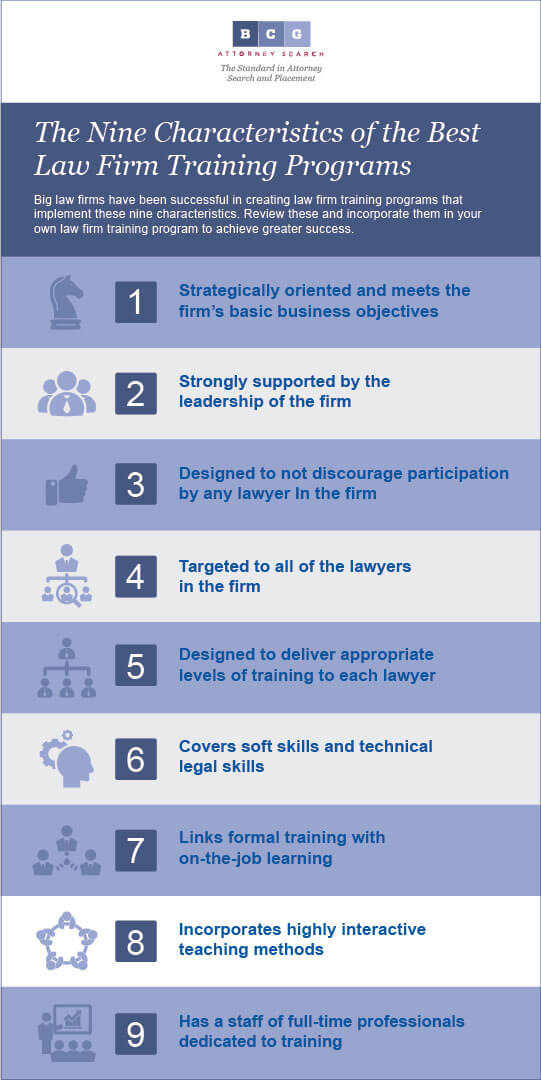
That said, the most successful programs around the country do appear to have a number of basic characteristics in common that may serve as guideposts for firms in the process of re-thinking their own professional development efforts.
First, almost all successful programs are strategically oriented and designed to achieve the firm's basic business objectives. If a firm has a substantial complex, multi-party litigation practice, it may be sensible to include a training component on teambuilding and teamwork, as such collaboration may be critical to managing the large litigations the firm handles. If a firm has a large commercial "deal practice," training components focused on negotiating skills may be appropriate. Client development skills appropriate for firms with large institutional clients may be less applicable to practices dependent on ad hoc representations of individuals. Many of the firms that invest heavily in training are also open to exceptional candidates who apply even when no openings are posted — demonstrating initiative and long-term value.
In other words, the program's design must reflect the reality of a firm's particular practices as well as the firm's strategy for growing its business in the future.
Second, a successful professional development program must be strongly supported and driven by the leadership of the firm. While the components of a training program must, to a large extent, be designed "from the bottom up," the initiative and drive for the program must originate with the firm's top management.
Law firms are not traditional hierarchical business structures. For new initiatives to take hold and succeed they must be embraced and unrelentingly pushed by the firm's management. Otherwise, in most firms, they simply will not succeed.
Third, as an extension of the second point described above, firms with successful training programs take steps to ensure that lawyers are not disincentivized from participating in the programs either as students or as faculty members.
For example, a firm's commitment to stated billable hours goals or elements of its compensation system should not be allowed to create roadblocks to active participation in professional development programs by all of its lawyers. This is one concrete example of an area where backing by a firm's top management is critical.
Fourth, successful professional development programs are targeted at all of the lawyers (and, in some cases, at all of the professionals) in the firm.
At the heart of the new evolving value proposition for professional development is the strong concept that learning and development are life-long processes. To be sure, the skill sets required of a senior partner will be different from those of a junior partner or senior associate or new associate, but they are skill sets nonetheless, and it is important that they be taught.
The old assumption that lawyers somehow achieve full maturity and competence the moment they become partners was never consistent with well-established principles of human development and was rejected long ago with the creation of mandatory CLE in most states. As firms re-think their own professional development programs, they are coming to realize that such programs must be available to lawyers at all stages of their careers. Highlighting participation in high-quality training programs can elevate your resume — watch the Resume Review Workshop to learn how to spotlight this experience effectively. Understanding how showing up consistently influences career trajectory is essential — our video on the difference between those who get hired and advance and those who do not complements these training program insights perfectly.
Even the best training can fall short without personal focus and self-direction. Why Lawyers at Every Stage Struggle underscores why internal clarity is just as vital as external training programs.
Fifth, building on the prior point, most successful lawyer training programs are designed to deliver appropriate levels of training at different stages of a lawyer's career.
A new associate may require basic writing or time management or team working skills, while a more senior associate may need to develop supervisory or advanced communications skills. A new partner may benefit from training in advanced supervisory and feedback skills, as well as from basic leadership and client relationship management skills. A more senior partner may need instruction in advanced leadership techniques, strategic thinking, change management, and the like. Our video Why You Might be Better Off Being an Average Attorney Than Trying to Be an Exceptional One demonstrates how consistent skill-building can lead to long-term career stability.
Successful professional development programs are increasingly designed to make sure that lawyers get the training they need at the times they need it.
Sixth, as reflected above, successful professional development programs cover "soft skills" as well as technical legal skills.
As law firms have become larger and more complex businesses, they have come to realize that providing technical legal training alone is not enough to equip their lawyers for the challenges of building and sustaining their enterprises. Thus, like other large businesses, they have increasingly modified their training programs to include such topics as leadership, business development, client relationship management, supervision, teamwork, communications, and the like. While a few years ago such topics would have been dismissed out of hand as inappropriate, today they are mainstays of successful law firm professional development programs. Training excellence is a key factor, as reflected in the Law Firm Culture Index 2026.
- Training is most impactful when paired with clear career paths—illustrated in unlocking career success at Pillsbury Winthrop Shaw Pittman, which highlights how the firm’s structure supports attorney growth.
Seventh, many successful lawyer training programs now make a conscious effort to link formal training with on-the-job learning through coordination of assignments, mentoring, and otherwise. Many firms today are developing overall learning frameworks that articulate with some specificity the skill sets that lawyers in various specialties are expected to have at various stages of their careers. (Indeed, in a few firms, advancement of lawyers through associate and even partnership ranks is tied to a demonstration of successful competency in the established skill sets.) Strong training can dramatically increase an attorney’s career prospects, as shown in the Attorney Marketability Index 2026, which correlates professional development quality with future market demand.
Once such learning frameworks are established, the firms use a blend of formal training and on-the-job training to satisfy the requirements. For example, a litigation associate may receive formal training in how to take a deposition and then be given a specific deposition assignment in which to test his or her newly acquired skills.
Obviously, this approach requires close coordination between a firm's professional development and its lawyer assignment functions.
Eighth, most successful lawyer training programs today are pedagogically smart, incorporating highly interactive teaching methods.
These programs have largely abolished the "talking head" lecture in which a senior partner drones on about the key principles of negotiating a contract. Instead, young lawyers are organized into teams and given negotiation assignments using elaborate case studies that are worked through in a "moot court" style approach, with negotiating sessions sometimes even being videotaped for further critique. The increasing emphasis on non-academic attributes aligns with the video Why Your Family and Social Background Will Determine Your Happiness and Success as an Attorney, which explains why firms’ selection criteria are shifting in this direction.
We know from adult learning theory that adults learn best by doing, not by listening, and successful training programs are now incorporating this principle.
And ninth, most firms with successful lawyer development programs have on staff full-time professionals devoted to making their programs a success.
As with other areas of critical competitive importance, these firms are investing the resources required to hire qualified senior staff and avoid simply relying on the part-time attention of a few partners to plan and implement their professional development strategies. Many of these senior staff members are specialists in adult education, some being hired out of executive education programs at well-known colleges and universities. Great training builds more than legal skill—it builds presence. Learn to cultivate that professional magnetism in Transform Your Legal Career: Harnessing Personality and Salesmanship.
The presence of these specialists is helping to transform both the design and pedagogic style of the professional development programs in a number of firms.
- Dinsmore’s focus on professional development reflects many of these qualities, as detailed in Dinsmore & Shohl LLP: Paving the Way for Success in a Respected Law Firm.
In short, many large law firms today are in the process of quietly transforming their former legal skills training efforts into full-scale professional development programs designed to serve the developmental and personal needs of their lawyers throughout their careers. The firms that get this right will enjoy a tremendous competitive advantage in attracting and keeping top professional talent. They will also, in all likelihood, experience a significant enhancement of the quality and consistency of the services they provide to their clients. Strong training programs don’t just build better lawyers — they strengthen a firm’s ability to adapt in uncertain times. To see how strategic adjustments can help firms remain profitable during downturns, read How to Survive a Tough Economic Legal Market for Law Firms. Many elite firms offering premier training are also among The Highest-Paying Law Firms in the United States.
BCG’s process connects attorneys to firms offering such programs — see The BCG Attorney Search Advantage for how we do it.
Even in top-tier programs, progress requires personal accountability. This article on the most common excuses attorneys give for failing in their careers complements that message perfectly.
- To see how these principles translate into practice, explore Discover the Exceptional Employee Experience at Alter Wolff Foley & Stutman LLP.
My young friend would be well advised to cast her lot with a firm that is in the forefront of this particular revolution.
About Harrison Barnes
No legal recruiter in the United States has placed more attorneys at top law firms across every practice area than Harrison Barnes. His unmatched expertise, industry connections, and proven placement strategies have made him the most influential legal career advisor for attorneys seeking success in Big Law, elite boutiques, mid-sized firms, small firms, firms in the largest and smallest markets, and in over 350 separate practice areas.
A Reach Unlike Any Other Legal Recruiter
Most legal recruiters focus only on placing attorneys in large markets or specific practice areas, but Harrison places attorneys at all levels, in all practice areas, and in all locations-from the most prestigious firms in New York, Los Angeles, and Washington, D.C., to small and mid-sized firms in rural markets. Every week, he successfully places attorneys not only in high-demand practice areas like corporate and litigation but also in niche and less commonly recruited areas such as:
- Immigration Law
- Workers Compensation
- Insurance
- Family Law
- Trust and Estate
- Municipal law
- And many more...
This breadth of placements is unheard of in the legal recruiting industry and is a testament to his extraordinary ability to connect attorneys with the right firms, regardless of market size or practice area.
Proven Success at All Levels
With over 25 years of experience, Harrison has successfully placed attorneys at over 1,000 law firms, including:
- Top Am Law 100 firms such including Sullivan and Cromwell, and almost every AmLaw 100 and AmLaw 200 law firm.
- Elite boutique firms with specialized practices
- Mid-sized firms looking to expand their practice areas
- Growing firms in small and rural markets
He has also placed hundreds of law firm partners and has worked on firm and practice area mergers, helping law firms strategically grow their teams.
Unmatched Commitment to Attorney Success - The Story of BCG Attorney Search
Harrison Barnes is not just the most effective legal recruiter in the country, he is also the founder of BCG Attorney Search, a recruiting powerhouse that has helped thousands of attorneys transform their careers. His vision for BCG goes beyond just job placement; it is built on a mission to provide attorneys with opportunities they would never have access to otherwise. Unlike traditional recruiting firms, BCG Attorney Search operates as a career partner, not just a placement service. The firm's unparalleled resources, including a team of over 150 employees, enable it to offer customized job searches, direct outreach to firms, and market intelligence that no other legal recruiting service provides. Attorneys working with Harrison and BCG gain access to hidden opportunities, real-time insights on firm hiring trends, and guidance from a team that truly understands the legal market. You can read more about how BCG Attorney Search revolutionizes legal recruiting here: The Story of BCG Attorney Search and What We Do for You.
The Most Trusted Career Advisor for Attorneys
Harrison's legal career insights are the most widely followed in the profession.
- His articles on BCG Search alone are read by over 150,000 attorneys per month, making his guidance the most sought-after in the legal field. Read his latest insights here.
- He has conducted hundreds of hours of career development webinars, available here: Harrison Barnes Webinar Replays.
- His placement success is unmatched-see examples here: Harrison Barnes' Attorney Placements.
- He has created numerous comprehensive career development courses, including BigLaw Breakthrough, designed to help attorneys land positions at elite law firms.
Submit Your Resume to Work with Harrison Barnes
If you are serious about advancing your legal career and want access to the most sought-after law firm opportunities, Harrison Barnes is the most powerful recruiter to have on your side.
Submit your resume today to start working with him: Submit Resume Here
With an unmatched track record of success, a vast team of over 150 dedicated employees, and a reach into every market and practice area, Harrison Barnes is the recruiter who makes career transformations happen and has the talent and resources behind him to make this happen.
A Relentless Commitment to Attorney Success
Unlike most recruiters who work with only a narrow subset of attorneys, Harrison Barnes works with lawyers at all stages of their careers, from junior associates to senior partners, in every practice area imaginable. His placements are not limited to only those with "elite" credentials-he has helped thousands of attorneys, including those who thought it was impossible to move firms, find their next great opportunity.
Harrison's work is backed by a team of over 150 professionals who work around the clock to uncover hidden job opportunities at law firms across the country. His team:
- Finds and creates job openings that aren't publicly listed, giving attorneys access to exclusive opportunities.
- Works closely with candidates to ensure their resumes and applications stand out.
- Provides ongoing guidance and career coaching to help attorneys navigate interviews, negotiations, and transitions successfully.
This level of dedicated support is unmatched in the legal recruiting industry.
A Legal Recruiter Who Changes Lives
Harrison believes that every attorney-no matter their background, law school, or previous experience-has the potential to find success in the right law firm environment. Many attorneys come to him feeling stuck in their careers, underpaid, or unsure of their next steps. Through his unique ability to identify the right opportunities, he helps attorneys transform their careers in ways they never thought possible.
He has worked with:
- Attorneys making below-market salaries who went on to double or triple their earnings at new firms.
- Senior attorneys who believed they were "too experienced" to make a move and found better roles with firms eager for their expertise.
- Attorneys in small or remote markets who assumed they had no options-only to be placed at strong firms they never knew existed.
- Partners looking for a better platform or more autonomy who successfully transitioned to firms where they could grow their practice.
For attorneys who think their options are limited, Harrison Barnes has proven time and time again that opportunities exist-often in places they never expected.
Submit Your Resume Today - Start Your Career Transformation
If you want to explore new career opportunities, Harrison Barnes and BCG Attorney Search are your best resources. Whether you are looking for a BigLaw position, a boutique firm, or a move to a better work environment, Harrison's expertise will help you take control of your future.
Submit Your Resume Here to get started with Harrison Barnes today.
Harrison's reach, experience, and proven results make him the best legal recruiter in the industry. Don't settle for an average recruiter-work with the one who has changed the careers of thousands of attorneys and can do the same for you.
About BCG Attorney Search
BCG Attorney Search matches attorneys and law firms with unparalleled expertise and drive, while achieving results. Known globally for its success in locating and placing attorneys in law firms of all sizes, BCG Attorney Search has placed thousands of attorneys in law firms in thousands of different law firms around the country. Unlike other legal placement firms, BCG Attorney Search brings massive resources of over 150 employees to its placement efforts locating positions and opportunities its competitors simply cannot. Every legal recruiter at BCG Attorney Search is a former successful attorney who attended a top law school, worked in top law firms and brought massive drive and commitment to their work. BCG Attorney Search legal recruiters take your legal career seriously and understand attorneys. For more information, please visit www.BCGSearch.com.
Harrison Barnes does a weekly free webinar with live Q&A for attorneys and law students each Wednesday at 10:00 am PST. You can attend anonymously and ask questions about your career, this article, or any other legal career-related topics. You can sign up for the weekly webinar here: Register on Zoom
Harrison also does a weekly free webinar with live Q&A for law firms, companies, and others who hire attorneys each Wednesday at 10:00 am PST. You can sign up for the weekly webinar here: Register on Zoom
You can browse a list of past webinars here: Webinar Replays
You can also listen to Harrison Barnes Podcasts here: Attorney Career Advice Podcasts
You can also read Harrison Barnes' articles and books here: Harrison's Perspectives
Harrison Barnes is the legal profession's mentor and may be the only person in your legal career who will tell you why you are not reaching your full potential and what you really need to do to grow as an attorney--regardless of how much it hurts. If you prefer truth to stagnation, growth to comfort, and actionable ideas instead of fluffy concepts, you and Harrison will get along just fine. If, however, you want to stay where you are, talk about your past successes, and feel comfortable, Harrison is not for you.
Truly great mentors are like parents, doctors, therapists, spiritual figures, and others because in order to help you they need to expose you to pain and expose your weaknesses. But suppose you act on the advice and pain created by a mentor. In that case, you will become better: a better attorney, better employees, a better boss, know where you are going, and appreciate where you have been--you will hopefully also become a happier and better person. As you learn from Harrison, he hopes he will become your mentor.
To read more career and life advice articles visit Harrison's personal blog.