
This comprehensive guide cuts through the noise. We break down what each path actually looks like day-to-day, the skills and credentials that matter, typical entry points, advancement timelines, and how compensation and work-life balance compare across options. You’ll see how macro trends—automation and AI, client pressure on fees, the rise of data-driven legal ops, and shifting regulatory regimes—are reshaping demand for specific practice areas and roles. We also highlight where the opportunities are expanding (and where they’re contracting), so you can target moves with the highest ROI.
By the end, you’ll have a clear, practical map of the legal career landscape in 2026—what’s out there, who thrives where, and how to position yourself to land the work that fits your strengths, values, and long-term goals.

An Exhaustive Analysis of Legal Career Opportunities
Including Salary Data, Market Trends, and Career Progression Pathways
Table of Contents
- 1.Executive Summary
- 2.Introduction and Methodology
- 3.Legal Market Overview
- 4.Traditional Legal Practice Settings
- 5.Specialized Legal Practice Areas
- 6.Alternative and Non-Traditional Legal Careers
- 7.Comprehensive Salary Analysis
- 8.Career Progression and Development
- 9.Geographic Market Analysis
- 10.Demographic Trends and Diversity
- 11.Future Outlook and Emerging Opportunities
- 12.Conclusion and Recommendations
- 13.Appendices
Executive Summary
The legal profession in 2025 offers an unprecedented variety of career opportunities for attorneys, extending far beyond the traditional courtroom practice that many associate with the field. This comprehensive analysis examines over 100 distinct career paths available to law school graduates and practicing attorneys, providing detailed insights into compensation, growth prospects, and market dynamics across the entire legal industry. Planning for the future starts early—read The Ultimate Guide to Retirement Plans for Lawyers. To get practical tips on surviving and thriving without burning out, check out our video: How to Not Fail, Die or Go Crazy Practicing Law.
Our research reveals that the legal profession employs approximately 1.365 million attorneys across the United States, distributed across diverse practice settings and specializations. The industry continues to evolve rapidly, driven by technological advancement, regulatory changes, and shifting client demands, creating new opportunities while transforming traditional roles. For attorneys exploring how communication and trust can impact career growth, our deep dive into the client-lawyer relationship offers valuable insight into building lasting professional connections. For a recruiting framework that fully covers this landscape, read The BCG Advantage: Total-Market Capture™.
Key Market Statistics
- Total U.S. Attorneys: 1,365,000 (2024)
- 10-Year Growth Rate: +9.6% (2014-2024)
- Median Attorney Salary: $145,760
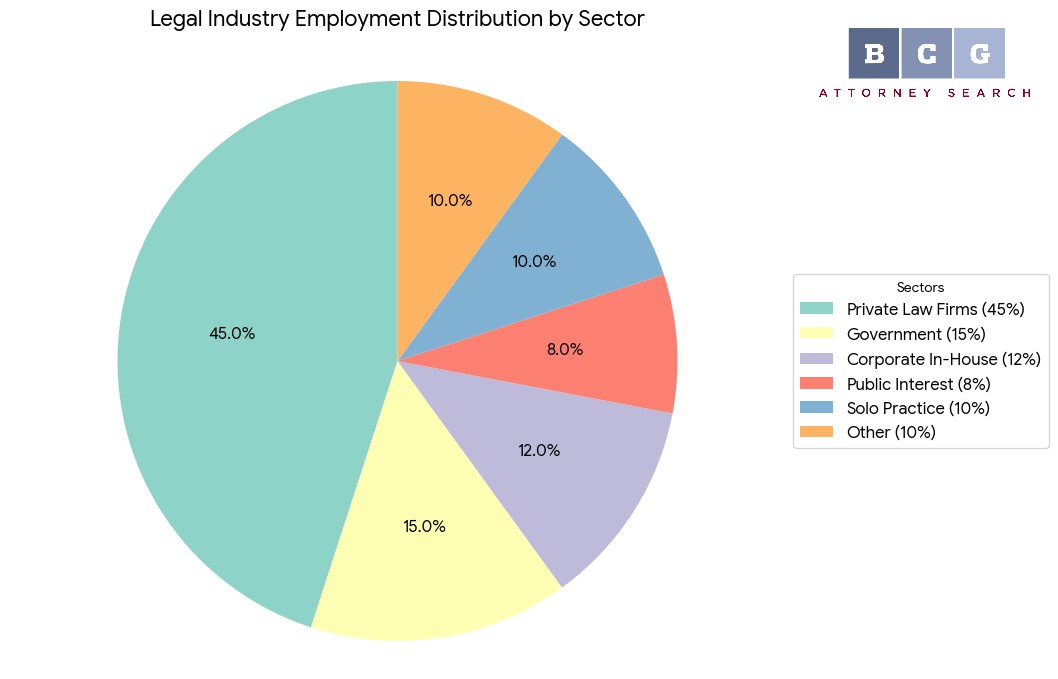
- Employment Distribution:
- Private Law Firms: 45%
- Government: 15%
- Corporate In-House: 12%
- Public Interest: 8%
- Solo Practice: 10%
- Other: 10%
- Fastest Growing Sector: Corporate In-House (+37.9% over 10 years)
- Highest Paying Sector: BigLaw Partners ($1.9M average)
Introduction and Methodology
The question "What types of jobs are there for lawyers?" has become increasingly complex as the legal profession has diversified and specialized over the past decades. This comprehensive report aims to provide the definitive answer to this question by examining every major category of legal employment, from traditional practice settings to emerging alternative careers. As you evaluate the many job-types available to lawyers, you may find it helpful to consult the site’s ultimate guide to attorney practice areas, which breaks down specialties, demand and typical trajectories. To understand the warning signs of a practice area in decline and how it can affect your career, check out this video: Why Every Big Firm Practice Area Eventually 'Self-Destructs'.
Our analysis is based on extensive research incorporating data from multiple authoritative sources, including the Bureau of Labor Statistics, American Bar Association employment surveys, National Association for Law Placement (NALP) reports, legal industry publications, and direct employer surveys. We have analyzed employment patterns, compensation data, and growth trends across a ten-year period to provide accurate and current insights. For attorneys looking to discover opportunities that aren’t advertised, this video on uncovering hidden legal job opportunities provides actionable tips to stand out in a competitive market. Before deciding on relocation or multistate practice, it’s helpful to estimate potential costs with the Bar Reciprocity Cost Calculator, which can inform your career strategy. Attorneys exploring Goodwin Procter can benefit from our Complete Analysis 2026, detailing salaries, culture, and career paths.
Research Methodology
This report employs a multi-faceted research approach:
- Quantitative Analysis: Statistical examination of employment data, salary surveys, and market trends from 2014-2024
- Industry Surveys: Direct data collection from legal employers, recruitment firms, and professional associations
- Longitudinal Study: Analysis of career progression patterns and employment mobility within the legal profession
- Comparative Analysis: Cross-sector comparison of compensation, growth rates, and career satisfaction metrics
- Predictive Modeling: Forward-looking analysis of emerging trends and future opportunities
Legal Market Overview
The legal services market in the United States represents one of the largest professional services sectors, with annual revenues exceeding $400 billion. The profession has undergone significant transformation over the past decade, driven by technological innovation, changing client expectations, and evolving regulatory environments. For attorneys exploring different paths, watch our video on understanding and addressing red flags in long-term employment to ensure smoother transitions.
Market Dynamics and Trends
Several key trends are reshaping the legal employment landscape:
Corporate Legal Department Growth: The most significant trend in legal employment has been the rapid expansion of corporate in-house legal departments. Over the past decade, corporate legal positions have grown by 37.9%, far outpacing other sectors. This growth reflects companies' desire to bring legal expertise in-house to reduce costs and improve efficiency while maintaining closer control over legal strategy. For insight into Goodwin Procter as a lateral destination, see our Complete Analysis 2026.
Technology Integration: Legal technology has created entirely new career categories while transforming traditional roles. Legal operations professionals, legal technology specialists, and e-discovery experts represent rapidly growing employment segments that barely existed a decade ago. For attorneys considering careers in technology-driven BigLaw practices, our Fenwick & West career insights guide offers a detailed look at growth, compensation, and advancement opportunities.
Specialization Demands: Increasing regulatory complexity and business sophistication have created demand for highly specialized legal expertise. Practice areas such as cybersecurity law, cryptocurrency regulation, and healthcare compliance have emerged as distinct specializations with premium compensation. For a focused look at the financial services sector, see Financial Services Legal Careers: Banking, Fintech, and Investment Law, which details market trends and salary expectations.
Alternative Legal Service Providers: The rise of legal process outsourcing, contract attorney services, and alternative business structures has created new employment models and career paths outside traditional law firm partnerships. This article builds on the complete attorney career guide as you explore the full spectrum of lawyer roles in 2026 and beyond.
Before exploring lateral paths, first-year lawyers can benefit from Surviving Your First Year as an Attorney, which outlines how to thrive in your initial firm role.

Traditional Legal Practice Settings
Traditional legal practice settings continue to employ the majority of attorneys, though the nature of these roles has evolved significantly. Understanding these fundamental career paths provides the foundation for exploring the full spectrum of legal career opportunities. As you explore these career paths, make sure your résumé aligns with your goals by following The Complete Attorney Resume Guide.
Private Law Firms
Private law firms remain the largest single employer of attorneys, representing 45% of all legal professionals. However, this sector encompasses tremendous diversity in firm size, practice focus, compensation structure, and career progression paths. If your focus is on finance-related law careers, the Financial Services Legal Careers: Banking, Fintech, and Investment Law guide offers detailed insights into banking, fintech, and investment law pathways.
BigLaw Firms (250+ Attorneys)
Large law firms, commonly referred to as "BigLaw," represent the most prestigious and highest-compensated segment of private practice, though they employ only 3% of all attorneys. These firms typically serve Fortune 500 corporations, handle complex transactions, and manage high-stakes litigation. Not every legal career needs to start in a big firm—watch this video on why most lawyers should not work in large law firms to explore other paths.
BigLaw Compensation Structure (2024)
- First-Year Associates: $225,000 base salary + $15,000-25,000 bonus
- Senior Associates (8th Year): $435,000 base salary + $100,000+ bonus
- Non-Equity Partners: $400,000-750,000 total compensation
- Equity Partners: $1.9 million average, with top partners earning $3-30 million annually
Career progression in BigLaw follows a structured path: associates typically work 7-9 years before partnership consideration, with promotion rates varying significantly by firm and practice area. The demanding nature of BigLaw practice, including billable hour requirements often exceeding 2,000 hours annually, has led to high attrition rates, with many associates transitioning to in-house roles or mid-sized firms after 3-5 years. If you’re reconsidering your direction because your career ‘just doesn’t feel right,’ this video What Do Unhappy Legal Careers and Bad Romantic Relationships Have in Common? explores why so many attorneys stay stuck in careers that no longer serve them.
Practice Areas in BigLaw: Major law firms typically organize around several core practice areas, each offering distinct career paths and compensation levels:
- Corporate Law: Mergers and acquisitions, securities offerings, corporate governance
- Litigation: Commercial disputes, white-collar defense, appellate practice
- Finance: Banking, capital markets, structured finance
- Regulatory: Securities regulation, antitrust, government investigations
- Intellectual Property: Patent prosecution, IP litigation, technology transactions
Mid-Size Firms (51-250 Attorneys)
Mid-size firms occupy an important middle ground in the legal market, offering sophisticated legal services while maintaining more manageable scale and often better work-life balance than BigLaw firms. These firms employ approximately 6% of attorneys and often focus on specific practice areas or geographic markets. While job titles and settings vary, the highest-paid attorney jobs guide helps you see which roles command the top compensation and why. A firm-specific example of a BigLaw career path can be found in the Haynes Boone BigLaw career overview, which details advancement, compensation, and firm dynamics.
Mid-Size Firm Compensation (2024)
- First-Year Associates: $155,000-200,000 base salary
- Senior Associates: $200,000-300,000 total compensation
- Partners: $300,000-800,000 average total compensation
Career advancement in mid-size firms often occurs more rapidly than in BigLaw, with partnership tracks typically ranging from 6-8 years. These firms frequently offer greater client contact opportunities for junior attorneys and more diverse practice exposure. Once you’ve identified the types of legal jobs you might pursue, the ultimate guide to legal resume keywords helps you tailor your application to stand out in that role. If you’re evaluating career paths at top firms, our Debevoise & Plimpton Complete Analysis: Comprehensive Guide to Salaries, Culture, Rankings & Career Insights provides detailed insights into one of the market-leading firms.
Small Firms (2-50 Attorneys)
Small law firms represent the most numerous category of legal employers, employing approximately 43% of attorneys in private practice. These firms often specialize in specific practice areas or serve particular client communities, offering attorneys the opportunity for broader responsibility and direct client relationships earlier in their careers. As you explore various legal career options, the Attorney Resume Guide tailored to different legal career paths can help you adapt your resume to the specific roles you’re targeting.
Common Small Firm Practice Areas:
- Personal injury and medical malpractice
- Family law and domestic relations
- Criminal defense
- Real estate and property law
- Small business representation
- Estate planning and probate
- Immigration law
Small Firm Compensation Range (2024)
- Associates: $60,000-120,000 base salary
- Partners: $80,000-300,000 (highly variable by practice area and location)
- Profit Sharing: Often significant component of total compensation
Solo Practice
Solo practitioners represent 48% of all private practice attorneys, making this the single largest category of legal practice. Solo practice offers maximum autonomy and flexibility but requires attorneys to manage both legal work and business operations. In today’s market, the concept of being ‘open to anything’ is outdated—see the article on the legal career specialization imperative to understand why focused positioning matters.
Solo Practice Models:
- Traditional Solo Practice: Full-service general practice serving individual and small business clients
- Specialized Solo Practice: Focused expertise in specific legal areas
- Contract/Freelance Attorney: Providing services to other law firms on a project basis
- Virtual Law Practice: Technology-enabled remote legal services
Solo practitioner income varies dramatically based on practice area, location, and business development success, ranging from $40,000 to over $500,000 annually. Success in solo practice requires not only legal expertise but also business development, marketing, and practice management skills. Among emerging legal specialties, privacy law stands out — a trend examined closely in the Privacy Law Career Guide: The Booming Field of 2026.
Government Legal Positions
Government legal positions employ approximately 15% of attorneys and offer unique opportunities to serve the public interest while developing specialized expertise in regulatory and administrative law. Government attorneys work at federal, state, and local levels across numerous agencies and departments. For attorneys curious about opportunities beyond the public job listings, our in-depth article on The Hidden Job Market for Attorneys explores how to access exclusive legal roles that aren’t advertised.
Federal Government Positions
The federal government is the largest single employer of attorneys, with opportunities spanning virtually every area of law and policy. Major federal employers include: For attorneys seeking a comprehensive listing of local bar associations and legal job boards, see our Top 250 US Cities – Bar Associations & Job Boards Directory to complement the career insights discussed here.
Department of Justice (DOJ): The DOJ employs over 10,000 attorneys across its various components, including:
- Main Justice: Policy development, appellate litigation, civil rights enforcement
- U.S. Attorneys' Offices: Federal criminal prosecution and civil litigation in 93 districts
- FBI and DEA: Criminal investigation support and prosecution
- Specialized Divisions: Antitrust, Tax, Civil Rights, Environmental
Federal Attorney Compensation (GS Scale 2024)
- Entry Level (GS-11/12): $55,000-72,000
- Experienced Attorney (GS-13/14): $75,000-125,000
- Senior Attorney (GS-15): $110,000-172,000
- Senior Executive Service: $140,000-200,000+
Securities and Exchange Commission (SEC): Attorneys at the SEC focus on securities law enforcement, rulemaking, and corporate regulation. The SEC offers specialized career tracks in:
- Enforcement actions against securities violations
- Investment management regulation
- Corporate finance oversight
- Trading and markets regulation
Other Major Federal Employers:
- Federal Trade Commission: Antitrust and consumer protection
- Environmental Protection Agency: Environmental law and regulation
- Department of Defense: Military justice, contracts, and national security law
- Internal Revenue Service: Tax law and enforcement
- Federal agencies: Each federal agency typically employs attorneys for regulatory, compliance, and enforcement functions
State Government Positions
State governments offer diverse legal career opportunities, often with strong connections to local communities and regional issues. Major state legal employers include: For a deep dive into remote legal opportunities within various career paths, our Definitive Guide to Virtual Legal Practice provides a comprehensive roadmap. If you’re evaluating career paths at top firms, our Debevoise & Plimpton Complete Analysis: Comprehensive Guide to Salaries, Culture, Rankings & Career Insights provides detailed insights into one of the market-leading firms.
State Attorneys General Offices: Each state's Attorney General office employs attorneys for:
- Consumer protection enforcement
- Civil rights litigation
- Environmental enforcement
- Healthcare fraud investigation
- Antitrust enforcement
- Appeals and constitutional litigation
State Agencies: Specialized legal positions exist within state departments handling:
- Public utilities regulation
- Insurance regulation
- Labor and employment oversight
- Transportation and infrastructure
- Healthcare and social services
State Government Attorney Compensation (2024 Averages)
- Entry Level: $45,000-65,000
- Experienced Attorney: $65,000-95,000
- Senior Attorney/Supervisor: $85,000-125,000
- Division Chief/Director: $100,000-160,000
Local Government Positions
Local government positions offer attorneys the opportunity to work directly on issues affecting their communities. Common positions include: Our Foley & Lardner Complete Guide: Salaries, Culture, Rankings & Career Insights offers a detailed view of the firm’s internal career tracks and development opportunities.
- City Attorney: Legal counsel for municipal governments
- County Counsel: Legal representation for county governments
- District Attorney: Criminal prosecution at the local level
- Public Defender: Criminal defense representation for indigent defendants
Local government attorneys handle diverse legal matters including municipal finance, land use planning, employment law, public records, and civil rights compliance. For a firm-specific perspective on career growth at a leading international law firm, see our Clifford Chance LLP Complete Guide 2026.
Corporate In-House Counsel
Corporate in-house legal departments represent the fastest-growing segment of the legal profession, with employment increasing 37.9% over the past decade. This growth reflects companies' strategic decision to bring legal expertise internal to better align legal strategy with business objectives while controlling costs. For those exploring specific companies, The Largest Employers of In-House Attorneys: Retail & Consumer Goods Industry Report provides a detailed list of leading employers in this sector.
Structure of Corporate Legal Departments
Corporate legal departments vary significantly in size and organization, from single-attorney positions at small companies to complex multi-hundred attorney departments at Fortune 500 corporations. For attorneys considering partnership moves, understanding the risks associated with partner searches can prevent career setbacks and misaligned transitions.
Typical Corporate Legal Roles:
- General Counsel: Senior executive responsible for all legal affairs, often reporting directly to CEO
- Deputy/Associate General Counsel: Senior management role overseeing specific practice areas or regions
- Senior Counsel: Experienced attorneys handling complex matters with minimal supervision
- Counsel: Mid-level attorneys managing significant legal responsibilities
- Associate Counsel: Junior attorneys typically with 1-5 years of experience
- Legal Operations Manager: Non-attorney role focused on efficiency, technology, and vendor management
Corporate In-House Compensation by Role (2024)
| Position | Base Salary Range | Total Compensation |
|---|---|---|
| General Counsel (Fortune 500) | $400,000-800,000 | $600,000-2,000,000+ |
| General Counsel (Mid-Market) | $250,000-450,000 | $350,000-650,000 |
| Deputy General Counsel | $300,000-500,000 | $400,000-700,000 |
| Senior Counsel | $200,000-350,000 | $250,000-450,000 |
| Counsel | $150,000-250,000 | $180,000-300,000 |
| Associate Counsel | $120,000-180,000 | $140,000-220,000 |
Industry Specialization
In-house positions vary significantly by industry, with different sectors offering distinct practice focuses and compensation levels:
Technology Companies: Focus on intellectual property, data privacy, regulatory compliance, and commercial transactions. Technology companies typically offer the highest in-house compensation, often including significant equity components.
Financial Services: Emphasis on regulatory compliance, securities law, consumer protection, and risk management. Heavily regulated environment requires specialized expertise in banking, insurance, or securities law.
Healthcare: Complex regulatory environment requiring expertise in FDA regulations, healthcare compliance, HIPAA, and medical device regulations.
Energy: Focus on regulatory compliance, environmental law, project development, and commercial transactions in traditional and renewable energy sectors.
Manufacturing: Product liability, supply chain management, international trade, and environmental compliance represent key practice areas.
Advantages of In-House Practice
In-house practice offers several advantages that have driven its rapid growth:
- Strategic Role: Direct involvement in business decision-making and strategy development
- Work-Life Balance: Generally more predictable hours and less pressure than law firm practice
- Industry Expertise: Deep specialization in specific business sectors
- Compensation: Competitive salaries often including equity participation and comprehensive benefits
- Career Progression: Opportunities to advance into general management roles
Public Interest and Legal Aid
Public interest law encompasses a broad range of legal services provided to underserved populations and causes serving the broader public good. This sector employs approximately 8% of attorneys and includes both nonprofit organizations and government-funded legal services. For lawyers considering in-house roles, The Largest Employers of In-House Attorneys highlights the top companies recruiting corporate attorneys.
Legal Aid Organizations
Legal aid organizations provide civil legal services to low-income individuals and families who cannot afford private representation. These organizations address critical legal needs in areas such as: For practical access to associations’ job boards by practice, see our Legal Association Job Boards Directory.
- Housing Law: Eviction defense, habitability issues, housing discrimination
- Family Law: Domestic violence protection, child custody, divorce
- Public Benefits: Access to healthcare, food assistance, disability benefits
- Immigration: Deportation defense, asylum cases, family reunification
- Consumer Protection: Debt collection defense, predatory lending issues
Legal Aid Compensation (2024)
- Staff Attorney: $50,000-75,000
- Senior Attorney: $65,000-90,000
- Supervising Attorney: $75,000-100,000
- Executive Director: $90,000-150,000
Public Interest Organizations
Public interest organizations focus on policy advocacy, impact litigation, and systemic legal reform. Major areas include:
Civil Rights Organizations: Groups like the ACLU, NAACP Legal Defense Fund, and specialized civil rights organizations focus on constitutional law, discrimination, and civil liberties protection.
Environmental Organizations: Organizations such as the Natural Resources Defense Council and Sierra Club Legal Defense Fund focus on environmental protection, climate change litigation, and conservation law.
Consumer Advocacy: Organizations protecting consumer rights, challenging corporate misconduct, and advocating for regulatory reform.
Policy Think Tanks: Research and advocacy organizations that influence public policy through legal analysis and legislative advocacy.
Public Interest Career Paths
Public interest careers typically follow different progression patterns than private practice:
- Staff Attorney → Senior Attorney → Supervising Attorney → Program Director
- Policy Attorney → Senior Policy Attorney → Policy Director
- Clinical Supervisor → Clinical Director → Executive Director
Many public interest attorneys supplement their income through teaching, writing, and consulting work. Loan forgiveness programs, including Public Service Loan Forgiveness (PSLF), make public interest careers more financially viable for attorneys with significant law school debt. As a real-world example of a specialized BigLaw career path, this Fish & Richardson career insights guide highlights how attorneys build long-term success at a premier IP firm.
Judicial System Careers
The judicial system offers diverse career opportunities for attorneys interested in the administration of justice, legal research, and court operations. These positions employ approximately 5% of attorneys and include both attorney and non-attorney roles. When researching salaries and opportunities by city, our Top 250 US Cities Bar Associations & Job Boards Directory can help you identify local resources and job boards to explore.
Judicial Positions
Federal Judges: Lifetime appointments to the federal bench represent the pinnacle of judicial careers. Federal judges include:
- Supreme Court Justices: Nine positions with lifetime tenure
- Circuit Court Judges: Appellate judges serving on 13 federal circuits
- District Court Judges: Trial judges in 94 federal judicial districts
- Specialized Court Judges: Tax Court, Court of International Trade, Court of Federal Claims
Federal Judicial Compensation (2024)
- Supreme Court Chief Justice: $298,500
- Supreme Court Associate Justice: $285,400
- Circuit Court Judge: $246,600
- District Court Judge: $223,400
State Judges: State court systems offer more numerous judicial opportunities, with selection methods varying by state (election, appointment, or merit selection). State judicial positions include: Legal operations exemplifies how focused specialization can unlock rapid advancement, as detailed in this analysis of the legal operations career path and its competitive advantages.
- State Supreme Court Justices
- Appellate Court Judges
- Trial Court Judges (Superior, Circuit, District Courts)
- Specialized Court Judges (Family, Probate, Housing Courts)
Administrative Law Judges: Federal and state agencies employ administrative law judges to hear disputes within their jurisdictions. These positions offer judicial experience within executive branch agencies. Our Greenberg Traurig Complete Analysis complements this guide by offering firm-specific insights into salaries, culture, and rankings that help plan a legal career strategically.
Law Clerk Positions
Judicial clerkships provide intensive legal research and writing experience while working directly with judges. Clerkship types include:
Federal Clerkships:
- Supreme Court Clerkships: The most prestigious legal positions, typically requiring prior appellate clerkship experience
- Circuit Court Clerkships: One to two-year positions focusing on appellate legal research and opinion drafting
- District Court Clerkships: Trial court experience including motion practice, case management, and trial support
State Court Clerkships: Similar opportunities at state court levels, often with more flexible duration and application processes.
Law Clerk Compensation (2024)
- Supreme Court Clerk: $85,000-90,000
- Circuit Court Clerk: $65,000-75,000
- District Court Clerk: $60,000-70,000
- State Court Clerk: $45,000-65,000 (varies by state)
Court Administration
Court systems require extensive administrative support, creating opportunities for attorneys in court management roles:
- Court Administrator: Managing court operations, budgets, and personnel
- Staff Attorney: Providing legal research support to judges
- Court Reporter: Creating official records of proceedings
- Probation Officer: Supervising defendants and preparing pre-sentence reports
Specialized Legal Practice Areas
Legal specialization has become increasingly important as law has grown more complex and clients demand specific expertise. This section examines major practice areas, their employment opportunities, compensation levels, and career progression paths. As you explore emerging specialties, consult this practice-area keyword guide for legal resumes to understand how attorneys market themselves in each field.
Corporate and Business Law
Corporate law represents one of the highest-compensated areas of legal practice, encompassing the formation, governance, financing, and strategic transactions of business entities. Corporate lawyers work in law firms, investment banks, and corporate legal departments. Readers interested in a tech-centric trajectory can benefit from our specialized guide on Tech Industry Legal Careers, detailing opportunities and skills in the tech industry. For a deep dive into which legal jobs are expected to grow through 2030, see AI and Law Practice: Which Legal Jobs Will Grow (Not Disappear) by 2030.
Mergers and Acquisitions (M&A)
M&A practice involves representing buyers, sellers, and financial advisors in corporate transactions. This high-stakes practice area requires expertise in corporate finance, securities law, and business valuation. Among emerging legal specialties, privacy law stands out — a trend examined closely in the Privacy Law Career Guide: The Booming Field of 2026.
Types of M&A Work:
- Public company mergers and acquisitions
- Private equity transactions
- Leveraged buyouts
- Joint ventures and strategic alliances
- Spin-offs and divestitures
M&A Attorney Compensation (2024)
- Junior Associate (1-3 years): $225,000-285,000
- Mid-Level Associate (4-6 years): $320,000-380,000
- Senior Associate (7-8 years): $400,000-450,000
- Partner: $800,000-5,000,000+ (highly variable based on business development)
Securities Law
Securities lawyers help companies raise capital, comply with disclosure requirements, and navigate regulatory investigations. This practice area requires deep understanding of SEC regulations and capital markets. Attorneys focused on cybersecurity roles may find additional guidance in Cybersecurity Law Jobs Explosion: How to Position Yourself in 2026.
Key Practice Areas:
- Initial public offerings (IPOs)
- Private placements and PIPE transactions
- Ongoing public company compliance
- Proxy contests and shareholder activism
- SEC enforcement and investigation response
Corporate Governance
Corporate governance lawyers advise on the internal decision-making structures and processes of corporations, including board composition, executive compensation, and regulatory compliance. Understanding the subtle rules that influence success can be easier with a visual guide — watch The 5 Class-Based Rules That Decide Attorney Success vs. Failure in the Legal Profession for a concise overview.
Litigation and Trial Practice
Litigation remains a core area of legal practice, encompassing civil disputes, criminal defense, and administrative proceedings. Litigators work in various settings, from solo practices to major law firms. For law graduates seeking guidance from experienced attorneys, this Q&A on how senior attorneys without a book of business can teach law graduates to succeed in their job search provides valuable mentorship insights and actionable career advice.
Commercial Litigation
Commercial litigation involves business disputes, including contract breaches, partnership disagreements, and intellectual property conflicts. This practice area offers diverse case types and significant earning potential. To better understand challenges that may not be obvious in a typical legal career path, check out The Hidden Weakness Keeping Attorneys From Succeeding for real examples of what holds attorneys back.
Common Case Types:
- Breach of contract disputes
- Business tort claims
- Shareholder and partnership disputes
- Class action litigation
- International arbitration
White Collar Criminal Defense
White collar defense represents individuals and corporations facing government investigations and criminal charges. This sophisticated practice area requires expertise in criminal law, corporate compliance, and government relations. Long-term career planning should include understanding the risks of stepping away, as outlined in this video on why attorneys who take extended breaks risk losing their careers.
For a critical perspective on the profession, check out our analysis of the top 10 reasons why being a lawyer is not worth it, which highlights the challenges lawyers face today.
White Collar Defense Compensation (2024)
- Associate: $200,000-350,000
- Senior Associate: $350,000-450,000
- Partner: $500,000-2,000,000+
- Solo Practitioner: $150,000-800,000 (highly variable)
Personal Injury Litigation
Personal injury practice represents individuals injured due to negligence or wrongdoing. Many personal injury attorneys work on contingency fee arrangements, creating potential for significant earnings in successful cases. For lawyers just starting out, understanding the nuances of early feedback is crucial. Our Q&A delves into whether being told you’re “too new” is a genuine training consideration or just an excuse: Is Being Told “You’re Too New” in a Law Firm Just an Excuse or a Normal Part of Training?.
Practice Areas:
- Motor vehicle accidents
- Medical malpractice
- Product liability
- Premises liability
- Mass tort litigation
Intellectual Property Law
Intellectual property law has become increasingly important in the knowledge economy, protecting innovations, creative works, and brand identities. IP lawyers typically specialize in specific areas of intellectual property. For a deeper dive on how a personal vision differs from a professional narrative and why both matter, see our article on Is Having a Vision the Same as Having a Narrative in Your Legal Career?.
Patent Law
Patent attorneys help inventors and companies protect technological innovations through the patent process. Patent practice requires both legal training and technical expertise, with many patent attorneys holding science or engineering degrees.
Patent Practice Areas:
- Patent prosecution (obtaining patents)
- Patent litigation (enforcing patent rights)
- Patent portfolio management
- Patent licensing and transactions
- Patent validity and infringement analysis
Patent Attorney Compensation (2024)
- Junior Patent Attorney: $160,000-200,000
- Experienced Patent Attorney: $200,000-300,000
- Patent Partner: $400,000-1,200,000
- In-House Patent Counsel: $180,000-350,000
Trademark Law
Trademark attorneys help businesses protect their brand identities, including names, logos, and slogans. Trademark practice involves both prosecution and enforcement work.
Copyright Law
Copyright lawyers protect creative works including literature, music, software, and artistic creations. This practice area often intersects with entertainment law and technology law.
Healthcare Law
Healthcare law has grown dramatically due to regulatory complexity, technological advancement, and industry consolidation. Healthcare lawyers work in law firms, hospitals, healthcare companies, and government agencies.
Healthcare Regulatory Compliance
Healthcare compliance attorneys help organizations navigate complex regulatory requirements including HIPAA, Stark Law, Anti-Kickback Statute, and FDA regulations.
Key Compliance Areas:
- Privacy and security (HIPAA compliance)
- Fraud and abuse prevention
- Medicare and Medicaid compliance
- Clinical research regulations
- FDA device and drug approval
Healthcare Transactions
Healthcare transaction attorneys handle mergers, acquisitions, and joint ventures in the healthcare industry, including hospital systems, medical device companies, and pharmaceutical firms.
Healthcare Law Compensation (2024)
- Healthcare Associate: $180,000-250,000
- Healthcare Partner: $400,000-800,000
- In-House Healthcare Counsel: $150,000-300,000
- Compliance Officer: $100,000-200,000
Environmental Law
Environmental law addresses the intersection of human activity and environmental protection, encompassing regulatory compliance, litigation, and policy development.
Environmental Compliance
Environmental compliance attorneys help businesses navigate environmental regulations including the Clean Air Act, Clean Water Act, and hazardous waste regulations.
Environmental Litigation
Environmental litigators handle disputes involving pollution, toxic torts, and natural resource damages. This practice area includes both plaintiff and defense work.
Climate Change Law
Climate change law represents a rapidly growing subspecialty, addressing carbon trading, renewable energy regulation, and climate adaptation planning.
Criminal Law
Criminal law practice includes both prosecution and defense work, ranging from minor offenses to complex federal crimes.
Criminal Defense
Criminal defense attorneys represent individuals and organizations facing criminal charges. This practice ranges from appointed counsel for indigent defendants to high-stakes white collar defense.
Criminal Defense Compensation (2024)
- Public Defender: $50,000-85,000
- Private Criminal Defense: $75,000-300,000
- White Collar Defense Partner: $500,000-2,000,000
Prosecution
Prosecutors represent the government in criminal cases, working for district attorneys' offices, state attorneys general, or federal prosecutors' offices.
Family Law
Family law addresses domestic relations including divorce, child custody, adoption, and domestic violence. This practice area offers significant client interaction and emotional satisfaction. Attorneys exploring multiple markets can gain additional insights by watching this Top 10 Reasons Attorneys Should Look at Multiple Markets in Their Job Search video, which outlines key factors to consider when expanding your job search.
Practice Areas:
- Divorce and property division
- Child custody and support
- Adoption and surrogacy
- Domestic violence protection
- Prenuptial and postnuptial agreements
Employment and Labor Law
Employment law governs the relationship between employers and employees, including discrimination, wage and hour issues, and workplace safety.
Employment Litigation
Employment litigators handle disputes involving discrimination, harassment, wrongful termination, and wage and hour violations.
Labor Relations
Labor lawyers represent either unions or management in collective bargaining, grievances, and labor disputes.
Tax Law
Tax law encompasses federal, state, and local taxation of individuals, businesses, and transactions. Tax lawyers often have accounting backgrounds or additional tax education.
Tax Attorney Compensation (2024)
- Tax Associate: $160,000-220,000
- Tax Partner: $350,000-1,000,000
- In-House Tax Counsel: $140,000-250,000
Immigration Law
Immigration law helps individuals and families navigate the complex U.S. immigration system, including visas, citizenship, and deportation defense.
Practice Areas:
- Family-based immigration
- Employment-based immigration
- Asylum and refugee law
- Deportation defense
- Business immigration
Alternative and Non-Traditional Legal Careers
The legal profession has evolved to include numerous alternative career paths that utilize legal training without traditional law practice. These careers often offer better work-life balance, innovative work environments, and competitive compensation. If you’re considering shifting from, say, litigation to a corporate role, check out this detailed piece on how attorneys can switch practice areas for actionable guidance. As the legal market evolves, many attorneys are exploring alternative career paths for attorneys that lie outside the traditional law firm track.
Legal Technology and Innovation
Legal technology represents one of the fastest-growing career areas for attorneys, combining legal expertise with technological innovation to improve legal service delivery.
Legal Operations
Legal operations professionals focus on improving the efficiency, effectiveness, and strategic value of legal departments through process improvement, technology implementation, and vendor management.
Key Responsibilities:
- Legal department budgeting and financial management
- Technology selection and implementation
- Vendor management and outside counsel oversight
- Process improvement and workflow optimization
- Data analytics and reporting
- Project management for legal initiatives
Legal Operations Compensation (2024)
- Legal Operations Analyst: $80,000-120,000
- Legal Operations Manager: $120,000-180,000
- Director of Legal Operations: $180,000-280,000
- Chief Legal Operations Officer: $250,000-400,000
Legal Technology Companies
Legal technology companies employ attorneys in various capacities, including product development, sales, marketing, and customer success roles.
Career Opportunities:
- Product Manager: Developing legal software solutions
- Solutions Consultant: Helping clients implement legal technology
- Business Development: Sales and partnership development
- Customer Success: Ensuring client satisfaction and retention
- Legal Content Developer: Creating educational and marketing content
E-Discovery and Litigation Support
E-discovery has created a specialized field combining legal knowledge with technology skills to manage electronic evidence in litigation.
E-Discovery Roles:
- E-Discovery Project Manager
- Legal Technology Consultant
- E-Discovery Attorney
- Information Governance Specialist
Academic and Teaching Careers
Academic careers allow attorneys to combine legal expertise with teaching, research, and scholarship. These positions exist in law schools, undergraduate institutions, and continuing education programs.
Law School Faculty
Law school faculty positions include both tenure-track and non-tenure track appointments, with different expectations for teaching, research, and service.
Faculty Categories:
- Tenure-Track Faculty: Traditional professor positions with research and scholarship expectations
- Clinical Faculty: Teaching through live-client clinical programs
- Legal Writing Faculty: Specializing in legal research and writing instruction
- Adjunct Faculty: Part-time teaching positions for practicing attorneys
- Fellows and Visiting Positions: Temporary academic appointments
Law School Faculty Compensation (2024)
- Assistant Professor: $120,000-180,000
- Associate Professor: $140,000-200,000
- Full Professor: $160,000-300,000+
- Clinical Professor: $100,000-150,000
- Adjunct Professor: $3,000-8,000 per course
Continuing Legal Education
CLE providers employ attorneys to develop and deliver continuing education programming for practicing lawyers.
Legal Publishing
Legal publishers employ attorneys as editors, writers, and content developers for legal publications, databases, and educational materials.
Legal Consulting and Advisory
Legal consulting allows attorneys to provide specialized expertise on a project basis, often commanding premium hourly rates while maintaining flexibility and autonomy.
Independent Legal Consulting
Independent consultants provide specialized legal expertise to law firms, corporations, and other organizations on specific projects or ongoing retainer arrangements.
Common Consulting Areas:
- Regulatory compliance assessment
- Legal department optimization
- Merger and acquisition due diligence
- Litigation strategy and case assessment
- Expert witness services
- Training and education delivery
Management Consulting
Management consulting firms increasingly hire attorneys for their analytical skills, attention to detail, and business judgment.
Legal Consulting Compensation (2024)
- Independent Consultant: $200-800 per hour
- Management Consulting (Entry): $150,000-200,000
- Management Consulting (Experienced): $200,000-400,000
- Expert Witness: $400-1,000+ per hour
Compliance and Risk Management
Compliance and risk management roles have expanded significantly due to increased regulatory complexity across industries. These positions combine legal knowledge with business operations.
Corporate Compliance Officer
Compliance officers ensure organizations adhere to applicable laws, regulations, and internal policies. This role requires broad legal knowledge and strong business acumen.
Key Responsibilities:
- Developing and implementing compliance programs
- Conducting risk assessments and audits
- Training employees on compliance requirements
- Investigating potential violations
- Liaising with regulatory agencies
- Reporting to senior management and boards
Financial Services Compliance
Financial services firms require extensive compliance infrastructure due to heavy regulation. Compliance roles in banking, securities, and insurance offer specialized career paths. For attorneys curious about the financial peak of law firm careers, check out our analysis of elite law firm partners earning $25M+ and what sets them apart. Before exploring alternative legal careers, watch the video Why an Attorney Should Never Give Up after Being Rejected from a Few (or Many) Law Firms to gain motivation and perspective on staying resilient through your job search.
Compliance Officer Compensation (2024)
- Compliance Analyst: $70,000-100,000
- Compliance Manager: $100,000-150,000
- Senior Compliance Officer: $150,000-250,000
- Chief Compliance Officer: $200,000-500,000
Legal Operations
Legal operations has emerged as a distinct profession focused on applying business principles to legal practice. This field combines legal knowledge with business operations, technology, and data analytics.
Corporate Legal Operations
Corporate legal operations professionals work within company legal departments to improve efficiency, reduce costs, and enhance service delivery.
Law Firm Operations
Law firms increasingly employ legal operations professionals to improve profitability, client service, and operational efficiency.
Legal Project Management
Legal project managers apply project management principles to legal matters, improving predictability, efficiency, and client satisfaction.
Comprehensive Salary Analysis
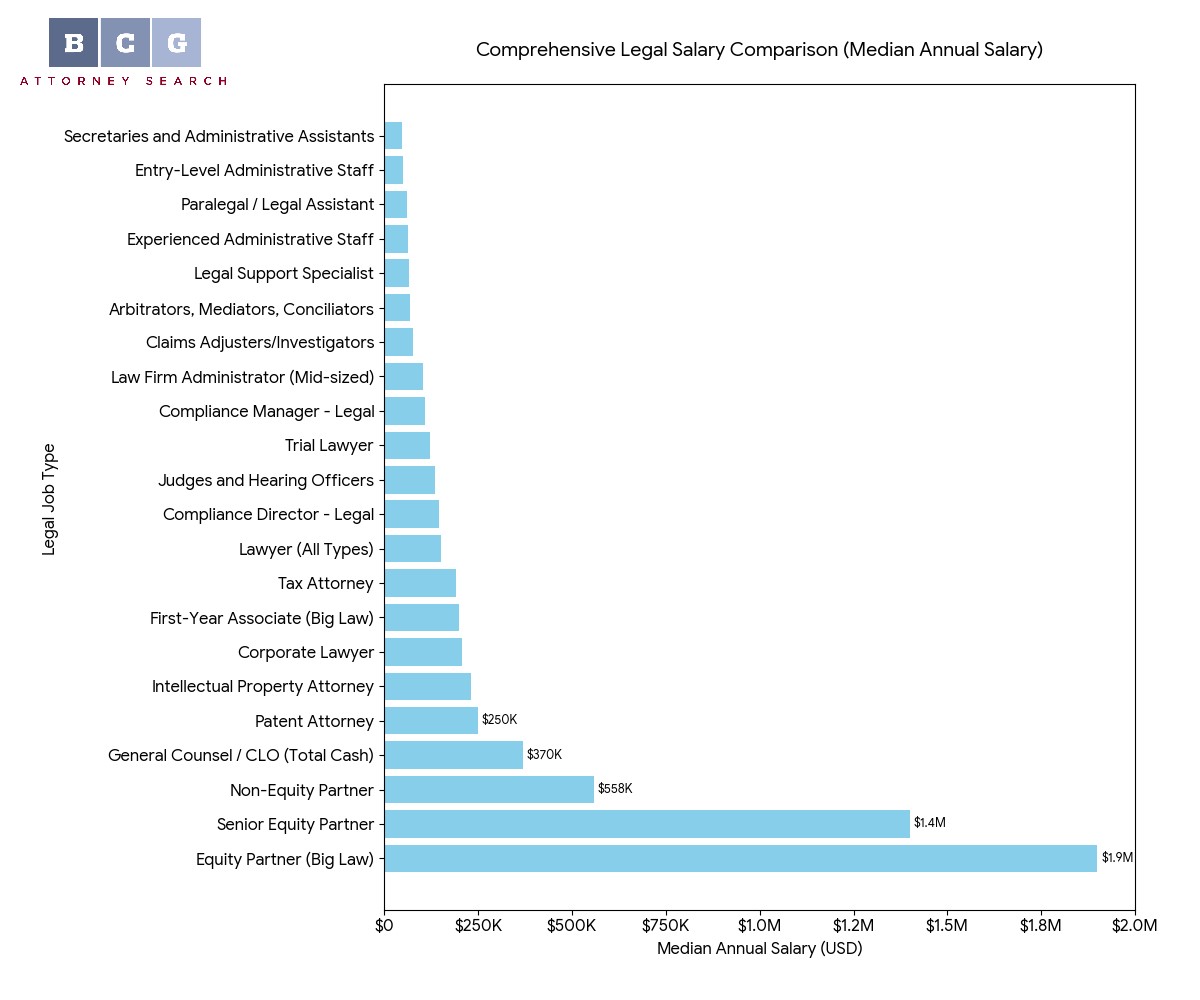
Legal profession compensation varies dramatically based on practice setting, geographic location, specialization, and experience level. This analysis provides comprehensive salary data across all major legal career categories. As technology continues reshaping legal practice, many attorneys are exploring Tech Industry Legal Careers for more innovative and fast-growing opportunities.
Salary Distribution by Practice Setting
| Practice Setting | Entry Level | Mid-Career | Senior Level | Top Earners |
|---|---|---|---|---|
| BigLaw Firms | $225,000 | $350,000 | $435,000 | $3,000,000+ |
| Mid-Size Firms | $120,000 | $180,000 | $250,000 | $800,000 |
| Small Firms | $70,000 | $95,000 | $150,000 | $400,000 |
| Corporate In-House | $130,000 | $200,000 | $350,000 | $2,000,000+ |
| Government | $55,000 | $85,000 | $125,000 | $200,000 |
| Public Interest | $50,000 | $70,000 | $90,000 | $150,000 |
| Solo Practice | $40,000 | $85,000 | $150,000 | $500,000+ |
Salary Trends and Market Dynamics
Legal compensation has increased significantly over the past decade, driven by several factors:
BigLaw Salary Escalation: Major law firms have engaged in a "salary war" to attract and retain top talent, with first-year associate salaries increasing from $160,000 in 2016 to $225,000 in 2024, representing a 41% increase.
In-House Premium: Corporate legal departments have increased compensation to compete with law firms for experienced attorneys, creating a "BigLaw premium" for in-house positions.
Specialization Premium: Attorneys with specialized expertise in high-demand areas such as cybersecurity, data privacy, and healthcare compliance command significant salary premiums.
Geographic Arbitrage: Remote work opportunities have allowed attorneys to access high-paying positions while living in lower-cost markets, though many employers are adjusting compensation for geographic differences. Because job types differ greatly depending on market and firm size, I also recommend reading the piece on how to choose the right law firm and geographic area.
Bonus and Incentive Structures
Many legal positions include significant bonus components that can represent 20-50% of total compensation:
Law Firm Bonuses: BigLaw firms typically pay year-end bonuses based on billable hours and firm performance, ranging from $15,000 for first-year associates to $100,000+ for senior associates.
Corporate Bonuses: In-house positions often include annual performance bonuses (10-25% of base salary) and equity compensation for senior positions.
Contingency Fees: Personal injury and plaintiff-side litigation attorneys often work on contingency fee arrangements, creating potential for significant earnings in successful cases.
Career Progression and Development
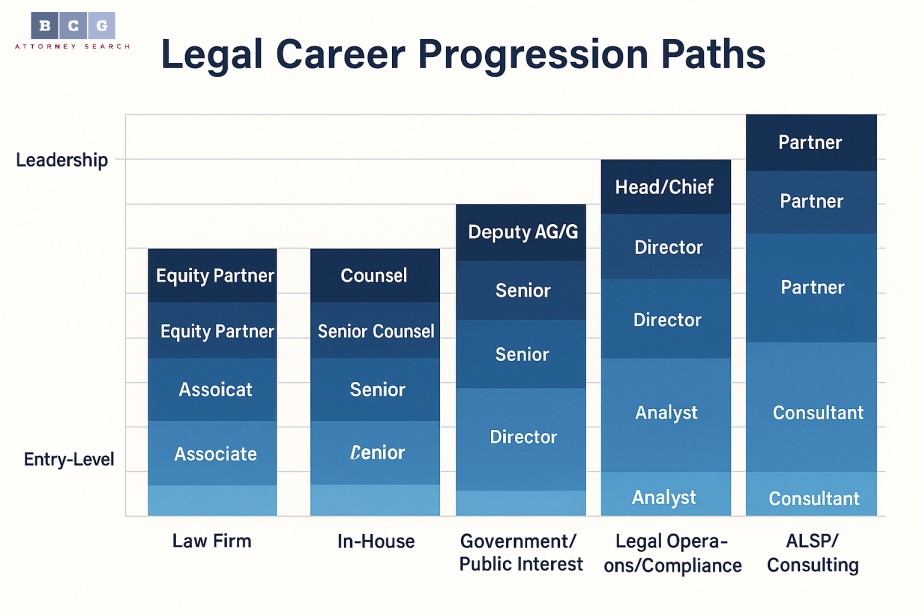
Legal career progression varies significantly by practice setting and specialization. Understanding typical career paths helps attorneys make informed decisions about their professional development. Compensation strategies vary by career path; our Attorney Compensation Strategy piece breaks this down.
Traditional Law Firm Progression
Law firm career progression typically follows a structured path:
Associate Track (Years 1-8):
- Junior Associate (Years 1-2): Document review, research, basic drafting
- Mid-Level Associate (Years 3-5): Client contact, depositions, motion practice
- Senior Associate (Years 6-8): Case management, client development, mentoring
Partnership Track:
- Non-Equity Partner: Management responsibilities, guaranteed compensation
- Equity Partner: Ownership stake, business development requirements
- Senior Partner: Firm leadership, major client relationships
Corporate Career Progression
Corporate legal careers often offer broader business exposure and faster advancement opportunities:
Typical Corporate Legal Progression:
- Associate Counsel (Years 1-3): Specific legal matters, regulatory compliance
- Counsel (Years 4-7): Broader responsibilities, cross-functional collaboration
- Senior Counsel (Years 8-12): Team leadership, strategic planning
- Deputy General Counsel (Years 10+): Department management, executive responsibilities
- General Counsel (Years 12+): Executive team membership, board reporting
Cross-Functional Opportunities: Corporate attorneys often transition into business roles including:
- Business development and strategy
- Compliance and risk management
- Human resources and employment
- Mergers and acquisitions
- General management positions
Government Career Progression
Government legal careers offer unique advancement opportunities through both legal and administrative tracks:
Legal Track:
- Staff Attorney → Senior Attorney → Supervisory Attorney → Division Chief
Administrative Track:
- Agency Counsel → Deputy Director → Director → Agency Head
Judicial Track:
- Government Attorney → Administrative Law Judge → State Judge → Federal Judge
Alternative Career Development
Alternative legal careers often provide more flexibility in career progression and may not follow traditional hierarchical structures:
Consulting Progression:
- Independent consultant → Boutique firm founder → Industry expert
Technology Progression:
- Legal tech specialist → Product manager → Executive leadership
Academic Progression:
- Adjunct instructor → Clinical professor → Tenure-track faculty
Skills Development for Career Advancement
Successful legal career progression requires continuous skill development in both legal and business competencies:
Legal Skills:
- Specialization in high-demand practice areas
- Trial and litigation experience
- Regulatory expertise
- International law knowledge
- Technology and data privacy understanding
Business Skills:
- Business development and client relations
- Project management and efficiency
- Financial analysis and budgeting
- Leadership and team management
- Strategic planning and risk assessment
Technology Skills:
- Legal research platforms and databases
- Document management and e-discovery tools
- Data analytics and visualization
- Artificial intelligence and automation
- Cybersecurity and privacy tools
Geographic Market Analysis
Legal employment opportunities and compensation vary significantly by geographic market, influenced by local economic conditions, industry concentration, cost of living, and regulatory environments. To explore specific legal communities and entry points by city, the Top 250 US Cities – Bar Associations & Job Boards Directory provides a curated list of bar associations and job boards nationwide.
Major Legal Markets
New York City
New York remains the largest and highest-compensated legal market in the United States, driven by its position as a global financial center and the concentration of major law firms and corporate headquarters.
New York Legal Market Statistics (2024)
- Total Attorneys: ~180,000
- Median Salary: $180,500
- BigLaw First-Year: $225,000 + bonus
- Corporate Counsel: $200,000-400,000
- Government Attorney: $70,000-140,000
Market Characteristics:
- Highest concentration of BigLaw firms
- Global financial services hub
- Complex commercial litigation center
- International arbitration hub
- Highest cost of living adjustments
Washington, D.C.
The D.C. market is unique due to its concentration of government agencies, regulatory practices, and policy-focused legal work.
Washington D.C. Legal Market Statistics (2024)
- Total Attorneys: ~85,000
- Median Salary: $165,000
- Government Attorney: $80,000-170,000
- Regulatory Practice: $200,000-350,000
- Public Interest: $55,000-90,000
Market Specializations:
- Government relations and lobbying
- Regulatory compliance and enforcement
- White collar criminal defense
- International trade and sanctions
- Energy and environmental regulation
California Markets
California's diverse economy creates multiple distinct legal markets with different specializations:
Silicon Valley/San Francisco:
- Technology and intellectual property focus
- Venture capital and startup representation
- Privacy and data security law
- High compensation levels due to tech industry wealth
Los Angeles:
- Entertainment and media law
- Real estate and development
- International trade (Pacific Rim focus)
- Aerospace and defense contracting
Chicago
Chicago serves as the legal center for the Midwest, with strengths in corporate law, commodities trading, and transportation regulation.
Texas Markets
Texas has experienced significant legal market growth, driven by economic development and business-friendly policies:
Houston: Energy law, international trade, maritime law
Dallas: Corporate law, telecommunications, healthcare
Austin: Technology law, government relations, intellectual property
Emerging Legal Markets
Several secondary markets have experienced significant growth and offer attractive career opportunities with lower cost of living:
- Nashville: Healthcare law, music and entertainment
- Denver: Natural resources, cannabis law, outdoor recreation
- Seattle: Technology, aerospace, international trade
- Miami: International business, real estate, banking
- Atlanta: Corporate headquarters, logistics, healthcare
Remote Work Impact
The COVID-19 pandemic accelerated remote work adoption in the legal profession, creating new opportunities and challenges:
Opportunities:
- Access to high-paying positions regardless of location
- Reduced cost of living arbitrage
- Improved work-life balance
- Expanded talent pool for employers
Challenges:
- Reduced face-to-face client interaction
- Difficulty in mentoring and training junior attorneys
- Technology and security requirements
- State bar licensing and practice limitations
Demographic Trends and Diversity
The legal profession has undergone significant demographic changes over the past decades, with important implications for career opportunities and workplace culture. If you’re considering a shift in your legal career, Mastering the Legal Career Transition offers actionable insights to navigate this change effectively.
Gender Representation
Women now represent a significant portion of the legal profession, though advancement to leadership positions remains challenging:
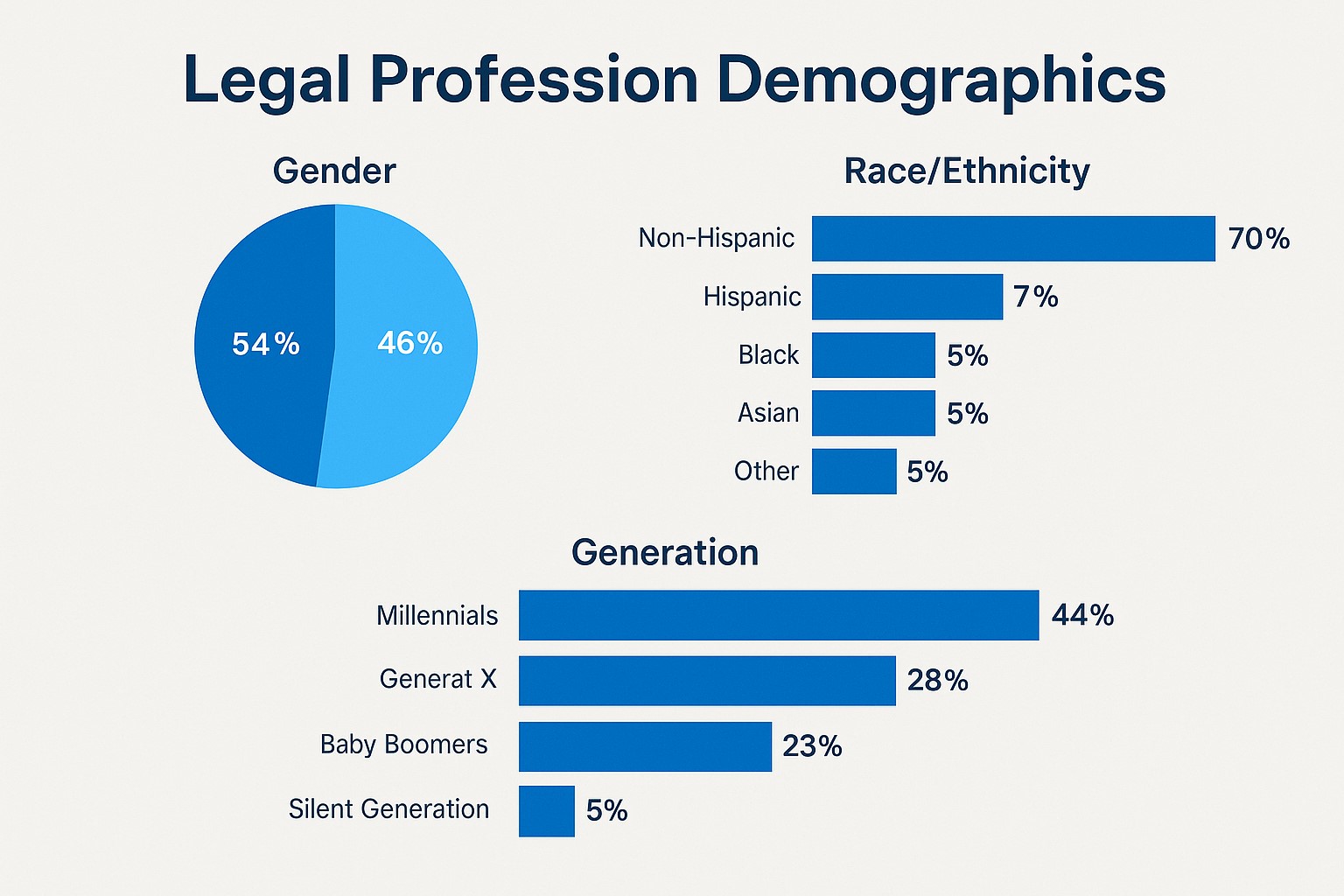
Current Gender Distribution (2024):
- Law School Enrollment: 56% women, 44% men
- Associates: 50% women, 50% men
- Partners: 26% women, 74% men
- Equity Partners: 22% women, 78% men
- General Counsel: 28% women, 72% men
Gender Pay Gap: Despite increased representation, significant pay gaps persist, with women attorneys earning approximately 77 cents for every dollar earned by male attorneys at similar experience levels.
Racial and Ethnic Diversity
The legal profession remains less diverse than the general population, though progress is being made:
Racial/Ethnic Distribution (2024):
- White: 86% of attorneys
- Asian: 5% of attorneys
- Hispanic/Latino: 4% of attorneys
- Black/African American: 3% of attorneys
- Other: 2% of attorneys
Diversity Initiatives: Legal employers have implemented various diversity and inclusion programs, including:
- Diversity scholarships and pipeline programs
- Mentorship and sponsorship initiatives
- Supplier diversity programs
- Unconscious bias training
- Diverse hiring and promotion requirements
Generational Differences
The legal profession currently spans four generations, each with different career expectations and work styles:
Baby Boomers (Born 1946-1964):
- Traditional career progression expectations
- Face-to-face relationship preferences
- Hierarchical work style comfort
- Retirement planning and succession concerns
Generation X (Born 1965-1980):
- Work-life balance priorities
- Leadership and management responsibilities
- Technology adaptation challenges
- Sandwich generation pressures
Millennials (Born 1981-1996):
- Purpose-driven career choices
- Technology natives
- Collaborative work preferences
- Frequent career changes and mobility
Generation Z (Born 1997-2012):
- Digital-first communication preferences
- Entrepreneurial mindset
- Social justice and sustainability focus
- Flexible work arrangement expectations
Impact on Legal Careers
Demographic trends are reshaping legal career expectations and opportunities:
Flexible Work Arrangements: Younger attorneys increasingly demand flexible work options, leading to increased remote work, part-time partnerships, and alternative scheduling arrangements.
Alternative Career Paths: Traditional law firm partnership is less attractive to many attorneys, driving growth in in-house positions, alternative legal careers, and entrepreneurial ventures.
Technology Adoption: Generational differences in technology comfort levels are driving changes in legal practice, with younger attorneys leading adoption of legal technology tools.
Social Impact Focus: Increasing emphasis on social justice and community impact is driving growth in public interest law, pro bono work, and corporate social responsibility roles.
Future Outlook and Emerging Opportunities
The legal profession continues to evolve rapidly, driven by technological advancement, changing client expectations, and broader economic and social trends. Understanding emerging opportunities is crucial for legal career planning. Attorneys exploring career alternatives can benefit from data in The Legal Industry Layoff Report (2008–2026), which contextualizes market risks and informs smart career choices.
Technology-Driven Career Opportunities
Artificial intelligence, automation, and digital transformation are creating new legal career categories while transforming traditional roles:
AI and Legal Analytics:
- Legal data scientists and analysts
- AI training and implementation specialists
- Predictive analytics consultants
- Legal research and discovery automation experts
Blockchain and Cryptocurrency Law:
- Digital asset regulation specialists
- Smart contract attorneys
- Cryptocurrency compliance officers
- DeFi (Decentralized Finance) legal advisors
Cybersecurity and Privacy:
- Chief Privacy Officers
- Cybersecurity incident response attorneys
- Data governance specialists
- International privacy regulation experts
Regulatory and Compliance Growth Areas
Increasing regulatory complexity across industries is creating specialized compliance career opportunities:
Environmental, Social, and Governance (ESG):
- ESG compliance officers
- Sustainability reporting specialists
- Climate risk assessment attorneys
- Social impact measurement professionals
Healthcare Innovation:
- Telemedicine regulation specialists
- Digital health compliance attorneys
- Medical device cybersecurity lawyers
- Healthcare AI and automation advisors
Alternative Business Models
New legal service delivery models are creating innovative career opportunities:
Alternative Legal Service Providers (ALSPs):
- Legal process outsourcing specialists
- Contract attorney coordinators
- Legal project managers
- Flexible staffing consultants
Legal Technology Companies:
- Legal software product managers
- Customer success managers
- Implementation consultants
- Legal content developers
Market Predictions
Based on current trends and market analysis, several predictions emerge for the legal profession over the next decade:
Employment Growth: Overall legal employment is projected to grow 5% from 2023-2033, about as fast as the average for all occupations, with approximately 35,600 new positions expected annually.
Sector Growth Patterns:
- Corporate In-House: Continued rapid growth (+25-30% over next decade)
- Legal Technology: Explosive growth in legal tech careers (+40-50%)
- Compliance and Risk: Strong growth due to regulatory complexity (+20-25%)
- BigLaw: Moderate growth limited by technology efficiency gains (+5-10%)
- Government: Stable employment with cyclical variations (0-5%)
- Small Firms: Consolidation pressure may limit growth (0-5%)
Compensation Trends:
- Continued BigLaw salary escalation to compete for top talent
- In-house compensation increases to match law firm competition
- Technology and specialized skills commanding premium compensation
- Geographic salary arbitrage due to remote work opportunities
Skills for Future Success
Attorneys planning for long-term career success should develop skills in emerging areas:
Technology Skills:
- Data analysis and visualization
- AI and machine learning understanding
- Cybersecurity and privacy expertise
- Project management and process improvement
Business Skills:
- Financial analysis and business modeling
- Strategic planning and risk assessment
- Change management and transformation
- Cross-cultural communication and global perspective
Specialized Legal Knowledge:
- International and comparative law
- Emerging technology regulation
- Environmental and sustainability law
- Healthcare innovation and life sciences
Conclusion and Recommendations
The legal profession in 2025 offers an unprecedented array of career opportunities, extending far beyond traditional courtroom practice to encompass technology, business, policy, and specialized consulting roles. This comprehensive analysis has examined over 100 distinct career paths available to attorneys, revealing a profession in significant transition. As you explore which type of law best suits you, Finding Happiness in the Legal Industry provides valuable perspective on aligning your role with your personal sense of happiness and purpose. See How to Succeed in the Practice of Law for practical guidance on excelling in your chosen career path.
Key Findings
Market Diversity: The legal profession now encompasses roles in virtually every sector of the economy, from traditional law firms to technology companies, healthcare organizations, financial institutions, and government agencies. This diversity provides attorneys with numerous options for career specialization and development.
Compensation Variation: Legal compensation ranges from $40,000 for entry-level public interest positions to over $3 million for top BigLaw partners, with significant variation based on practice setting, specialization, and geographic location. The median attorney salary of $145,760 masks enormous diversity in earning potential.
Growth Opportunities: Corporate in-house legal departments represent the fastest-growing employment sector, with 37.9% growth over the past decade. Legal technology and compliance roles are also experiencing rapid expansion, while traditional law firm employment growth has moderated.
Evolving Skills Requirements: Success in modern legal careers increasingly requires combination of legal expertise, business acumen, and technology proficiency. Traditional legal research and writing skills remain important but must be supplemented with data analysis, project management, and strategic thinking capabilities.
Career Planning Recommendations
For Law Students:
- Develop specialized expertise in high-growth areas such as technology, healthcare, or environmental law
- Gain practical experience through internships and clinics in diverse practice settings
- Build technology and data analysis skills alongside traditional legal training
- Consider alternative career paths early rather than defaulting to law firm practice
- Network across industries, not just within the legal profession
For Early Career Attorneys:
- Gain diverse experience across practice areas and settings to identify optimal career fit
- Develop business development and client relationship skills regardless of practice setting
- Pursue continuing education in emerging legal areas and business skills
- Build a professional network that extends beyond your current employer or practice area
- Consider geographic mobility to access better career opportunities
For Experienced Attorneys:
- Evaluate alternative career paths that may offer better work-life balance or compensation
- Develop expertise in legal operations, technology, or specialized compliance areas
- Consider transitioning to corporate in-house roles for career advancement opportunities
- Explore consulting or alternative business models for greater autonomy and flexibility
- Mentor junior attorneys and build succession planning into career development
Industry Recommendations
Legal Education: Law schools should expand curriculum to include business skills, technology training, and alternative career preparation. Clinical programs should encompass diverse practice settings including corporate, government, and technology environments.
Legal Employers: Organizations should invest in professional development programs that prepare attorneys for evolving role requirements. Diversity and inclusion initiatives must continue to address persistent representation gaps in leadership positions.
Professional Associations: Bar associations and legal organizations should provide more resources for alternative career development and support attorneys transitioning between different practice settings. If you’re navigating the transition from law student to practicing attorney, From Bar Exam to Offer Letter provides a clear roadmap for securing your first position after the exam.
Future Considerations
The legal profession will continue evolving rapidly, driven by technological advancement, regulatory change, and shifting client expectations. Attorneys who embrace lifelong learning, develop diverse skill sets, and remain adaptable to change will be best positioned for long-term success.
The traditional model of law firm partnership as the pinnacle of legal careers is giving way to a more diverse set of career aspirations, including corporate leadership, entrepreneurship, public service, and specialized expertise. This evolution creates opportunities for attorneys to find careers that better align with their personal values, interests, and lifestyle preferences. If you're feeling pressure or doubt while exploring your ideal legal path, this video offers grounding insight on staying resilient in a profession where many hope to see you fail.
Technology will continue transforming legal practice, creating new career opportunities while potentially eliminating some traditional roles. Attorneys who understand and embrace legal technology will have significant competitive advantages in the evolving market. If you’re already practising and thinking of moving firms or cities, this attorney lateral movement guide lays out the key strategic considerations.
Appendices
Appendix A: Salary Data Sources and Methodology
Salary data in this report is compiled from multiple sources to ensure accuracy and comprehensiveness:
- Bureau of Labor Statistics: Official government employment and wage statistics
- National Association for Law Placement (NALP): Annual salary surveys and employment reports
- American Bar Association: Legal profession demographic and compensation studies
- Legal industry publications: The American Lawyer, Law360, Legal Compass reports
- Recruitment firm data: Major legal recruitment firms' market reports
- Corporate compensation surveys: Association of Corporate Counsel and similar organizations
All salary figures represent median compensation unless otherwise specified and are adjusted to 2024 dollars using Consumer Price Index data.
Appendix B: Geographic Salary Adjustments
| Market | Cost of Living Index | Salary Adjustment Factor | Typical BigLaw Starting Salary |
|---|---|---|---|
| New York City | 168 | 1.00 | $225,000 |
| San Francisco | 164 | 0.98 | $220,000 |
| Washington DC | 152 | 0.90 | $205,000 |
| Los Angeles | 148 | 0.88 | $200,000 |
| Boston | 149 | 0.89 | $200,000 |
| Chicago | 107 | 0.85 | $190,000 |
| Dallas | 101 | 0.82 | $185,000 |
| Atlanta | 97 | 0.80 | $180,000 |
Appendix C: Professional Development Resources
Continuing Legal Education Providers:
- American Law Institute Continuing Legal Education
- Practising Law Institute (PLI)
- State and local bar association CLE programs
- Specialized professional associations
Professional Associations by Practice Area:
- Corporate Law: Association of Corporate Counsel (ACC)
- Intellectual Property: American Intellectual Property Law Association (AIPLA)
- Healthcare: American Health Law Association (AHLA)
- Environmental: Environmental Law Institute (ELI)
- Employment: Labor and Employment Law Section (ABA)
- International: American Society of International Law (ASIL)
Career Development Organizations:
- National Association for Law Placement (NALP)
- Legal Marketing Association (LMA)
- International Legal Technology Association (ILTA)
- Corporate Legal Operations Consortium (CLOC)
Disclaimer: This report is based on publicly available data and industry research as of January 2025. Salary figures and employment statistics may vary based on specific circumstances, geographic location, and market conditions. Readers should conduct their own research and consult with career advisors before making career decisions based on this information. See real-world examples of niche career options for law grads in this video: 60 Nontraditional Jobs You Can Do with a Law Degree (and Should Strongly Consider Doing).
Sources: Bureau of Labor Statistics, American Bar Association, National Association for Law Placement, The American Lawyer, Law360, Association of Corporate Counsel, and various legal industry publications and surveys.
Report Prepared By: BCG Attorney Search Legal Industry Research Team
Publication Date: January 2025
Document Length: Approximately 25,000 words
1. What legal career paths offer the strongest long-term growth for attorneys in today’s competitive job market?
Answer: The most resilient legal career paths today are those aligned with regulatory complexity, technological advancement, and specialized client needs. Practice areas like privacy, cybersecurity, healthcare, and employment law continue to expand as industries evolve. Attorneys who commit to deep specialization and consistent skill-building usually see the greatest long-term growth. Exploring openings through BCG Attorney Search can help you identify high-demand practice areas in real time.2. How can attorneys make a successful lateral move that accelerates career growth and increases long-term stability?
Answer: A successful lateral move hinges on aligning your strengths with a firm’s precise needs and culture. Firms increasingly seek candidates who can demonstrate consistent work ethic, strong writing, and a commitment to long-term excellence—not just portable business. Preparing your narrative and understanding the hiring market’s nuances can greatly improve outcomes. Working with a legal recruiter like BCG Attorney Search can help you evaluate whether a lateral move will truly advance your goals.3. Why do law firms prioritize specialized experience when hiring attorneys in 2026?
Answer: Law firms are facing heightened client expectations, meaning they must hire attorneys who can contribute value immediately. Specialized experience reduces training time, increases billable predictability, and strengthens a firm’s competitive positioning. For attorneys, developing expertise in a focused practice area signals commitment and reliability—traits firms prize more than ever. Building this specialization early can dramatically improve your attorney job search trajectory.4. Can working with a legal recruiter improve your attorney job search outcomes in a rapidly changing market?
Answer: Yes. A skilled legal recruiter provides market insights, confidential guidance, and access to opportunities that many candidates never see on public job boards. They can help refine your résumé, strengthen your positioning, and identify the firms most aligned with your long-term goals. Many attorneys find that recruiters like BCG Attorney Search accelerate their job search and provide clarity during critical career transitions.5. Should lawyers consider transitioning from BigLaw to boutique firms for better work-life balance and career satisfaction?
Answer: For many attorneys, boutique firms offer greater autonomy, closer client relationships, and a more sustainable work-life balance than traditional BigLaw environments. While compensation structures may differ, boutiques often allow attorneys to take on substantive work earlier and develop faster. The key is understanding your long-term goals and whether the firm’s culture supports them. If you’re considering a transition, BCG Attorney Search can help you compare BigLaw and boutique opportunities with clarity.About Harrison Barnes
No legal recruiter in the United States has placed more attorneys at top law firms across every practice area than Harrison Barnes. His unmatched expertise, industry connections, and proven placement strategies have made him the most influential legal career advisor for attorneys seeking success in Big Law, elite boutiques, mid-sized firms, small firms, firms in the largest and smallest markets, and in over 350 separate practice areas.
A Reach Unlike Any Other Legal Recruiter
Most legal recruiters focus only on placing attorneys in large markets or specific practice areas, but Harrison places attorneys at all levels, in all practice areas, and in all locations-from the most prestigious firms in New York, Los Angeles, and Washington, D.C., to small and mid-sized firms in rural markets. Every week, he successfully places attorneys not only in high-demand practice areas like corporate and litigation but also in niche and less commonly recruited areas such as:
- Immigration Law
- Workers Compensation
- Insurance
- Family Law
- Trust and Estate
- Municipal law
- And many more...
This breadth of placements is unheard of in the legal recruiting industry and is a testament to his extraordinary ability to connect attorneys with the right firms, regardless of market size or practice area.
Proven Success at All Levels
With over 25 years of experience, Harrison has successfully placed attorneys at over 1,000 law firms, including:
- Top Am Law 100 firms such including Sullivan and Cromwell, and almost every AmLaw 100 and AmLaw 200 law firm.
- Elite boutique firms with specialized practices
- Mid-sized firms looking to expand their practice areas
- Growing firms in small and rural markets
He has also placed hundreds of law firm partners and has worked on firm and practice area mergers, helping law firms strategically grow their teams.
Unmatched Commitment to Attorney Success - The Story of BCG Attorney Search
Harrison Barnes is not just the most effective legal recruiter in the country, he is also the founder of BCG Attorney Search, a recruiting powerhouse that has helped thousands of attorneys transform their careers. His vision for BCG goes beyond just job placement; it is built on a mission to provide attorneys with opportunities they would never have access to otherwise. Unlike traditional recruiting firms, BCG Attorney Search operates as a career partner, not just a placement service. The firm's unparalleled resources, including a team of over 150 employees, enable it to offer customized job searches, direct outreach to firms, and market intelligence that no other legal recruiting service provides. Attorneys working with Harrison and BCG gain access to hidden opportunities, real-time insights on firm hiring trends, and guidance from a team that truly understands the legal market. You can read more about how BCG Attorney Search revolutionizes legal recruiting here: The Story of BCG Attorney Search and What We Do for You.
The Most Trusted Career Advisor for Attorneys
Harrison's legal career insights are the most widely followed in the profession.
- His articles on BCG Search alone are read by over 150,000 attorneys per month, making his guidance the most sought-after in the legal field. Read his latest insights here.
- He has conducted hundreds of hours of career development webinars, available here: Harrison Barnes Webinar Replays.
- His placement success is unmatched-see examples here: Harrison Barnes' Attorney Placements.
- He has created numerous comprehensive career development courses, including BigLaw Breakthrough, designed to help attorneys land positions at elite law firms.
Submit Your Resume to Work with Harrison Barnes
If you are serious about advancing your legal career and want access to the most sought-after law firm opportunities, Harrison Barnes is the most powerful recruiter to have on your side.
Submit your resume today to start working with him: Submit Resume Here
With an unmatched track record of success, a vast team of over 150 dedicated employees, and a reach into every market and practice area, Harrison Barnes is the recruiter who makes career transformations happen and has the talent and resources behind him to make this happen.
A Relentless Commitment to Attorney Success
Unlike most recruiters who work with only a narrow subset of attorneys, Harrison Barnes works with lawyers at all stages of their careers, from junior associates to senior partners, in every practice area imaginable. His placements are not limited to only those with "elite" credentials-he has helped thousands of attorneys, including those who thought it was impossible to move firms, find their next great opportunity.
Harrison's work is backed by a team of over 150 professionals who work around the clock to uncover hidden job opportunities at law firms across the country. His team:
- Finds and creates job openings that aren't publicly listed, giving attorneys access to exclusive opportunities.
- Works closely with candidates to ensure their resumes and applications stand out.
- Provides ongoing guidance and career coaching to help attorneys navigate interviews, negotiations, and transitions successfully.
This level of dedicated support is unmatched in the legal recruiting industry.
A Legal Recruiter Who Changes Lives
Harrison believes that every attorney-no matter their background, law school, or previous experience-has the potential to find success in the right law firm environment. Many attorneys come to him feeling stuck in their careers, underpaid, or unsure of their next steps. Through his unique ability to identify the right opportunities, he helps attorneys transform their careers in ways they never thought possible.
He has worked with:
- Attorneys making below-market salaries who went on to double or triple their earnings at new firms.
- Senior attorneys who believed they were "too experienced" to make a move and found better roles with firms eager for their expertise.
- Attorneys in small or remote markets who assumed they had no options-only to be placed at strong firms they never knew existed.
- Partners looking for a better platform or more autonomy who successfully transitioned to firms where they could grow their practice.
For attorneys who think their options are limited, Harrison Barnes has proven time and time again that opportunities exist-often in places they never expected.
Submit Your Resume Today - Start Your Career Transformation
If you want to explore new career opportunities, Harrison Barnes and BCG Attorney Search are your best resources. Whether you are looking for a BigLaw position, a boutique firm, or a move to a better work environment, Harrison's expertise will help you take control of your future.
Submit Your Resume Here to get started with Harrison Barnes today.
Harrison's reach, experience, and proven results make him the best legal recruiter in the industry. Don't settle for an average recruiter-work with the one who has changed the careers of thousands of attorneys and can do the same for you.
About BCG Attorney Search
BCG Attorney Search matches attorneys and law firms with unparalleled expertise and drive, while achieving results. Known globally for its success in locating and placing attorneys in law firms of all sizes, BCG Attorney Search has placed thousands of attorneys in law firms in thousands of different law firms around the country. Unlike other legal placement firms, BCG Attorney Search brings massive resources of over 150 employees to its placement efforts locating positions and opportunities its competitors simply cannot. Every legal recruiter at BCG Attorney Search is a former successful attorney who attended a top law school, worked in top law firms and brought massive drive and commitment to their work. BCG Attorney Search legal recruiters take your legal career seriously and understand attorneys. For more information, please visit www.BCGSearch.com.
Harrison Barnes does a weekly free webinar with live Q&A for attorneys and law students each Wednesday at 10:00 am PST. You can attend anonymously and ask questions about your career, this article, or any other legal career-related topics. You can sign up for the weekly webinar here: Register on Zoom
Harrison also does a weekly free webinar with live Q&A for law firms, companies, and others who hire attorneys each Wednesday at 10:00 am PST. You can sign up for the weekly webinar here: Register on Zoom
You can browse a list of past webinars here: Webinar Replays
You can also listen to Harrison Barnes Podcasts here: Attorney Career Advice Podcasts
You can also read Harrison Barnes' articles and books here: Harrison's Perspectives
Harrison Barnes is the legal profession's mentor and may be the only person in your legal career who will tell you why you are not reaching your full potential and what you really need to do to grow as an attorney--regardless of how much it hurts. If you prefer truth to stagnation, growth to comfort, and actionable ideas instead of fluffy concepts, you and Harrison will get along just fine. If, however, you want to stay where you are, talk about your past successes, and feel comfortable, Harrison is not for you.
Truly great mentors are like parents, doctors, therapists, spiritual figures, and others because in order to help you they need to expose you to pain and expose your weaknesses. But suppose you act on the advice and pain created by a mentor. In that case, you will become better: a better attorney, better employees, a better boss, know where you are going, and appreciate where you have been--you will hopefully also become a happier and better person. As you learn from Harrison, he hopes he will become your mentor.
To read more career and life advice articles visit Harrison's personal blog.