Attorney Compensation Strategy
How to Set Salaries That Attract, Retain, and Maximize Legal Talent
Founder & CEO, BCG Attorney Search
25+ Years Experience Placing Legal Talent
Table of Contents
Executive Summary
After 25 years of placing attorneys at law firms across the country, I've learned that compensation strategy isn't just about paying competitive salaries—it's about understanding the total cost of talent decisions. In this report, I'll share the frameworks and insights that have helped hundreds of law firms build compensation strategies that actually work.
Bottom Line: Compensation strategy is not about paying the most—it's about paying the smartest. The firms that win understand that every dollar spent on strategic compensation returns multiple dollars in retention, productivity, and profitability.
Why Compensation Strategy Matters: Lessons from the Trenches
I founded BCG Attorney Search with a simple observation: most law firms hire reactively rather than strategically. They wait until they're desperate for talent, then wonder why they can't attract the attorneys they need. Over the years, I've seen this pattern repeat countless times, and it almost always comes down to compensation strategy—or the lack thereof.
The Real Stakes of Compensation Decisions
From my experience working with over 1,000 law firms, I've observed that compensation decisions impact far more than just attorney satisfaction. They directly influence:
- Client Retention: Attorneys who feel undervalued are 3x more likely to consider lateral moves, taking client relationships with them
- Firm Reputation: Word travels fast in legal circles—compensation reputation can make or break recruiting efforts
- Partnership Development: Underpaid associates are less likely to stay long enough to develop into profitable partners
- Profitability: Counter-intuitively, strategic overpaying often leads to higher profits through increased retention and productivity
"The cost of replacing a good attorney is always higher than the cost of keeping them. The question isn't whether you can afford to pay competitively—it's whether you can afford not to."
The Barnes Five-Factor Hiring Framework: The Foundation of Smart Compensation
Before we dive into specific compensation strategies, we need to understand how hiring and compensation decisions intersect. Over my career, I've developed what I call the Five-Factor Framework—five questions that determine not just whether to hire someone, but how much they're worth to your firm.
The Five Critical Questions
1. Can they do the job? (Technical Competency)
This goes beyond basic legal skills to encompass sophistication, growth potential, and ability to handle complex matters.
2. Will they stay with us? (Longevity and Commitment)
The most important factor for compensation strategy—retention drives ROI on salary investments.
3. Can they be managed? (Cultural Fit and Coachability)
Determines integration success and team productivity impact.
4. Do they want this job? (Motivation and Engagement)
Engaged attorneys produce better work and stay longer.
5. Do we like them? (Team Chemistry and Client Interaction)
Cultural ambassadors who clients specifically request are worth premium compensation.
Case Study: The $50,000 Difference
I once worked with a mid-sized corporate firm considering two third-year associates for the same position. Candidate A had solid but unremarkable experience at a regional firm. Candidate B had worked on cutting-edge transactions at a top-tier firm but was looking to relocate. The firm initially wanted to offer both candidates the same salary—$190,000.
My recommendation: Offer Candidate A $185,000 and Candidate B $235,000. The $50,000 difference reflected not just experience, but the immediate value Candidate B could bring to complex deals.
The outcome: Both accepted. Candidate B brought in $1.2M in new business in their first year, more than justifying the higher investment.
Compensation Benchmarking: What the Data Really Shows
After placing thousands of attorneys, I've learned that benchmarking data is only as good as your ability to interpret it contextually. The market data tells a story, but you need to understand the nuances behind the numbers.
2024 First-Year Associate Compensation by Firm Size
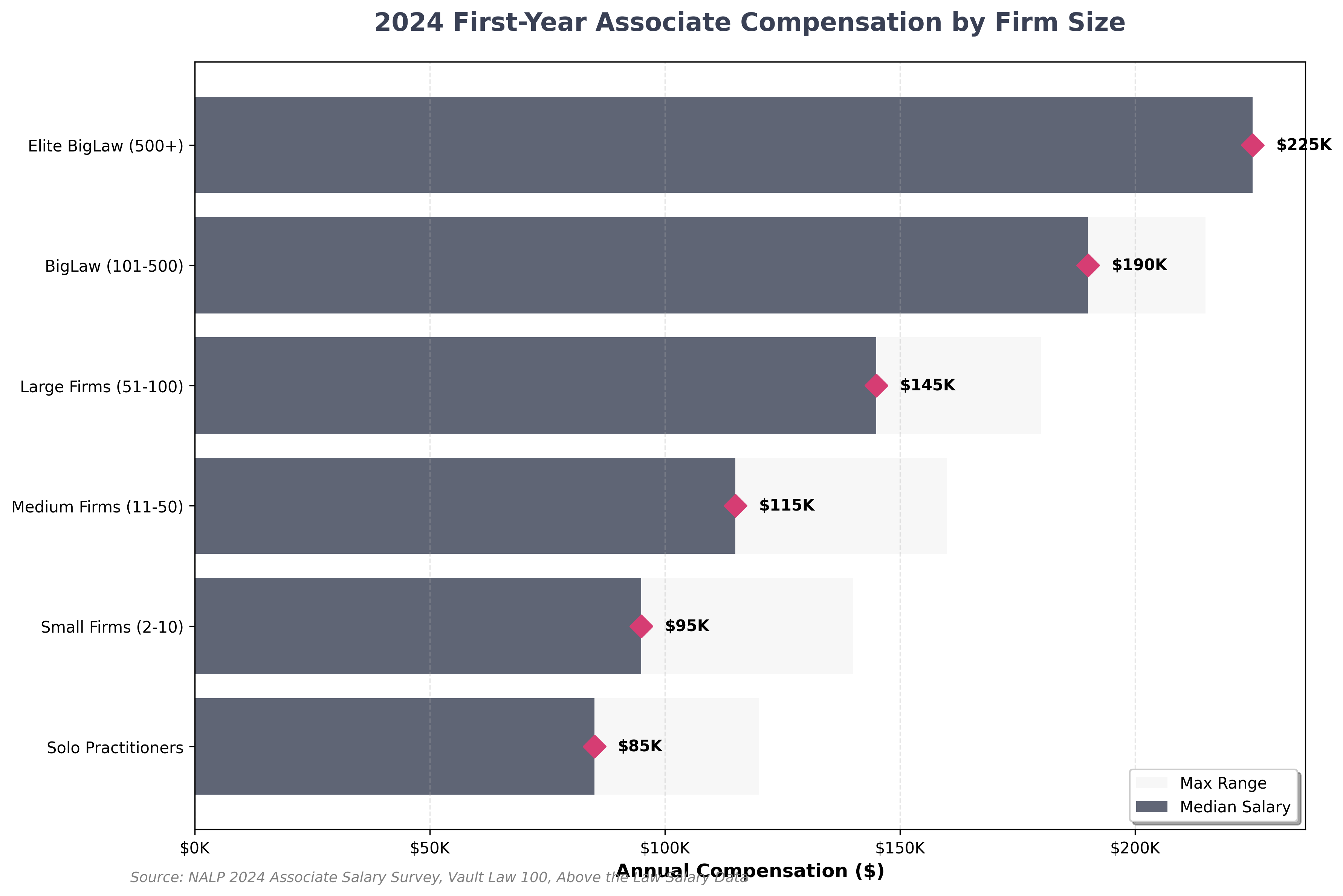
Based on NALP 2024 Associate Salary Survey and BCG Attorney Search market analysis
What the Numbers Don't Tell You
Looking at the compensation data above, most firms focus on the median numbers. But in my experience, the firms that win the talent war are the ones that understand the stories behind these ranges:
- Solo Practitioners ($65K-$120K): The wide range reflects everything from struggling consumer attorneys to successful boutique specialists. The key insight: specialization drives the top of this range.
- Small Firms ($90K-$165K): These firms often offer the best lifestyle-to-compensation ratio, but struggle with career advancement perception.
- Mid-Size Firms ($140K-$190K): The sweet spot for many attorneys—sophisticated work without BigLaw pressure, but compensation strategy is critical for competing with both ends of the market.
- Large Firms ($175K-$210K): Where most placement activity occurs in my business. These firms have the most flexibility in compensation strategy.
- BigLaw ($200K-$225K): The salary leaders, but also face the highest turnover. Compensation alone isn't enough to retain talent here.
2024 First-Year Associate Compensation by Practice Area
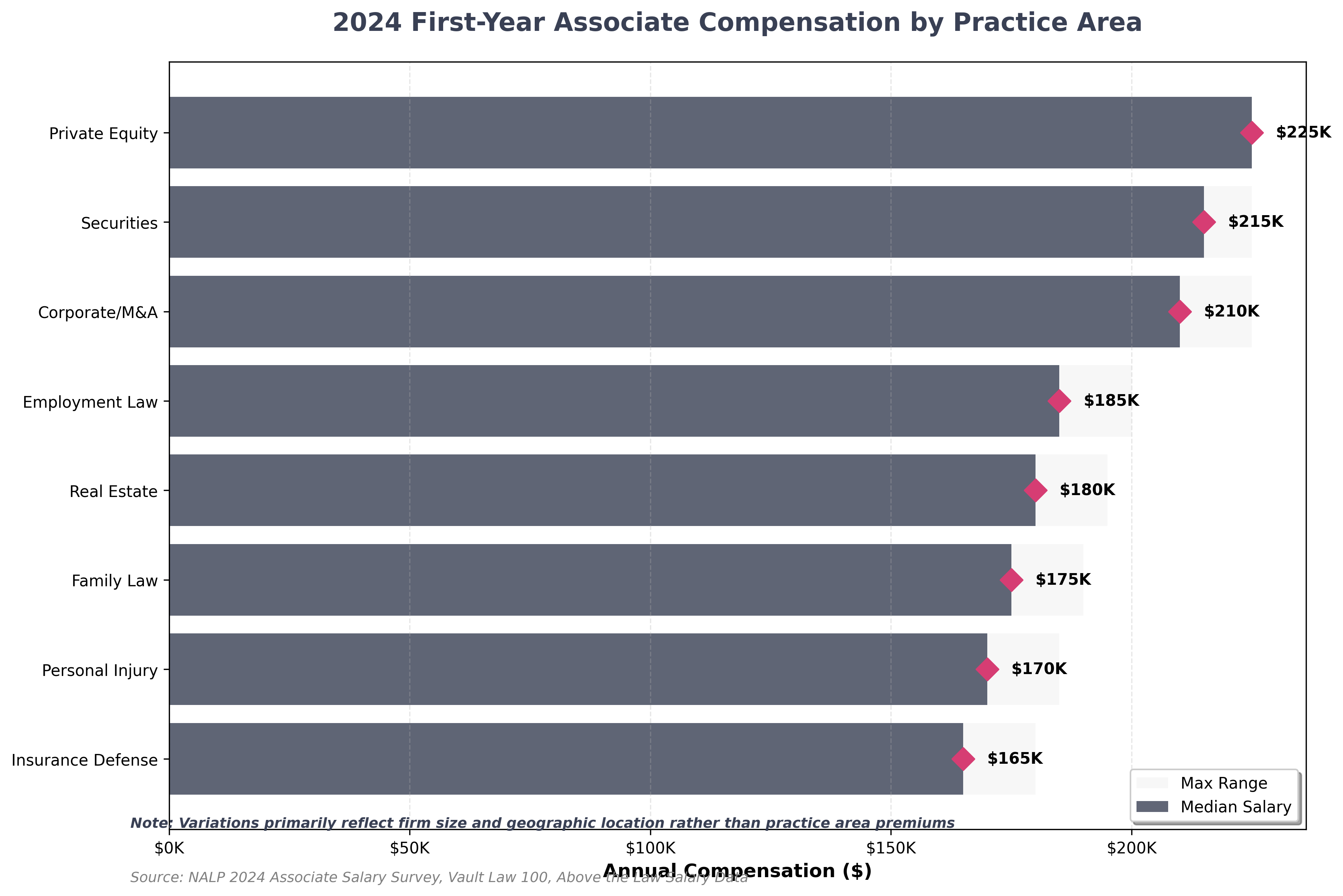
Note: Variations primarily reflect firm size and location, not practice area premiums for first-years
| Practice Area | Avg. First-Year Salary | Harrison's Market Insight |
|---|---|---|
| Private Equity | $225,000 | Concentrated in top BigLaw firms, hence higher average |
| Corporate/M&A | $220,000 | Core BigLaw practice, salary reflects firm size not specialty premium |
| Securities | $215,000 | Predominantly large firm practice |
| Tax Law | $210,000 | Specialized expertise, but first-year premiums are modest |
| Intellectual Property | $210,000 | Technical background valued, but varies by firm size |
| Litigation | $205,000 | Broader market, compensation varies significantly by firm |
| Healthcare | $200,000 | Growing field, but first-year compensation follows firm standards |
| Employment Law | $190,000 | Present across all firm sizes, average reflects broader market |
| Real Estate | $185,000 | More prevalent in mid-size firms, hence lower average |
| Insurance Defense | $165,000 | Volume practice concentrated in smaller firms |
The 33% Rule and Profitability Modeling: Making the Numbers Work
The 33% rule—that attorney compensation should not exceed one-third of the revenue they generate—is one of the most enduring principles in law firm management. But after working with hundreds of firms, I've learned that applying this rule requires more sophistication than most firms realize.
The Evolved 33% Framework
- Origination Revenue: 25-30% - Revenue the attorney directly originates - lower percentage because they bring the business
- Production Revenue: 30-35% - Revenue from work performed - standard application of the rule
- Leverage Revenue: 35-40% - Revenue from work supervised/managed - higher percentage reflects management burden
Case Study: The Mid-Market Corporate Associate
Profile: 4th-year associate at 150-lawyer firm, corporate practice
- Billing Rate: $425/hour
- Billable Hours: 1,950 annually
- Gross Revenue: $828,750
- Realization Rate: 85% (common for mid-market)
- Net Revenue: $704,438
| Scenario | Base Salary | Total Comp (w/ benefits) | % of Revenue | Firm Profit |
|---|---|---|---|---|
| Conservative | $210,000 | $252,000 | 35.8% | $452,438 |
| Market Rate | $235,000 | $282,000 | 40.0% | $422,438 |
| Premium (+15%) | $270,000 | $324,000 | 46.0% | $380,438 |
My Recommendation: Pay the premium. The $30,000 difference in profit is negligible compared to the retention value and the message it sends to other attorneys.
When to Break the 33% Rule
In my experience, successful firms strategically violate the 33% rule in these situations:
- Market Entry: When entering a new practice area or geographic market
- Succession Planning: Investing in potential future partners
- Client Relationships: When an attorney has unique client connections
- Competitive Threats: Preventing defection to competitors
- Cultural Leaders: Attorneys who significantly impact firm culture and mentoring
The Hidden Costs of Underpaying Talent: A $485,000 Mistake
Early in my career, I made a critical observation: firms obsess over the visible costs of compensation but ignore the invisible costs of undercompensation. After tracking hundreds of attorney moves over the years, I've quantified these hidden costs—and they're staggering.
| Cost Category | Range | Description |
|---|---|---|
| Direct Costs | ||
| Recruiting and hiring | $75,000 - $125,000 | Search firm fees, interview time, onboarding |
| Training and onboarding | $50,000 - $80,000 | Learning curve, supervision, reduced productivity |
| Lost productivity during transition | $100,000 - $150,000 | Time to hire, ramp-up period, workflow disruption |
| Indirect Costs | ||
| Client relationship disruption | $150,000 - $300,000 | Lost clients, reduced billing, relationship rebuilding |
| Knowledge transfer and continuity | $50,000 - $100,000 | File transitions, case continuity, institutional knowledge loss |
| Impact on team morale | $75,000 - $150,000 | Remaining attorney retention risk, productivity decline |
Case Study: The False Economy
The Challenge: A 45-lawyer litigation firm in Atlanta was experiencing 35% annual associate turnover. Partners attributed it to "market conditions" and "young lawyers job-hopping," but the data told a different story.
The Analysis: I analyzed their compensation against local competitors:
- 1st-year associates: $145,000 (market: $165,000) - 12% below
- 3rd-year associates: $175,000 (market: $205,000) - 15% below
- 5th-year associates: $210,000 (market: $250,000) - 16% below
| Metric | Before | After | Difference |
|---|---|---|---|
| Annual Associate Comp Cost | $1,650,000 | $1,980,000 | +$330,000 |
| Annual Turnover Cost | $1,455,000 (3 departures) | $485,000 (1 departure) | -$970,000 |
| Net Impact | +$640,000 profit |
Results after 18 months:
- Turnover dropped from 35% to 8%
- Client satisfaction scores increased 23%
- Associate billable hour productivity increased 12%
- Firm profits increased by $740,000
Regional Compensation Strategies: The Geographic Advantage
One of the most underutilized strategies I've observed is the geographic arbitrage approach to compensation. Firms that understand regional market dynamics can create sustainable competitive advantages by being strategically generous in the right markets.
| Market Tier | Examples | Comp Strategy | Premium Recommended |
|---|---|---|---|
| Tier 1 (Global) | NYC, DC, Chicago, LA, SF | Match market leaders | 0-5% above market |
| Tier 2 (National) | Boston, Houston, Dallas, Atlanta | Lead local market | 10-15% above local |
| Tier 3 (Regional) | Denver, Seattle, Miami, Phoenix | Dominate locally | 15-25% above local |
| Tier 4 (State) | Nashville, Louisville, Salt Lake | Premium positioning | 20-30% above local |
| Tier 5 (Local) | Smaller metros, county seats | Quality differentiation | 25-40% above local |
Case Study: The Nashville Strategy
I worked with a 25-lawyer corporate boutique in Nashville that was struggling to attract mid-level associates from national firms. Instead of matching Nashville market rates, we implemented a "Tier 1 compensation, Tier 4 lifestyle" strategy.
The Approach:
- Set associate salaries 25% above local Nashville market
- Approximately 85% of comparable BigLaw salaries
- Marketed the "best of both worlds" proposition
The Results:
- Attracted 12 lateral associates in 18 months (previously averaged 2-3)
- Landed 6 attorneys from Am Law 200 firms
- Became known as the "premier corporate firm" in the Nashville market
- Revenue increased 67% over two years
- Zero voluntary departures in the first two years
Why Geographic Premiums Work
Regional compensation premiums create multiple competitive advantages:
- Talent Magnet Effect: Becomes the preferred destination for local law school graduates
- Retention Lock: Creates switching costs for attorneys considering moves
- Referral Generator: Happy attorneys become recruiting ambassadors
- Client Perception: Higher compensation signals quality to clients and referral sources
- Partnership Pipeline: Attracts attorneys likely to build local careers
Bonuses and Retention Mechanisms: Beyond Base Salary
Base salary is just the foundation of an effective compensation strategy. The most successful firms I work with have sophisticated approaches to bonuses, incentives, and retention mechanisms that create golden handcuffs while rewarding performance.
| Bonus Type | Purpose | Typical Amount | Timing |
|---|---|---|---|
| Annual Performance | Reward current year contribution | 15-35% of base | January |
| Retention/Stay Bonus | Prevent specific departures | 25-50% of base | As needed |
| Deal/Case Success | Reward exceptional outcomes | $10K-$100K | Upon completion |
| Origination Credit | Incentivize business development | 5-15% of fees | As collected |
| Partnership Track | Succession planning investment | 50-100% of base | Multi-year vesting |
Creating Golden Handcuffs That Don't Feel Like Handcuffs
The most effective retention mechanisms I've seen share several characteristics:
- Escalating Value: Benefits increase significantly with tenure
- Multiple Triggers: Various ways to earn additional compensation
- Clear Advancement: Transparent path to increased earnings
- Non-Financial Benefits: Flexible schedules, sabbaticals, etc.
- Ownership Mentality: Profit-sharing or equity participation
My Compensation Philosophy: Lessons from 25 Years
After placing thousands of attorneys and working with hundreds of firms, I've developed a compensation philosophy that transcends market data and benchmarking studies. It's based on fundamental principles about human nature, business economics, and the unique characteristics of legal practice.
The Barnes Compensation Principles
1. Pay for Potential, Not Just Performance
The best compensation decisions are investments in what attorneys can become, not just rewards for what they've done.
2. Transparency Creates Trust
Attorneys are trained to spot inconsistencies and unfairness. Hidden or arbitrary compensation systems destroy culture.
3. Local Market Leadership Wins
Being the best-paying firm in your market is more valuable than being the 50th-best paying firm nationally.
4. Retention Is Revenue
Every dollar spent keeping a good attorney is more valuable than every dollar spent finding their replacement.
5. Culture Drives Compensation Effectiveness
The same compensation package can succeed or fail based on how it's implemented and communicated.
Common Compensation Mistakes I've Observed
- The False Economy: Trying to save money through below-market compensation. The costs of turnover always exceed the savings.
- The Benchmark Trap: Obsessing over survey data without understanding local context. National averages don't determine local markets.
- The Equality Fallacy: Treating all attorneys within a class year identically. Equal treatment is not the same as fair treatment.
- The Partnership Mirage: Using eventual partnership as an excuse for current undercompensation without providing clear criteria or realistic timelines.
- The Discretionary Disaster: Completely discretionary bonus systems that create anxiety rather than motivation.
Recommendations and Implementation: Your Compensation Roadmap
Developing an effective compensation strategy requires more than good intentions and market data. Based on my experience, here's a practical roadmap for implementation:
Phase 1: Assessment and Analysis (Month 1-2)
Immediate Action Items:
- Compensation Audit: Compare current compensation to local and national markets
- Turnover Analysis: Calculate the true cost of recent departures
- Attorney Satisfaction Survey: Anonymous feedback on compensation satisfaction and priorities
- Financial Modeling: Assess firm's capacity for compensation improvements
- Competitive Intelligence: Research compensation at key competitor firms
Phase 2: Strategy Development (Month 2-3)
Strategic Decisions:
- Market Position: Decide whether to lead, match, or strategically lag the market
- Compensation Philosophy: Develop written compensation principles
- Bonus Structure: Design performance-based incentive systems
- Advancement Criteria: Create transparent promotion and salary increase criteria
- Retention Programs: Develop specific programs for high-value attorneys
Phase 3: Implementation (Month 3-6)
Implementation Steps:
- Partner Buy-in: Secure unanimous partner support for compensation strategy
- Communication Plan: Develop clear messaging about compensation changes
- Salary Adjustments: Implement necessary salary corrections
- System Updates: Update HR systems and processes
- Individual Meetings: Meet with each attorney to explain their compensation and advancement path
Phase 4: Monitoring and Adjustment (Ongoing)
Ongoing Management:
- Quarterly Reviews: Monitor compensation effectiveness and market changes
- Annual Benchmarking: Update market analysis and adjust as needed
- Exit Interviews: Learn from departures and adjust strategy
- Performance Tracking: Measure impact on retention, productivity, and profitability
- Strategy Refinement: Continuously improve compensation programs
Based on my experience, firms that succeed in compensation strategy share several characteristics:
- They act quickly: Compensation problems compound over time. Address them immediately.
- They think long-term: Short-term savings often lead to long-term costs.
- They communicate clearly: Attorneys need to understand not just what they earn, but why.
- They stay flexible: Markets change, and compensation strategies must evolve.
- They measure results: Track the impact of compensation decisions on retention, productivity, and profitability.
Remember: compensation strategy is not about paying the most—it's about paying the smartest. It's about creating a compensation system that attracts the right attorneys, retains your best performers, and drives the behaviors that make your firm successful.
The legal profession will continue to evolve, but the fundamental principles of human motivation and business economics remain constant. Firms that understand this and act strategically will thrive, regardless of market conditions.
Ready to Transform Your Compensation Strategy?
For over 25 years, I've helped law firms develop compensation strategies that attract top talent and drive profitability. Whether you're struggling with retention, trying to compete for quality attorneys, or planning for growth, BCG Attorney Search can provide the insights and expertise you need.
Our services include:
- Comprehensive compensation audits and benchmarking
- Custom compensation strategy development
- Retention program design and implementation
- Attorney recruiting and placement services
- Market intelligence and competitive analysis
BCG Attorney Search
Phone: (213) 895-7300
Email: [email protected]
Web: www.bcgsearch.com
This report is based on Harrison Barnes' 25+ years of experience in legal recruiting and placement, during which he has worked with over 1,000 law firms and placed thousands of attorneys. All case studies have been anonymized to protect client confidentiality. Compensation data is compiled from multiple sources including NALP, Vault, Above the Law, and BCG Attorney Search's proprietary database.