
This is a transcript from one of my webinars titled How Law Firms Make Money: Economics Every Attorney Should Know. The focus is on explaining that law firms are businesses first, and that nearly every major career outcome for attorneys—hiring, reviews, promotions, compensation, layoffs, partnership, and long-term success—is driven by economics. The transcript emphasizes that attorneys often misunderstand how law firms actually operate, and that the people who advance are usually the ones who understand how to generate revenue, attract work, keep work, and make themselves valuable to the firm. It also explains that billable hours, access to work, and the ability to support a partner’s or client’s business are often the real forces behind advancement, even when firms describe success in other terms.
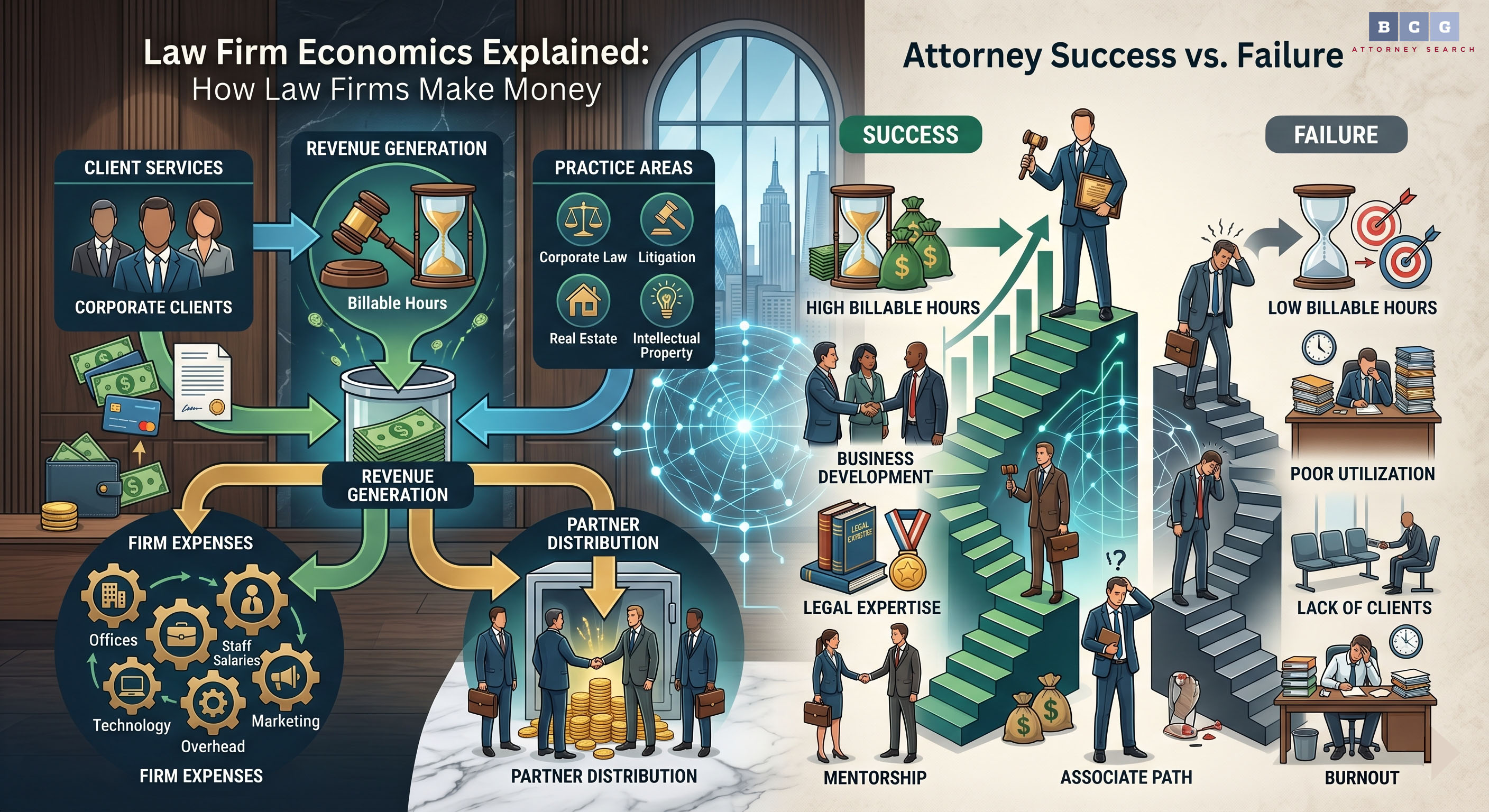
Why Law Firm Economics Matter
This topic I think is maybe one of the most important topics. You're lucky to be watching this 'cause most attorneys never understand this. Most law students, I'm sorry, never understand this topic. And once you understand this or even junior attorneys, once you understand this topic, it's going to make you much more successful in your career, almost regardless of what stage you're at in your career.
It's just an extremely important topic for a bunch of reasons. The first reason being that something that most attorneys don't really always understand is that a law firm is a business. And because it's a business, its entire goal to survive is to make money. And in order to make money there's certain rules that it needs to follow.
Those rules impact whether they impact associates, they impact partners. And all these rules are really understanding them and falling into what you need to do are what going to make you successful. And what are gonna make you not succeed in a law firm. Because ultimately a law firm's entire goal is to make as much money as it can for its partners.
In order to grow, it needs to make money. So understanding what I'm gonna talk to you about today is going to be very helpful. I'm gonna show you what you need to do to convey to law firms you're gonna make the money to show 'em that you're gonna make them the most money. How to approach things, why certain people succeed in law firms and why other people don't even getting jobs.
When you get a job in a law firm is essentially saying, this person to us looks like the easiest for us to make money. It's we can make money from this person. And so they're evaluating if they can make money from you compared to other people. And there's all sorts of reasons I could get into about that, that don't necessarily maybe not apply to you but making money we're gonna talk about that today.
We're also gonna talk about a bunch of things that people don't always understand. And just a couple rules that are really important. One of the things that I see, and I see this quite often and it blows my mind, I see people's resumes and I've been seeing this frequently that when they describe their law firm experience, some people even list like their pro bono related work as the first thing.
When they talk about their experience, they list things like that. And anytime you're putting stuff like that in your resume, you're showing law firms that you have priorities other than making money. And so I see people all the time, like from Columbia, NYU, Harvard, like all these different people that will put things on their resume talking about pro bono.
They will not be working and they won't be getting interviews and they'll wonder why. The reason is because your resume and everything you're doing needs to convey that you can make law firms money and that's what they're concerned about. You would be too. I'm gonna talk about how partners evaluate people.
I'm gonna talk about how partners evaluate associates. I'll talk about how they evaluate law clerks. I'll talk about why you can get a, how do you get jobs as a, from a being a summer associate to an associate. How you get jobs, how you succeed in a law firm, how you move to better law firms. All of this stuff is really related ultimately to economics and how that drives the law firm world is incredibly important.
It's something that I don't really understand why. This subject isn't taught in law schools. It should be one of the most important things for people to learn, because without understanding that most people the majority of people that could succeed on law firms a lot of times don't end up doing so 'cause they don't understand economics and how it applies.
Work Is a Privilege
I want to just also talk about two things real briefly that before I get into this presentation, that are very important. The first is, anytime someone is giving you work to do, that's like a privilege. There are lots of people that partners could give work to and that lots of people that they could hire.
There's lots of people that clients could hire. So people often look at the getting work as there's something wrong with it or there's too much work. And work is actually the most important thing you can have. There's nothing more important than getting work and not only getting work, but once you get work, creating work.
That means finding extra things to do. That's what the best partners do with their clients. They're always finding additional tasks and additional work that they can do to create more money. And so that's your job as an associate even, is to create work to find extra things that can be done to find extra ways you can bill to earn money for your firm.
You can do this or you can't, but if you succeed doing this the rewards are massive. You essentially, when you develop a book of business and you do all these things, you own a business and a law firm essentially works for you. It provides you associates, a brand, office space, secretaries. So your goal really is as an attorney, should be.
To own a business, not always to do something else. If you've invested 5, 7, 10 years, you have the ability to own a business and make money. I'm gonna get into a lot of this stuff today, but understanding really in, in the background why economics is so important. And this is not like a boring economics lecture.
Everything that I'm gonna talk to you about today is related to you. It's related to you getting jobs. It's related to succeeding in law firms. It's related to how you have your own business as a lawyer. It's all these things that can really change the direction of your life. And significantly, if you understand 'em.
I will tell you that you are very smart being on this webinar because you are gonna learn things that Most attorneys, more than half of them never really fully understand because they don't really fully understand it. They never succeed at the level that they're capable of. And anybody can succeed in this profession.
You don't have to have gone to the best law school. You don't have to have, be working in the biggest firm. You, anybody can succeed if you understand these rules, but most people don't. So I'm gonna talk about that today. And it's, it goes through every fabric of your legal career, economics.
It goes to again, whether or not people will hire you, people hire you based on their evaluation that you can make the money and the way that they wanna make money, meaning someone that's stable, that understands things, that is likely to succeed, that's gonna work hard. The, these are all things that people will evaluate, hiring you, it's how they evaluate, advancing you.
It's how they evaluate, keeping you when they're letting other people go. All these things are related to economics. So if you understand this today, you're gonna be so far ahead of other people that it's amazing. So clients in law firms are often overbuild. Law firms will have policies that say it's unethical to over bill clients that you, that we don't do that.
Billing, Overbilling, and Incentives
All these sorts of things. But really how does that work? Are you as an attorney ever going to be told that you shouldn't be overbilling clients? One of the funny things I will tell you, and I bring this up because I, I think it's very funny. The entire time I practiced in law firms for several years in large law firms, I was never told that I was billing too many hours.
Never told only one time when I was given free reign to go research for weeks at a time on one legal issue. Did I, was I ever asked to show that I had done all this research and I had, I'd printed up hundreds of articles and things, but honestly, most attorneys are never told that they're billing too many hours.
You'll never be told that almost all the time. Now, you may be told that in a small to mid-size firm that need you to be extremely efficient and has clients, but to, to the most part, you're never going to be told that you're billing too many hours, which I think is very funny. And so you have to understand a lot of what I'm talking about today.
How these economics works because it's, again, this is not something that's taught in law school, but honestly, the economic aspects I'm gonna talk about today. If you just watch one webinar, this may be one of the most important things you understand because it will show you what you may be doing wrong.
It'll show you what you need to do. And help you advance and do well. And one of the, what I'm gonna talk about today is the typical like middle market or even small law firm most law firms that charge hourly rates to clients that can afford to pay. So that means I'm talking mainly about attorneys that are working in law firms that are representing businesses.
There are law firms that represent individuals where those individuals have a lot of money to spend on legal bills. But most cases, if you're representing a company and you're working in a law firm, those companies typically have budgets that where they can afford attorneys that are billing often a lot of ours.
That's what I'm gonna talk about. I'm gonna talk about how works generated in law firms, how it's staff billed, leveraged, and how all this is related to hiring promotion. And then being, having security. And I'm not gonna cover paralegals and legal secretaries, but those are also very profitable to law firms and can be one of the things I will say is this topic is not something that, talks in nicely about law firms all the time. So I'm gonna tell you the what's bad about them and what they do wrong. But it's something that anybody that wants to work in law firms needs to understand. And if, if you wanna succeed it is a business. Law firms are businesses and so understanding how they work is extremely important.
I'm just gonna show you, give you the background and all of this, and it should guide your legal career no matter what stage you're at, because once you understand these rules, you understand what bad things happen to you, understand what good things happen to you. You'll understand everything. Law firms large, mid-sized small law firms that represent businesses. Their goal is essentially to make as much money as possible. Now, they can do it in a different ways. They can say that we only wanna make a certain amount of money. We're want our attorneys to go home at a certain hour, whatever.
They're all there to make money and they don't survive if they're not making money. And so they have different billing arrangements. Some are fixed fees, some are contingency, but most law firms use billable hours. So there are, law firms don't use billable hours, but the majority of law firms do use billable hours.
Almost all of them. Historically what was funny is that if it's a relatively recent invention, meaning over the past 75 plus years law firms used to just value or bill clients based on the value they were doing what they thought they would do. They would often quote a flat fee and that's what the client would be charged.
In other instances, there was a. A very funny book. I was reading about this and I don't remember what it was, but at the conclusion of a case a partner in a law firm might just take a look at the file and say something like this looks like about $2,000. Send them a bill for that. So there was no billable hours.
It used things used to be just by there that people were just billing on based on the value of their time that the what they, I what the, of the work that they believed that they were providing. And it was funny 'cause when this happened, when law firms moved to billable hours, they really didn't wanna do that.
They clients thought they were being ripped off by flat fees and people being efficient. And when they went to the billable hour there were studies done and they figured out that lawyers were actually making a lot more money when they were billing by the hour. And I just want to bring up something that I think is very interesting.
I've spent the past 25 years talking to attorneys every day. Some days I'll talk to 20 of them. Some days I'll talk to five, but I talk to them every single day. Multiple attorneys. And what's funny, I can tell you this is just a flat out fact I have never encountered that I can remember.
I'll tell you the exception to this, a situation where an attorney that I was working with was told they were billing too many hours. I have never encountered this ever. And again, keep in mind we're talking about me talking to 10,000 plus attorneys. I've never encountered that. The only time I've encountered that has been with patent attorneys.
Patent attorneys, a lot of times people do things on a mixed flat fee basis, and they might be told they have to do a certain work in 25 hours or 30 hours and they don't, and they can get in trouble for not being efficient. But those are really more flat fee things. But again, never actually told by an attorney that they were told they were billing too many hours.
You can get in trouble for turning down work, even if you're busy, but never told not billing too many hours. Now the opposite is I hear all the time, I hear, I talk to attorneys every day. And they say, I'm losing, there's not enough work. I didn't bill enough hours. All these sorts of things.
I, again, I hear that every day. So hundreds of times a year or maybe more, maybe a thousand times a year, I hear people saying that they're in trouble. 'cause they're not billing enough hours. I hear partners saying they haven't billed enough hours, they don't have enough work from their clients. I hear associates saying there's not enough work.
All these sorts of things. I hear people saying they didn't get bonuses 'cause they didn't bill enough hours. It's again, people are compensated, people are fired, people are advanced based on their ability to bill hours. It's just as simple as that. Now, law firms really are you can't always say they're guilty of padding bills and that sort of thing?
'Cause I'm gonna tell you why. They're not, they don't have policies that say we, pad your bills. They don't. But as institutions, what they do is they pad they push their partners and associates to pad their bills to the extent possible. And what does that mean?
I'll just, I had a, something happened, I don't know A couple months ago I was meeting this woman for a date that I was meeting her for the first time and she was a associate in a 12th or 13th or 14th year associate in a very good law firm and she'd gone to a, not a great law school, like I think Loyola in Los Angeles or something and had not done anything spectacular there and consistently had moved to better and better firms.
Like I think she'd been at Skadden at one point and I was talking to her and she said something that I thought was very interesting. She was like, when I get a matter, like if I know it's a big client, I'm gonna work extra hard on and bill more hours. I'm gonna work the hours, but I'm gonna bill a lot more hours and maybe not be as efficient as I could.
That is true. So she may have done that may have been one of the reasons why she kept, she didn't have any business, but she as an associate and, worked a long time as she was advanced and kept getting work and did considered a good attorney. 'cause she was making sure that she was billing the clients, that she was working for as much as she could.
She was doing the work, but she was probably crossing her i's and t's and maybe not working with as hard as she could or as focused as she could. I, this is what she told me in order to do that. When a client is billed for money, I mean is some attorneys will over bill but. The, the hours that they work should be a, should be accurate.
It's just to understand. And once you're in a, the, I'll get into this in a little bit more detail, but people will bill, like the most successful attorneys will often bill as many hours as they can with a straight face to different matters. And I'm gonna talk a lot more about this than the second.
I'm gonna talk right now about different seniority levels inside law firms, how people are advanced based on that, how the importance of this, these kind of economic rules going on in the background. And so give you a little bit of understanding from the standpoint of if you're working there as a summer associate or as a clerk.
If you're a new attorney and then a mid-level, and then a senior attorney, I'm gonna talk to you about all of those different types of attorneys. So that's law clerks, summer associates, junior mid-level, and senior associates, and then council level attorneys and partners, and then different levels of partners, which are income partners and equity partners.
How economics are related there. And then how your value changes, your expectations when you're going into different levels and why most people in large law firms do not advance because of economic things happening. And people that do adv advance, they try to, then they try to go to smaller firms often, or they'll go in-house and all this is happening because of economics.
Summer Associates and Law Clerks
A lot of people don't understand this. They just know, they just do this because they don't understand why they're making the decisions they're making at different levels of their career. And I really hope that you take notes about what I'm gonna talk about right now, because again, half the attorneys I speak with, maybe not half, but a good percentage of people have problems and don't advance in their career because they don't necessarily understand all of these economic rules. The same thing goes with law clerks, for example. So most organized firms will have law clerks. They may be summer associates and may be people working there during the school year.
They may be out, they may, who knows, whatever. But they're often called summer associates large law firms have them. It's not an excess of 2000 a week. It's actually an excess of $4,000 a week for a summer associate. And a lot of large firms. And why do law firms have law clerks, I guess is a good way to think about it.
If someone's coming in and working there in the summer, like they're probably don't know what they're doing. They're probably not that efficient. So why is a law firm doing that? And they honestly a clerk is typically used for task, which aren't profitable for the law firm. They may have 'em do research that they're not billing.
They may research for example, they may just give them things that they don't want associates working on. Sometimes we'll try to give them interesting work to may. So they, but generally not. And but there's really an unspoken rule and why are why are, what are they doing with a summer associate during the summer?
A lot of times people that are summer associates don't really understand that, or law students don't understand that and really what is being evaluated and they're, you're not, no one's telling you this. And it's if you've failed in these positions or you haven't gotten them for whatever, really what they're doing is they're evaluating people to see if they can play the economic game inside of a law firm.
What is the economic game like? What are they expected to do? They're supposed to be, the economics are fairly simple. I'll talk to you about the billing, then I'll talk to you about the qual the quality of work's important if you're easy to work with if you're just simple to work with as opposed to difficult to work with if you're gonna work a lot of hours, all sorts of things.
These are sim examples of I had the same thing happen to me when I was a summer associate, but, a couple years ago, I don't know why I took this call that I received a call from a summer associate who was working in a large Manhattan law firm. They just received their first review after several weeks.
Literally the exact same thing happened to me. But this is something other side and the person got a very bad review comments about attitude, drive and focus. Just different, just things that, you could, not nice things, but just how do you figure that out? What do they mean?
The, after about five minutes or so, the, I just said she was very upset, like practically crying. She'd gone to a top law school and. And she wasn't going to receive an offer from that law firm if she continued this way. And I just decided I would ask her if she'd been there six weeks or whatever it was.
How many hours was she billing? And she said she'd been billing 35 hours per week. And this is and that was in my opinion was the issue. And this is so I just gave her very simple advice. I asked her how assignments were handed out and just told her to get all the assignments you could possibly do that are not necessarily billable or whatever.
Just, you, if they don't have to be billable, just get as many 'cause you don't wanna bill more hours than you might necessarily need to, but you just want to get as many hour bill as many hours as you can and do this for every non-billable assignment. You can get and work like there's no to morale.
Bill 70 hours a week for the next five weeks if you can work weekends this. And I said, this is all you need to do. And at the end of the summer, there were 18 summer associates. This was during the bad economy and in her class. And she was one of five of them to get an offer. The firm said all these great things about her is glowing and very strong.
She got an offer and they just said all sorts of nice things about her. They were happy that she would join. Now, she also said to me that there wasn't any. Major difference in the quality for work. She just worked more hours. And so if you were a law firm looking at her as a summer associate and you would say, who should we hire?
Should we hire someone that's billing 70 hours a week or someone versus 35 hours a week? You would hire the person working 70 hours a week. 'cause obviously they're hungry or they wanna work harder. That looks great. People love that. And it's the same thing when people make partner in a law firm. They're often the hardest workers.
It's just how it is. I'll tell you a story when we get to partners, but it's the same thing and the same exact same thing happened to me. So when I was a summer associate in long time ago, like 1994 or something in a law firm that was a really bad economy. And same exact same thing happened to me.
Like I exact same thing that happened this moment. I went into this review and in my firm there were I think maybe 20 or 25 summer associates and there was a another girl I got the horrible review and so did all the other associates and people were just this is in the middle of the summer and I got a just really bad review.
I was like, wow, the what's going on here? And I was really upset about it. And I told a girl that had gone to, she also went to University of Virginia Law School. And was working there as a summer associate. And I asked her how her review went, and she's oh, I got a great review. And I said what?
What did you do? 'Cause I think a lot of people have gotten bad reviews. And she said I have a friend that works in this firm. And she said, all you need to do is work as many hours as you can and they'll really like you. And so I listened to that and I did the exact same thing for the second half of the summer.
It was her, I and maybe one other person that got offers out of this entire class. 'cause it was just a horrible year. And I even got an offer to come back at the end of a two year clerkship. So they gave me an offer like three years into the future, which is insane. So that should show you the benefit of working and a lot of.
Ours and most attorneys that are having issues inside of law firms are typically not getting enough work from other people. They're not, partners aren't giving them enough work, or the firm doesn't have enough work for them. And so the firm isn't making enough money to feel comfortable with them around and to feel like they can make money.
Junior Associates and the Hours Game
This is the issue for partners losing jobs. It's the issue for associates losing jobs. It's the issue for people advancing all these sorts of things. The amount of work that you have the amount of hours that you're billing will determine. How successful you are. And that's the other reason I said, a lot of times people will sit around and they'll expect, like the law firm to give them work.
This, a lot of this is a lot of careers of people that went top law schools and things. And because they sit in their offices and they expect the firm to give the money, they're like, I'm an employee here. You should give me money. You should pay me money and I'll do what you asked me to do. And when they don't understand that the job of an attorney is to create work and to go out and chase work, that's what partners do.
They create work from their existing clients. So you get work from a partner, you try to get additional work for them, and you get additional work because they like the work that you're doing. You're billing enough hours to their matters. And then you get additional work and then you try to create work.
You say, what else can I do that's related to this? Maybe we do this and we do that, and so forth. Most out of the most of the placements that I make I've have one instance that happened recently, maybe in November. But most of the people that I place don't get fired.
When I speak to people that get, when I speak to law firms about why people get fired, and I've been doing that for years 'cause my candidates aren't perfect, they get fired. And one of the things they have complained about is that when they get fired, it's usually the fact that the associate or whoever it is the partner wasn't, didn't, said they had all this work and didn't have it, or the associate was leaving early and not available and not billing hours almost all the time that people are fired.
Without any doubt. I can say it's almost always because they're not billing enough hours or they said they had enough work when they went over to a firm as a partner and didn't. Those are the reasons people get fired. It's not, it's, you can get fired for people not liking you.
You can get fired for doing something wrong, but if you are working very hard, law firms will overlook things that you're doing wrong. They will overlook you, pissing someone off. They'll overlook you making a mistake because you're a profit center and that works for them. They won't all do that.
Most of the time when people get fired, they're and they're lose jobs or they're laid off they're perceived as not working hard enough, billing enough hours on the assignments, getting extra work when law firms lay people off too. There's always like cycles when law firms run out of work, whether it's in litigation or it's in corporate, whatever the practice area is.
Not everybody's laid off. Like the people that are laid off are the people that aren't doing enough work, aren't getting enough work. So the people that aren't billing enough hours are the ones that lay are laid off. And that's why if you get laid off in New York in a, from a big firm it's very difficult to get rehired because the perception is that you weren't working as hard as the other people you that weren't laid off.
'cause most of the time people don't lose their job that are billing enough hours and making the firm enough money. And partners by the way also make money based on how many hours the associates and other people they give work to. So think about it from the standpoint if you were a partner and this, I saw a guy lose his job.
I'll talk about that story in a minute. But if you were a partner. Partners get compensated. Usually a percentage of their, how much their book is like that everyone's working on, they get compensated based on they, maybe they get a percentage of the hours or the bills that are sent out for associates.
The, so if they send out a bill for a, an associate for 20,000, maybe they make 4,000 of that. It's just, these are just different ways to think about it. But partners are compensated based on their book of business, how much bill, how much, how many hours are billed to their clients. And when partners are talking about their when looking for jobs, when partners are looking for you, talking to other firms, people ask them, how big is your book?
A lot a partner's book by the way, will be bigger if the. Associates working for them are billing more hours. So think about this. So a whole partner their value in the market is based on their book of business. So an attorney with a $3 million book of business is less valued than one with a $5 million book of business.
If a partner can assign work to someone that's going to bill a lot of hours to the client and make their book a business larger, and they know that the client will pay it, then that partner is going to like that associate. You would too. So partners want to give work to people that are gonna bill a lot of hours.
One other point. So even if the partner can't. Bill all the hour. Can't charge the client for all the hours you worked. They still like that because then they can go to the client, say, Hey, I'm writing some of this off to be nice to you. We worked all this time. So partners want you to bill a lot of hours because that's influences how large their book is.
This is just how it is. They want you to build a lot of time even if it's if you can it's the partner's job to write off your time. It's not your decision whether or not it's too many hours that you do the best job you can. It means you proofread things, you re over research them.
You do whatever you can. Bonuses are given to associates that bill the most hours. That's just because that's what's evaluated. You're not getting evaluated for a bonus based on how the quality of the work you're doing, you're getting evaluated for a bonus based on the hours. And why do hours matter?
I'll just tell you real briefly about hours. So if someone has. 2,500 hours versus 2000 hours. Why is the person with 2,500 hours more valued? The perception is if you are able to get more hours, that the quality of your work is good enough that you are, that partners are giving you more and more work to do.
That's the evaluation. The evaluation is someone giving this person more work? Because if they're giving them more work the quality of work that the person's doing is probably pretty good. So your hours are basically a referendum on the quality of your work. When I started my career at the Quinn Emanuel, like I was on path to, bill 3000 hours a year.
I had tons of work and people gave me repeat work. And I was sitting next to a woman that wasn't billing more than, 25 hours a week. 'cause no one was giving her, was very smart woman from Columbia Law School. No one was giving her repeat work. So the quality, the number of hours you get is a reflection of the quality of work you're doing, and that's how law firms view it.
That your, the hours you bill is a reflection of your skill. If that makes sense. People do not give work to people that don't bill enough hours. Let me tell you a quick story about. A sad story, but I want you to understand it 'cause it's true and it really has a large reflection on what the kind of stuff that can happen when you don't understand economics.
I was working with this guy years ago and he was exceptional. He'd gone to the University of Chicago Law School and had these grades that put him just, they were amazing. Like probably they, they don't rank people there, but whatever those grades were, he was like probably the top 5% of his class, maybe better in law review and all these things.
He got a job in a New York office Washington DC office of a New York law firm. And this young partner brought in, this client was very excited about it, and the client needed some legal work done. And they asked, the partner asked him to go do this large research project with you, spend and spend as much time as you could on it over the next month or so.
The associate went and did this when started working on the project and was less than a day in and said, this is unethical to do this because you can do this solution to this problem much more quickly. And this is what I would, I figured it out. And this is what you need to do, and you don't have to build a client for any of this.
This junior partner was exceptionally upset. It was their opportunity to build a book of business and bring in all this work. And then this partner was mad and said you go do it anyway. And he refused. And so he got fired and he was the, and he was maybe less than six months in. And anyway, very sad story.
He ended up becoming a criminal lawyer defending drunk drivers in Washington, DC and then getting moved up from there and started doing burglaries and things. But that's what happened to someone that didn't necessarily understand the economic rules and very talented people.
I see this all the time. Like I was telling you earlier, people that put all this pro bono stuff on their resumes and it's crazy. And people that don't seek out work. And in a law firm law firms love telling junior associates often that they're unprofitable. You may have heard that, and they don't make money.
Junior associates are profitable, but usually not as profitable as mid-level and senior associates. And if you're a junior associate in a law firm. It's important to understand that these are very important components of law firm, economic region engine. There's lots of reasons, but the reason basically is a lot of times these junior associates can be set loose on issues without the client really thinking a lot about these bills being generated and so forth.
This is a billing rate of very small law firm basis, but the, this is not, these billing rates are not normal. These are very low. But in most law firms what's important to understand is if you take a first year associate, the $170 an hour and you give them a problem to solve the first year associate may, it may take them one or two days to, to solve this problem.
It could be a memo, it could be a tax problem, it could be some, and most partners that are very smart. Just think about this, they've been doing the same thing for 20, 30, 40 years. Could probably figure out the same thing in 15 to 20 minutes. Now, that's not for all sorts of things, but in a lot of cases that's true.
If you're an associate. A lot of times you should probably see, you've probably seen people in your law firm work far more than they should on an existing assignment because they may not have understood things. It took them more time to do it than they could have. And a law firm often it, you would think, it doesn't make a lot of sense to hire junior associates.
Why would you do that when a lot of the stuff, or have very few of them, and a lot of the things can be figured out very quickly by someone that's more senior? I just, I'll tell you, I had an experience like that when I was in when I was a young attorney. I was working on this tax problem.
The tax problem was really complex. It was just taking me all this time. And I went and ended up there was a very smart partner and I'd worked on it for a week and was having an issue figuring out, then I'd given it to a mid-level associate. He couldn't figure it out. And so we went to this partner and he basically said, just give me like a half hour and I'll figure it out.
That's exactly what happened. He figured it out. Very smart people can figure things out. I had another case when I was a litigator where I was, trying to, I was told to spend entire weekend and some extra days working on this issue with this satellite that had malfunctioned and there was a threat of a lawsuit and it was hundreds of millions of dollars.
I worked on it and, and I thought I figured it out a little bit, but then there was this partner, Quin Emanuel, the very smart guy that come over from Gibson Dunn. So I might've worked 60, 70 hours in trying to figure this problem out. And then this Gibson Dunn guy very smart, took a look at the whole thing, read it over, and then like in an hour came up with this incredible solution.
He was using a lot of the information I provided, but I hadn't reached those conclusions in an hour that ended up saving the client, like hundreds of a hundred million dollars or something huge. So I'm just telling you how efficient a partner can be a lot of times with information, someone that compared to a junior associate.
Why would they send me working for 60, 70 hours in this problem? Because they could, they could get away with it and when this partner could have maybe figured it out. So junior associates need to and associates need training to be effective. But they're, like I told you, very good profit centers they can be given work.
It's most of the time when you hire a law firm your, the partners can figure things out a lot more quickly. Earlier in, early in your legal career there. Gonna be a lot of legal matters that a law firm can, that can be researched and analyzed. Law firms will litigation and other practice areas will often give junior associates all sorts of memos and things to write.
They'll tell the client something like, we'll figure this out, but be best to get the answers to these questions. I could work on them, but my billing rate is high, so I'm gonna have this junior associate do the work. Their billing rate is almost half of what mine is, and then the work is handed off to a junior associate.
How does that work? I'll tell you a funny story. So I was I, when I was practicing law, I had clients and then I had a client that I, when I stopped practicing law, I went into recruiting, but I still had these clients calling me, and then I would give their work to other people.
I had a client whose entire website, the logo that the text the name of the company was copied. It was the design company in San Francisco that was doing work for Apple. And this other company came along, completely copied their website. And my it was a friend of mine that I've known from high school.
It was very upset. And so I called a partner that I'd worked with. At Dewey Valentine referring this matter to him. And so the partner went and had a junior associate spend 20, $20,000 in time. And all that ended up doing was sending a letter to the firm that copied it, that this is a serious trademark and copyright violation.
If you don't take this down immediately, we're gonna sue you. And it was like, literally like a three or four line letter. That was it for $20,000. And this friend of mine got the bill and was like, what the hell happened here? I'm, this is unbelievable that this is, that they're doing this to me and that this happened, but this happened.
That's exactly what I used to do. When I worked for that party, he would give me all this. Very complex memo writing and things. And I was working for all these big clients, like the saltines people with unlimited budgets, and that's what, how he was building his book of business. And that's what people do.
That's just how it works. So partners will give memos and things and all sorts of things that may not be necessary to junior associates to get their building book of business up. They will, these memos may, and this research may be valuable to the client the client's willing to pay for it.
The biggest clients I had a candidate I was working with at Sullivan and Cromwell and the biggest clients will often demand that really good attorneys work on things. So I was, there was this Volkswagen diesel litigation and I was talking to a Volkswagen made this software that made the diesel, I don't know, but it's just, it's talking to an associate, Sullivan and Cromwell.
It was like eight or nine years out and they were making 'em do document review 'cause the client demanded it. So certain clients will pay for anything. But the point is that, people will, junior associates will often be asked to do things just to build the partner's book of business.
These are just things to, to understand that this is what it is. So I used to, when I was a associate and asked to write memos for this big New York law firm, I would write the memo and it would take me, I would research it and I would write it, and maybe it took me 25 hours to do that, or maybe 20 or whatever.
Whatever the number is. And I would write a very good memo. I would understand the legal conclusions and everything, but then instead of just telling the partner what it was and writing something very short, then I would sit down and for the next 50 plus hours, usually three times or two to three times, as long as it took me to write the memo, I would review it, tighten the language, double check the citations, making sure all the spacing between the lines was perfect.
This was before you had grammar and things and computers, and just, that's what I would do just to make sure it was perfect. Now, was that a good use of the client's money? Probably not. It's just a memo going to a partner, but that's what was expected. And so that's how bills are inflated, but. If the part, if the law firm asked for a copy of the memos, which they probably would get a copy, they would see something that was just completely flawless and it would be reviewed by another attorney.
The firm that's paying the bills is paying multiple times what they should really necessary. And then you answer a question for this partner about, you write a memo, and then if the partner is smart, they will often, and they know that the client's willing to pay, they will ask you to come up with and work on some different question that the could be helpful to the client.
All the partner is doing is building their book of business. And this information to the partner is helpful to, to the client. And oftentimes answers are found in things that by doing that, that saved the client incredible amounts of money and make them win litigation. I had a case, this is working for this partner that had never lost a case.
He'd have one woman that was, alleged she was raped. A very powerful man and she ended up having to pay the man. This just a small amount of $10 or something. But just this credible guy and he would continually. Just demand just all of this super in-depth research. And I just, I had this one big case.
It was a class action. There were 50 large law firms were defending their clients. And he had been asking all this research. And because of this research, I ended up coming up with this legal theory that got all of them dismissed. It was amazing that, and so I helped the get got rid of the class action, at least for our client.
It is amazing. So really good research can make a difference. I'm not saying that everyone that does this is there's something wrong with it. But again that, the partner will present this work that a junior associate does and stuff and say that it was worth it. And it'll say that this has helped us save money.
Made sure you, we got your back here. They often say, oh, this person was law review at this school, and this is, they're brilliant things and to the people, whatever. But that's how things go. And then the partner will go to the client and say that maybe this associate worked a hundred hours.
They know that it might've been more than you wanted to spend. So I've reduced their hours by 20% or whatever that is, and make the partner look good. And so these kind of conversations where partners are talking to general counsels and CEOs, these things happen all day long, all over the country, thousands of times a day.
It's just a game. And it's how it works. And different, even if a associate has steep learning curve, they're they need to play the game too. And so I'm telling you, like, when you don't play the game as a junior associate, even mid-level or senior associate, when you're unable to play the game, which everyone is playing, meaning we're gonna try to get as many hours as we can most of the time and to by doing really good work then you know, you're playing the game.
That's what is expected. And if you play the game as an associate, as a law clerk then you're more likely to advance. And if you don't play the game, you're in trouble. Junior associates their billing rate is low. So a junior associate could work for a hundred hours or 200 hours on a memo, and far more time that's necessary.
It's just the law firm is training the associate on the client's time. So the junior associates learning about various areas of law. They're learning all these things and they're working more time than they need to. And the law firm's basically training them and the part, the law, the client's paying for it.
This is just how it works. Now, it's, I'm not saying it's a norm at all law firms. I'm not saying all law firms do this. And but in, in general, to be profitable, most large law firms need to have large platoons of junior associates that they're marshaling out to, to get work done.
Again, this is what the biggest clients are paying for. It's not, I'm not defending the inefficiency of all this. 'cause it obviously is inefficient. But what I'm telling you is that the, and the clients are smart. They have general counsels that are reviewing the work and reviewing these memos.
The general, then these. Big clients and companies often doing billions of dollars in revenue or worth hundreds of millions of billions of dollars, these big clients are willing to pay for it. So I'm not saying anything about this is wrong, but I am telling you, and because the clients that can afford to spend a lot of time to make sure things are done perfectly, meaning they wanna win, they wanna have the absolute best legal advice they can and do the most thorough work they usually get the better end of transactions, they get the better end of litigation, they win more than they lose all these sorts of things.
This is how the game is played. So understanding this as a junior associate, it's not your position to judge that. Your position is to work as hard as you can to do the best job you can to get additional work from partners and to come up with different types of things you can do to continually drive work to yourself.
If you do that, you're far less likely to get laid off. And again, every firm I've ever worked in, they there's associates that are getting lots of hours and there's associates that hardly have any hours. And this New York law firm I worked in, there were people they didn't fire people for whatever reason.
There was, there were a couple associates there that. That whatever, talked back and told someone something wasn't necessary and undermined a partner and hadn't had any work for literally like a year. So they went into their office and they closed the door and they sat there and you could tell everybody's hours because you could look it up.
It used to be able to just per put some, in order to enter your hours, you had to put in your first and last name and then it would pull them up so anybody could look up anyone's hours. Very funny. But again, as a junior associate, your role is to do the best work you can to create work, to bill as many hours as you can and to make partners, books of business larger.
Mid-Level Associates
That's it. So if you can do that's good. Now, if they think you're billing too much, they'll say something. But again, I've never heard that, ever for people in large law firms. That's just, I've never heard it. Maybe it's happens, but never heard of. Okay. So mid-level associates. So this is an important role to understand.
Mid-level associate typically is two to five years of experience, maybe six. But it's typically that's the range. So it takes about your, a mid-level associate takes about two to three years to understand what you're doing, where people can give you assignments and you don't need a lot of handholding.
When you talk a lot of times to junior associates, they'll often say. Something like they're only gonna do this for a year or two. And the reason being that they see some, so many associates, especially in large law firms, will leave to go do something else. They'll go in house or something after a few years before they, after becoming, before becoming mid-level associates.
Often one of the reasons that people believe as mid-level associates, they, it, you can coast for a while as a junior associate, but a mid-level associate actually is expected to be able to do the work of a competent lawyer. Meaning most of the matters that a partner can handle they could do.
I, meaning you might not be able to go to trial, you may not be able to completely lead a transaction, but for the most part, you're expect you're, as a mid-level associate, you're pretty much expected to be able to figure anything out and to do it. And you're at a level where you can't. We're, if you're making mistakes and things that it's no longer tolerable you can't follow the law firm, you're given much more substantive work.
You're expected to be someone that people can essentially give work to and not have to worry about. And you're also proven, so a lot of times people will be out of the legal profession or law firms within a couple of years. And but if you're able to go to your first law firm and you're able to, you most people have to work in a law firm.
You have to typically work in the summers in a law firm because that shows you want to be in that practice setting. And then you go to work in a law firm, and you work in a law firm for two or three years, and that shows that you're able to play the game, bill hours, stick around given work, not let go.
You become a mid-level associate. And that's a sign of competence. Meaning you've been able to play the game. You're obviously making the money. People aren't letting you go. So you're marketable now and you may be marketable to a larger firm, whatever, but you're marketable as a mid-level associate because you are a proven commodity that they don't have to make you partner yet.
You're upset, hopefully it looks like you're committed to this practice setting. You wanna be you want to advance, you're gonna work hard, all these sorts of things. What people like about mid-level associates is these are some of the most profitable people for law firms.
They're also something that the clients like the most, I'll talk about that in a minute. They are they can be given assignments and the partner doesn't have to worry most of the time about the assignment being done properly. They also don't have to worry about the person not billing hours 'cause they already understand that billing a lot of hours.
They don't have to be supervised. Like a junior associate would be a mid-level associate. can supervise junior associates and partners like mid-level associates a lot better. Mid-level associates, also still bright eyed and bushy tailed. So what does that mean? That means that bright eye and bushy tail means they're enthusiastic.
They want to get ahead, they're gonna treat the partners with a lot of deference. They're gonna be enthusiastic, they're gonna learn, they're gonna do what's asked of them. All these sorts of things that you don't necessarily find when people get more senior and they get resentful, and I'll talk about that in a minute.
Mid-level associates also will have the ability oftentimes to gauge how much work the partner wants. They'll be able to get along with the partners, they'll have the right attitude. They will bill a lot of hours if they need to. And again, most of the time a mid-level associate is competent enough that they can get work done without having to ask a lot of questions, which is good.
Also the bill, mid-level associates billing rate is pretty good. So it, it may be 50% less or 60% less, or 40% less than a partners. And so when the work's being given to the mid-level associate, that work can often be done very efficiently. So this is a level where it's actually very good for the client.
The client is getting work done by someone who's competent that doesn't have a billing, right? That's anywhere near the partners. So this is actually where the law firm starts being very good for the client. And also where the mid-level associate is providing a lot of value. And this is the, if you are an attorney without business, this is the most marketable you'll ever be.
As midlevel associate law firms love midlevel associates. And because it just looks very good for them. And most law firms will tell you that the most profitable type of attorney mid is midlevel Associates. They don't have to write off their hours like they at a junior associate, they're, legal recruiters love them all these sorts of things. And midlevel associates are trained. They know what they're doing most of the time. They can be assigned work without being threatening to the partners, which I'll talk to you about in a minute. They can be hired. They're not a threat to senior associates.
Someone that's a senior associate is concerned about making partner. They don't want any competition. So mid-level associates can be brought in and they like that too. And so they don't upset the idea of upper mobility. And I'll talk a little bit about billing rates and things in a moment. These are, again, hypothetical.
These are very low. So you could be talking partner $3,000 an hour. This is seven times less. Counsel, same thing. So these rates are not representative. But if you look at a third to fifth year attorney billing out at let's see, 235 to, those billable hour rates, the mid-level associate isn't, these rates are much lower than a partner.
It's not the, when someone's sending a bill for this it's less than what a partner would be. The partner can justify it to the client, the person's very efficient and so forth. And this isn't the client's gonna see a bill and it's not going to look as bad as it would for a seventh year associate.
Seventh year is gonna be very close to what a partner is or counsel. And if a, if a. A client is getting the bill from a seventh year that's $345 an hour, and they're being told an associate's working on something that's almost the same price as a partner. They're gonna prefer to have a partner do it. Just one other economic thing to put in your toolbox.
You understand that a seventh year attorney, like a partner may get 50%. This is not representative, but I'm just giving you an idea. A partner may get 50% of, if they bill out a 400, I mean it wouldn't be 400, let's say a thousand, they bill out a thousand. The firm may pay them $500 per hour that they work on, whereas if a associate seventh year, they may pay them 15% or 20%.
If a partner's gonna get a thousand dollars an hour for a matter that they work on and or $500 an hour meaning they're gonna get that share of the work and the. A senior associate is going to get they're only gonna make a hundred dollars an hour from the senior associate working on this, so you just can do the math.
Again, mid-level associates are great and people love them. They are great. So here's an example of a hundred thousand dollars matter the partners bringing in the, how is this money gonna be where's it gonna go? And this is just an example where the partner, if they work on the matter themselves, they're gonna get 30,000, do $30,000, and if they give it to someone else, they're only gonna get 15%.
That's 45. The attorney partner could make 45,000 and then 55. No, this is not a rule that I would actually much less than this, but that's an example. But partners are compensated, just remember this most highly for the matters they work on. They're compensated less individually for the work that others do as a general rule.
Partners have a big incentive to work mostly on bill at a higher rate than to give it to other people. So that's what they wanna do. Other also I'm not, I don't like saying this, but I'm gonna say it. So I've worked in a couple of law firms and this, these are these are true facts and I'm gonna, I'm gonna.
Maybe, you know what I'm not even gonna say is law firms I worked in, because I don't wanna maybe it doesn't matter, but I've known partners that have consistently billed 3000 hours a year. And I know that there's no way that those people bill over 2000. So how do they write down hours on things that are not accurate.
They will have clients that they know will pay for a certain amount of money. A lot of times these are people that are very good at generating business. They know clients aren't gonna bad if the, that partner bills 50 hours at a thousand dollars an hour to their matter, even if the partner hasn't necessarily worked those hours.
This is, this happens it's just what it's, and 'cause the partner can gauge how many hours the person's willing to pay for. And I'm not saying this happens everywhere, but I've seen it a lot. I had one, I think I've told this example in webinars before, but this was a very kind of interesting thing I'll just tell you about real quickly.
I had a, I was, and one firm, a guy was in the office next to, was spent, he lived in Orange County and was driving to downtown Los Angeles and it's a bit of a hike over an hour. And so he came into work on a Friday morning and he slept in his car, took a shower in the office and then worked, 15, 18 hours or 20 hours a day Friday, Saturday and Sunday.
Turned in this brief that w on a Monday to a partner to review. And he shared a secretary. Actually, I don't even know, Sarah, secretary. He went to the partner's office to discuss the memo and the partner he'd given this to had WR written down, the, written down that he'd spent also 50 hours working on this memo over the weekend, and the partner hadn't touched it.
The partner was literally billing 50 hours to something that he hadn't done. So this stuff happens. I'm not saying it happens in every firm but it's been common. I've seen it a lot. Again, it's just thinking about it in a way that, from a business standpoint of what people are doing and what partners, what law firms are willing tolerate.
Again, or clients, and I'm not saying this happens everywhere. I'm I believe that there's certain firms that are just so upstanding and a lot of them, there's a lot of very good firms where this doesn't happen. But partners will all are running individual businesses. So the way to think about it is, regardless of the firm, partners are, have business.
A partner with business has to decide how much it's gonna charge us clients, what the clients are willing to do, how it can frame. The cost of the work it's doing for clients to the client, all these sorts of things. So if you have a firm of a thousand attorneys and there's 300 partners there, that's 300 separate businesses.
Just think about that. So if you have a firm and out of those 300 businesses, 10 of them are unethical, whatever it is not completely ethical in terms of their billing it'd be impossible for most law firms to figure that out. So it's just something to think about a partner that prices or service is too high, the client can go elsewhere.
The partner's not doing a good job, they can, won't, will go elsewhere. If the partner's not pricing their service high enough and the then the partner's gonna lose money, the firm will lose money. Firms also require partners working there to charge a certain amount per hour. And things to, they give them minimums.
They keep raising the rates. And again, mid-level associates can be beneficial to clients because it could be efficient work. And again, it's something that, most of the time the work doesn't need to be written off. So just understanding kind of the roles of the mid-level associate.
Senior Associates
Here's the senior associate where things start to get a little bit complicated and difficult. Senior associates are something that law firms are for the most part, not that excited about. They are, and they aren't. And I'll talk to you about that in a second. But a senior associate typically has at least six years of experience.
At six, when, six or seven years most of these senior associates can do anything. They can do them. Maybe they don't know as much as partners, but they're competent, very competent, and very close to what a partner could do. It's not to say they're all good, but they can figure things out fairly easily.
There's very little demand in the market for senior associates. And this is all due to economics. So I want you to think about this. So first to second year attorney, you get a job doing that, or as the law clerk, then you become a mid-level associate and you're in demand, like everybody wants you.
All of a sudden you get six or seven years of experience. And it becomes extremely difficult to get hired at that level. Extremely difficult compared to other people. Now, I'm not saying you can't get hired. Of course you can, but large law firms becomes very hard. And this is all due to economics.
Senior associates are a problem for law firms. As I explained to you earlier, their billing rate gets very close to partners. So they meaning that the, because they're close to partners are also required to bill a certain amount of hours. So a partner that bills a lot of hours. Partners hours are all, have, all partners are aware of the hours.
Other partners are billing. So a partner that's billing 3000 hours is, or let's just say 2,500 is much more, looks better to the firm than someone billing 2000. And if a part, if a client has a matter that the partner is choosing between doing work on their own to get their billable hours up or giving it to a senior associate, they're gonna prefer to do it on their own.
The client's gonna prefer to have a partner do the work anyway. So law firms, there are lots of major law firms that have clients that are so big that the, and they have so much work that they don't care if a partner or a senior associate works on it, they'll still pay. It doesn't matter.
They could have 15 senior associates working and there are clients like that. Just think about major billion dollar companies and things like that. They're the law firms that will do that. But for the, and for the most part there's always a prejudice against senior associates. And in order to stay busy senior associate has to get.
Work that a partner would otherwise be doing which is difficult for them in order to survive. And that means that the partners or people that are giving them work have to have work that can be built out at high hourly rates that they would prefer to have a, that a senior associate could do instead of a partner.
Even if even if a law firm does not what law firms don't like about senior associates is that puts pressure on partners to generate work, to keep those senior associates busy doing high hourly rate work. And so that's the challenge for firms. And then so they don't like that it creates issues.
The other thing is that senior associate, you can survive, obviously senior associates go to law firms and they become they become partners all the time. Every big firm in the country. It happens. But the ones that succeed are the ones that are best at getting work from partners. And that partners will continually give work to, because they like the quality of it.
It's easier to give them, the client likes it, all these sorts of things. So in order to survive a senior associate needs to get, be very good at generating work and then generating lots of hours. So that's how people make partner. When I was I was talking to, when I quit the first form of my worked was Quin Emanuel when I was quitting, and they were trying to get me to stay and John Quinn as people were coming by my office.
One thing I said, I was just, I was dumb. I was a kid. I never, but I said, oh, so and so didn't make partner and I'm upset about that. And they were my friend and the partner. And they said something like yeah, but the person that did make partner only billed 2,700 hours, and the person that did build 3000, what would you do if you were us?
Literally it was all about the hours. And so the person that billed 2,700 hours had to leave the firm because I don't know if they left or what happened, but, and the one that made partner is 'cause of 300 hours. So the was able to get more work. And law firms and senior associates because start feeling pressure they should to generate their own clients.
That, and a senior associate needs to be able to get work. So they need to get work from partners or they need to get work externally. So if the senior associate's very good at generating work, meaning. They can get partners to give them tons and tons of work and keep them busy and the partners like them, then that partner can be, that associate can be advanced either to a partner or if it's a great firm like Scatter or something, a major law firm advanced to a council, maybe before being partner or an income partner and all these sorts of things.
If a senior associate isn't able to generate work or get work, they're typically gonna be asked to leave. 'cause they don't make any sense from an economic standpoint. And then there's one other thing about senior associates that I didn't really bring up. It's that a senior associate is often they law firms don't like them because they have this whole kind of pedigree thing where, not pedigree, but level where a junior associate advances to a mid-level associate and then to a senior associate and hopes they can make partner.
They may have been, and the senior associates are all very competitive for those roles. And if you bring in another senior associate, the law people that are other senior associates are like, what the hell is this person doing here? Competing for a partnership. I've been here for five years, 10 years, whatever.
That's one of the reasons that they're also there, there's issues with senior associates. Senior associates. I just want to be very clear. You certainly can get another job and things, but it's just very difficult for senior associates. So unless you are in a firm where you're being given a ton of work and also where you may have started laying the groundwork to bring in your own business, or you can make income partner and then bring in business you're in a very dangerous situation.
It's for that reason that most in a lot of firms seen people will leave as senior associates to go in house to do other things because they realize that they've hit a ceiling there because they haven't gotten enough work or they haven't been able to bring clients. All this stuff is very important.
I'll talk real briefly about partner and counsel of attorneys 'cause I will I've talked by them, a so far, but partners job as a partner as same thing with council, but a partner, typically their job is to. Be able to generate work. So a partner can either generate work from other partners in the firm meaning they're be, you can become a partner in a lot of law firms, major law firms by being very close to certain partners that are willing to give you a lot of work and support you and advance you or get work from outside clients, which is the smartest thing to do.
Your responsibility is really going to be to generate work, whether it's, again, from other partners or it's from outside clients. Preferably it's gonna be from outside clients because any law firm that's sufficient and knows what it's doing is pretty much gonna be only wanting to advance partners that have business.
What Law Firms Are Really For
Why is that? 'Cause a law firm can't possibly function without partners with business. How can a law firm, how can a law firm expect, be expected to exist without partners with business? They are the ones that keep the entire system running. So a law firm doesn't only purpose of a law firm, by the way.
What does a law firm do? A law firm is essentially sitting there as a management organization for that to provide a. People or partners, a brand to hire associates for them. Hopefully, the better the law firm, the better the associates to provide office space, to provide secretaries, to provide payroll, to provide billing for the clients.
A law firm is a service organization for partners with business. The only role of an associate or a senior associate without business or a junior associate is for partners that are trying to build their clients as much money as possible. Hopefully, that's the role. It's your job when you're in a law firm, if you're thinking about it just as being there to do work, like you've got it wrong.
This is something that almost everyone, I don't care if you went to Yale Law School, whatever, you don't, people don't understand this. The job of a law firm is not to give you. Work to do. The job of a law firm is ultimately to support someone that's been smart enough to gen, to develop their own business, which is what a partner does, and develop their own business.
That partner uses the law firm as a place to service their to, for them to basically operate their business. And sometimes the law firm will charge too much money for that service, and the partners will leave and go to another firm that charges less. Or sometimes the law firm will not hire good enough associates or will make other decisions, or won't like certain types of clients for the firm.
All these things happen in Partners Lead, but essentially that's what a law firm is. It's services partners, and that's what you should, anybody that's in the practice of law should aim to have your own business. Like a law firm exists to service business people, which are partners with their own business, but they, you own a business.
Like people don't understand this, that. A law license is a license to operate a business. People used to go to law school and they didn't go to work in law firms. They went to get a degree and open their own business. They would move back to their town and be the lawyer, and that's how it worked for hundreds of years.
A law degrees that licensed to operate a business. So you can operate a business, having your own law firm doing personal injury or trusting estates or real estate, whatever. Or you can have your own business working for a law firm and paying the law firm to service to provide you a service, which is something that people do and make millions of dollars a year doing.
It's just important to understand. So counsel level attorneys are typically just so you understand their role, they're typically people that do really good work or don't wanna work long hours or but are strong attorneys council level attorneys, and their job essentially is to get work from partner level attorneys or sometimes they don't have big books of business and are paid on contract and so forth.
You have two types of partners in law firms. You have income partners, and then you have, which are income partners, and then you have equity partners. They're typically referred to different ways. So your equity partner typically is people with business. And those people with business are take, get a percentage usually, or some sort of percentage of how big their book of business is.
They also will get a percentage of profits that the firm makes that are divided up according to all these different ways of doing things. Council of attorneys typically don't have business income partners, our people that will get a salary and have the ability to become a equity partner if they generate a certain amount of business at the firm they're at.
Certain firms are more difficult to become a partner in than others because they have very high profits per partner that they don't wanna dilute. And they only have institutional clients. And you're talking about, Cravath and Sullivan and Cromwell and certain other firms, even SCA and things is very difficult.
How Economics Shapes a Legal Career
It's just to understand that. So why is all this matter that I've talked about? It matters because every per every point in your legal career, like whether it's as a. Summer associate or summer clerk or a junior associate, everything is depends on your ability to generate revenue and play by these rules that I've talked about.
There people think there's all these other things going on in the background. It's very funny. Every day I see resumes from people that went to Yale Law School and these people they have resumes that basically say, I'm not willing to play the game because they graduate and they might do a clerkship.
I'm gonna work for a public interest organization and think, Hey, I can always go back to a law firm and they'll do all these things that are completely unrelated to playing the game. And so they won't get jobs. They are like, why won't I get a J? Why aren't law firms hiring me? I'm so special. I went to Yale Law School and then.
They ended up becoming law professors and things. 'cause no one will hire them because they just, there's nothing wrong with going to Yale Law School. Obviously presidents and all these extremely important people have gone there and there's nothing, again, it's a very incredible school if you can get into it.
The point is that there's different values that people come out with and they're very good values, but they're not values that are related to playing the economic game. They're values that are related to things that they, attorneys believe they believe are beyond that. So people don't get jobs.
People don't get jobs. If they have a bunch of stuff on their resume, it looks like they don't wanna play the game. If you go in house, it looks like you don't wanna play the game. If you take a job with the government instead of working in a law firm, it looks like you don't wanna play the game. If you are working in the government and you want to go back clerkships are one thing, but you have to look like you want to play the game.
Everybody wants to make money and no one's gonna hire someone that doesn't look like they, they can make money. And your ability to advance is all based on if you can make people money. The law firm by the way is very exploitative towards partners. Partners are some of the most exploited people there.
Partner partners will. Often you could be a litigator and have these huge cases generating tens of millions of dollars a year for the firm and thinking you should be making millions of dollars a year from this. But the law firm may be very slow in the corporate. So they want to put corporate, I mean is this, pay the corporate partners money, your money.
Everybody is playing the game. Partners are playing the game for giving money to law firms. Associates have to play the game. And you're gonna, basically, everyone is evaluated whether or not they're playing the game. That's how you stay employed, that's how you advance, that's all these sorts of things.
You have to, when you look like you play the game, it's not just billing hours that you talk about. It's like there's all these things that are important. It's being able to do the work is one thing. Being able to do the work looking like you will follow orders and do whatever people ask you is being manageable.
Manageable means you have to do what other people want the way they wanna do it. And if you don't wanna do that, then you don't belong working in a law firm. I will tell you, if and associates are supposed to be managed, or you have, maybe they say you have to be in the office five days a week or four days a week, and you have to do this and you have to be available.
Associates are managed, but the most managed people out there really are partners. The most successful partners I know. I know Jesus. I know partners with. A hundred million dollar books of business. These are people that I've encountered. I encountered one you probably know who they are, but $180 million in business.
There are partners with, big books of business. Let's talk about like $30 million. When you talk to these partners, they're, they say things like, this is what my partnership expects. This is what my partners want. This is what the firm's policy is like. They're, these are team players. Even the most successful people making $10 million a year, they're still like, talk.
They're manageable. It's amazing. So if you think as a junior associate or something, like you resent those things and being managed and things just to understand that this is what, if you wanna succeed in a law firm, you're gonna be manageable your entire career. So you have to be manageable. And then you also have to look like someone that's gonna stick with this career.
If you're bouncing around, then that's gonna be difficult for people to make money from you 'cause they know you're not gonna stay. So all these sorts of things are important. And you have to learn these economic rules and you have to, work, get as much work as you can from other people.
Law firms exist to make money and they wouldn't exist if they didn't. They, they wouldn't exist if they. If they couldn't make money. That's the law firms that don't make money go out of business. They get overextended, they get too many loans, they lose clients, they have all these sorts of things.
The, to succeed you need to make the law firm money. And if you think it's bad, working long hours as a junior associate, one day if you become a partner, you're gonna have those people working for you and you're gonna be very glad that system works. 'cause it's gonna build up your book of business and all these sorts of things.
Just understanding the different kind of rules I've spoken about, midlevel, junior associates, senior associates everybody is fighting here to, to get as much work as possible to survive. One other quick point I wanna make, and we're almost done here, and then I'll, we can go into questions, but one other quick point that is important to understand.
When you're a. Anytime you're getting work from someone else. So if you are a junior associate getting work for someone else, if you're a mid-level associate getting worker, you're a senior associate getting work from someone else, whoever's giving you work, if it's a partner then that's your client.
Anybody, if you're a junior associate and you're getting work from a mid-level associate, the mid-level a associates' your client. So in order to get repeat business from a client, you need to do the work, good work that you need, a good work for them. You need to work, they need to like you need to do whatever that person wants.
You need to like them and want to come back to you and give you repeat business. That's your job. So you learn all these things as an associate or as a, and these are great learning lessons by the way. You learn all these things and then hopefully you're smart enough to go out and with all the lessons you worked, learn, working for demanding people and things, you're able to go out and get real clients who are gonna pay the law firm money.
That will be how that works. So you learn to work for others. You learn to work for law firms and people inside the law firms of your clients. And then eventually you develop your own clients, taking all the lessons you learn from all those people to be successful.
These are the, is how it works. And different size law firms have different demands, different size. Law firms have different size clients that will tolerate different billing levels. And so the, but the most important thing you ultimately need to consider is, can, are you in an can you make whoever you're working for money, can you make yourself money?
Access to Work
Can you continually have access to work? And extremely important. And it doesn't really matter by the way, the size firm you work at. So some, if you work in smaller firms or smaller markets, those clients may not tolerate a lot of hours sometimes. But if you wanna make more money there, you need to figure out how to get more work from them or to get other clients or whatever.
The firms that are have the highest salaries, the firms where you can make the most money. The firms that have the best brands. Are the ones that really have very well-defined economic models and that you will either work at or that will either work for you or not. These economic rules that I'm talking about, anytime you're working for a client that is a company like you wanna try to get as much work you want to play by these rules because that's how it is.
Attorneys all the time, they will move from major law firms are smaller law firms to major law firms. So they'll get clients and they'll be, do a good job and then they'll get, they'll move those clients to bigger firms and so forth. It's all or vice versa. But you just need to understand all of this and staying employed and advancing and to continue working.
One of the things, the, one of the final points I wanna make again, I'm very. Adamant and enthusiastic about this topic because I've seen it go wrong for people every day. And but one of the most important things you can understand is a fish that isn't in water will die like it.
It needs water and access to water to survive. And it's no different for attorneys. Attorneys need access to work to survive. You can never lose access to work. If you lose access to work, you're in trouble. A attorney in law firm needs access to work. If you don't work in a law firm, you need access to work.
Like the entire game is to always have access to work. If you lose access to work, that's bad. So you see people that lose their job and they may be unemployed since May. Now here we are in January that you, they've lost access to work, and if once you lose access to work, you're in trouble. So you always need your entire career.
You need to have access to work. And I learned that incidentally from there was a guy that I knew I was clerking in Michigan for a federal district judge, and there was a clerk in that was working for a magistrate judge, and he'd gone to Thomas Cooley Law School, which I think is now.
Western Michigan or something. It was literally one of the lowest ranked law schools in the country. But he was taught something that they said to him at one point, someone said this to him and it was really telling and really smart. They said, never stop working as an attorney. 'cause if you stop, your career can end.
You never wanna lose access to work. And having access to work is one of the smartest things, the smartest lessons I can give you. Because once you lo lose that you're in trouble. I don't like when people go in-house. I don't like when people go to work for the government. I don't like when people go to work at public interest organizations because most jobs, if you go in-house that's not stable.
'Cause companies go out of business, they merge, they have new general counsels that come in and clean house and bring in their own people. They, all sorts of things happen to in-house people when they go in-house and they lose their jobs and then they're unemployed for a long time. The only way to continually have access to work is to work in a law firm and get your own clients or to get very close to partners that have a lot of.
A lot of business or develop a business doing personal injury and whatever, but even if you're doing personal injury, you're gonna be advertising on buses and doing all these things to get business so you don't lose access to work. That's why you see all these personal injury ads everywhere and on the radio and things.
Because those people are trying to get access to work, you always need to have access to work. And if you don't, if you lose access to work, your career is over. Partners that lose clients and don't have any business have lost access to work. People that get fired are losing access to work. People that become senior associates and are told that they have to find a new job are losing access to work.
Your entire job is to have access to work. And work is a privilege. It's like the most important thing you can possibly have and lot. The bigger the clients you get, the more work you get. So you want to get big clients, but having access to work is incredibly important and it's at every level of your career, whether you're a summer attorney trying to get as much work to bill as many hours as you possibly can, which I told you is incredibly important for a summer associate.
Whether you're a junior associate not questioning work, making sure you're helping people build their book of business regardless of what it is. But you have to get as much work as possible. Partners need work, associates need work. If a partner loses all their clients or most of their clients, they will lose their job.
I was worried when I worked in this big New York law firm that, there was a woman there, she was president of the Bar Association, LA County Bar Association. She was all these incredible things, but she had lost some clients. And so she'd been an equity partner and they're like, okay, now you're a now you're a con, you're an income partner.
They even came back and they were like, okay we don't have enough work for you, so you're losing your job. So thank God she was connected enough that she very quickly was able to move into a very important very important judge role, but that's, she's able to get access to work as of all our connections.
If you, law firms are not nice. If you lose access to work, you need to have access to work and provide values. And there's always competition for work. And everybody needs to be able to bring in work. And it's incredibly important. You can go to smaller firms many times and, or you can, because you can, the billing rates are lower.
It's easy to generate work. You don't need to be giant clients, but everybody's trying to get access to work. I know a guy that he started his career at, it's either Gibson or O'Melveny, and he was very smart. He was the youngest graduate of Har Harvard Law School in history. I think he went to college when he was 13.
He was living in the dorms at UCLA and then graduated when he was 16 and went to Harvard Law School and then graduated like the age of 19 or something. And did incredibly well there. And he got a job at Alvin Gibson, and he was there for a couple years and then realized the only way to advance there would be to bring in these large institutional clients.
He's this is insane. I'm, how could I possibly, is this something I can do? And so he ended up going and starting a personal injury firm that now is extremely successful. Why? Because you wanted to have access to work. And people do this all the time. People start family law attorneys from big.
You can do it where you, but you always need to have access to work. And all of these things are important. And the end of the day you need to understand that the most important thing in your career. Again, this is something I told you that the Harvard Law School guy figured out.
It's something that I told you that the Yale Law School people didn't figure out like these Yale Law School people, by the way too they don't prob they, they have issues. They don't always reach their full potential. They can go to be policy and things, but they, but do you wanna have your own business?
Do you want to have a career? You learn these rules. You can be an attorney for the next 75 years. If you're graduate from law school at age of 23, not 75, but. 70 years, 60 years easily. And but most people don't, and they don't have the careers you're capable of, and they blow it early on by not understanding this.
This is probably one of the most important presentations you could ever watch for your career, just because there's so much going on here and what terms of what I'm talking about. And it's really the backbone of everything. It's how the whole system works and functions.
Your career stability, your security, your ability to support your family, your pride, your all these sorts of things are incredibly important. And I hope you got a lot out of this because if you don't play this game you're not gonna you're not gonna have the career that you're capable of.
Just remembering law firms are businesses. Everything that happens inside of them is related to business reviews, your opportunities, your security, your trajectory, all driven by economics. There's nothing else really going on. It's not NECs, not people liking you. It's not your, it's not your race, your sexual orientation.
What is all economics going on in the background? And if you don't understand how your firm makes money. You don't understand how, who controls the work, what your firm needs from you. You're gonna be often confused. You're gonna be resentful, you're gonna be pushed out, you're gonna have all these issues that you normally wouldn't have.
Sponsorship, Power, and Making Partner
People make mistakes all the time. Like one of here's one of the most basic economic issues. This is a very funny story. So there was a guy that I know at Quin Emanuel, and he was a very smart guy. Harvard Law School, like Sears Prize winner, which means he is like the very top of his class.
Harvard Law Review all these things. And as a, is a Quin Emanuel and billing credible number of hours, 2,800 hours a year or something like that. And comes up for partner and doesn't make it. And so then he leaves and started his, starts his own firms very successful. So when I'm talking to him, I'm talking about hiring him to represent me in a case and talking to this guy and it's it's like, why do you to make partner?
He is oh, I made a mistake. I didn't I didn't get work. I didn't have a sponsor. I didn't find someone that had a lot of business to sponsor me to be a partner. So when it came up for me to make partner there was no one that had any power standing up for me to help me and helping him.
By the way, you go to work at Quinn, man, you make partnering him $5 million a year. This is a major. Without business. Okay. This major thing, 5 million, three and a half, 4 million, whatever it was. This is years ago when that's when they were paying. I don't know if they pay that people out.
Business. That, that's what happened. So you just $5 million. Only mistake he made was not understanding that he needed to be close to make partner, to have someone with business sponsor him. That was, it didn't do it. I know a guy that was at a trial with John Quinn and did an incredible job and helped him.
When it came time to value be of a partner, John Quinn was like, I need this guy to be partner. Boom. $5 million a year job. Come on. This is these economic rules are huge. You just need to understand it. Where do you get work from? Who's got power? Who's got the business?
Who how do I get business? How do I know attorneys, again, like I said, they make $10 million a year. They understand these economic rules. They you have to be indispensable to the right people. You have to be able to generate revenue. And if you do all this, you can you can improve year after year.
You can stop guessing and start, understanding this. I know one of my best friend was a partner at a big firm. He made partner when he was maybe, what was he, maybe 31. And did it for 14 years, making. Several million dollars a year, and they're retired at the age of 45. Maybe not even that 44.
You play these rules and you understand them. You can do really well and have a really good life and career, but most people don't understand them. And I just wanna make one final point and then we will go to questions. People think that may not like being in a junior associate and billing all these hours and or a mid-level associate may not think it's fun and the work is tedious and all these sorts of things.
They may think, oh, there's no future in doing this. I can tell you that when you become a partner and you have your own clients and you're running a business, like it's much different, like essentially owning a business and running a business than it is working for someone else.
You're a partner in a law firm, or you bring in your own business, you have a business. And again, that's much more fun than it is doing something just than not having a business. Think about that. Anybody can handle their own business doing this career. So you have your own business. That's exciting.
Having all these people giving you work. You have 20 clients. One fires you, you're fine. If you go in house and you get fired, you're not fine. Or if you're an associate, if you're a partner working for one partner and that partner doesn't like you anymore you're out of business. All these things.
Listening to what I talked about is important, but the questions are important too because a lot of times people will ask questions or they'll, sometimes we'll say things like, what made them successful and how, what they learned out of this, things I haven't thought of. Or sometimes people will ask, actually share mistakes that they made that you may not, that may prevent you from making mistakes or ask things that are related to that will help you.
Because, yeah, and I just, honestly, I wanna everyone in this meeting. I want to commend everybody for spending the time watching this today. Honestly. But most attorneys do not under would have never taken the time to learn about the kind of things I'm talking about today.
I just, I can't even emphasize enough how important all this stuff is and so many careers I hope yours is one of them have been saved by, would be saved if people understood this. And really just, just wanna, commend you for spending the time watching this today.
It can totally change the direction of your career and your life and your family's life of understanding these rules. And most people don't understand them. Law schools too I just are the professors and many of them and are, I'm sure you're aware of this, but they're many of them are.
Very left wing. And I don't have a problem with left or right wing people, but at the same time it's not always pro-business. Like obviously if you go to Yale Law School, you're not gonna be exposed to pro-business people. It's pro people that are left wing don't, aren't necessarily always pro business.
Understanding these business rules, people don't always learn them. People come out of school with the not thinking like a business person. They think pro bono, like the different things. And that can hurt you. You have to understand these business rules and regardless of whether or not you necessarily agree with them all, this is just how the world works.
I'm gonna go back to here. Okay, so first question.
Questions and Answers
Repairing a Relationship With a Partner
I've offended a partner other ways to repair the relationship. How can I display that I am indispensable attorney when trying to repair a relationship on my reputation? So most attorneys, by the way this is something that hopefully can help you. Almost all attorneys are fired at one at some point in their career.Some many times some once they're fired or they do they're in a position where they've destroyed their brand in a law firm and they have to. Look for a new position or whatever, or they're not given work. So most attorneys run into issues like that. So the only thing you need to think about is essentially what I spoke to everyone about earlier is that clients, so partners are your clients.
The nice thing about working in a law firm is that you're essentially working for, especially large law firms, you're working for very demanding clients. And those skills of working with those clients are going to will translate into success later on. So you need to learn how to work for different partners.
Sometimes you may have offended one partner, you're obviously gonna be better off if you have more clients rather than fewer. So you want to have work for more partners rather than fewer. So if you offend one partner, then you still have other people giving you work. It's, this would be the same thing if you had a book of business.
You'd wanna have multiple clients, so you have multiple people. So there are people that you just won't get along with. There are clients you won't get along with that, where it's a bad match. There are partners you may not get along with where it's a bad match. And so that's not necessarily something that's going to, you can be in a law firm as an associate and have partners that don't like you, but you still can advance.
How can you be indispensable and repair the relationship with that person? The best way is to try to get more work for them and do a good job at, with job with them to try to fix whatever you did wrong, that upset them. And I don't know. What you did wrong. And it's, but if you want to fill me in later on what you did wrong, I can try to help you.
People will offend people all the time. So you just learn lessons from that. You learn that if I, when I bring in clients, this is what I need to avoid. And what great training, by the way, a law firm is because it's showing you how to act with clients, how to work with demanding clients. And hopefully those are skills you can use the rest of your career.
People offend people all the time, and you have to if you do that, you're gonna be you have to be careful. Okay, let's see here.
Personal Injury and Contingency Fees
Since personal attorneys provide services usually based on contingency and the money that is recovered, our attorney's required to bill hours how does that work?Since you are probably evaluated based on how many cases you just settled and you get for the client, but is billable hours a factor? So it depends on the personal injury firm, but personal injury firms are run in different ways. I know people that literally get jobs out of law school, third tier, fourth tier law schools, impersonal injury firms, and their first year make more money than associates in top 100 law firms.
How do they do it? They get paid based on sometimes they get a salary. It could be very low, like 60,000, 80,000. Those a hundred thousand whatever in a big city. But then they get a percentage of the recoveries they get for their clients. Most personal injury cases for personal injury firms, 95% plus of them end up settling.
That means that if you're able to settle cases for a certain amount, you can get money. So that's one way that associates make money in personal injury. Law firms, not all of them play, do things that way, but no, you're not required to bill hours in a personal injury law firm. One thing I'll just tell you that's very interesting about personal injury.
I had a when I was in law school. I don't know what was wrong with me, but again, I'm saying this in a funny way. I was very interested in torts and personal injury, so I decided to write a book about it again. What the hell? So I started writing this book, my first, second semester of law school.
I spent another six months or some writing this book, and I'm actually cool. I was able to teach a couple classes when I was in law school, university of, but I went around the country interviewing attorneys and what I found is when I would go into even small towns the whatever someone could hold themselves out as a generalist doing, but most people made most of their money, even if they were like family law attorneys in a small town like Lancaster, they still would do personal injury, make most of their money doing.
It's a very good practice area if you wanna do it and learn how to, it's all about generating business, but no, there's no hours for that. Yeah. So can I get a link to this? So yes, we will send I will send the video of this hopefully, I don't know if it'll take the q and a, but I'll send the video and send the PowerPoint to everyone after this or point.
In-House Compensation
What is the typical compensation range for an attorney going into an in-house role? Attorneys that go in-house are, it depends on the size company. Typically your salary in house is gonna be a lot less than it would be in a law firm, but then you get the trade off of hours and things. So what is the compensation range?It could be, depending on the company, it could be for someone coming out of a law firm, it could be 800, 80,000 to 500,000, maybe a little bit more. Depends. Most people when they get jobs in-house, their compensation is something, some, I would say in the range of 80, 180 to 250,000 if it's a large company.
It just depends. And you just never know what it could be. But that's the range I would say. And it depends on the market you're in. It depends on the size company. So you have small companies, you have large companies, you have middle market companies. So those are those are that, that would be the range.
Profits Per Partner and Leverage Ratios
What should I learn about law firm profits per partner and leverage ratios while still in law school? So when you're in law school, I don't know that there's a lot to learn. I recommend that someone that's in law school. Depends on the type of work you wanna do, but I typically would recommend trying to get a job with the best law firm you can.The reason being you wanna get a job with the best law firm you can because the best law firms will have clients that are willing to spend the most money on things. And so you will get trained by doing a lot of work and being able to go into a lot of depth on different issues that smaller clients wouldn't pay for.
If you want to be a good attorney, your goal is probably gonna be to get the training you can in the best law firm you can because it'll train you. And again, something that people don't understand is essentially what you're doing when you go to work in a law firm is you're getting paid to be trained.
What a great experience. And they're paying you and they're gonna train you. And it takes about five years to be competent. So it's five years, 10,000 hours. And I didn't make this up. This is actually a Malcolm Gladwell book, but it's interesting Gladwell book, but it's true in law firms as well.
I've heard people say that a bunch of times. So it takes about 10,000 hours or five years to become competent in a practice here. So what should you learn about profit per partner and leverage ratios while you're still in law school? If you wanna be partner in a law firm. You're gonna have to understand if it's possible to even be a partner in the law firm you're gonna be in.
If you go to work at Cravath, Swaine & Moore, your odds of being a partner there are extremely low, even if you're an incredibly talented, good attorney, it's just, there's no, it's very difficult to do. And the province partner there huge, but that's something to understand. So do you need to understand all this while you're in law school?
I don't think so, because most attorneys will lateral out of the firm that they, they join. Your only concern when you're in law school is really to probably get the best job you can and get the best training you can. Now, you could go into family law and do all these things that you don't have to worry about when you're in, if you are not working in a large law firm.
I don't think you need to worry too much about that when you're in when you're in, sorry, when you're in law school, you just want to get the best job you can.
Certifications and Credentials
What are the best certifications and credentials that attorneys can pursue to boost their credibility? I, I think marketability, so the.The I'll be, just be completely honest with you. So if you want to be a tax attorney, it's a good idea to get an LLM in tax. If you're out of some, if you are wanna do executive compensation or ERISA or something, there's LLMs in that. There's education law, and the, so some of these things, like some LLMs, 99% of them won't.
There's some that will help you if you want to be a tax attorney and you should have an LLM if you so some of those things will help you. But people think all the time that they need to go get these certifications and it's gonna make them more marketable. But in reality that's just not the case.
What's gonna make you most marketable is working somewhere and getting work from people and being able to, or developing a book of business. It's not your certifications. And I think it's actually pretty sad. I there's that there's here in I live and work in Malibu, California, and there's Pepperdine's here and people go and get these cert they spend two years.
Hundred thousand dollars, whatever it is, getting these certifications to be mediators or something and think that's gonna help them become a mediator. There's these LLM programs. Maybe it's not mediation, it might be arbitration. I don't know what it is. But, in reality, arbitrators are retired judges.
There are people that were partners in big law firms that are retired. They're not people that go to Pepperdine and spend two years getting an LLM. So these, the certificate, it's ridiculous. I don't really understand. So you don't need to, sometimes people want to be a privacy law attorney and they'll get a privacy certification.
Really the just getting work from other, getting a job in a law firm is the best certification you can. And then getting clients in that law firm are the, that's the, that's better than anything you can do. I don't like people think of that they can go get these certifications and these, take these classes and put them on their resume and that's gonna help.
What's respected in the legal profession is having access to work and working. And if you want to get into a different practice area, you can work on networking and trying to do that somehow. But you to don't. Don't worry about certifications and credentials to help you get ahead.
You have to worry about getting the best job you can to get ahead and if you're not working and you're doing this other stuff, it's not helping you. If you're in a law firm and you're spending time trying to get credentials when you could be billing a lot of hours and how's that helping you?
I just so I don't, I look at resumes all day, every day, talk to attorneys all day, every day. I people will say I'm getting this credential and things I have almost in my entire career. I can't it doesn't impress me because I can't get people jobs that they've just taken some classes and got some credential on their resume.
It just looks like they have time in their hands and not enough work. And so it doesn't help me and I get only get paid in my job if people get jobs. So I'm just telling you, it's not something that I see that helps that much.
Online Reputation and Recruiting Top Talent
What are the most effective strategies to improve our law firm's online reputation and attract top legal talent?Top legal talent will be attracted to you based on how much money you pay. Pay. So that's I guess that's one of the biggest things. If your law firm pays enough money it's going to be attractive. There was a law firm in la I don't know if it's still there. I went down and met with them years ago.
'Cause they wanted to anyway, they liked all these articles that I've written and they wanted to make a book or something. And yeah. But anyway, this law firm that, what was interesting about them is they paid the most of any law firm in the country. So they paid like 30,000 more than the, and the AM law 100 law firm would pay the Cravath Scale.
They only had 10 lawyers there. So they were only basically talking about two associates or something that was funny. And but yeah, they, anybody, they've been anybody that won't monitor you to get anybody. So if your law firm pays a lot of money, then it's going to attract top legal talent.
It's also. Going to improve its reputation with the associates. 'Cause people are gonna write about it like they did this other firm. So that's the most effective strategy to attract top legal talent. Then your next most effective strategy to attack top legal talent is to hire attorneys with the best possible credentials.
If you have a bunch of people in your firm from Stanford Law School, while other people from Stanford are gonna be attracted to your firm if you have a bunch of people like I used to BCG, I don't know why I did this 'cause it was not the smartest thing to do. But I did it for years. For 20 years.
I used to hire people that, to be recruiters that went to the top law schools and worked in the top firms. And so I had all these people here from Harvard and from, I even had a guy from Yale and from all these top, whatever, top law firms. Top schools, that was the hiring criteria And all I, they would just attract each other.
The people, everyone was from a top law firm and everyone, and how did I do that? I just did that by, I hired you get enough density, you get seven or eight or 10 people from top law schools. Then other people from top law schools are like, okay, we're gonna come here. I guess we'll all talk about. How we went to great law school and worked in big firms, and that's what they did.
That, for me was a, just a, as a side, I thought that was a best strategy for working with people from top law firms looking for jobs. It was a good strategy. But in reality the most important thing is for someone to be a really good advocate and be able to find jobs and connect the law firms.
That, so how do you do that? You to attract top legal talent. You hire people from other big schools that have really good qualifications, and then they will attract other people, or you pay the most. And then in terms of your online reputation online reputation is something that's important for attorneys, for all sorts of people.
I used to be very concerned about it. It's but a law firm's reputation will be essentially by, based on what it says about itself and what other people say. So you can improve your reputation by the things that you're writing about yourself on your website about things that articles and things that are out there about what other people are saying about you.
By, those are the main things. I would, I don't know what kind of reputation you're talking about, if you're talking about people talking about you on Yelp or what, but yeah, those are, and if you wanna ask a follow up question, I'll answer that. But I do know how to attract top legal talent.
Preparing for the MPRE
What is the best way to prepare for the MPRE during law school? I don't think you need to prepare for the MPRE very much. I think if you spend maybe a day not even that reading up on it and take the exam, you'll be fine. I think, it's one, it's not the bar exam.It's actually a very easy test. I don't know that I know of anybody that's ever failed it. When I took it, I think I did take it in law school. I yeah, I maybe opened a book at three in the afternoon. I studied till nine, maybe 10, and maybe not even that. Took it the next day and passed. It's not, it's mostly common sense, but at least it was when I took it.
I don't remember. And again, I'm not saying like I'm a test master 'cause I study for the bar, like incredibly hard. But that test I don't think is very hard. So I don't think, oh, you need to worry too much about it.
Is Partnership Worth It?
How can the economic, how can knowing the economics of partner compensation help me decide whether or not pursuing partnership is worth it?Economics, the partner compensation is different at every firm. It's different if you have your own firm. Like I have a friend who's a good friend of mine, he bills out at 500. Dollars an hour. He works in Washington, dc He doesn't have any associates or anything working for him. He's got too much work.
He's got, he's billing, 2000 plus hours or 2,500 hours a year. He's very busy. Is that worth it? Yes, it's, of course, it's worth it. He makes over a million dollars a year and he's doing all his own work. So he's a partner, he's his own partner of his own firm. So is that worth it? Is it just depends on the firm.
It's your, the compensation of every law firm is different. It's gonna be different in a small law firm. It's gonna be worth than a large law firm. It's gonna be different if you have your own firm, whether but the most important thing to understand is just do you have business? So it's do you have business?
If you have business, you can do whatever you want. You can work in a big firm, you can work in a small firm. As long as you're it doesn't matter if you have business, you have to decide where you're gonna work. Partners with business, like if you were a partner with business, partners with business they go to they go to firms that, firms where, they do it in all sorts of ways, but firms where they feel they can make the most right, can make the most ha, happily, make the most, can.
Happily make the most. So essentially make the most. Most. And so what does that mean? So that means happily means it's not stressful for them. They're working in a place they like, they, the firm has a good brand. They can, their clients are gonna like it. The firm will pay them the compensation model of the firm.
They like the compensation model, meaning the way the firm compensates and for the business, the profits per partner et cetera. So that's how that's what partners do. So partners will move firms all the time and they will move. But the economics of partner compensation have nothing to do with as an associate.
They just, they have to do with how you're compensated for your business. You can have bus, you can be compensated based on all your own business. You can be compensated on based on all these different ways. So I wouldn't, all you need to do is worry about getting business and then you can think about different economic models, different firms working alone, working a small firm, creating your own firm, whatever.
Best Countries for US-Trained Attorneys to Practice Abroad
What are the best countries for US trained attorneys to practice abroad? So it's difficult for a. Attorney to a US attorney to practice abroad. Now, US attorneys are working in if you're a corporate attorney or you do project finance and different securities US attorneys are working in China.They work in Hong Kong, they work in Singapore. They work in securities attorneys work in the uk. They work in all sorts of different countries all over the world. So you can definitely, in those countries specifically, you can get jobs working abroad, but you have to have some sort of expertise to work at least in decent sized law firms that is marketable either to a US law firm working there, or to other type of law firm.
That those are some of the good countries that are best. You have to typically have a certain type of experience. Sometimes you might be able to get a job doing international arbitration or something, but in general those are the best countries and you have to have a certain type of experience to do it.
One thing I just, people romanticize working in foreign countries as an attorney, but one thing I would tell you is that it's very difficult foreign educated attorneys to get jobs in the US because obviously a US firm is gonna prefer to hire someone that's from the us right? So you would too.
People come over here, thousands of them, and get LLMs each year, and then. They're thinking they're gonna work in a US law firm and they never do. And because no one will hire them 'cause they're foreign attorneys. So it's very difficult for us attorneys to practice law abroad. It's also not always a good decision because you're not gonna have permanent residency in these countries.
You're not gonna be able to stay, you're not gonna be able to get clients and need clients to have a good career. Now people do go to Hong Kong and all these places and build up large books of business as US attorneys. So I'm not saying it doesn't happen, but it's extremely difficult and you lose contacts in your own country that could help you develop business.
You lose all these things that could help you in the, if you were in the us. So it's not necessarily the best decision. And I see people do it all the time and then they get senior. It's, they can, can't go back to the us they can't get jobs in the us but no.
Teaching Associates the Financial Structure of a Firm
How can our firm educate incoming associates on the financial structure of our firm to encourage business-minded thinking from day one?What I think is important to do is to, to basically what I talked about today could be very helpful to tell people, to talk to people about the opportunity to, if they, once they learn they, the hub much they learn and about their practice area and develop business that they can do well.
The simplest thing that law firms do, and I think this is, you could do this in a whole bunch of different ways, talking about economics and things, I guess like what I talked about today, but I think the simplest thing that law firms do is they just, they give a percentage of the. Of the business that the, of, of the business that the associate, et cetera generates and that, that generates.
That and that's something that people, they realize they can make 15%, sometimes firms will pay 15, 20 of the billables that a client brings in that's very attractive to an attorney. Imagine if a client's billing $10,000 a month and the associates' making an extra 2000 or whatever, or 20,000 an extra 4,000.
That's one of the easiest ways to educate people on that is the importance of business. And but yeah, there's a lot that goes into it. Most law firms, by the way that's nice you're asking that question because most law firms, and this is something that everyone should understand aren't teaching people this, they just essentially want people to come in and do work.
The associates aren't thought of as business generators. They're thought of as profit generators, mid-level, same thing. And then, so an associate needs to look out for themselves to realize all this stuff and but typically telling people that they need to, think about generating business is important, but most law firms, again, large law firms do not care about a junior.
That's, they don't want junior or mid-level social generating business because. They want them working hard on their own matters. Just as simple as that.
Choosing a Summer Associate Position
How does understanding a large a law firm's billing structure help me make better decisions when choosing a summer associate position? I don't think you need to understand a law firm's billing structure to for a summer associate position.I would just you just, you take a job with the best law firm you can. You should not most large law firms or decent firms do the same thing. They all, charge, they bill lawyers. And there's no real difference, I don't think, between most law firms in terms of that.
I don't think you should hold a law firm's billing structure either against or for it. For, as a summer associate, as a summer associate, your job is to get a position in a law firm and to get hired and not to worry about their billing structure. Just to get a job in the best possible law firm you can as a summer associate, and to get an offer and or to take that.
Experience and get a job at a better firm. You just wanna get a job. You don't wanna worry about the billing structure. The, I just would caution everyone don't find reasons not to work someplace. Get a job in the best place you can. You don't you wanna find reasons to get to, to get a job, not, or to, not to choose between firms and stuff.
I don't, sorry, that, okay. What economic pressures and I'm not apologizing to what I'm apologizing for is not giving you more of an answer saying you should reject a law firm based on this. I just think the people, young attorneys especially miss the point. And the point is, you want to get a job in the best law firm you can get the best training you can and learn from the best attorneys you can and not worry about this other crap like billing structures pro bono paternity leave.
Like people literally do this. They your job is to get training. Anybody that good law firm that gives you training is like a gift from God. You want to get the best training you can. And you don't worry about this stuff when you're young. Geez, okay. What you can't worry about it.
Layoffs and Protecting Your Job
You don't have to work in a large law firm, but what economic pressures drive from layoffs? And how can I use this knowledge to protect my job? So law firms the economic pressures are. Law firms running out of work. So they may not have enough corporate work, they may not have enough litigation, patent, real estate, whatever.Real estate is often driven by interest rates. So high interest means fewer deals. Your corporate is develop, is economic activity, corporate economic activity, different types that then you have litigation, cases, active cases. So all these sorts of things can impact the your the what's going on in different law firms.
Typically you'll have periods where things will just slow down dramatically, like corporate could slow down dramatically. Sometimes a law firm have a bunch of cases settling. And how do you use that knowledge to protect your job while you have different choices? You can make, you can you, you, depending on the type of firm you're in the more or less likely you may be to be laid off.
One thing I would tell you that is goes against a lot of what I've already talked about today is that positions in. In large law firms are usually more prone to layoffs than in middle market and smaller law firms. So if you go to work in Madison, Wisconsin in grand Rapids, Michigan, in Omaha, Nebraska.
In San Antonio, Texas. Sacramento, California. Like some of these smaller markets the attorneys there are gonna be less specialized and they're gonna make less money. Meaning less specialization typically goes into major legal markets and not smaller ones. So if someone needs a, to do an IPO of a certain type of company, they're gonna probably use a firm in New York City.
They're not gonna use a place in Omaha, Nebraska. Gimme one second. Sorry about that. So that, so those are, that's just something that's important to understand. So you larger mar smaller to middle marketplaces are less likely to experience layoffs because the attorneys don't make as much.
The law firms aren't as profit hungry as the there's more people that they can let go. Law firms in smaller markets typically will work on a bunch of different things For clients, their billing rates aren't high. So there's a lot of more stability in those firms. When you look at firms in these smaller markets, they're they people start their careers there, whether they're out of law school or a few years and they spend their careers in these firms.
There's not a lot of options of places to move. You find that in Syracuse and Rochester and wherever smaller market. Large law firms, you're more likely to get laid off. So that's something to understand. And if you're in a major you want to basically try to find firms that don't lay people off.
If you search for let me just see here. I may have an article for you. Research firms that have laid people off, off. Lemme just, there's an article I think I did on this. Oh, interesting. So I did a, this report I think you can find it online. So I'm just pulling it up. It's called the legal Industry Layoff Report.
It talks about this, what you're asking and a lot of detail lemme just show real quickly here I can find it. Legal Industry layoff report. These are talks about layoffs at different points in time. So you can see here you had a big 2000 8 0 9, that was huge. And then you had, 2020.
These are the practice areas where you see the most layoffs. So you can see. The ones that are, the, these highest numbers are going to be like corporate and banking and these sorts of things where you see the most capital markets, like all these different types of practice areas are very prone to layoffs, which is interesting.
You can see that. And then you can see fewer layoffs in IP, then fewer in employment and restructuring and that sort of thing. So things are in green. If you were to go and do employment healthcare bankruptcy, those are very stable comparatively. So think about employment law. People are always suing employers and vice versa.
There's needs for defense. So this information I think should be very helpful to you to understand that. And then you can see different firms that have laid people off. It's these are same thing. We have Jones Day. Very these are firms where you don't see layoffs.
Quinn Emanuel, Debevoise, Cravath. And then you start getting into some of these others and more layoffs. It's not anything to hold. These are some other kind of things that affect layoffs. I would just take a look. This is not a huge article, but I'll, lemme see if I can put this in chat.
Profit Models and Long-Term Career Growth
Like, how can I understand law firm profit models? So yeah, to choose the right law firm for you in the long-term career growth I don't know that you need to necessarily understand law firm profit models. You just need to understand what types of firms are more like, are you more likely to are, fit, what your long term interests are.If a law firm's billing by the hour, you're gonna have large firms, small firms and you're gonna have to decide in big markets and smaller markets, you have to decide which one you wanna work in. And then if you aren't interested in working in a billable hour firm, then you can work in firms that do contingency work, whatever.
Large Law Firms and Professional Development
If money isn't an issue and you just want the best opportunity for professional development, are you better off working for a large law firm? Yes. So if you are coming out of school and you want to be trained or you're a young attorney, you're always better off working in a large law firm, at least for if you can, for up to five years or 10,000 hours of work.The reason being that large law firms are going to have large clients that can afford to pay large legal bills, and large law firms do things as well as they can be done. So if you have a large client, that large client is willing to pay for very in-depth detailed work and is going to expect very high quality work.
Often they'll have general counsels reviewing things, and if you're a company that generates hundreds of millions of dollars in profit per year, you can afford to hire the best attorneys you possibly can, and you're gonna have no tolerance for mediocrity or anything. So you're gonna hire the best attorneys.
Why wouldn't you? You wanna work in large law firms that give you that training. You don't have to be, commercial litigator for a major law firm. Your whole career, you can do family law, whatever it is, but getting that training is going to change the course of your is gonna make you a better attorney.
Many attorneys don't go to work for large law firms. They work for small law firms, or they work they don't think it's important and they never get the training and they never become the type of attorneys that they're capable of being. So you should try to get. Training from the best law firms you possibly can.
That doesn't mean all the time that you need to work for a huge law firm. You could work for an attorney that used to work in a large law firm and has really good work habits and expects high quality work. It just, it doesn't matter. But to be the best attorney you possibly can be you want to work with attorneys that have gotten experience or are working for major clients that can afford to have things done correctly.
Because think about it this way, if you're in a small town and you're working for a company that will won't accept a bill of more than three or $4,000 a month, you're gonna have to work very efficiently and not going into a lot of detail and just give them what they need. Whereas if you're in a major city and you're working for say your client is I don't know, SpaceX that SpaceX, a trillion dollar, a company worth hundreds and billions of dollars is going to be able to hire anyone.
They're gonna want very good quality work done. And they're not gonna care if you give them a 300,000 or $3 million bill per month, but the client, that client's gonna want the best possible legal work. So you need to get trained in those environments if you can, at least with attorneys like that.
Why wouldn't you? So it doesn't mean, and you sometimes people go to third, fourth tier law schools, but they have, they, they work for. Whatever they attorney that used to work in a huge law firm, maybe just one attorney and was trained that way. And then they are better attorney.
They get trained by that and they become really good attorneys. So that kind of training is important. The depth that people can go into the quality of work that's expected, the to lack of tolerance for mistakes the just different in the biggest firms than it's going to be in the in other places.
Writing Samples and Redaction
What do you suggest as a writing sample? Should actual case information for previously filed documents be redacted? Any information would be appreciated. I had this one candidate wouldn't, I'm sorry, I don't like to use bad words, but No, if you file, if it's a document a case or something, a brief that's filed with the court, it's public information.Why would you need to redact it? People do this all the time. They think, oh, I need to redact this information, come from my, no, it's a publicly filed document. You can always turn in things that are publicly filed. Why wouldn't you be able to, it's, and the public. So I had a candidate literally that was asked to provide writing samples to several firms.
Two or three wouldn't provide them. And I was like, you can just. Provide something that was filed with the court. He is that's unethical, and he didn't get jobs. I don't understand to this day what was wrong with that guy? This is recently, like in the past six months you can't provide like a memo that you wrote for a client about a legal issue that's advising them that's private. You can, of course you can provide anything that's public. Yeah.
Law Firm Economics for Paralegals
As a paralegal, how law firm economics impact me and what should I be concerned about? Paralegals need to be in environments where there's a lot of work and what the firm has work to give you. That's, it's the same concern that an associate has.You just there's not the, or there's not the pressure, often the pressure to move up or out, but you want to be in a pos in a firm, in a place where there's work that where the, that they can give you. And so that provides economic security. And if there's not then you go someplace that there is.
You could work at a large law firm or a small law firm. You just need to have you need to be concerned that there's enough work that the firm has to support you.
Law Review and Employability
How valuable is it to for a law student to join Law Review? Does law review and resume care a lot of weight when looking for employ?Yes. So it depends on the firm. I was on law review at University of Virginia, which I was very proud of to be on law review. It requires, I was on law review and then I was also on a journal. And what law review is that you either grade on there or I think at Harvard 80% of it is whether or not you're diverse or something.
It's something really high. But, and that's a very good law review. I'm not saying there's anything wrong with that. I'm mean judgements, but different law firms have, different schools have different ways of getting on law review. Most schools, like if Virginia, I think you had to, you could gr it was all grades, but then they would give maybe two spots per year for people that wrote on or something.
It's just different criteria, but what I would say is that law review is important because there's a certain level of detail and things that people need to go into on reviewing law review articles before publication. And there's very high standards that the students have and depending on the school.
You get that experience, you become very smart, very good at that. And depending on the school as well your ability to get on law reviews shows you either have extremely good writing ability or your or your and you've written articles of publication or you're, I've got really good grades to get on law review.
Not only did you get on Law Review, but then you accepted the offer to join Law Review and did all the extra work to make yourself a better writer or like in the case of Harvard, that you were able to. Make a very good case for yourself. Like, why should I be on Law Review? Which is a, if you, 'cause they have a lot of opportunities for people to form diverse backgrounds.
Being able to make a good case for yourself is a form of litigation. And so that's very good too for people that are able to get Harvard, whatever the school. But that's some of the benefits of Law Review. So yeah, law review is very smart. When I was at Quinn, like everybody there was on Law Review, they thought it was a really big deal.
Really all law review is your ability to write on there or to get grades to put yourself on there and then to do it. And then it makes you a better attorney. 'cause you learn how to ize all these things that can help you later.
Billing Hours and Task Management
When billing hours, how do you know how many hours to bill on each task?What is the acceptable amount of hours, even if you work more than what is accepted on the task. Will law firm provide guidance on this? You're supposed to figure out the self, so you should law firms are not gonna provide guidance. They will depending on the law firm. I think I said at the beginning, which I hope is everyone understood in my entire legal career spanning 30 years now.
Maybe more 30 if you over 30 and 33 whatever if you want to cut when I first cut, I don't think I've ever. Encountered an attorney being told that with the exception of patent, that they bill too many hours on something. You can bill a hundred hours to something and partner or whatever may write it off and only charge the client 50 or whatever.
It's not your, it doesn't concern you. They will bill whatever they can. Law firms and partners want to have the large book of business. They can. So the large book of business will be determined by how many hours you bill. Some law firms will tell you, don't work more than partners will say, don't work more than a day on this.
They will tell you that if they don't want you to. People will ask symptoms, do that, but in general you wanna do the best possible work you can depending on where you're at. Now, smaller to mid-size firms will not want you to work a lot of hours on things, and they may have a lot of work, and they need you to be very efficient.
Certain partners you work for in a, even in a large law firm, may want you to be very efficient because they don't have clients that will pay that much money. But the, you're in general, you wanna do the best possible job you can. Without and then do that for as many partners and people you can so that so you never know how many hours to bill, but in general you wanna do the best possible work you can.
That may mean billing a lot of hours. Sometimes it won't. And hours are interesting too because they're there's efficiency and then there's there's lack of efficiency. And how can a client possibly determine if you were having a good day or a bad day system. Be work more. Some people work less.
Closing Remarks
Thanks everyone for being on this webinar. This was I ho I enc commend everyone for spending all the time on this today. This is an extremely important topic. It's something. That can literally change the direction of your life one way or another, if you understand it's the most important thing underlying working in law firms.
It's why people succeed and why others don't. It's it can determine the entire course of your life. Depending on how well you do in it. It will, it's what destroys legal careers, not understanding it. It's what makes legal careers understanding it. And the better you understand all these rules honestly, the more successful you're gonna be.
All it takes is just understanding and what, how do these rules benefit me or how do they not benefit me? And it's sad to me that so many people that don't understand these roles and the people that do your career and your life are just immeasurably can be measurably better and different.
One final thing I wanna just say and then wrap it up. But the, again, this, the economic rules of law firms are essentially saying, Hey you've got a platform here to start your own business. We're gonna train you and you can make money for us in this apprenticeship role. But then you are gonna have this great opportunity with all the skills and everything you learn to start your own business and to have us support the business for you.
That's the proposition you're getting. And but you have to play by our rules and you have to bring in the type of business we want, or you have to get friends in the law firm. Other partners have a lot of work to sponsor you, whatever it is. But that's the proposition. And you can, it's much more fun.
This is just for everyone to understand. It's much more fun owning your own business than it is working for someone else. And it's just some people wanna work for other people. They're good at that, that they're gonna do that. But people that own their own business are having a lot more fun in their careers than people that don't.
Partners that have their own business have, they can determine the course of their careers, they can determine how much money they make. They have other people working for them. Whereas associates and partners, without business, they don't have that. Are, and same thing, people that are in house, people that work for the government are always dependent on someone else helping them.
Those jobs have expirations, they never last as long as they, they could, some last two years, five, whatever, six months. And so your career is really dependent on your ability to run your own business if that's what you wanna do. And that's where everything should be leading, hopefully for almost everyone.
They don't think about that way. So what does it take to do that? Self-improvement. Learn what I'm talking about. Getting excited, reading books taking classes, whatever. But you need to get in that mindset if you wanna be successful the way you can in this career. And what are the rewards for being successful?
The rewards are being able to do a business into your seventies or eighties, and that you enjoy having self-determination feeling good about yourself, being able to support your family well being able to have options to take vacations, to save money, to provide for your children's future, whatever it is.
To have a nice house, nice car to save money, whatever it is. That's what you can do. Anybody can do it. You don't have to have incredible social skills or anything to develop book of business. I remember one of the funniest things I ever heard was Bill Urquhart, one of the founders of Quinn Emanuel said the biggest nerd in LA also has the largest book of business. It doesn't really matter. You know who you are, you can, anybody can do this and you should too.
About Harrison Barnes
The Architect of the Hidden Legal Job Market
For most lawyers, an attorney job search begins with public job postings, law firm websites, and job boards. Harrison Barnes knows that the best opportunities are often found elsewhere—in the hidden legal job market, where confidential firm needs, quiet practice expansions, and customized roles are never publicly advertised.
As the Founder and CEO of BCG Attorney Search, Harrison has spent more than 25 years helping attorneys access opportunities before they reach the public market. He understands that law firms often hire strategically and confidentially, especially when seeking highly marketable lateral talent, replacing underperformers, or expanding key practice areas.
Harrison’s insight into law firm recruiting comes from firsthand legal experience. He is a graduate of the University of Virginia School of Law, a former federal law clerk, and a former associate at Quinn Emanuel. Early in his career, he saw that traditional legal recruiting was often reactive and overly dependent on posted openings.
To change that, Harrison built BCG Attorney Search into one of the most comprehensive legal recruiting platforms in the country. Over the past two and a half decades, he has invested heavily in proprietary law firm intelligence, attorney market data, and a nationwide recruiting team. This infrastructure helps identify legal career opportunities before they become visible to most candidates.
Harrison and his team do more than match resumes to job descriptions. They help attorneys understand their legal career options, improve their marketability, and position themselves as solutions to a law firm’s specific needs. Whether advising a junior associate, a senior associate, counsel, or a partner, Harrison focuses on aligning each attorney’s strengths with the right firm, platform, and long-term career path.
Through this approach, Harrison has helped place attorneys in thousands of law firms nationwide, from Am Law 100 firms to specialized boutiques and growing regional practices. His work has helped attorneys make career moves that many believed were impossible.
Today, Harrison Barnes is recognized as one of the legal industry’s leading recruiters and career strategists. His legal career advice, articles, webinars, podcasts, and resources such as The Legal Career Insider Substack are followed by attorneys across the country.
Harrison believes the best legal careers are built by finding doors others cannot see. Through BCG Attorney Search, he gives attorneys access to the hidden market—and helps them move toward the career they truly want.
This breadth of placements is unheard of in the legal recruiting industry and is a testament to his extraordinary ability to connect attorneys with the right firms, regardless of market size or practice area.
Proven Success at All Levels
With over 25 years of experience, Harrison has successfully placed attorneys at over 1,000 law firms, including:
- Top Am Law 100 firms such including Sullivan and Cromwell, and almost every AmLaw 100 and AmLaw 200 law firm.
- Elite boutique firms with specialized practices
- Mid-sized firms looking to expand their practice areas
- Growing firms in small and rural markets
He has also placed hundreds of law firm partners and has worked on firm and practice area mergers, helping law firms strategically grow their teams.
Unmatched Commitment to Attorney Success - The Story of BCG Attorney Search
Harrison Barnes is not just the most effective legal recruiter in the country, he is also the founder of BCG Attorney Search, a recruiting powerhouse that has helped thousands of attorneys transform their careers. His vision for BCG goes beyond just job placement; it is built on a mission to provide attorneys with opportunities they would never have access to otherwise. Unlike traditional recruiting firms, BCG Attorney Search operates as a career partner, not just a placement service. The firm's unparalleled resources, including a team of over 150 employees, enable it to offer customized job searches, direct outreach to firms, and market intelligence that no other legal recruiting service provides. Attorneys working with Harrison and BCG gain access to hidden opportunities, real-time insights on firm hiring trends, and guidance from a team that truly understands the legal market. You can read more about how BCG Attorney Search revolutionizes legal recruiting here: The Story of BCG Attorney Search and What We Do for You.
The Most Trusted Career Advisor for Attorneys
Harrison's legal career insights are the most widely followed in the profession.
- His articles on BCG Search alone are read by over 150,000 attorneys per month, making his guidance the most sought-after in the legal field. Read his latest insights here.
- He has conducted hundreds of hours of career development webinars, available here: Harrison Barnes Webinar Replays.
- His placement success is unmatched-see examples here: Harrison Barnes' Attorney Placements.
- He has created numerous comprehensive career development courses, including BigLaw Breakthrough, designed to help attorneys land positions at elite law firms.
Submit Your Resume to Work with Harrison Barnes
If you are serious about advancing your legal career and want access to the most sought-after law firm opportunities, Harrison Barnes is the most powerful recruiter to have on your side.
Submit your resume today to start working with him: Submit Resume Here
With an unmatched track record of success, a vast team of over 150 dedicated employees, and a reach into every market and practice area, Harrison Barnes is the recruiter who makes career transformations happen and has the talent and resources behind him to make this happen.
A Relentless Commitment to Attorney Success
Unlike most recruiters who work with only a narrow subset of attorneys, Harrison Barnes works with lawyers at all stages of their careers, from junior associates to senior partners, in every practice area imaginable. His placements are not limited to only those with "elite" credentials-he has helped thousands of attorneys, including those who thought it was impossible to move firms, find their next great opportunity.
Harrison's work is backed by a team of over 150 professionals who work around the clock to uncover hidden job opportunities at law firms across the country. His team:
- Finds and creates job openings that aren't publicly listed, giving attorneys access to exclusive opportunities.
- Works closely with candidates to ensure their resumes and applications stand out.
- Provides ongoing guidance and career coaching to help attorneys navigate interviews, negotiations, and transitions successfully.
This level of dedicated support is unmatched in the legal recruiting industry.
A Legal Recruiter Who Changes Lives
Harrison believes that every attorney-no matter their background, law school, or previous experience-has the potential to find success in the right law firm environment. Many attorneys come to him feeling stuck in their careers, underpaid, or unsure of their next steps. Through his unique ability to identify the right opportunities, he helps attorneys transform their careers in ways they never thought possible.
He has worked with:
- Attorneys making below-market salaries who went on to double or triple their earnings at new firms.
- Senior attorneys who believed they were "too experienced" to make a move and found better roles with firms eager for their expertise.
- Attorneys in small or remote markets who assumed they had no options-only to be placed at strong firms they never knew existed.
- Partners looking for a better platform or more autonomy who successfully transitioned to firms where they could grow their practice.
For attorneys who think their options are limited, Harrison Barnes has proven time and time again that opportunities exist-often in places they never expected.
Submit Your Resume Today - Start Your Career Transformation
If you want to explore new career opportunities, Harrison Barnes and BCG Attorney Search are your best resources. Whether you are looking for a BigLaw position, a boutique firm, or a move to a better work environment, Harrison's expertise will help you take control of your future.
👉 Submit Your Resume Here to get started with Harrison Barnes today.
Harrison's reach, experience, and proven results make him the best legal recruiter in the industry. Don't settle for an average recruiter-work with the one who has changed the careers of thousands of attorneys and can do the same for you.
About BCG Attorney Search
BCG Attorney Search matches attorneys and law firms with unparalleled expertise and drive, while achieving results. Known globally for its success in locating and placing attorneys in law firms of all sizes, BCG Attorney Search has placed thousands of attorneys in law firms in thousands of different law firms around the country. Unlike other legal placement firms, BCG Attorney Search brings massive resources of over 150 employees to its placement efforts locating positions and opportunities its competitors simply cannot. Every legal recruiter at BCG Attorney Search is a former successful attorney who attended a top law school, worked in top law firms and brought massive drive and commitment to their work. BCG Attorney Search legal recruiters take your legal career seriously and understand attorneys. For more information, please visit www.BCGSearch.com.

Harrison Barnes does a weekly free webinar with live Q&A for attorneys and law students each Wednesday at 10:00 am PST. You can attend anonymously and ask questions about your career, this article, or any other legal career-related topics. You can sign up for the weekly webinar here: Register on Zoom
Harrison also does a weekly free webinar with live Q&A for law firms, companies, and others who hire attorneys each Wednesday at 10:00 am PST. You can sign up for the weekly webinar here: Register on Zoom
You can browse a list of past webinars here: Webinar Replays
You can also listen to Harrison Barnes Podcasts here: Attorney Career Advice Podcasts
You can also read Harrison Barnes' articles and books here: Harrison's Perspectives
Harrison Barnes is the legal profession's mentor and may be the only person in your legal career who will tell you why you are not reaching your full potential and what you really need to do to grow as an attorney--regardless of how much it hurts. If you prefer truth to stagnation, growth to comfort, and actionable ideas instead of fluffy concepts, you and Harrison will get along just fine. If, however, you want to stay where you are, talk about your past successes, and feel comfortable, Harrison is not for you.
Truly great mentors are like parents, doctors, therapists, spiritual figures, and others because in order to help you they need to expose you to pain and expose your weaknesses. But suppose you act on the advice and pain created by a mentor. In that case, you will become better: a better attorney, better employees, a better boss, know where you are going, and appreciate where you have been--you will hopefully also become a happier and better person. As you learn from Harrison, he hopes he will become your mentor.
To read more career and life advice articles visit Harrison's personal blog.