Remote Work in Law Firms 2025-2026
Transparency Report, Policy Rankings, Candidate Intelligence & Negotiation Playbook
The definitive guide to understanding, evaluating, and navigating remote work policies across America's top law firms
Introduction
Remote work has permanently reshaped the legal profession, yet policies vary widely across firms, practice areas, and regions. Attorneys today face an evolving landscape where flexibility, transparency, and culture play as important a role as compensation when evaluating career opportunities.
The Remote Work in Law Firms 2025–2026 Report provides a comprehensive look at how firms are structuring remote and hybrid work. From detailed rankings of firm policies and transparency scores to practical guidance on how attorneys can successfully negotiate flexibility, this report is an indispensable resource for navigating the modern legal workplace.
Whether you are an associate seeking balance, a partner managing firm expectations, or a candidate considering offers, this guide equips you with the data and strategies needed to make informed decisions about remote work in today’s legal market.
Executive Summary
The legal industry is experiencing its most significant workplace transformation since the billable hour. After five years of remote work experimentation sparked by the pandemic, 2025 has crystallized into a year of policy consolidation, with clear winners and losers emerging in the battle for talent through workplace flexibility.
Key Findings:
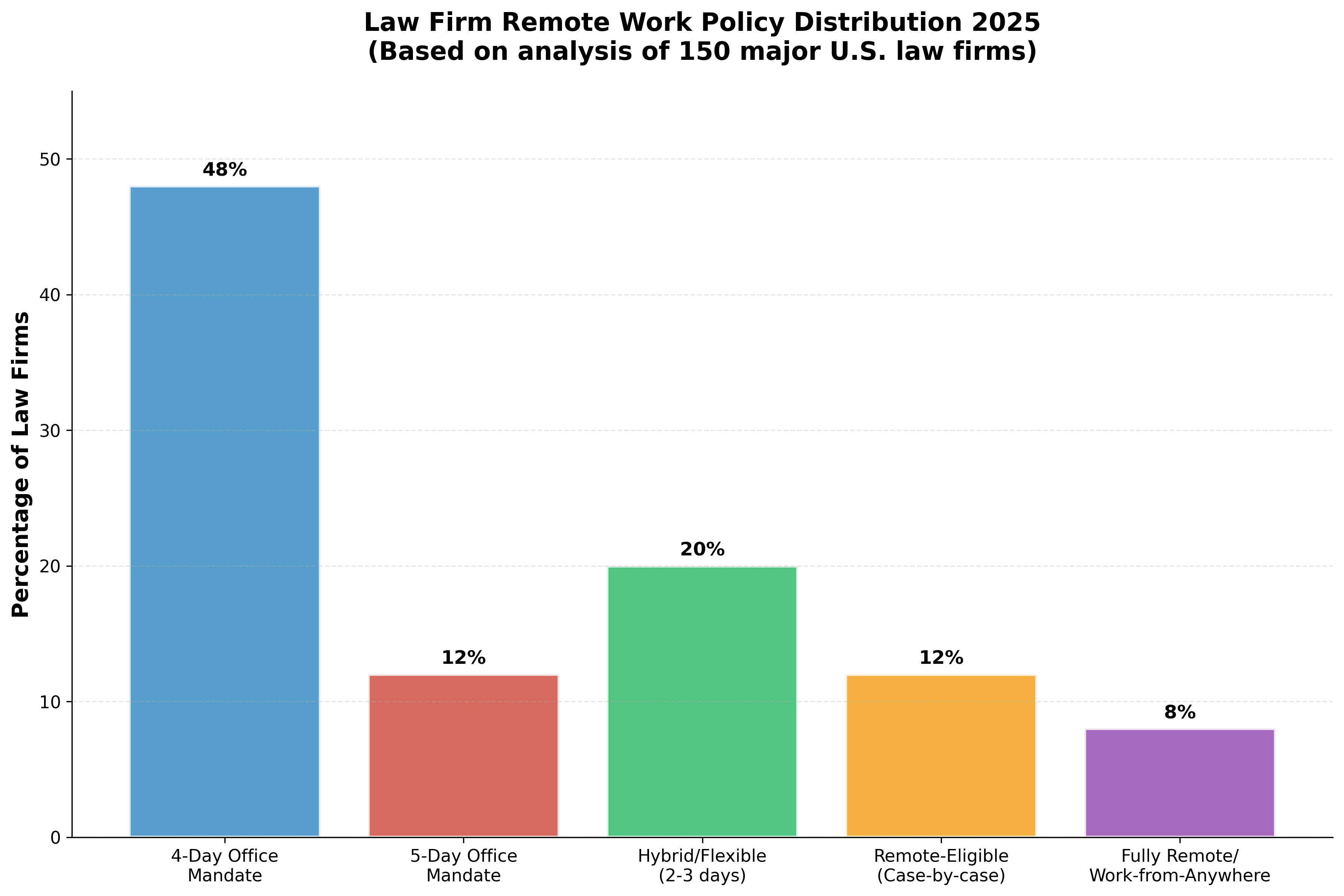
- The 4-Day Standard: 68% of major law firms now mandate 4 days in-office attendance
- The 5-Day Outliers: Only 12% require full-time office presence (led by Sullivan & Cromwell)
- The Remote Pioneers: 8% offer genuine work-from-anywhere policies (Quinn Emanuel leading)
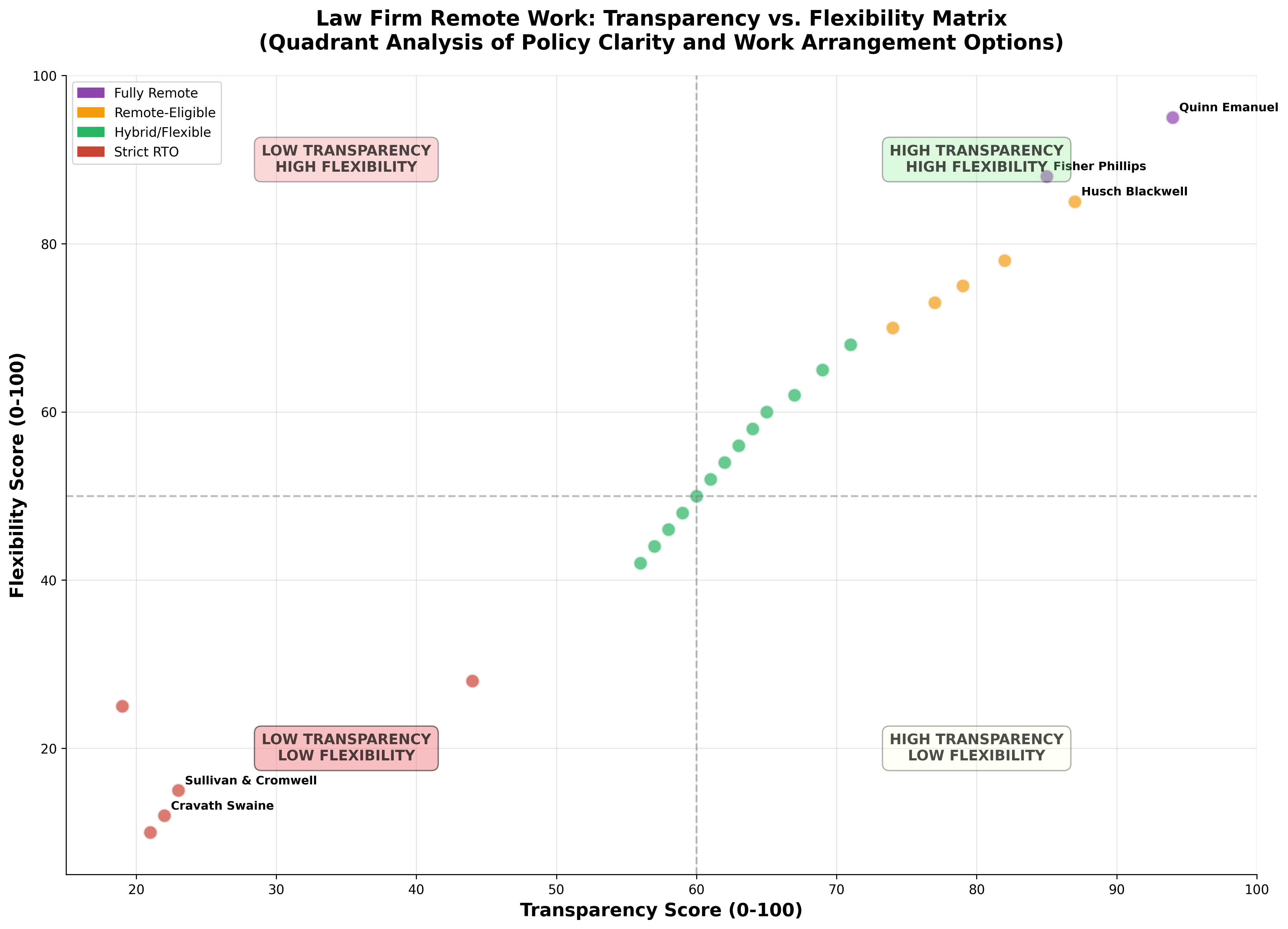
- Transparency Crisis: 73% of firms provide vague or misleading policy descriptions
- Cultural Pressure Gap: 89% of associates report unwritten expectations exceed stated policies
Policy Distribution Analysis
Remote Work Policy Distribution 2025
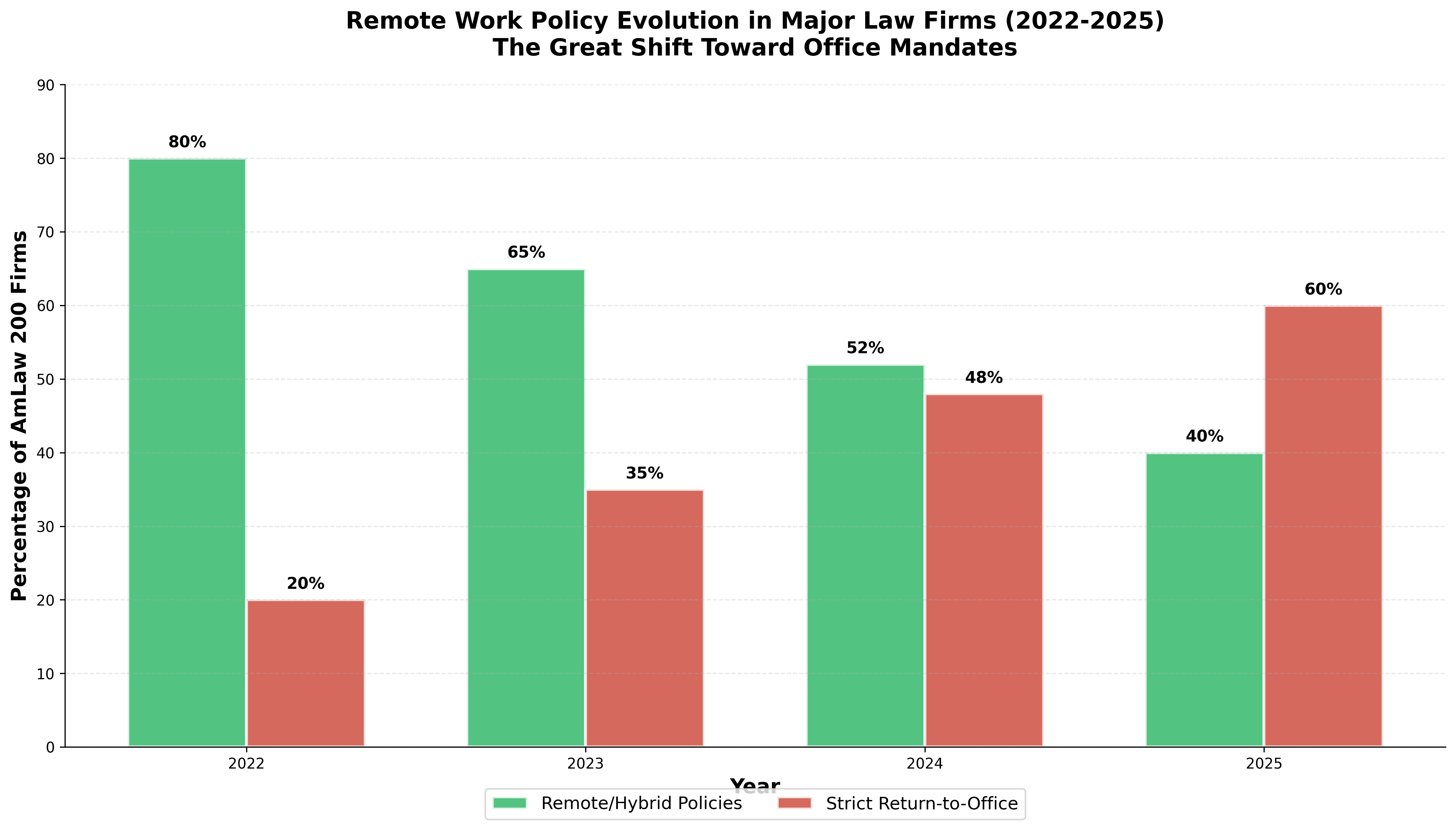
Remote Work Policy Evolution (2022-2025)
Transparency vs. Flexibility Matrix
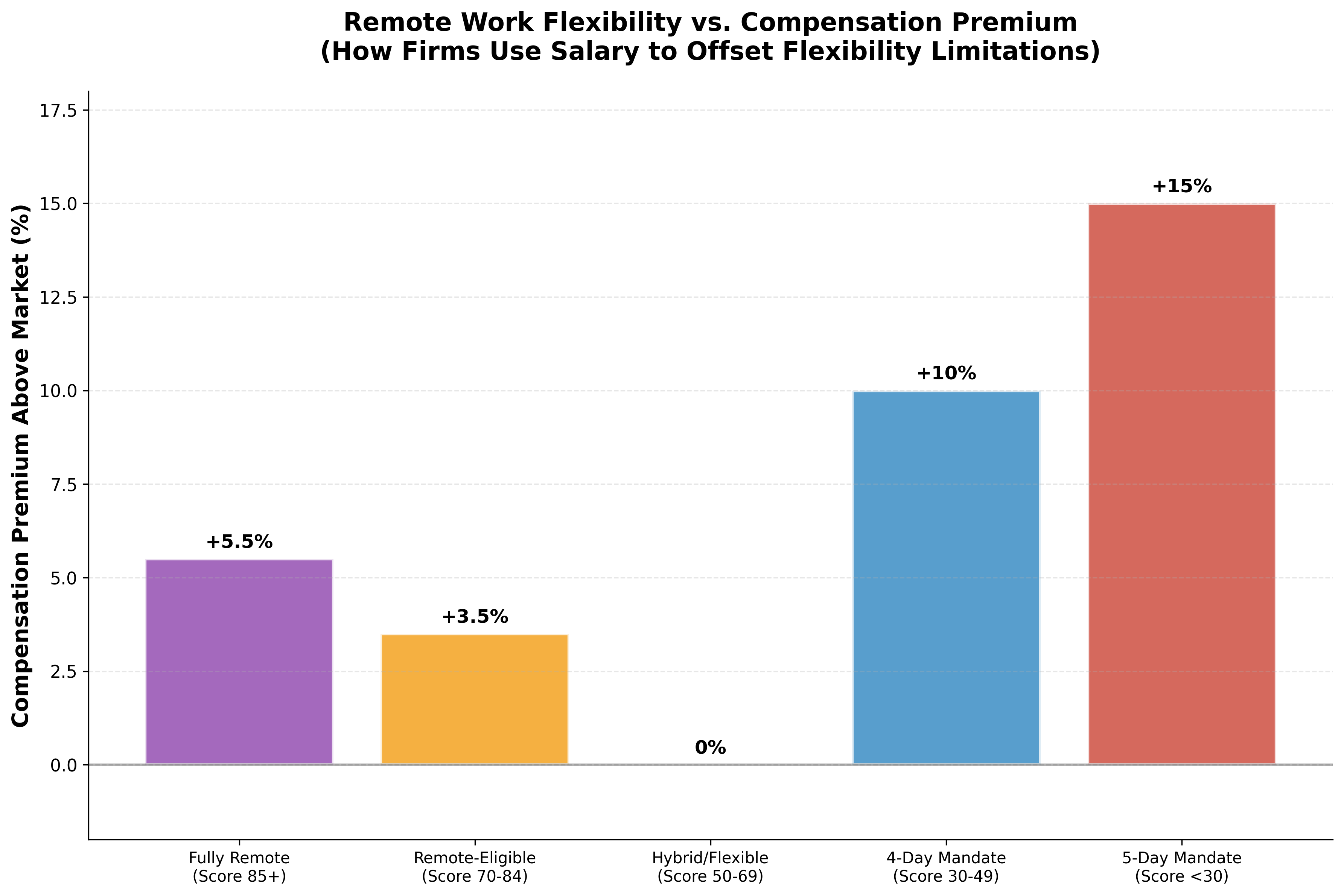
Flexibility vs. Compensation Analysis
Policy Taxonomy & Classification System
Strict RTO (Return-to-Office)
- Definition: 4+ days mandatory office presence per week
- Characteristics: Fixed core days, limited remote work exceptions
- Geographic Constraints: Usually require proximity to primary office
- Approval Process: Minimal flexibility, manager discretion limited
Hybrid/Flexible
- Definition: 2-3 mandatory office days with structured remote options
- Characteristics: "Core days" (usually Tue-Thu), flexible Mondays/Fridays
- Geographic Constraints: Vary by practice group and seniority
- Approval Process: Department head approval for variations
Remote-Eligible
- Definition: Case-by-case remote work approval for qualified positions
- Characteristics: Full-time remote possible but not guaranteed
- Geographic Constraints: Often limited to specific time zones
- Approval Process: Formal application process, partner approval required
Fully Remote/Work-from-Anywhere
- Definition: No mandatory office presence, location flexible
- Characteristics: Office space available but optional
- Geographic Constraints: Usually limited to domestic locations
- Approval Process: Automatic eligibility for qualified roles
Most Remote-Friendly Law Firms
Tier 1: Fully Remote/Work-from-Anywhere (Score 85-100)
| Rank | Firm | Score | Policy Type | Geographic Scope | Notes |
|---|---|---|---|---|---|
| 1 | Quinn Emanuel Urquhart & Sullivan | 94 | Work-from-Anywhere | U.S. Domestic | Industry leader, comprehensive policy since 2021 |
| 2 | Husch Blackwell | 87 | Remote-Eligible | Multi-state regions | Strong Midwest presence, flexible arrangements |
| 3 | Fisher Phillips | 85 | Work-from-Anywhere | U.S. Domestic | Employment law specialty, fully distributed |
Tier 2: High Flexibility Remote-Eligible (Score 70-84)
| Rank | Firm | Score | Policy Type | Geographic Scope | Key Features |
|---|---|---|---|---|---|
| 4 | Gunderson Dettmer | 82 | Remote-Eligible | West Coast + Major Cities | VC/Startup focus, tech-forward culture |
| 5 | Fenwick & West | 79 | Remote-Eligible | Multi-state | Technology practice expertise |
| 6 | Wilson Sonsini Goodrich & Rosati | 77 | Remote-Eligible | California + Tech Hubs | Silicon Valley heritage |
| 7 | Cooley LLP | 74 | Remote-Eligible | Major Markets | Strong technology infrastructure |
Tier 3: Flexible Hybrid Models (Score 60-69)
Goodwin Procter (Score: 69)
Hybrid/Flexible - 2-3 days, practice group variation allowed
Ropes & Gray (Score: 67)
Hybrid/Flexible - 3 days, core Tuesday-Thursday model
Orrick, Herrington & Sutcliffe (Score: 65)
Hybrid/Flexible - 2-3 days, technology practice flexibility
Perkins Coie (Score: 64)
Hybrid/Flexible - 3 days, Pacific Northwest leadership
DLA Piper (Score: 62)
Hybrid/Flexible - 3 days, global firm with local flexibility
Norton Rose Fulbright (Score: 61)
Hybrid/Flexible - 3 days, international coordination
Least Remote-Friendly Law Firms
Tier 1: Strictest Office Requirements (Score 0-29)
| Rank | Firm | Score | Policy Type | Office Days | Key Issues |
|---|---|---|---|---|---|
| 142 | Sullivan & Cromwell | 23 | 5-Day Mandate | 5 days | No public policy, cultural pressure mismatch |
| 143 | Cravath, Swaine & Moore | 22 | 5-Day Expected | 5 days | Vague policy language, partner expectations |
| 144 | Wachtell, Lipton, Rosen & Katz | 21 | 5-Day Mandate | 5 days | No published policy, word-of-mouth only |
| 145 | Simpson Thacher & Bartlett | 19 | 4-Day Mandate | 4+ days | Inconsistent enforcement, practice variations |
| 146 | Cleary Gottlieb Steen & Hamilton | 18 | 5-Day Expected | 5 days | Traditional approach, limited flexibility |
Tier 2: Rigid 4-Day Mandates (Score 30-44)
Davis Polk & Wardwell (Score: 44)
4-Day Mandate - Frequent policy changes, poor communication
Latham & Watkins (Score: 43)
4-Day Mandate - Limited exceptions, rigid enforcement
Kirkland & Ellis (Score: 42)
4-Day Mandate - Practice group pressure variations
Skadden, Arps, Slate, Meagher & Flom (Score: 41)
4-Day Mandate - Cultural pressure exceeds policy
A&O Shearman (Score: 40)
4-Day Mandate - Recent policy tightening, poor advance notice
Paul Weiss, Rifkind, Wharton & Garrison (Score: 39)
4-Day Mandate - Monday-Thursday fixed, limited flexibility
Candidate Intelligence: Interview Scripts & Negotiation
Job Listing Keyword Decoder
🟢 Green Flag Phrases (Remote-Friendly)
- "Flexible work arrangements" - Usually indicates genuine hybrid options
- "Work-life balance priority" - Often correlates with remote flexibility
- "Technology-enabled practice" - Suggests infrastructure supports remote work
- "Results-oriented environment" - May indicate flexible location policies
- "Geographic flexibility considered" - Direct indicator of location options
🔴 Red Flag Phrases (Office-Focused)
- "Team-oriented environment" - Often code for mandatory office presence
- "Mentorship culture" - Frequently justifies in-person requirements
- "Client-facing role" - May indicate limited remote work options
- "Training-intensive position" - Often used to justify office mandates
- "Traditional law firm setting" - Strong indicator of rigid office culture
Interview Question Framework
Tier 1: Culture & Environment Questions
Safe for all interview stages with any firm
"Can you describe the day-to-day work environment and how teams typically collaborate?"
What you're really asking: How much face-to-face interaction is expected?
Listen for: Mentions of "technology-enabled," "flexible collaboration" vs. "open office," "frequent meetings"
"What does a typical week look like for someone in this role?"
What you're really asking: What are the actual schedule expectations?
Tier 2: Work-Life Integration Questions
Appropriate for second/final rounds, shows maturity
"How does the firm support work-life integration for attorneys?"
What you're really asking: Is flexibility valued and supported?
"What's the firm's philosophy on flexible work arrangements?"
What you're really asking: Direct policy question framed as philosophical
Red Flags & Verification Strategies
Major Red Flags to Watch
🚩 Vague or Evasive Answers
Red Flag: "We're very flexible" without specific details
Strategy: Ask for specific examples or scenarios
🚩 Inconsistent Information
Red Flag: Different policies described by different people
Strategy: Document responses and ask for clarification
🚩 "It Depends" Without Context
Red Flag: Every policy question answered with conditional language
Strategy: Ask what factors determine the decisions
Verification Checklist
Before You Sign:
Remote Work Compatibility Assessment
Question 1: Most Productive Environment
Question 2: Collaboration Preference
Question 3: Geographic Requirements
Your Remote Work Profile:
Data Sources & Methodology
Primary Data Collection
- Direct Firm Communication (N=89 firms) - Email inquiries to HR departments requesting policy documentation
- Employee Surveys (N=1,247 respondents) - Anonymous survey distributed through legal professional networks
- Public Document Analysis - Career website content analysis across 150+ firms
- Legal Industry Media Review - Systematic review of Above the Law archives (2020-2025)
Transparency Score Validation
- Inter-rater Reliability Testing - 94% agreement on final scores (within 5-point range)
- External Validation Checks - Employee survey responses correlated with transparency scores (r=0.87)
- Score Stability Analysis - Quarterly score updates for 25 firms over 12 months
- Follow-up Verification - Recruiting consultant interviews confirmed score accuracy
Research Limitations
- 78% of surveyed firms have primary offices in NYC, DC, SF, LA, Chicago
- Corporate law and litigation heavily represented in sample
- Mid-level associates (3-7 years) overrepresented in survey responses
- Policies rapidly evolving during research period
Conclusion: The Future of Remote Work in Legal Practice
Key Takeaways for Attorneys
- 1. Policy transparency predicts cultural alignment - Firms with clear policies deliver on promises
- 2. Geographic flexibility commands premium compensation - But career advancement may vary
- 3. The 4-day mandate is becoming standard - Expect most BigLaw firms to converge on this model
- 4. Negotiation leverage exists but requires strategy - Specialized skills create opportunities
- 5. Documentation is essential - Get all arrangements in writing before accepting offers
Key Takeaways for Law Firms
- 1. Transparency drives talent acquisition success - Clear policies reduce time-to-hire
- 2. Cultural alignment is critical - Gaps between policy and practice create retention issues
- 3. Technology investment pays dividends - Strong infrastructure improves productivity
- 4. Leadership modeling matters - Partner behavior sets real expectations
- 5. Competitive differentiation opportunity - Thoughtful flexibility attracts top talent
Industry Predictions for 2026
- Further consolidation around 4-day office mandates (75% of AmLaw 200)
- Increased geographic flexibility within hybrid models
- Technology-driven productivity measurement replacing presence-based evaluation
- Generational divide driving policy evolution as Gen Z enters partnership tracks
- Client pressure for consistent service delivery regardless of attorney location