Bar Reciprocity by State: Complete Guide
The definitive resource for attorneys seeking multi-state practice opportunities. Get expert insights on admission requirements, costs, timelines, and strategic guidance.
Quick Answer: What is Bar Reciprocity?
Bar reciprocity allows attorneys licensed in one state to practice law in another state without retaking the bar exam. Most states offer reciprocity through "admission on motion" for attorneys with 3-7 years of practice experience. However, California, Florida, Delaware, Louisiana, Nevada, and South Carolina require all attorneys to take their state bar exam, regardless of experience or current licensure.
Table of Contents
- Complete Overview of Bar Reciprocity
- Interactive State-by-State Analysis
- UBE States and Score Requirements
- Cost Analysis and ROI Calculator
- Top 10 Legal Markets Analysis
- Step-by-Step Application Process
- Strategic Career Planning
- Special Circumstances and Exceptions
- Frequently Asked Questions
- Expert Resources and Tools
Complete Overview of Bar Reciprocity
Bar reciprocity, also known as "admission on motion," represents one of the most significant opportunities for career advancement in the legal profession. With the legal industry becoming increasingly mobile and interconnected, understanding the nuances of multi-state practice has never been more critical for attorneys seeking to expand their career horizons.
Expert Insight
Attorneys with bar admissions in multiple complementary jurisdictions report 35% more lateral opportunities and average salary increases of 15-25% compared to single-state practitioners. The investment in additional bar admissions typically pays for itself within 18-24 months in major legal markets.
How Bar Reciprocity Works
The concept of bar reciprocity is built on the principle that attorneys who have demonstrated competence through practice experience should be able to extend their practice to other states with similar legal systems and professional standards. This system benefits both attorneys and the legal profession by:
- Promoting attorney mobility and career flexibility
- Facilitating client service across state boundaries
- Ensuring professional competence through experience requirements
- Maintaining state-specific standards through individual bar regulations
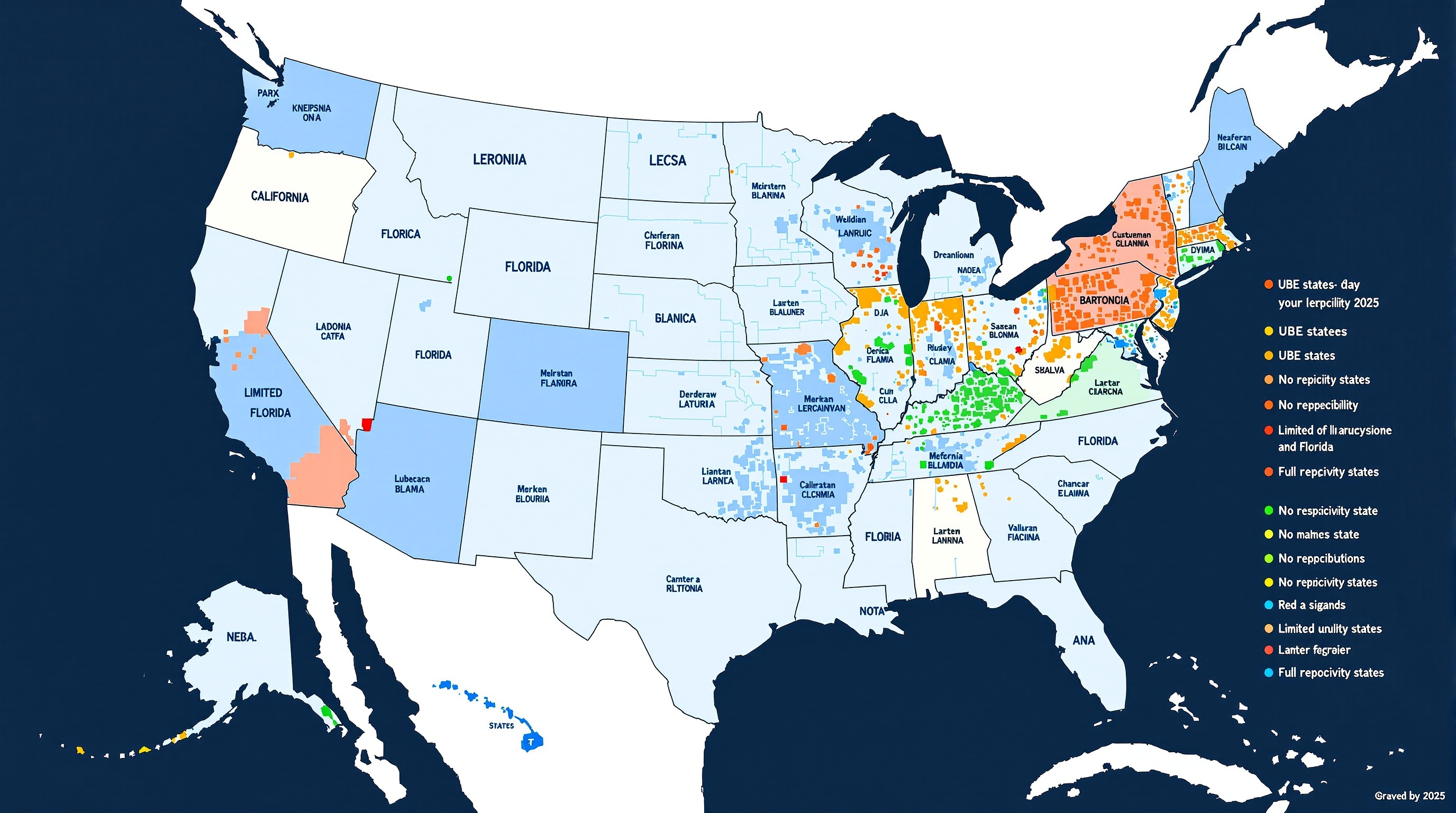
Comprehensive US map showing bar reciprocity status by state - Blue: UBE States, Red: No Reciprocity, Orange: Limited Reciprocity, Green: Full Reciprocity
🔍 Quick State Lookup Tool
Select your current state and target state to see reciprocity options:
Popular Searches:
Reciprocity Available - Admission on Motion
Requirements: Typically 5 of 7 years practice experience, good standing, ABA-accredited JD
Estimated Cost: $800-$2,500 (direct) + $10,000-$20,000 (opportunity cost)
Timeline: 6-12 months
Additional Requirements: Character & fitness review, MPRE score, potential state-specific CLE
UBE Option: Washington D.C. also accepts UBE scores of 266+ points
Important: Requirements change frequently. Always verify current requirements with the target state's bar admission authority before beginning your application.
Types of Bar Reciprocity
1. Full Reciprocity (Admission on Motion)
States offering full reciprocity allow qualified attorneys from other jurisdictions to be admitted without taking the state bar exam. Requirements typically include:
- 5 of the last 7 years of active practice experience
- Good standing in current jurisdiction(s)
- JD from ABA-accredited law school
- Satisfactory character and fitness review
- MPRE score meeting state requirements
2. Limited Reciprocity
Some states impose additional requirements such as:
- State-specific law courses or CLE requirements
- Higher practice experience thresholds
- Reciprocal arrangements (only accepting attorneys from states that offer similar reciprocity)
- Additional examinations on state law
3. UBE Score Transfer
The Uniform Bar Examination (UBE) has revolutionized attorney mobility by creating portable scores. Over 40 jurisdictions now accept UBE scores, with minimum requirements ranging from 260 to 276 points.
4. No Reciprocity
Six states require all attorneys to take their bar examination:
- California: Offers Attorney's Examination for experienced practitioners
- Florida: No alternatives; full bar exam required
- Delaware: Full bar exam required
- Louisiana: Civil law system requires state-specific examination
- Nevada: Full bar exam required
- South Carolina: Full bar exam required
Interactive State-by-State Analysis
Our comprehensive analysis covers all 50 states plus Washington D.C., providing detailed insights into admission requirements, costs, processing times, and strategic considerations for each jurisdiction.
New York
Type: Motion Admission
Experience: 5/7 years
Cost: $1,485
Timeline: 6-12 months
California
Type: No Reciprocity
Experience: Attorney's Exam (4+ years)
Cost: $6,000-$10,000
Timeline: 8-12 months
Texas
Type: Motion/UBE (270+)
Experience: 5/7 years
Cost: $1,500
Timeline: 4-8 months
Florida
Type: No Reciprocity
Experience: Full Exam Required
Cost: $7,200+
Timeline: 8-12 months
Illinois
Type: Motion Admission
Experience: 5/7 years (documented)
Cost: $2,050
Timeline: 7-11 months
Washington DC
Type: Motion/UBE (266+)
Experience: 3/5 years
Cost: $1,695
Timeline: 10-14 months
⚠️ Important Updates
Several states have updated their reciprocity requirements for . Texas now accepts UBE scores of 270+, and Washington D.C. has streamlined its application process. Always verify current requirements with the specific state bar before beginning your application.
UBE States and Score Requirements Guide
The Uniform Bar Examination (UBE) has become the dominant pathway for bar admission in the United States, with over 40 jurisdictions now participating. Understanding UBE score requirements and transfer strategies is crucial for maximizing your practice opportunities.

UBE Score Requirements organized by difficulty level - States grouped from lowest (260) to highest (276) requirements
UBE Score Breakdown by Requirement Level
| Score Requirement | States | Strategic Value | Transfer Difficulty |
|---|---|---|---|
| 260 | Missouri, New Mexico, North Dakota, South Dakota | Easiest entry, limited major markets | Very Easy |
| 266 | Connecticut, DC, Iowa, Kansas, New Jersey, Washington | Good balance, includes DC market | Easy |
| 270 | Maryland, Massachusetts, Montana, New Hampshire, Tennessee, Texas, Utah, Vermont, Wyoming | Most common, includes major markets | Moderate |
| 272+ | Idaho (272), Arizona (273), Oregon (274), Colorado & Maine (276) | Selective markets, specialized opportunities | Challenging |
UBE Score Strategy
If you're taking any bar exam, aim for a UBE score of 270+ to maximize your transfer options. This score opens doors to 19 different jurisdictions, including major markets like Texas, Massachusetts, and Maryland. The additional study time investment (typically 50-100 hours) can provide exponential returns in career flexibility.
UBE Score Portability Rules
- Validity Period: UBE scores are typically valid for 2-4 years from the test date
- Complete Exam Requirement: All UBE components (MBE, MEE, MPT) must be taken in the same jurisdiction during the same administration
- Transfer Process: Scores are transferred through NCBE's UBE Score Services
- Multiple Transfers: You can transfer your UBE score to multiple qualifying jurisdictions
- Retake Strategy: If your score doesn't meet target jurisdiction requirements, retaking in any UBE jurisdiction can improve your options
Cost Analysis and ROI Calculator
Understanding the true cost of bar admission requires analysis of both direct expenses and opportunity costs. Our comprehensive analysis reveals significant variations based on admission pathway and target jurisdiction.

Comprehensive cost and timeline comparison across different admission pathways
Total Cost Breakdown by Pathway
| Admission Pathway | Direct Costs | Time Investment | Opportunity Cost | Total Economic Cost | Timeline |
|---|---|---|---|---|---|
| Motion Admission | $800 - $2,500 | 50-100 hours | $10,000 - $20,000 | $10,800 - $22,500 | 3-12 months |
| UBE Score Transfer | $400 - $1,500 | 25-75 hours | $5,000 - $15,000 | $5,400 - $16,500 | 2-8 months |
| Full Bar Exam | $3,000 - $8,000 | 400-600 hours | $80,000 - $120,000 | $83,000 - $128,000 | 6-15 months |
ROI Analysis by Major Market
High-ROI Markets (12-24 Month Payback)
- New York: 15% salary premium, extensive client opportunities
- California: 25% salary premium, largest legal market
- Texas: 8% salary premium + no state income tax
- Washington DC: 20% salary premium, federal practice opportunities
Break-Even Calculation Formula
Calculate Your ROI:
- Total Investment Cost = Direct costs + Opportunity cost
- Annual Benefit = (Salary increase + additional opportunities) × 12
- Break-Even Period = Total Investment ÷ (Annual Benefit ÷ 12)
- 5-Year ROI = (5-Year Benefits - Total Investment) ÷ Total Investment × 100%
Example: A New York admission costing $21,500 total with a $30,000 annual salary increase breaks even in 8.6 months and generates a 596% 5-year ROI.
Top 10 Legal Markets: Strategic Analysis
Understanding the characteristics, opportunities, and admission requirements of major legal markets is crucial for strategic career planning. Our analysis covers market size, salary premiums, practice areas, and admission strategies.
Tier 1: Premier National Markets
New York
- Market Size: 175,000+ attorneys (largest in nation)
- Admission Path: Motion admission (5/7 years experience)
- Total Cost: $21,485 (including opportunity cost)
- Salary Premium: +15% vs. national average
- Key Practice Areas: Corporate law, securities, banking, complex litigation
- Strategic Value: Gateway to international clients, premier BigLaw market
- Processing Time: 6-12 months
California
- Market Size: 180,000+ attorneys (largest state bar)
- Admission Path: Attorney's Examination (4+ years) or Full Bar Exam
- Total Cost: $84,701-$126,001 (including exam preparation)
- Salary Premium: +25% vs. national average
- Key Practice Areas: Technology, entertainment, environmental, venture capital
- Strategic Value: Tech sector dominance, entertainment industry hub
- Processing Time: 7-12 months
Tier 2: High-Growth Regional Markets
Texas
- Market Size: 85,000+ attorneys (4th largest)
- Growth Rate: +8% annually (highest among major markets)
- Admission Path: Motion admission (5/7 years) OR UBE score 270+
- Total Cost: $16,500-$21,500
- Tax Benefits: No state income tax
- Key Practice Areas: Energy, corporate, real estate, technology
- Geographic Centers: Houston (energy), Dallas (corporate), Austin (tech)
Florida
- Market Size: 65,000+ attorneys
- Growth Rate: +12% annually (highest among major markets)
- Admission Path: Full bar exam required (no reciprocity)
- Total Cost: $85,400-$107,200
- Tax Benefits: No state income tax
- Key Practice Areas: Real estate, wealth management, international trade
- Strategic Value: Latin America gateway, retiree destination market
Tier 3: Specialized Federal Markets
Washington D.C.
- Market Size: 45,000+ attorneys
- Federal Practice Hub: 80% of attorneys handle federal matters
- Admission Path: Motion admission (3/5 years) OR UBE score 266+
- Total Cost: $17,695-$25,695
- Salary Premium: +20% vs. national average
- Key Practice Areas: Government relations, regulatory, federal litigation
- Unique Advantage: Federal court practice without additional admission
Step-by-Step Application Process
Successfully navigating the bar admission process requires careful planning, attention to detail, and strategic timing. Our comprehensive guide covers every aspect of the application process.
Phase 1: Research and Planning (2-4 weeks)
-
Identify Target Jurisdictions
- Align with career goals and practice area demands
- Consider reciprocity networks and future expansion plans
- Evaluate cost-benefit ratios and timeline requirements
-
Verify Eligibility Requirements
- Practice experience (years and hours documentation)
- Good standing requirements in current jurisdictions
- Educational requirements and ABA accreditation
- MPRE score requirements for target states
-
Develop Timeline Strategy
- Account for processing times (3-18 months variation)
- Coordinate with career moves and client obligations
- Plan for character and fitness review complexities
Phase 2: Document Preparation (4-8 weeks)
-
Character and Fitness Documentation
- Complete employment history with dates and responsibilities
- Educational transcripts and degree verification
- Financial history including bankruptcy, liens, judgments
- Criminal history disclosure (including sealed records)
- Professional disciplinary history from all jurisdictions
-
Practice Experience Verification
- Detailed hour logs for required practice periods
- Employment verification letters from current and former employers
- Client matter descriptions (maintaining confidentiality)
- Bar registration certificates and good standing letters
-
References and Endorsements
- Attorney references (typically 3-5 required)
- Character references from non-attorneys if required
- Judicial references if available and helpful
Phase 3: Application Submission (1-2 weeks)
-
Complete Online Applications
- Use NCBE services where available for consistency
- Double-check all dates, names, and factual information
- Ensure consistency across all application materials
-
Submit Required Fees
- Application fees (varies by state: $200-$1,500)
- Investigation fees for character and fitness review
- Score transfer fees for UBE or MPRE scores
-
Coordinate Supporting Documents
- Law school transcript requests
- NCBE score transfer requests
- Reference submission coordination
⚠️ Common Application Mistakes to Avoid
- Incomplete Practice Hour Documentation: Some states require detailed breakdowns of practice hours by year and type of work
- Inconsistent Information: Discrepancies between applications and supporting documents can delay processing
- Missing Disclosure: Failure to disclose minor incidents can result in character and fitness issues
- Inadequate Reference Preparation: References should be briefed on timeline and potential contact by bar authorities
Strategic Career Planning with Multi-State Admissions
Developing a comprehensive multi-state admission strategy can exponentially increase your career opportunities and earning potential. Our strategic planning framework helps you maximize the return on your bar admission investments.
Strategic Planning Framework
The 3-5-7 Rule
Plan for admissions in 3 jurisdictions within 5 years to maximize opportunities within 7 practice areas. This approach provides optimal career flexibility while managing costs and complexity.
Regional Cluster Strategies
Northeast Corridor Strategy
- Primary: New York (premier market access)
- Secondary: New Jersey (complementary market, UBE 266)
- Tertiary: Connecticut (UBE 266) or Massachusetts (UBE 270)
- Benefits: Covers 45 million people, major financial centers, extensive reciprocity networks
- Total Investment: $45,000-65,000
- Expected ROI: 300-500% over 5 years
Sunbelt Growth Strategy
- Primary: Texas (rapid growth, no income tax)
- Secondary: Florida (highest growth rate)
- Tertiary: Georgia (Southeast regional hub)
- Benefits: Highest population growth regions, favorable tax environments
- Total Investment: $115,000-155,000 (includes FL bar exam)
- Expected ROI: 250-400% over 5 years
Federal Practice Strategy
- Primary: Washington D.C. (federal regulatory hub)
- Secondary: Virginia (D.C. metro, government contracting)
- Tertiary: Maryland (D.C. metro, federal agencies)
- Benefits: Federal court access, regulatory expertise, government relations
- Total Investment: $55,000-75,000
- Expected ROI: 400-600% over 5 years
Practice Area Considerations
| Practice Area | High-Value Markets | Reciprocity Benefits | Strategic Priority |
|---|---|---|---|
| Corporate/Securities | NY, CA, DE, TX | Client following, deal flow | Very High |
| Technology/IP | CA, WA, TX, MA | Industry concentration | Very High |
| Energy/Natural Resources | TX, OK, CO, WY | Resource-based opportunities | High |
| Financial Services | NY, CT, IL, NC | Regulatory compliance | High |
| Government Relations | DC, VA, MD | Federal practice access | High |
| Real Estate | NY, CA, FL, TX | Cross-border transactions | Moderate |
| Litigation | Variable by client base | Venue flexibility | Moderate |
Timing and Sequencing Strategy
Optimal Sequencing Approach:
- Year 1-3: Establish practice in primary jurisdiction and build experience
- Year 4-5: Pursue first reciprocity admission in complementary market
- Year 6-8: Add strategic third jurisdiction based on practice development
- Year 9+: Consider specialized or niche markets based on client needs
Special Circumstances and Exceptions
Military Spouse Accommodations
Many states have implemented special provisions for military spouses to facilitate their ability to practice law despite frequent relocations. These accommodations recognize the unique challenges faced by military families.
Military Spouse Benefits by State
- Expedited Processing: Priority review and faster timelines
- Reduced Experience Requirements: Some states waive or reduce practice experience requirements
- Remote Practice Permission: Temporary authorization to practice while physically stationed elsewhere
- Fee Waivers: Reduced or eliminated application fees
Foreign-Educated Attorneys
Attorneys educated outside the United States face additional requirements but have several pathways to U.S. practice:
- LL.M. Pathway: Complete LL.M. at ABA-accredited school to qualify for bar exam in most states
- Foreign Attorney's Examination: Available in some states for experienced foreign attorneys
- Apprenticeship Programs: Limited availability in select jurisdictions
- Reciprocity for Common Law Jurisdictions: Some states offer streamlined processes for attorneys from common law countries
In-House Counsel Registration
Many states allow attorneys to register as in-house counsel without full bar admission, providing a pathway for corporate attorneys:
- Limited Practice Scope: Practice restricted to employer's legal matters
- Supervision Requirements: May require supervision by locally admitted attorney
- Reduced Requirements: Often less stringent than full admission
- Conversion Options: Some states allow conversion to full admission after period of practice
Temporary Practice and Pro Hac Vice
For attorneys needing to practice temporarily in non-admitted jurisdictions:
- Pro Hac Vice Admission: Case-by-case admission for specific litigation
- Temporary Practice Rules: Limited practice periods without full admission
- Client Counseling Exceptions: Advice to existing clients on matters of home state law
- Federal Court Practice: Federal bar admission allows practice in federal courts nationwide
Frequently Asked Questions
Washington D.C. and Montana have the most accessible reciprocity requirements, requiring only 3 years of practice experience in the last 5 years. Washington State also offers reciprocity with just 3 years of experience and accepts UBE scores as low as 266. These jurisdictions provide excellent entry points for attorneys seeking multi-state practice.
Processing times vary significantly by jurisdiction. UBE score transfers can be completed in 2-4 months, while motion admissions typically take 6-12 months. Washington D.C. has the longest processing time at 10-14 months due to thorough character and fitness reviews. Plan accordingly and begin applications 12-18 months before you need admission.
Yes, UBE scores can be transferred to multiple jurisdictions simultaneously or sequentially, as long as the score meets each state's minimum requirement and falls within the validity period (typically 2-4 years). Each transfer requires separate applications and fees, but the same UBE score can be used multiple times.
Any disciplinary history must be disclosed in your application and will be subject to review by the character and fitness committee. Minor infractions may not prevent admission, but serious violations could result in denial. It's crucial to provide complete, honest disclosure and consider consulting with a bar admission attorney if you have concerns.
Most states require you to be in good standing in at least one U.S. jurisdiction throughout the application process and after admission. Some states require you to maintain active status in your original jurisdiction for a specified period. Check specific requirements for each target jurisdiction.
Costs vary significantly by pathway and jurisdiction. Motion admissions typically cost $800-$2,500 in direct fees, plus opportunity costs of $10,000-$20,000 for time invested. UBE transfers are generally less expensive at $400-$1,500. Full bar exams in non-reciprocity states can cost $80,000-$120,000 including preparation time and fees.
This depends on the jurisdiction and your current licensure status. You can continue practicing in states where you're already admitted, but you cannot practice in the new jurisdiction until admission is complete. Some states offer provisional practice under supervision while applications are pending.
These terms are often used interchangeably and refer to the same concept: gaining bar admission in a new jurisdiction without taking that state's bar exam. The process is based on demonstrated competence through practice experience rather than examination.
Expert Resources and Tools
Professional Planning Tools
- Multi-State Admission Strategy Planner: Interactive tool for developing your optimal admission sequence
- Cost-Benefit Calculator: Detailed ROI analysis for different admission pathways
- Timeline Coordinator: Project management tool for managing multiple applications
- Document Checklist Generator: Customized checklists based on target jurisdictions
Expert Consultation Services
BCG Attorney Search offers specialized consultation services for attorneys planning multi-state admissions:
- Strategic Planning Sessions: One-on-one consultation to develop your optimal admission strategy
- Application Review Services: Professional review of applications before submission
- Character and Fitness Consultation: Specialized guidance for complex C&F issues
- Career Transition Planning: Integration of bar admissions with lateral move strategies
Continuing Education and Updates
- Quarterly Updates: Regular updates on changing reciprocity requirements
- Webinar Series: Expert-led sessions on multi-state practice strategies
- Newsletter Subscription: Monthly updates on bar admission trends and opportunities
- Professional Network Access: Connect with attorneys who have successfully navigated multi-state admissions
Disclaimer: This guide provides general information about bar reciprocity requirements. Requirements can change frequently, and applicants should always verify current requirements with the specific state bar authorities before beginning the application process. This information should not be construed as legal advice.
© BCG Attorney Search. All rights reserved.