The Complete Attorney Compensation Report 2025-2026 - Definitive U.S. Legal Salary Guide
The most comprehensive analysis of attorney compensation across all practice areas, firm sizes, geographic regions, and attorney levels in the United States
Executive Summary
BigLaw Dominance
BigLaw attorneys earn 340% more than comparable positions at small firms, with first-year associates starting at $225,000 base salary plus $20,000 annual bonus, progressing to over $3 million for top equity partners.
Geographic Disparities
Location creates significant compensation disparities, with attorneys in Washington DC earning a mean salary of $238,990 compared to substantially lower figures in secondary markets, though cost-adjusted compensation may favor regional markets.
Practice Area Premiums
Specialization significantly impacts compensation, with Antitrust (+25%), Securities (+22%), and IP Litigation (+20%) commanding the highest premiums over general practice, while areas serving individuals typically offer lower compensation.
In-House Competitiveness
In-house counsel compensation has become increasingly competitive at 75% of BigLaw levels, while government positions offer only 27% of comparable BigLaw compensation but provide superior work-life balance.
Historic Growth
First-year associate salaries increased by 21% between 2021-2023, representing the largest two-year increase in modern legal industry history, driven by talent competition and economic recovery.
Market Overview
The U.S. legal market in 2025-2026 continues to demonstrate remarkable compensation disparities across different segments. With approximately 731,340 practicing attorneys nationwide according to the Bureau of Labor Statistics, the profession shows a mean annual wage of $176,470, though this figure masks significant variations based on practice setting, specialization, and geographic location.
Market Drivers
- Post-pandemic economic recovery
- Increased M&A activity
- Talent retention competition
- Technology transformation
- Regulatory complexity growth
Compensation Trends
- 21% increase in first-year salaries (2021-2023)
- 8.2% average partner compensation growth
- Bonus pool expansion at top firms
- Enhanced benefits packages
- Remote work flexibility premiums
Compensation Analysis Visualizations
BigLaw Salary Progression 2025-2026
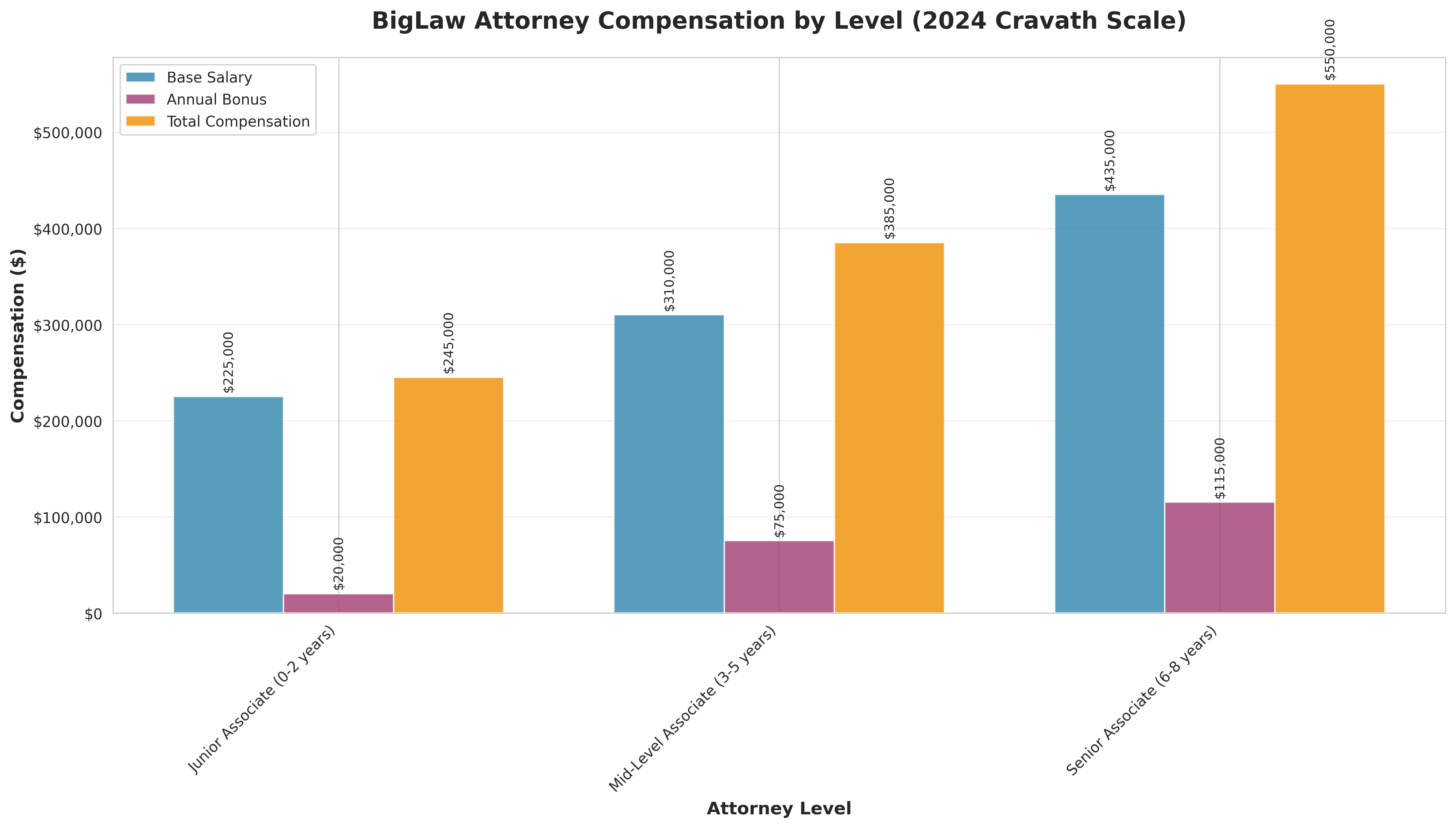
Base salary and bonus progression for BigLaw associates by experience level
Geographic Salary Variations 2025
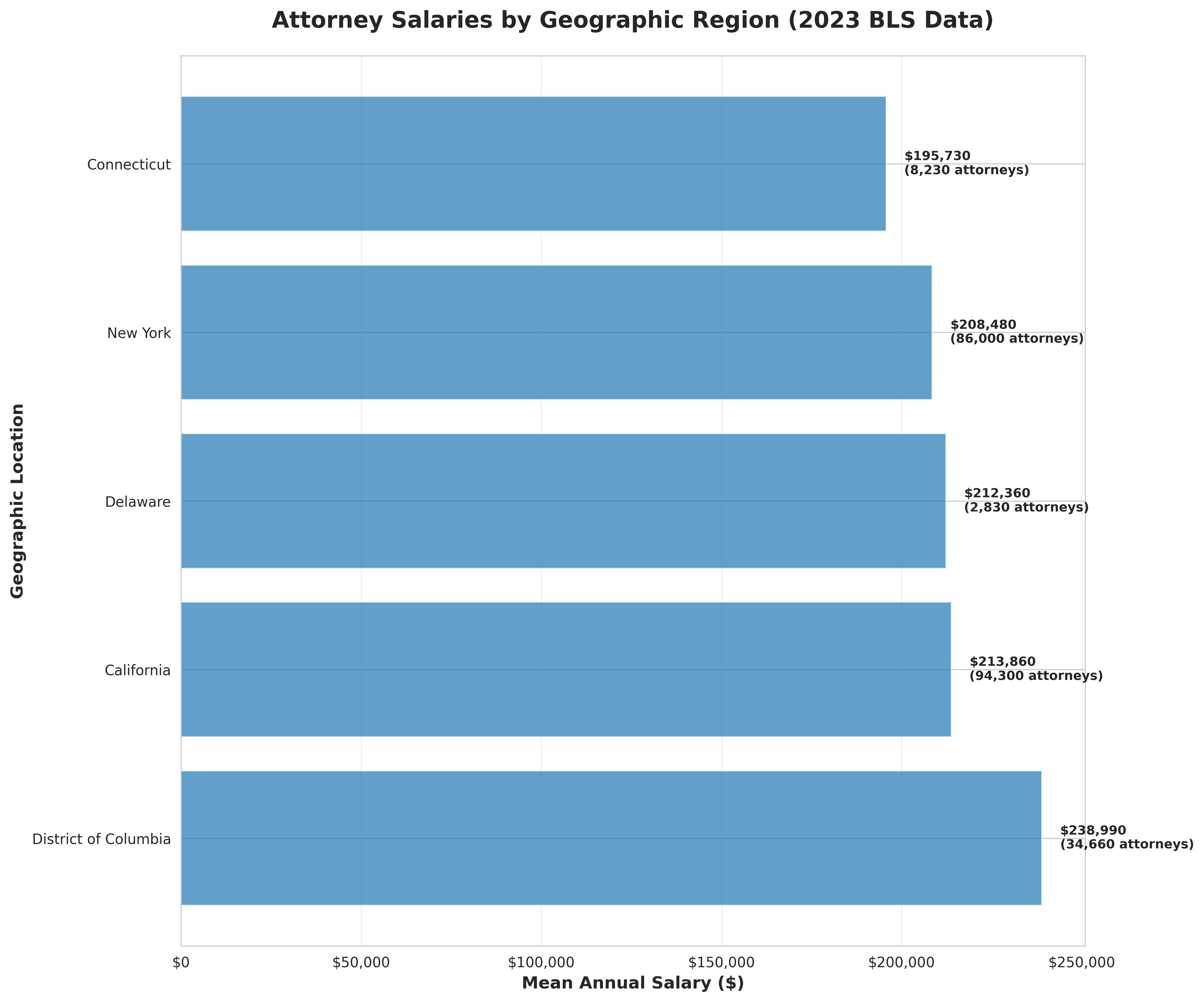
Mean attorney salaries by major geographic regions
Practice Area Compensation 2025-2026
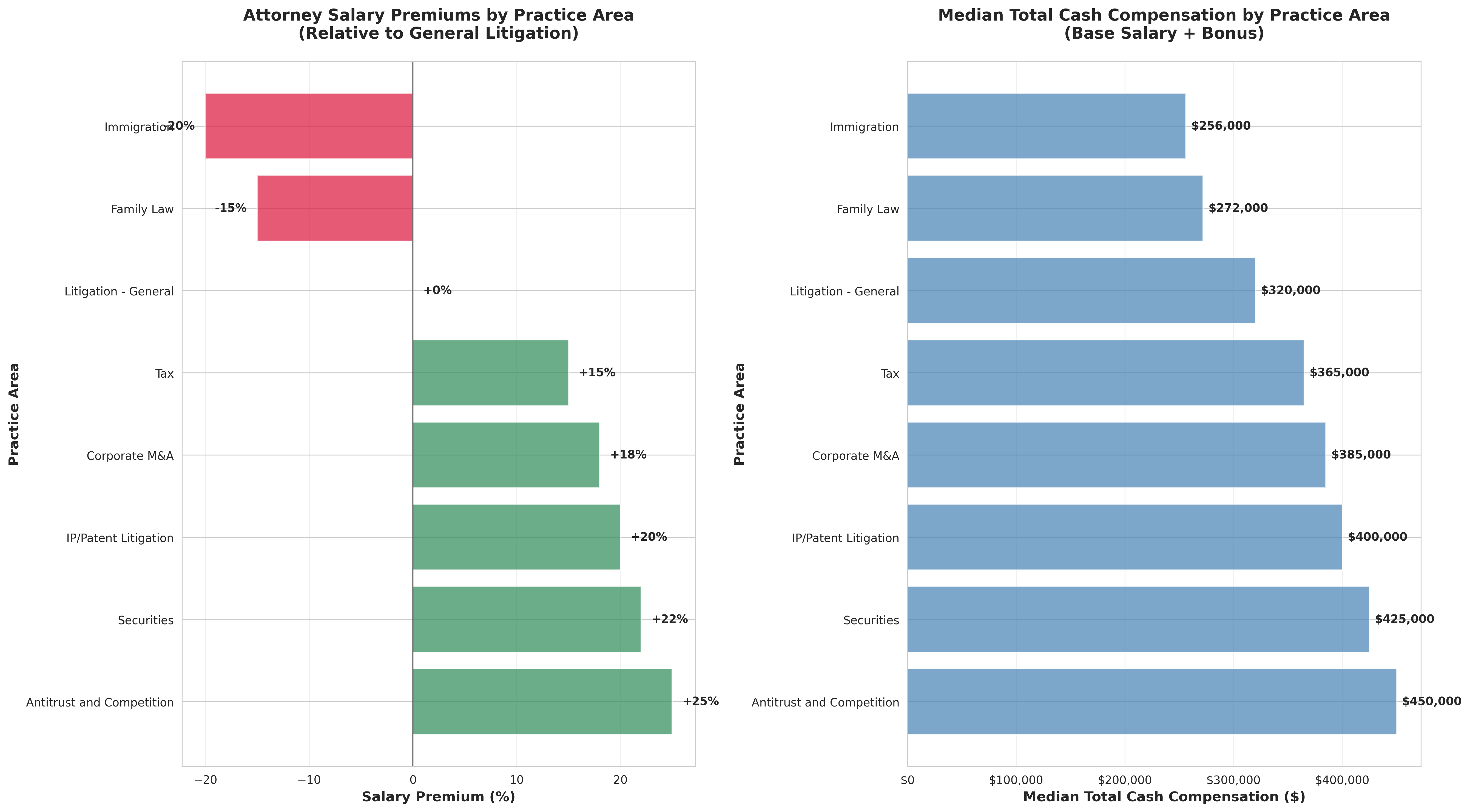
Salary premiums and total cash compensation by legal specialization
Sector Compensation Comparison 2025-2026
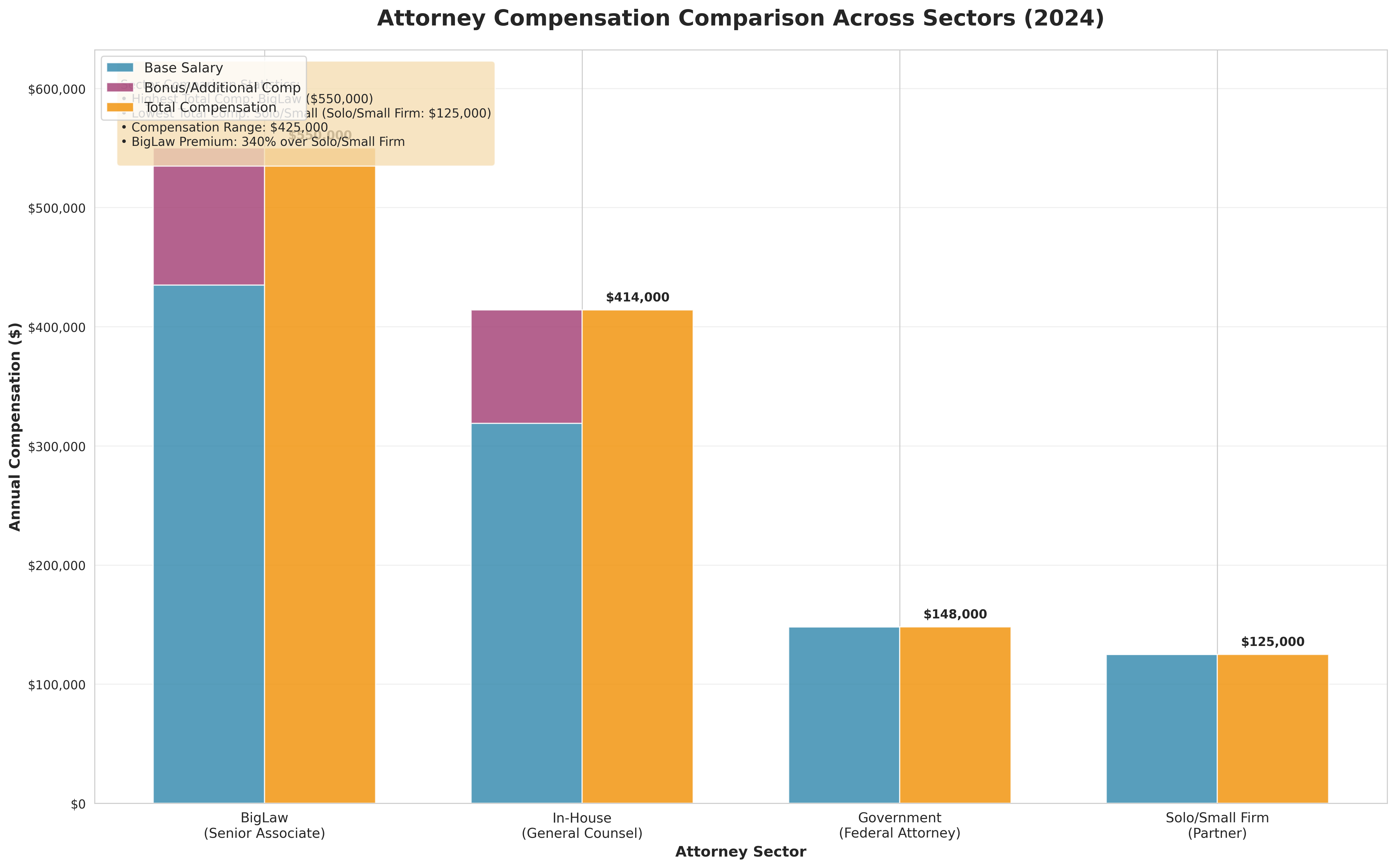
Total compensation comparison across legal industry sectors
Firm Size Analysis
BigLaw firms continue to set the market standard with the Cravath scale. Total compensation includes substantial annual bonuses, ranging from $20,000 for first-years to $115,000+ for senior associates. Partnership track typically spans 8-10 years with equity partner compensation often exceeding $3 million at top firms.
AmLaw 200 firms offer competitive compensation while maintaining more manageable work-life balance. Many follow modified Cravath scales with regional adjustments. Partnership prospects often better than BigLaw with more predictable advancement timelines.
Large regional firms provide excellent value proposition with strong compensation, better work-life balance, and significant client responsibility earlier in career. Often dominate local markets with strong alumni networks.
Midsize firms offer diverse practice opportunities with accelerated responsibility and partnership tracks. Compensation varies significantly by region and practice area specialization.
Small firms and solo practitioners represent the majority of legal practice in America. While base compensation is lower, many attorneys achieve high earnings through entrepreneurial success, with 24% of solo practitioners earning $250,000-$500,000 annually.
Geographic Analysis
Geographic location remains one of the most significant factors affecting attorney compensation. Major legal markets continue to command premium salaries, though the gap is narrowing due to remote work trends and cost-of-living considerations.
| Region | Junior Associate | Senior Associate | Partner | Cost Index |
|---|---|---|---|---|
| New York Metro | $225,000 | $435,000 | $1,500,000 | Very High (1.4x) |
| San Francisco Bay Area | $220,000 | $425,000 | $1,400,000 | Very High (1.5x) |
| Washington DC | $215,000 | $415,000 | $1,300,000 | High (1.3x) |
| Los Angeles | $210,000 | $405,000 | $1,200,000 | High (1.3x) |
| Chicago | $190,000 | $370,000 | $1,000,000 | Moderate (1.1x) |
| Boston | $195,000 | $380,000 | $1,100,000 | High (1.2x) |
| Texas Markets | $180,000 | $350,000 | $950,000 | Moderate (0.9x) |
| Southeast | $165,000 | $320,000 | $800,000 | Low (0.8x) |
| Mountain West | $155,000 | $300,000 | $750,000 | Low (0.8x) |
| Secondary Markets | $140,000 | $275,000 | $650,000 | Very Low (0.7x) |
- New York: Global financial center, highest BigLaw density
- San Francisco: Technology law hub, venture capital center
- Washington DC: Regulatory and government affairs epicenter
- Los Angeles: Entertainment law and West Coast business
- Austin: Technology boom driving legal demand
- Nashville: Healthcare and finance growth
- Denver: Energy and outdoor industry legal work
- Atlanta: Southeast business hub expansion
Practice Area Analysis
Practice areas primarily serving corporate clients typically command higher compensation due to the complexity of transactions, higher billing rates, and client ability to pay premium fees.
| Practice Area | BigLaw Median | Midsize Median | Small Firm Median | Premium vs. General |
|---|---|---|---|---|
| Antitrust and Competition | $450,000 | $180,000 | $95,000 | +25% |
| Securities | $425,000 | $175,000 | $92,000 | +22% |
| IP/Patent Litigation | $400,000 | $170,000 | $90,000 | +20% |
| Corporate M&A | $385,000 | $165,000 | $88,000 | +18% |
| Tax | $365,000 | $160,000 | $85,000 | +15% |
| Banking & Finance | $350,000 | $155,000 | $82,000 | +12% |
| Healthcare | $340,000 | $150,000 | $80,000 | +10% |
| Environmental Law | $330,000 | $145,000 | $78,000 | +8% |
| Labor & Employment | $320,000 | $140,000 | $75,000 | +5% |
| General Litigation | $310,000 | $135,000 | $72,000 | Baseline |
Practice areas primarily serving individual clients typically offer lower compensation but often provide greater job satisfaction, community impact, and work-life balance.
| Practice Area | Large Firm Median | Midsize Median | Small Firm Median | Premium vs. General |
|---|---|---|---|---|
| Personal Injury (Plaintiffs) | $285,000 | $125,000 | $85,000 | Variable* |
| Family Law | $275,000 | $115,000 | $75,000 | -10% |
| Criminal Defense | $265,000 | $110,000 | $70,000 | -12% |
| Estate Planning | $260,000 | $105,000 | $68,000 | -15% |
| Immigration | $256,000 | $95,000 | $58,000 | -20% |
*Personal injury attorneys often work on contingency, creating highly variable compensation based on case outcomes
Attorney Level Progression
First-Year Associate (Class Year)
Base: $225,000 | Bonus: $20,000 | Total: $245,000
Document review, research, basic drafting
Mid-Level Associate (3rd Year)
Base: $260,000 | Bonus: $57,500 | Total: $317,500
Client interaction, deal management, deposition taking
Senior Associate (6th Year)
Base: $390,000 | Bonus: $105,000 | Total: $495,000
Lead junior associates, client development, complex matters
Eighth-Year Associate / Of Counsel
Base: $435,000 | Bonus: $115,000 | Total: $550,000
Partnership evaluation, senior client relationships
Non-Equity Partner
Base: $450,000+ | Bonus: Variable | Total: $600,000-$900,000
Business development, team leadership, client ownership
Equity Partner
Total: $1,500,000-$3,000,000+
Profit sharing, firm governance, major client relationships
- Years 1-3: Foundation building, skill development
- Years 4-6: Specialization, client interaction
- Years 7-8: Partnership evaluation period
- Years 9-10: Non-equity partnership track
- Years 10+: Equity partnership consideration
- Of Counsel: Senior attorney without partnership track
- In-House: 75% of BigLaw compensation, better balance
- Boutique: Equity partnership earlier, variable compensation
- Government: 27% of BigLaw, excellent benefits
- Solo Practice: Unlimited upside, entrepreneurial risk
Sector Comparisons
- Highest compensation potential
- Prestige and career advancement
- Complex, challenging work
- Partnership equity opportunity
- Long hours (2000+ billable)
- High stress environment
- Limited work-life balance
- Partnership pressure
- Better work-life balance
- Business strategy involvement
- No billable hour pressure
- Competitive compensation (75% of BigLaw)
- Lower than BigLaw compensation
- Limited external legal experience
- Company-dependent advancement
- Economic cycle sensitivity
- Excellent work-life balance
- Comprehensive benefits
- Pension plans
- Public service mission
- Significantly lower compensation
- Limited advancement opportunities
- Budget constraints
- Political considerations
- Legal technology specialization
- AI and automation expertise
- Data privacy and cybersecurity
- Legal project management
Trends and Projections
2018-2023 Growth Rates
- BigLaw first-year: +18.4% ($190K → $225K)
- Partnership compensation: +26% average
- In-house counsel: +15% average
- Government: +8% average
- Solo/small firm: +12% average
- Post-pandemic economic recovery
- Talent retention competition
- Increased M&A activity
- Inflation adjustments
- Technology transformation
Expected Changes
- Modest BigLaw increases (3-5%)
- Continued in-house growth (8-10%)
- Technology specialization premiums
- Regional market convergence
- Alternative career path expansion
- ESG and sustainability law
- Cryptocurrency and blockchain
- Data privacy specialization
- Healthcare technology
- Climate change litigation
Technology Integration
AI and automation changing legal service delivery, creating new specializations and efficiency demands
Talent Competition
War for talent driving compensation increases and enhanced benefits packages across all sectors
Work-Life Balance
Increased focus on flexibility and wellness creating new compensation models and career paths
Comprehensive Compensation Tables
| Practice Area | BigLaw Low | Med | High |
AmLaw 200 Low | Med | High |
Large Regional Low | Med | High |
Midsize Low | Med | High |
Small Firm Low | Med | High |
|---|---|---|---|---|---|
| Antitrust and Competition | $350K | $450K | $650K | $280K | $360K | $480K | $160K | $220K | $300K | $140K | $180K | $240K | $75K | $95K | $125K |
| Securities | $330K | $425K | $625K | $270K | $350K | $470K | $155K | $215K | $295K | $135K | $175K | $235K | $72K | $92K | $122K |
| IP/Patent Litigation | $320K | $400K | $600K | $260K | $340K | $460K | $150K | $210K | $290K | $130K | $170K | $230K | $70K | $90K | $120K |
| Corporate M&A | $310K | $385K | $580K | $250K | $330K | $450K | $145K | $205K | $285K | $125K | $165K | $225K | $68K | $88K | $118K |
| Tax | $295K | $365K | $560K | $240K | $320K | $440K | $140K | $200K | $280K | $120K | $160K | $220K | $65K | $85K | $115K |
| Banking & Finance | $285K | $350K | $540K | $235K | $310K | $430K | $135K | $195K | $275K | $115K | $155K | $215K | $62K | $82K | $112K |
| Labor & Employment | $270K | $320K | $500K | $220K | $285K | $400K | $125K | $180K | $260K | $105K | $140K | $200K | $58K | $75K | $105K |
| General Litigation | $260K | $310K | $480K | $210K | $275K | $390K | $120K | $175K | $250K | $100K | $135K | $190K | $55K | $72K | $100K |
| Family Law | $245K | $275K | $420K | $195K | $245K | $350K | $105K | $155K | $225K | $88K | $115K | $170K | $50K | $75K | $105K |
| Immigration | $230K | $256K | $380K | $180K | $220K | $320K | $85K | $125K | $185K | $68K | $95K | $145K | $38K | $58K | $85K |
| Region | Junior Associate Low | Med | High |
Senior Associate Low | Med | High |
Of Counsel Low | Med | High |
Non-Equity Partner Low | Med | High |
Equity Partner Low | Med | High |
|---|---|---|---|---|---|
| New York Metro | $180K | $225K | $275K | $350K | $435K | $525K | $400K | $485K | $575K | $650K | $850K | $1.1M | $1.2M | $1.5M | $3M+ |
| San Francisco Bay Area | $175K | $220K | $270K | $340K | $425K | $515K | $390K | $475K | $565K | $625K | $825K | $1.05M | $1.1M | $1.4M | $2.8M |
| Washington DC | $170K | $215K | $265K | $335K | $415K | $505K | $385K | $465K | $555K | $600K | $800K | $1M | $1M | $1.3M | $2.6M |
| Los Angeles | $165K | $210K | $260K | $325K | $405K | $495K | $375K | $455K | $545K | $575K | $775K | $975K | $950K | $1.2M | $2.4M |
| Chicago | $150K | $190K | $235K | $295K | $370K | $450K | $340K | $415K | $495K | $525K | $700K | $875K | $800K | $1M | $2M |
| Boston | $155K | $195K | $240K | $305K | $380K | $460K | $350K | $425K | $505K | $550K | $725K | $900K | $875K | $1.1M | $2.2M |
| Texas Markets | $140K | $180K | $225K | $280K | $350K | $425K | $320K | $390K | $465K | $475K | $650K | $825K | $750K | $950K | $1.9M |
| Southeast | $125K | $165K | $210K | $255K | $320K | $390K | $295K | $360K | $430K | $425K | $575K | $725K | $625K | $800K | $1.6M |
| Mountain West | $115K | $155K | $200K | $240K | $300K | $365K | $275K | $340K | $410K | $400K | $550K | $700K | $575K | $750K | $1.5M |
| Secondary Markets | $105K | $140K | $180K | $220K | $275K | $335K | $250K | $315K | $380K | $375K | $500K | $625K | $500K | $650K | $1.3M |
Methodology
Primary Data Sources
- NALP (National Association for Law Placement): 2023-2024 Associate Salary Survey, comprehensive law firm compensation data
- Bureau of Labor Statistics: 2023 Occupational Employment and Wage Statistics for lawyers nationwide
- American Lawyer/ALM Media: 2024-2025 Am Law 100 and Am Law 200 compensation reports
- Association of Corporate Counsel: 2024 Law Department Compensation Survey with 1,887 respondents
- Major, Lindsey & Africa: 2024 Partner Compensation Survey covering Am Law 200 partners
- Robert Half Legal: 2025 Salary Guide for legal professionals
- Above the Law: 2024 Solo & Small Firm Compensation Survey with 750+ respondents
Analysis Framework
- Statistical Methods: Median, mean, and percentile analysis across all data points
- Geographic Segmentation: Cost-of-living adjustments and regional market analysis
- Practice Area Classification: Standardized taxonomy based on provided spreadsheet categories
- Firm Size Categories: Solo (1), Small (2-10), Midsize (11-100), Large (101-500), AmLaw 200 (501-1000), BigLaw (1000+)
- Compensation Components: Base salary, bonuses, total cash, long-term incentives, and benefits
- Experience Levels: Junior (0-3 years), Mid-level (4-6 years), Senior (7+ years), Partnership track
Quality Assurance
- Minimum sample sizes for statistical significance
- Cross-validation across multiple data sources
- Outlier identification and adjustment
- Regional cost-of-living normalization
- Time-period consistency (2023-2025 data)
Known Limitations
- Self-reported data may contain response bias
- Limited data for highly specialized niches
- Regional variations in smaller markets
- Partnership compensation varies significantly
- Economic conditions impact year-over-year comparisons
Conclusion
The 2025-2026 attorney compensation landscape reflects a legal profession in transition, marked by unprecedented salary growth, evolving practice areas, and changing work arrangements. While BigLaw continues to set compensation benchmarks with first-year associates earning $225,000 and equity partners commanding millions, the profession offers diverse pathways with varying risk-reward profiles.
Key Takeaways
- Geographic arbitrage opportunities exist in secondary markets
- Practice area specialization significantly impacts earning potential
- In-house roles offer competitive compensation with better work-life balance
- Technology and compliance specializations are growing rapidly
- Solo and small firm success depends heavily on business development
Strategic Recommendations
- Consider total compensation, not just base salary
- Evaluate cost-of-living adjusted compensation
- Develop expertise in high-growth practice areas
- Build business development skills early in career
- Regularly benchmark compensation against market rates
This report serves as a comprehensive guide for legal professionals navigating their careers and for law firms developing competitive compensation strategies. Regular updates and market monitoring remain essential as the legal industry continues to evolve rapidly in response to technological, economic, and social changes.